Native EnglishNatural Grammar
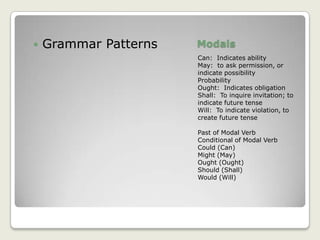
ModalsCan:  Indicates abilityMay:  to ask permission, or indicate possibilityProbabilityOught:  Indicates obligationShall:  To inquire invitation; to indicate future tenseWill:  To indicate violation, to create future tensePast of Modal VerbConditional of Modal VerbCould (Can)Might (May)Ought (Ought)Should (Shall)Would (Will)Grammar Patterns
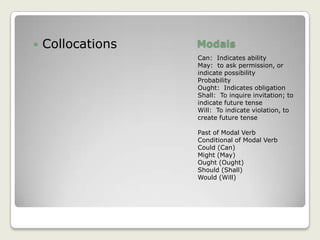
ModalsCan:  Indicates abilityMay:  to ask permission, or indicate possibilityProbabilityOught:  Indicates obligationShall:  To inquire invitation; to indicate future tenseWill:  To indicate violation, to create future tensePast of Modal VerbConditional of Modal VerbCould (Can)Might (May)Ought (Ought)Should (Shall)Would (Will)Collocations
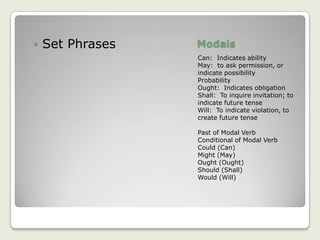
ModalsCan:  Indicates abilityMay:  to ask permission, or indicate possibilityProbabilityOught:  Indicates obligationShall:  To inquire invitation; to indicate future tenseWill:  To indicate violation, to create future tensePast of Modal VerbConditional of Modal VerbCould (Can)Might (May)Ought (Ought)Should (Shall)Would (Will)Set Phrases
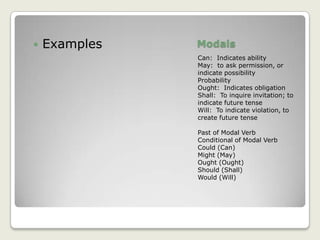
ModalsCan:  Indicates abilityMay:  to ask permission, or indicate possibilityProbabilityOught:  Indicates obligationShall:  To inquire invitation; to indicate future tenseWill:  To indicate violation, to create future tensePast of Modal VerbConditional of Modal VerbCould (Can)Might (May)Ought (Ought)Should (Shall)Would (Will)Examples
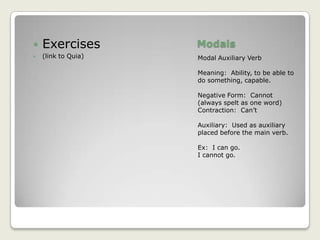
ModalsModal Auxiliary VerbMeaning:  Ability, to be able to do something, capable.Negative Form:  Cannot (always spelt as one word)Contraction:  Can’tAuxiliary:  Used as auxiliary placed before the main verb.Ex:  I can go.I cannot go.Exercises(link to Quia)

Modals

  • 1.
  • 2.
    ModalsCan: IndicatesabilityMay: to ask permission, or indicate possibilityProbabilityOught: Indicates obligationShall: To inquire invitation; to indicate future tenseWill: To indicate violation, to create future tensePast of Modal VerbConditional of Modal VerbCould (Can)Might (May)Ought (Ought)Should (Shall)Would (Will)Grammar Patterns
  • 3.
    ModalsCan: IndicatesabilityMay: to ask permission, or indicate possibilityProbabilityOught: Indicates obligationShall: To inquire invitation; to indicate future tenseWill: To indicate violation, to create future tensePast of Modal VerbConditional of Modal VerbCould (Can)Might (May)Ought (Ought)Should (Shall)Would (Will)Collocations
  • 4.
    ModalsCan: IndicatesabilityMay: to ask permission, or indicate possibilityProbabilityOught: Indicates obligationShall: To inquire invitation; to indicate future tenseWill: To indicate violation, to create future tensePast of Modal VerbConditional of Modal VerbCould (Can)Might (May)Ought (Ought)Should (Shall)Would (Will)Set Phrases
  • 5.
    ModalsCan: IndicatesabilityMay: to ask permission, or indicate possibilityProbabilityOught: Indicates obligationShall: To inquire invitation; to indicate future tenseWill: To indicate violation, to create future tensePast of Modal VerbConditional of Modal VerbCould (Can)Might (May)Ought (Ought)Should (Shall)Would (Will)Examples
  • 6.
    ModalsModal Auxiliary VerbMeaning: Ability, to be able to do something, capable.Negative Form: Cannot (always spelt as one word)Contraction: Can’tAuxiliary: Used as auxiliary placed before the main verb.Ex: I can go.I cannot go.Exercises(link to Quia)