Getting in Shape for 2018:
Product Management Best Practices
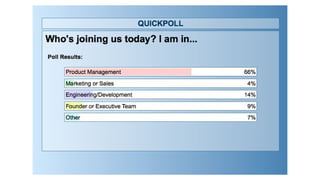
Who is joining us today?
Brought to you by The Product Stack, a group of like-minded organizations
that offer practical solutions for modern product teams. Our quest is to shine
a light on the challenges everyday product teams face and offer up real
advice and solutions that address these challenges head on.
Join the conversation at www.TheProductStack.com.
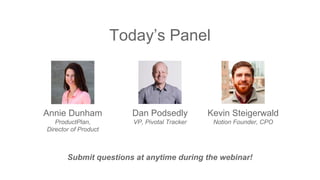
Kevin Steigerwald
Notion Founder, CPO
Today’s Panel
Dan Podsedly
VP, Pivotal Tracker
Annie Dunham
ProductPlan,
Director of Product
Submit questions at anytime during the webinar!
Let’s get ready for 2018!
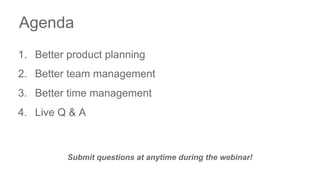
Agenda
1. Better product planning
2. Better team management
3. Better time management
4. Live Q & A
Submit questions at anytime during the webinar!
1. Better Product Planning
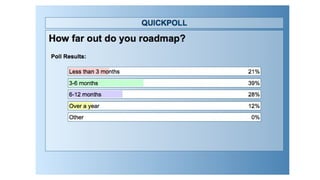
How far out do you roadmap?
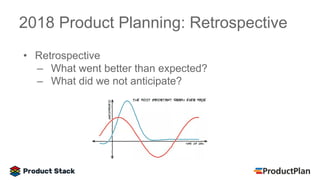
2018 Product Planning: Retrospective
• Retrospective
– What went better than expected?
– What did we not anticipate?
• Retrospective
• Analysis
– Set your current roadmap aside
– Opportunities
– Challenges
2018 Product Planning: Analysis
• Retrospective
• Analysis
• Aspirations
– What do we want to accomplish?
– Do X even over Y
2018 Product Planning: Aspirations
• Increase Market Share even over increased ARPU
• Product priority examples:
– Increase referrals
– Address 20% of sales lost
– Decrease time in other tools
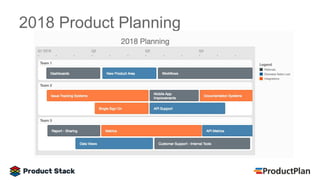
2018 Product Planning
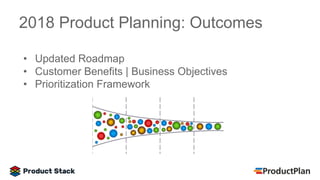
• Updated Roadmap
• Customer Benefits | Business Objectives
• Prioritization Framework
2018 Product Planning: Outcomes
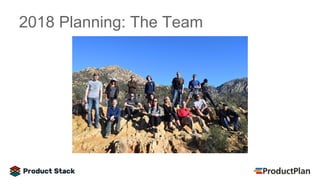
2018 Planning: The Team
2018 Planning: Your Career
2. Better Team Management
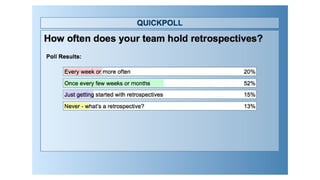
How often does your team hold retrospectives?
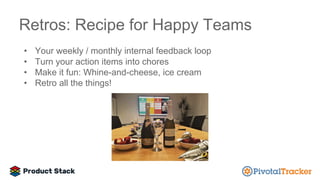
Retros: Recipe for Happy Teams
• Your weekly / monthly internal feedback loop
• Turn your action items into chores
• Make it fun: Whine-and-cheese, ice cream
• Retro all the things!
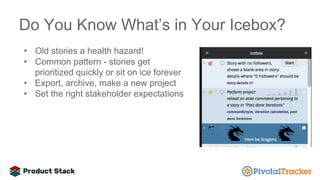
• Old stories a health hazard!
• Common pattern - stories get
prioritized quickly or sit on ice forever
• Export, archive, make a new project
• Set the right stakeholder expectations
Do You Know What’s in Your Icebox?
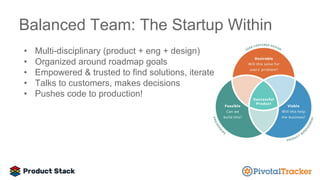
Balanced Team: The Startup Within
• Multi-disciplinary (product + eng + design)
• Organized around roadmap goals
• Empowered & trusted to find solutions, iterate
• Talks to customers, makes decisions
• Pushes code to production!
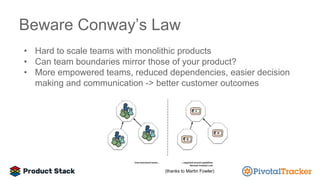
Beware Conway’s Law
• Hard to scale teams with monolithic products
• Can team boundaries mirror those of your product?
• More empowered teams, reduced dependencies, easier decision
making and communication -> better customer outcomes
(thanks to Martin Fowler)
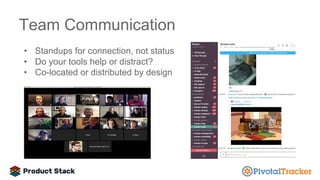
Team Communication
• Standups for connection, not status
• Do your tools help or distract?
• Co-located or distributed by design
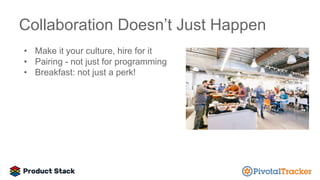
Collaboration Doesn’t Just Happen
• Make it your culture, hire for it
• Pairing - not just for programming
• Breakfast: not just a perk!
3. Better Time Management
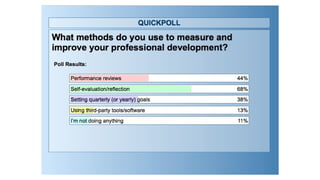
What methods do you use to measure and
improve your professional development?
While you’re worrying about the
product and your team, who is
looking after you?
Creativity and productivity are
crucial to your success as a PM.
So how can you foster productivity?
With frequency.
“We are what we repeatedly do. Excellence, then, is not an
act, but a habit.” — Aristotle
Let your goals—not tools—dictate
your process.
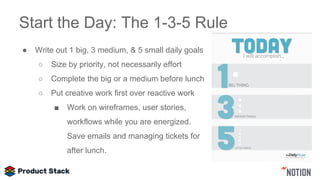
Start the Day: The 1-3-5 Rule
● Write out 1 big, 3 medium, & 5 small daily goals
○ Size by priority, not necessarily effort
○ Complete the big or a medium before lunch
○ Put creative work first over reactive work
■ Work on wireframes, user stories,
workflows while you are energized.
Save emails and managing tickets for
after lunch.
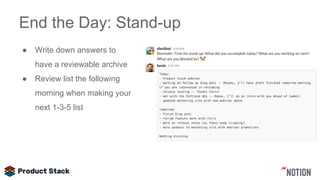
End the Day: Stand-up
● Write down answers to
have a reviewable archive
● Review list the following
morning when making your
next 1-3-5 list
Best Tools to Get the Job Done
● Like everything else a good PM does, experiment to find the right tool and
process for you. Consistency is all that matters.
● 135list.com
● Slack, Evernote, Notes, Things, OmniFocus, Paper, Sheets, Tracker, your
Calendar
● Anything that lets you maintain a running archive and lets you check things
off as progress is made
In Summary
● Take time to step back and look at the past, present, and future
● Align behind high level goals for a successful 2018 and…
● ...organize your team(s) around your product goals
● Retrospect on your feedback loops and revisit old priorities
● Frequency fosters creativity and productivity
● Setting a habitual routine for yourself benefits your product and team
Questions?
Continue the conversation at www.TheProductStack.com
Free Product Trials:
www.productplan.com
www.pivotaltracker.com
www.usenotion.com
Thank You.
Continue the conversation at www.TheProductStack.com
Free Product Trials:
www.productplan.com
www.pivotaltracker.com
www.usenotion.com

Getting in Shape for 2018: Product Management Best Practices

  • 1.
    Getting in Shapefor 2018: Product Management Best Practices
  • 2.
    Who is joiningus today?
  • 4.
    Brought to youby The Product Stack, a group of like-minded organizations that offer practical solutions for modern product teams. Our quest is to shine a light on the challenges everyday product teams face and offer up real advice and solutions that address these challenges head on. Join the conversation at www.TheProductStack.com.
  • 5.
    Kevin Steigerwald Notion Founder,CPO Today’s Panel Dan Podsedly VP, Pivotal Tracker Annie Dunham ProductPlan, Director of Product Submit questions at anytime during the webinar!
  • 6.
  • 7.
    Agenda 1. Better productplanning 2. Better team management 3. Better time management 4. Live Q & A Submit questions at anytime during the webinar!
  • 8.
  • 9.
    How far outdo you roadmap?
  • 11.
    2018 Product Planning:Retrospective • Retrospective – What went better than expected? – What did we not anticipate?
  • 12.
    • Retrospective • Analysis –Set your current roadmap aside – Opportunities – Challenges 2018 Product Planning: Analysis
  • 13.
    • Retrospective • Analysis •Aspirations – What do we want to accomplish? – Do X even over Y 2018 Product Planning: Aspirations
  • 14.
    • Increase MarketShare even over increased ARPU • Product priority examples: – Increase referrals – Address 20% of sales lost – Decrease time in other tools 2018 Product Planning
  • 15.
  • 16.
    • Updated Roadmap •Customer Benefits | Business Objectives • Prioritization Framework 2018 Product Planning: Outcomes
  • 17.
  • 18.
  • 19.
    2. Better TeamManagement
  • 20.
    How often doesyour team hold retrospectives?
  • 22.
    Retros: Recipe forHappy Teams • Your weekly / monthly internal feedback loop • Turn your action items into chores • Make it fun: Whine-and-cheese, ice cream • Retro all the things!
  • 23.
    • Old storiesa health hazard! • Common pattern - stories get prioritized quickly or sit on ice forever • Export, archive, make a new project • Set the right stakeholder expectations Do You Know What’s in Your Icebox?
  • 24.
    Balanced Team: TheStartup Within • Multi-disciplinary (product + eng + design) • Organized around roadmap goals • Empowered & trusted to find solutions, iterate • Talks to customers, makes decisions • Pushes code to production!
  • 25.
    Beware Conway’s Law •Hard to scale teams with monolithic products • Can team boundaries mirror those of your product? • More empowered teams, reduced dependencies, easier decision making and communication -> better customer outcomes (thanks to Martin Fowler)
  • 26.
    Team Communication • Standupsfor connection, not status • Do your tools help or distract? • Co-located or distributed by design
  • 27.
    Collaboration Doesn’t JustHappen • Make it your culture, hire for it • Pairing - not just for programming • Breakfast: not just a perk!
  • 28.
    3. Better TimeManagement
  • 29.
    What methods doyou use to measure and improve your professional development?
  • 31.
    While you’re worryingabout the product and your team, who is looking after you?
  • 32.
    Creativity and productivityare crucial to your success as a PM. So how can you foster productivity?
  • 33.
    So how canyou foster productivity? With frequency. “We are what we repeatedly do. Excellence, then, is not an act, but a habit.” — Aristotle
  • 34.
    Let your goals—nottools—dictate your process.
  • 35.
    Start the Day:The 1-3-5 Rule ● Write out 1 big, 3 medium, & 5 small daily goals ○ Size by priority, not necessarily effort ○ Complete the big or a medium before lunch ○ Put creative work first over reactive work ■ Work on wireframes, user stories, workflows while you are energized. Save emails and managing tickets for after lunch.
  • 36.
    End the Day:Stand-up ● Write down answers to have a reviewable archive ● Review list the following morning when making your next 1-3-5 list
  • 37.
    Best Tools toGet the Job Done ● Like everything else a good PM does, experiment to find the right tool and process for you. Consistency is all that matters. ● 135list.com ● Slack, Evernote, Notes, Things, OmniFocus, Paper, Sheets, Tracker, your Calendar ● Anything that lets you maintain a running archive and lets you check things off as progress is made
  • 38.
    In Summary ● Taketime to step back and look at the past, present, and future ● Align behind high level goals for a successful 2018 and… ● ...organize your team(s) around your product goals ● Retrospect on your feedback loops and revisit old priorities ● Frequency fosters creativity and productivity ● Setting a habitual routine for yourself benefits your product and team
  • 39.
    Questions? Continue the conversationat www.TheProductStack.com Free Product Trials: www.productplan.com www.pivotaltracker.com www.usenotion.com
  • 40.
    Thank You. Continue theconversation at www.TheProductStack.com Free Product Trials: www.productplan.com www.pivotaltracker.com www.usenotion.com