











YOU ARE WHAT YOU THINK
Coach –
Rajesh Panicker
MSc.(Psy)
MSc.(Y.S)
NOT TO FAR, NOW…
JAROFLIFE
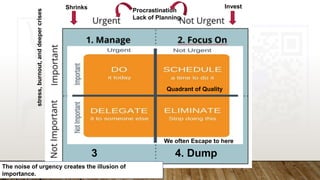
Procrastination
Lack of Planning
Quadrant of Quality
3
.
4. Dump
InvestShrinks
stress,burnout,anddeepercrises
The noise of urgency creates the illusion of
importance.
We often Escape to here
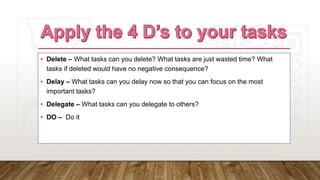
• Delete – What tasks can you delete? What tasks are just wasted time? What
tasks if deleted would have no negative consequence?
• Delay – What tasks can you delay now so that you can focus on the most
important tasks?
• Delegate – What tasks can you delegate to others?
• DO – Do it
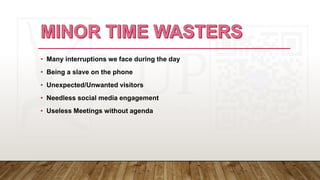
• Many interruptions we face during the day
• Being a slave on the phone
• Unexpected/Unwanted visitors
• Needless social media engagement
• Useless Meetings without agenda
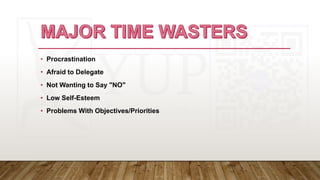
• Procrastination
• Afraid to Delegate
• Not Wanting to Say "NO"
• Low Self-Esteem
• Problems With Objectives/Priorities
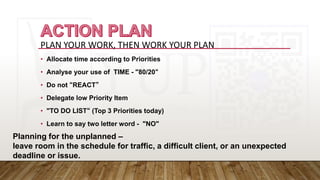
PLAN YOUR WORK, THEN WORK YOUR PLAN
• Allocate time according to Priorities
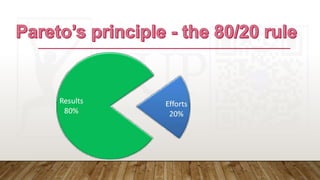
• Analyse your use of TIME - "80/20“
• Do not “REACT”
• Delegate low Priority Item
• "TO DO LIST“ (Top 3 Priorities today)
• Learn to say two letter word - "NO"
Planning for the unplanned –
leave room in the schedule for traffic, a difficult client, or an unexpected
deadline or issue.
Time Management
Time Management

Time Management

  • 1.
    YOU ARE WHATYOU THINK Coach – Rajesh Panicker MSc.(Psy) MSc.(Y.S)
  • 4.
  • 12.
  • 13.
    Procrastination Lack of Planning Quadrantof Quality 3 . 4. Dump InvestShrinks stress,burnout,anddeepercrises The noise of urgency creates the illusion of importance. We often Escape to here
  • 15.
    • Delete –What tasks can you delete? What tasks are just wasted time? What tasks if deleted would have no negative consequence? • Delay – What tasks can you delay now so that you can focus on the most important tasks? • Delegate – What tasks can you delegate to others? • DO – Do it
  • 18.
    • Many interruptionswe face during the day • Being a slave on the phone • Unexpected/Unwanted visitors • Needless social media engagement • Useless Meetings without agenda
  • 19.
    • Procrastination • Afraidto Delegate • Not Wanting to Say "NO" • Low Self-Esteem • Problems With Objectives/Priorities
  • 21.
    PLAN YOUR WORK,THEN WORK YOUR PLAN • Allocate time according to Priorities • Analyse your use of TIME - "80/20“ • Do not “REACT” • Delegate low Priority Item • "TO DO LIST“ (Top 3 Priorities today) • Learn to say two letter word - "NO" Planning for the unplanned – leave room in the schedule for traffic, a difficult client, or an unexpected deadline or issue.

Editor's Notes

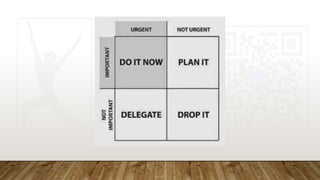
  • #14 Is it bad to be in Quadrant I? Are you in Quadrant I because of the urgency or the importance? If urgency dominates, when importance fades, you’ll slip into Quadrant III. But if you’re in Quadrant I because of importance, when urgency fades you’ll move to Quadrant II.
  • #21 Blind Polygon Set up: Depending on your group size you may have to divide your group into teams of 9 -15 players. Blindfold each person. (NOTE: If you have more people than blindfolds then require them to close their eyes. Let them know that trust and integrity are key to a successful outcome.) The Challenge: Place a length of rope in the center of the circle. Explain that their task is to form the rope into a shape of your choosing–a square, a “Z,” or a pentagon. Everyone must be in contact with the rope at all times and they must use the entire rope. No tangles or knots are allowed. When the group feels they have made whatever shape you specified they can set it on the ground and take their blindfolds off. Debrief: During the event you will see all sorts of personality styles, leadership styles, communication styles and a definite pecking order. Regarding Time Management, the group’s process is often very hectic. You can discuss team time management or use the experience as a metaphor for personal time management, asking “what is the most efficient way to accomplish a task?” The group will find that when they are deprived of sight, their normal their normal ways of accomplishing a task are thrown into confusion. As part of your debrief talk about what process they would use if they were to do the exercise again. This is also a great processing tool for management training because I can assure what happens when they are blindfolded will not be what happens at the office.