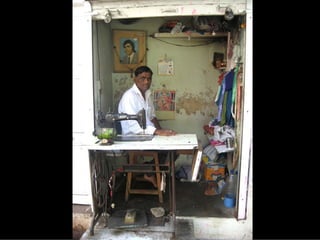
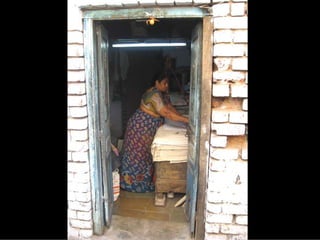
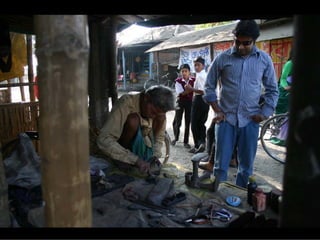
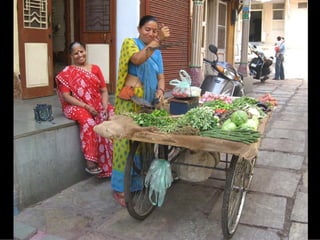
democratising culture

 a designer‐curator’s view
cultural change
• individuals, institutions, the environment and chance—all 
  participate in and contribute to the transformation of culture
• it is not always organic, benign or inclusive 
   – colonization, globalization, ‘knowledge economics’, etc.
• the state, institutions and industry & commerce are the 
  empowered authors & engineers of (cultural) change… 
   – leaving very little room for the public except as subjects/recipients
massive & pervasive subversion
• there is less and less that the public (the non‐producers of 
  culture, the marginalised majority) can actively do, except try 
  to resist and re‐appropriate the dominant, imposed culture 
  via “everyday acts of subversion”
   – reading, talking/narrating, playing, using, walking, wearing, dwelling, 
     cooking…
• we should not underestimate its contribution to cultural 
  transformation
• however, we must ask if this strengthens society on the whole 
  or not… 
• …and if it is truly democratic or not

                                                                   DE CERTEAU, 1988
what is ‘social capital’?
• that in life which tends to… count for most in the daily lives of 
  people… goodwill, fellowship, mutual sympathy and social 
  intercourse (HANIFAN, 1913)
• connections among individuals… and the norms of reciprocity 
  and trustworthiness that arise from them (PUTNAM, 2000)
the state and social capital
• modernists believed that informal systems (of organization 
  and management) need to be replaced with formal ones.
   – rational bureaucracy constitutes the essence of modernity (WEBER)
• however, informal coordination persists—and has become 
  even more important as economic activity becomes more 
  complex and technologically sophisticated.
• social capital (an aggregate of informal coordinations) is a 
  byproduct of (many) factors outside the control of 
  governments.
   – like religion, shared histories, social systems, tradition, etc. 

• unlike economic policies & institutions, social capital cannot 
  be easily created or shaped by public policy.

                                                                         FUKUYAMA, 2000
how can states nurture social capital?
• governments best produce social capital via education.
• they can indirectly nurture it by providing vital public goods 
  and ensuring property rights and public safety.
• they can have a serious negative impact on social capital 
  when they start to undertake activities better left to private 
  sector or civil society.


                                                     FUKUYAMA, 2000
ideas for enhancing social capital
• family ties
• (socialisation through) education
• community participation & volunteering
• urban & housing design
• community facilities/assets (galleries, museums, libraries, 
  history/heritage, sports)
• internet & telecom
• csr
• citizen participation in governance


                          PRODUCTIVITY COMMISSION OF AUSTRALIA, 2003
• where is culture? where are the arts?
   – the arts offer a unique means of connecting us to our common humanity. 
     (HAVEL)

• we need better explorations and understandings of the 
  dynamics between arts & culture and social capital
culture = institutions & artefacts
• January 16, 2010
• Prime Minister Manmohan Singh termed as ‘unfortunate’ the
  failure of four premier cultural institutions in Kolkata to fully
  utilise a special allocation of Rs.90 crore (=SEK 150 million)
  given for modernisation.
   – “Each of these institutions is a cultural icon in the country.
     Unfortunately, these institutions have not been able to fully utilise this
     grant in the first year…”
   – “I do hope that these four institutions will work harder to use the
     allocated funds to introduce state-of-the-art systems of preservation,
     display and storage of their priceless antiquities, paintings and
     manuscripts…”
• where is the public?
   – in enshrining art within ... ‘temples of culture’ … we may have lost touch with 
     the spirit of art: its direct relevance to our lives … art became something that 
     we watch other people do … rather than something we do ourselves. (NEA, 
      1997)

• …alternatively, are we (the ‘high priests’) failing to notice, 
  appreciate and celebrate the ‘art’ of ordinary people?
• …what are we doing?
Regime Culture and Instrumentalized Art
•   in the age of globalization, leaders of the state produce a specific kind of culture, called
    “regime culture”—which reinforces the power of the existing regime
•   it features
     –   patriotism
     –   values financial success
     –   a narrow definition of family values
     –   a culture of fear limiting civil liberties
     –   reinterprets the past
     –   legitimates the status quo, and
     –   tolerates racism
•   culture has been increasingly used in a specific direction: instrumentalized culture
•   a contributor to economic development, fostering the growth of an economically
    productive “creative class”
•   its critical and transcendent potential has been eviscerated
•   instrumentalization may help artists in the short run, it poses a danger to the ultimate
    social role of the arts
•   policies generated around the of a “creative class”, and the use of the arts as a tool of
    economic development, are becoming the norm
•   globalization accentuates each of these tendencies


                                                                             MARCUSE, 2007
The future of art in postcultural democracy
•   Has the future of art fallen irredeemably into the grip of the ‘creative
    industries’ directed by a consortium of public and private cultural
    entrepreneurs?
•   Is democracy the natural guardian of artistic independence?
•   Or has the cultural policy agenda of neoliberal democracy solidified into
    a managerial instrumentalization of art geared to the functions of the
    market and the state?
•   The authors are independent curators operating from dissident research
    groups whose aim is to challenge the dominant neoliberal model of
    cultural enterprise and offer viable alternatives to it.


                                                           APPIGNANESI, 2007
• state attitudes about arts and culture tend to be biased, 
  dogmatic and instrumentalist
   – elitist, modernist, nationalist, economic…
• even when they are openly debated, the resulting policies are 
  rarely democratic – in the sense of being conceptualised 
  around people’s cultural needs, aspirations and practices
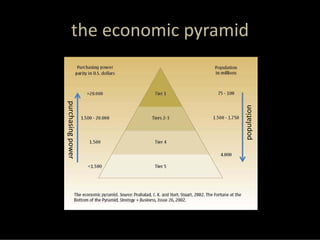
the economic pyramid
purchasing power


                           population
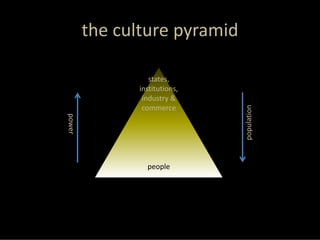
the culture pyramid

                  states, 
               institutions, 
                industry & 
                commerce


                                population
power


                 people
• we need a rich, vibrant and seamless ecosystem of arts & 
  culture entities, spaces and opportunities, that places people 
  at its centre (as producers) and also the periphery
• remaining alert to: 
   – the hijacking of culture and cultural innovation by any elite and/or the 
     bureaucracy
   – an imposition of ‘regime culture’ 
   – instrumentalization of the arts & culture for economic or other agenda
   – adoption of uncritical populism as the sole criterion, and rejecting other 
     perspectives on quality and value
towards a ‘cultural democracy’?
• the right to culture for everyone
   – right to PRODUCE and PRACTICE, not just CONSUME or CONSERVE
• active participation in cultural life
   – celebrating and respecting all forms (HIGH/LOW, etc.)
   – recognizing & valuing participation
• participation in policy decisions
   – LISTENING to people
• fair and equitable access to cultural resources and support
   – creating CONDITIONS and STRUCTURES for universal ACCESS (particularly 
     for the MARGINAL)
• however, even these can easily turn into a patronage system if 
  culture were to be separated from other activity

                                   INSTITUTE FOR CULTURAL DEMOCRACY, 1995/98
• current progressive thinking almost exclusively targets the 
  internet as the new ‘public sphere’ and as the new site for 
  cultural creativity, citizenship and democracy
   – the values and intentions are indisputable, but the forms are dangerous
• perhaps true and applicable to wealthy nations, it aggravates 
  the crisis of poorer nations 
   – pushes us harder on the prescribed vector of development and quality of life 
     (when we really need to pause, reflect and maybe even reverse forward)
   – accelerates the obsolescence of daily architectures of living (and their 
     replacement with global products, services and aesthetics – rather than their 
     validation and strengthening) and their repackaging as exotic (and premium) 
     cultural commodities
so…
• let us never forget…
   –   culture is not development
   –   culture is not business
   –   culture is not institutions
   –   it is not a bounded field or area, nor even a vector
   –   it is not a discipline or theory
   –   it is above and beyond, it is our everyday practice
• culture is our interface between inner/spiritual and 
  outer/material worlds
• art is the technology of culture
• can we return artistry and culture to the people?
• in forms by which it strengthens social capital…
• …and prevent it from becoming a commodity?
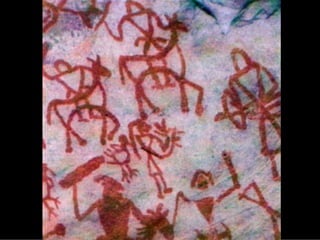
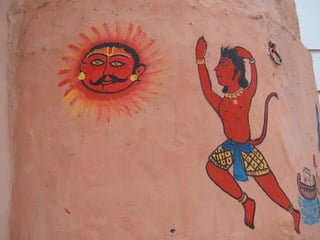
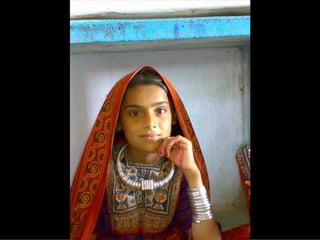
visual thesis

                     the case of india
NOTE: all images used here are downloaded from the internet and are somebody 
 else’s creativity and property. i am indebted to them for sharing them online.
some possible principles…
•   people are cultural innovators
     –   living culture is about people; not only some people but all people
     –   it is what they can and want to do, not what we want them to do
     –   we must create the best possible conditions for this
     –   left to themselves, they do very well – and generate massive social capital
•   rules and laws
     – accept the defeat of modernist and globalist utopias
     – have rules & laws, but accept their limitations
     – intrinsic (organised around inner order) vs. extrinsic (organised around external order)
•   commerce and technology
     –   can be highly empowering for culture, but also severely crippling
     –   encourage them, but don’t accord them superior status
     –   retain space for everyone, particularly the marginalised
     –   retain free access to knowledge and cultural resources, discourage commodification and 
         ownership
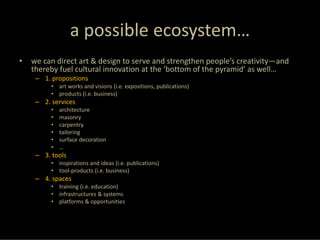
a possible ecosystem…
•   we can direct art & design to serve and strengthen people’s creativity—and 
    thereby fuel cultural innovation at the ‘bottom of the pyramid’ as well…
     – 1. propositions
          • art works and visions (i.e. expositions, publications)
          • products (i.e. business)
     – 2. services
          •   architecture
          •   masonry
          •   carpentry
          •   tailoring
          •   surface decoration
          •   …
     – 3. tools
          • inspirations and ideas (i.e. publications)
          • tool‐products (i.e. business)
     – 4. spaces
          • training (i.e. education)
          • infrastructures & systems
          • platforms & opportunities
many (im)possible ideas…
• (most of these will not materialize)
   –   playgrounds of culture
   –   culture & identity curriculum
   –   design serves craft
   –   reverse ethnography
   –   art@center (for the 2011 indian art summit)
   –   future india report/conference on wheels
   –   a.ha = architecture of happiness
   –   ngo 2.0
   –   srishti center for contemporary arts
   –   srishti regional arts & culture center
   –   …
“culture is too precious to be left 
    in the hands of experts…”

Democratising Culture

  • 1.
  • 2.
    cultural change • individuals, institutions, the environment and chance—all  participate in and contribute to the transformation of culture • it is not always organic, benign or inclusive  – colonization, globalization, ‘knowledge economics’, etc. • the state, institutions and industry & commerce are the  empowered authors & engineers of (cultural) change…  – leaving very little room for the public except as subjects/recipients
  • 3.
    massive & pervasive subversion • there is less and less that the public (the non‐producers of  culture, the marginalised majority) can actively do, except try  to resist and re‐appropriate the dominant, imposed culture  via “everyday acts of subversion” – reading, talking/narrating, playing, using, walking, wearing, dwelling,  cooking… • we should not underestimate its contribution to cultural  transformation • however, we must ask if this strengthens society on the whole  or not…  • …and if it is truly democratic or not DE CERTEAU, 1988
  • 4.
    what is ‘social capital’? • that in life which tends to… count for most in the daily lives of  people… goodwill, fellowship, mutual sympathy and social  intercourse (HANIFAN, 1913) • connections among individuals… and the norms of reciprocity  and trustworthiness that arise from them (PUTNAM, 2000)
  • 5.
    the state and social capital • modernists believed that informal systems (of organization  and management) need to be replaced with formal ones. – rational bureaucracy constitutes the essence of modernity (WEBER) • however, informal coordination persists—and has become  even more important as economic activity becomes more  complex and technologically sophisticated. • social capital (an aggregate of informal coordinations) is a  byproduct of (many) factors outside the control of  governments. – like religion, shared histories, social systems, tradition, etc.  • unlike economic policies & institutions, social capital cannot  be easily created or shaped by public policy. FUKUYAMA, 2000
  • 6.
    how can states nurture social capital? • governments best produce social capital via education. • they can indirectly nurture it by providing vital public goods  and ensuring property rights and public safety. • they can have a serious negative impact on social capital  when they start to undertake activities better left to private  sector or civil society. FUKUYAMA, 2000
  • 7.
    ideas for enhancing social capital • family ties • (socialisation through) education •community participation & volunteering • urban & housing design • community facilities/assets (galleries, museums, libraries,  history/heritage, sports) • internet & telecom • csr • citizen participation in governance PRODUCTIVITY COMMISSION OF AUSTRALIA, 2003
  • 8.
    • where is culture? where are the arts? – the arts offer a unique means of connecting us to our common humanity.  (HAVEL) • we need better explorations and understandings of the  dynamics between arts & culture and social capital
  • 9.
    culture = institutions & artefacts • January 16,2010 • Prime Minister Manmohan Singh termed as ‘unfortunate’ the failure of four premier cultural institutions in Kolkata to fully utilise a special allocation of Rs.90 crore (=SEK 150 million) given for modernisation. – “Each of these institutions is a cultural icon in the country. Unfortunately, these institutions have not been able to fully utilise this grant in the first year…” – “I do hope that these four institutions will work harder to use the allocated funds to introduce state-of-the-art systems of preservation, display and storage of their priceless antiquities, paintings and manuscripts…”
  • 10.
    • where is the public? – in enshrining art within ... ‘temples of culture’ … we may have lost touch with  the spirit of art: its direct relevance to our lives … art became something that  we watch other people do … rather than something we do ourselves. (NEA,  1997) • …alternatively, are we (the ‘high priests’) failing to notice,  appreciate and celebrate the ‘art’ of ordinary people? • …what are we doing?
  • 11.
    Regime Culture and Instrumentalized Art • in the age of globalization, leaders of the state produce a specific kind of culture, called “regime culture”—which reinforces the power of the existing regime • it features – patriotism – values financial success – a narrow definition of family values – a culture of fear limiting civil liberties – reinterprets the past – legitimates the status quo, and – tolerates racism • culture has been increasingly used in a specific direction: instrumentalized culture • a contributor to economic development, fostering the growth of an economically productive “creative class” • its critical and transcendent potential has been eviscerated • instrumentalization may help artists in the short run, it poses a danger to the ultimate social role of the arts • policies generated around the of a “creative class”, and the use of the arts as a tool of economic development, are becoming the norm • globalization accentuates each of these tendencies MARCUSE, 2007
  • 12.
    The future of art in postcultural democracy • Has the future of art fallen irredeemably into the grip of the ‘creative industries’ directed by a consortium of public and private cultural entrepreneurs? • Is democracy the natural guardian of artistic independence? • Or has the cultural policy agenda of neoliberal democracy solidified into a managerial instrumentalization of art geared to the functions of the market and the state? • The authors are independent curators operating from dissident research groups whose aim is to challenge the dominant neoliberal model of cultural enterprise and offer viable alternatives to it. APPIGNANESI, 2007
  • 13.
    • state attitudes about arts and culture tend to be biased,  dogmatic and instrumentalist – elitist, modernist, nationalist, economic… • even when they are openly debated, the resulting policies are  rarely democratic – in the sense of being conceptualised  around people’s cultural needs, aspirations and practices
  • 14.
  • 15.
    the culture pyramid states,  institutions,  industry &  commerce population power people
  • 16.
    • we need a rich, vibrant and seamless ecosystem of arts &  culture entities, spaces and opportunities, that places people  at its centre (as producers) and also the periphery • remaining alert to:  – the hijacking of culture and cultural innovation by any elite and/or the  bureaucracy – an imposition of ‘regime culture’  – instrumentalization of the arts & culture for economic or other agenda – adoption of uncritical populism as the sole criterion, and rejecting other  perspectives on quality and value
  • 17.
    towards a ‘cultural democracy’? • the right to culture for everyone – right to PRODUCE and PRACTICE, not just CONSUME or CONSERVE • active participation in cultural life – celebrating and respecting all forms (HIGH/LOW, etc.) – recognizing & valuing participation • participation in policy decisions – LISTENING to people • fair and equitable access to cultural resources and support – creating CONDITIONS and STRUCTURES for universal ACCESS (particularly  for the MARGINAL) • however, even these can easily turn into a patronage system if  culture were to be separated from other activity INSTITUTE FOR CULTURAL DEMOCRACY, 1995/98
  • 18.
    • current progressive thinking almost exclusively targets the  internet as the new ‘public sphere’ and as the new site for  cultural creativity, citizenship and democracy – the values and intentions are indisputable, but the forms are dangerous • perhaps true and applicable to wealthy nations, it aggravates  the crisis of poorer nations  – pushes us harder on the prescribed vector of development and quality of life  (when we really need to pause, reflect and maybe even reverse forward) – accelerates the obsolescence of daily architectures of living (and their  replacement with global products, services and aesthetics – rather than their  validation and strengthening) and their repackaging as exotic (and premium)  cultural commodities
  • 19.
    so… • let us never forget… – culture is not development – culture is not business – culture is not institutions – it is not a bounded field or area, nor even a vector – it is not a discipline or theory – it is above and beyond, it is our everyday practice • culture is our interface between inner/spiritual and  outer/material worlds • art is the technology of culture
  • 20.
  • 21.
    visual thesis the case of india NOTE: all images used here are downloaded from the internet and are somebody  else’s creativity and property. i am indebted to them for sharing them online.
  • 40.
    some possible principles… • people are cultural innovators – living culture is about people; not only some people but all people – it is what they can and want to do, not what we want them to do – we must create the best possible conditions for this – left to themselves, they do very well – and generate massive social capital • rules and laws – accept the defeat of modernist and globalist utopias – have rules & laws, but accept their limitations – intrinsic (organised around inner order) vs. extrinsic (organised around external order) • commerce and technology – can be highly empowering for culture, but also severely crippling – encourage them, but don’t accord them superior status – retain space for everyone, particularly the marginalised – retain free access to knowledge and cultural resources, discourage commodification and  ownership
  • 41.
    a possible ecosystem… • we can direct art & design to serve and strengthen people’s creativity—and  thereby fuel cultural innovation at the ‘bottom of the pyramid’ as well… – 1. propositions • art works and visions (i.e. expositions, publications) • products (i.e. business) – 2. services • architecture • masonry • carpentry • tailoring • surface decoration • … – 3. tools • inspirations and ideas (i.e. publications) • tool‐products (i.e. business) – 4. spaces • training (i.e. education) • infrastructures & systems • platforms & opportunities
  • 42.
    many (im)possible ideas… • (most of these will not materialize) – playgrounds of culture – culture & identity curriculum – design serves craft – reverse ethnography – art@center (for the 2011 indian art summit) – future india report/conference on wheels – a.ha = architecture of happiness – ngo 2.0 – srishti center for contemporary arts – srishti regional arts & culture center – …
  • 43.
    “culture is too precious to be left  in the hands of experts…”