RAVELLO LAB 2014 
PANEL 3 – Place-shaping and designing creative ecosystems to make 
territories competitive 
Ravello, 24 October 2014 
CITTALIA 
The research hub of the National Association of Italian Municipalities (ANCI) 
Gabriele Guazzo
• a multiplier of good practices at national and EU level and a node for urban innovation 
and urban making, active in the analysis, promotion, exchange and dissemination of 
innovative practices by bringing together ideas, experiences and positive approaches 
developed in the urban landscape(s) 
• a powerhouse for innovation and a promoter of social innovators networks, 
comprising both institutional and non institutional players and including city officers 
and administrators, policy makers, experts, stakeholders, start-uppers, urban makers, 
architects, media, academic (multistakeholders approach) 
 The activities carried out by Cittalia in the field of urban creativity and social 
innovation rely on capitalization projects and on local initiatives that are developed 
mostly through EU projects and/or network initiatives. Thanks to them, Cittalia is able to 
bring together different urban players and social innovators, acting as a “bridge” 
between local authorities and other community groups. Cittalia is right in the middle, 
where the exchange of information, know how, experiences, takes place. 
 URBACT NDP / Coordinator of the SEiSMiC NaNet / Coordinator of ANCI Smart 
City Observatory
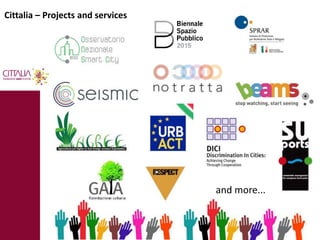
Cittalia – Projects and services 
and more...
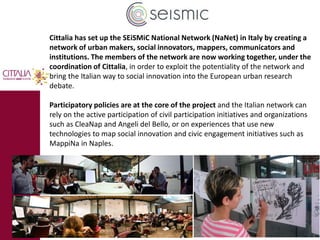
Cittalia has set up the SEiSMiC National Network (NaNet) in Italy by creating a 
network of urban makers, social innovators, mappers, communicators and 
institutions. The members of the network are now working together, under the 
coordination of Cittalia, in order to exploit the potentiality of the network and 
bring the Italian way to social innovation into the European urban research 
debate. 
Participatory policies are at the core of the project and the Italian network can 
rely on the active participation of civil participation initiatives and organizations 
such as CleaNap and Angeli del Bello, or on experiences that use new 
technologies to map social innovation and civic engagement initiatives such as 
MappiNa in Naples.
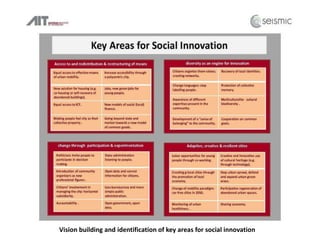
Vision building and identification of key areas for social innovation
Culture-based creativity plays a key role in the generation of social 
innovation which refers to new strategies, concepts, ideas and 
organisations which meet social needs of all kinds - from promoting 
new skills for new jobs, improving working conditions/workplaces 
and education, fostering longer and healthier life, and promoting 
gender equality to (sustainable) community development, fight 
against crime, social exclusion, to well-being improvement - and 
which strengthen civil society as well as social integration. 
The concept can also be related to social entrepreneurship. 
Sometimes it may coincide with innovation in public policy and 
governance.
Challenges identified by SEiSMiC can be gathered in three main areas: 
Participation, open government, communication 
All the working groups highlighted the crisis of representative institutions 
and the need for innovative solutions. The keywords are “accountability, 
openness, interactive communication, debureaucratization of Public 
Administration”. 
Community building in the public space 
Cities need more self-conscious and responsible communities, and institutions 
should encourage citizens to feel the city as a common good rather than a 
private property. All around Italy, the experiences of citizens spontaneously 
taking care of common goods in cities are expanding. 
New models of urban sustainable economy 
Co-working, sharing economy, urban agriculture are just some of the many 
innovative practices discussed in the working groups. Moreover, new models of 
urban welfare are arising to face the decrease of resources devoted to traditional 
welfare.
SEiSMiC initiatives/projects 
1. Civic monitoring of public services. 
This working group explores existing practices and proposes new models of 
citizens’ involvement in monitoring and assessing the quality of public services in 
cities (e.g. mobility, welfare, waste management etc.) 
2. Collaborative mapping for urban transformation. 
A particular emphasis is devoted to the use of collaborative maps for sharing the 
knowledge of public spaces in cities and gathering the civic energies willing to 
engage in transforming them. Among the social innovations in urban 
transformation there are practices such as temporary use of public spaces, 
community gardens, social streets etc. 
3. Dynamic mapping of stakeholders in participatory processes. 
This working group carries out a research and develops pilot projects in order to 
experiment new methods in identifying stakeholders in decision making and 
participatory processes on urban matters. 
4. Social innovation in urban economy. 
The goal is to identify social innovations to face the global crisis through the re-localization 
of production and the diffusion of a new paradigm whose keywords 
are sharing, sustainability, equity. Among the practices already discussed in the 
inaugural meeting there are: sharing economy, co-working, urban agriculture etc.
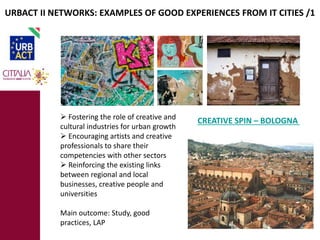
URBACT II NETWORKS: EXAMPLES OF GOOD EXPERIENCES FROM IT CITIES /1 
 Fostering the role of creative and 
cultural industries for urban growth 
 Encouraging artists and creative 
professionals to share their 
competencies with other sectors 
 Reinforcing the existing links 
between regional and local 
businesses, creative people and 
universities 
Main outcome: Study, good 
practices, LAP 
CREATIVE SPIN – BOLOGNA
Critical success factors for networks 
Multistakeholders approach / Capacity to bring together different 
organizations and institutions and people with different backgrounds 
i.e. Creative Spin: synergy between municipality of Bologna, architecture 
companies and designers which regenerated a street of Bologna (Via 
Sant’Apollinare) through a simple initiative: renovation of municipal properties 
in that street and allocation of these spaces in the hands of MIRA and Vicolo 
Pagliacorta (architectures and designers). Positive chain-effect and replication of 
this initiative in other neighborhoods, i.e. Piazza dei Colori which is becoming an 
attractive area for social activities and collaborations thanks to the settlement of 
creative organizations and start-ups. 
Participatory approach (co-decision, sharing) 
Openness and flexibility of the network (open to new inputs and ablr 
to change) 
Effective sustainability models 
 Self-feeding and capacity of the network to create sense of 
identification with its specific practices through effective 
multidirectional communication 
Combination of culture-based creativity and social innovation
Critical success factors to create favourable habitats for creative professionals? /1 
 Capacity of the city environment to (a) generate new ideas; (b) identify, 
retain and manage creative talents; (c) invest in creative ideas and take 
risks 
 Policy support. Policy has a crucial role to play in setting the appropriate 
conditions to break the “silos” between different visions and mind-sets for 
interdisciplinary interactions to happen and innovation to flourish. Regions 
and local authorities are the primary institutional partners for SMEs in the 
creative sector and they can foster creative networks particularly by 
enhancing participatory approaches at local level 
 Capacity of self-organization of a network and funding / financial capacity 
of the networks (effective business models) 
 Presence of cultural and creative companies and institutions as well as 
creative social networks 
 Society, which nurtures a creative ecology conducive through creativity 
through regulation, education and investment in technology and culture
Critical success factors to create favourable habitats for creative professionals? /2 
 Presence of strong cultural institutions and operators 
 Creative incubators and/or working and co-working spaces 
 Existence of science parks, investment funds, creative 
districts/clusters, education institutes and research centres 
 Strong ICT sector 
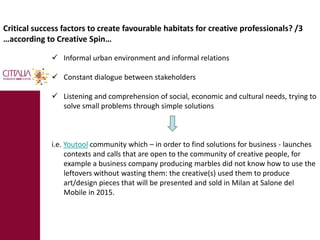
ASSET: territories, as expression of identities, 
playing a vital role in fostering the different 
and the creative (strong cultural traditions 
and specificities / cultural heritage)
Critical success factors to create favourable habitats for creative professionals? /3 
…according to Creative Spin… 
 Informal urban environment and informal relations 
 Constant dialogue between stakeholders 
 Listening and comprehension of social, economic and cultural needs, trying to 
solve small problems through simple solutions 
i.e. Youtool community which – in order to find solutions for business - launches 
contexts and calls that are open to the community of creative people, for 
example a business company producing marbles did not know how to use the 
leftovers without wasting them: the creative(s) used them to produce 
art/design pieces that will be presented and sold in Milan at Salone del 
Mobile in 2015.
Absolute Do’s / 1 
Foster public policy governance and local development through the 
horizontal integration of culture in other policies related to the economy, 
environment, urban planning, youth and entrepreneurship, tourism, 
social integration, etc. 
Foster Innovative products and services 
Develop Open and collaborative models of work / organisational 
models through PARTICIPATORY APPROACH (i.e. collaborative mapping, 
open data and other urban crowdsourcing experiences) 
Activate Marketing/communication strategies to better brand 
companies, public organisations, or cities and regions 
Innovate public services to foster communication and trust with 
citizens or increasing participation of marginalised groups. 
Set up an environment conducive to innovation that further attracts 
creative talents, new investors but also visitors (soft location factor) 
Be open and available to develop new images and attractive places 
Create the conditions for the rise of a “creative class” through the 
setting up of multidisciplinary education programmes or the clustering of 
companies making an area attractive for living and work.
Absolute Do’s / 2 
Practical examples of “DO’s” activities 
-Workshops/seminars to stimulate or incubate new ideas 
-Open calls for innovative ideas and meeting with investors 
-Training programmes for artists to consult companies on creativity and 
direct artistic interventions in companies/workplaces 
-Multidisciplinary teams working on specific assignments (e.g. to solve 
problems of small companies) 
-Clustering of companies to promote together creativity/design as a tool for 
innovation 
-Training programmes on the application of design in companies 
Stimulation of user-driven innovation and application of results to 
companies
Absolute Dont’s 
For creative people: 
- Don’t expect others to activate a creative network and to let you in: do it 
yourself! 
-Don’t rely only on institutions / public authorities for permanent funding, but 
look for public funding only in the start-up phase then create your own 
business model! 
-Don’t isolate yourself but always look for multifaceted connections through a 
multi-stakeholders’ approach 
For cities/local authorities: 
-Do not be closed to changes, open yourself and provide citizens with new 
spaces and opportunities of interaction 
-Don’t be silly, you need to empower citizens and foster societal engagement 
-Don’t be too sectoral: life is more complicated, the new economy too. Look 
for interactions and collaboration also between different admin departments 
in order to mainstream culture 
-Don’t be reticent to engage with other businesses and commercial interests
THANK YOU! 
Gabriele Guazzo - Cittalia 
guazzo@cittalia.it
KEYWORDS 
generating new ideas and disruption 
identify and nurture talent 
understand the investment value of creative ideas 
foster participatory processes
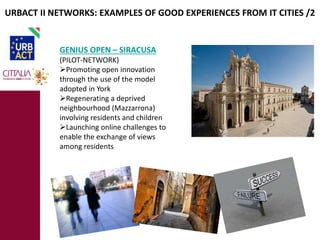
URBACT II NETWORKS: EXAMPLES OF GOOD EXPERIENCES FROM IT CITIES /2 
GENIUS OPEN – SIRACUSA 
(PILOT-NETWORK) 
Promoting open innovation 
through the use of the model 
adopted in York 
Regenerating a deprived 
neighbourhood (Mazzarrona) 
involving residents and children 
Launching online challenges to 
enable the exchange of views 
among residents

RAVELLO LAB 2014 | Cittalia

  • 1.
    RAVELLO LAB 2014 PANEL 3 – Place-shaping and designing creative ecosystems to make territories competitive Ravello, 24 October 2014 CITTALIA The research hub of the National Association of Italian Municipalities (ANCI) Gabriele Guazzo
  • 2.
    • a multiplierof good practices at national and EU level and a node for urban innovation and urban making, active in the analysis, promotion, exchange and dissemination of innovative practices by bringing together ideas, experiences and positive approaches developed in the urban landscape(s) • a powerhouse for innovation and a promoter of social innovators networks, comprising both institutional and non institutional players and including city officers and administrators, policy makers, experts, stakeholders, start-uppers, urban makers, architects, media, academic (multistakeholders approach)  The activities carried out by Cittalia in the field of urban creativity and social innovation rely on capitalization projects and on local initiatives that are developed mostly through EU projects and/or network initiatives. Thanks to them, Cittalia is able to bring together different urban players and social innovators, acting as a “bridge” between local authorities and other community groups. Cittalia is right in the middle, where the exchange of information, know how, experiences, takes place.  URBACT NDP / Coordinator of the SEiSMiC NaNet / Coordinator of ANCI Smart City Observatory
  • 3.
    Cittalia – Projectsand services and more...
  • 4.
    Cittalia has setup the SEiSMiC National Network (NaNet) in Italy by creating a network of urban makers, social innovators, mappers, communicators and institutions. The members of the network are now working together, under the coordination of Cittalia, in order to exploit the potentiality of the network and bring the Italian way to social innovation into the European urban research debate. Participatory policies are at the core of the project and the Italian network can rely on the active participation of civil participation initiatives and organizations such as CleaNap and Angeli del Bello, or on experiences that use new technologies to map social innovation and civic engagement initiatives such as MappiNa in Naples.
  • 5.
    Vision building andidentification of key areas for social innovation
  • 6.
    Culture-based creativity playsa key role in the generation of social innovation which refers to new strategies, concepts, ideas and organisations which meet social needs of all kinds - from promoting new skills for new jobs, improving working conditions/workplaces and education, fostering longer and healthier life, and promoting gender equality to (sustainable) community development, fight against crime, social exclusion, to well-being improvement - and which strengthen civil society as well as social integration. The concept can also be related to social entrepreneurship. Sometimes it may coincide with innovation in public policy and governance.
  • 7.
    Challenges identified bySEiSMiC can be gathered in three main areas: Participation, open government, communication All the working groups highlighted the crisis of representative institutions and the need for innovative solutions. The keywords are “accountability, openness, interactive communication, debureaucratization of Public Administration”. Community building in the public space Cities need more self-conscious and responsible communities, and institutions should encourage citizens to feel the city as a common good rather than a private property. All around Italy, the experiences of citizens spontaneously taking care of common goods in cities are expanding. New models of urban sustainable economy Co-working, sharing economy, urban agriculture are just some of the many innovative practices discussed in the working groups. Moreover, new models of urban welfare are arising to face the decrease of resources devoted to traditional welfare.
  • 8.
    SEiSMiC initiatives/projects 1.Civic monitoring of public services. This working group explores existing practices and proposes new models of citizens’ involvement in monitoring and assessing the quality of public services in cities (e.g. mobility, welfare, waste management etc.) 2. Collaborative mapping for urban transformation. A particular emphasis is devoted to the use of collaborative maps for sharing the knowledge of public spaces in cities and gathering the civic energies willing to engage in transforming them. Among the social innovations in urban transformation there are practices such as temporary use of public spaces, community gardens, social streets etc. 3. Dynamic mapping of stakeholders in participatory processes. This working group carries out a research and develops pilot projects in order to experiment new methods in identifying stakeholders in decision making and participatory processes on urban matters. 4. Social innovation in urban economy. The goal is to identify social innovations to face the global crisis through the re-localization of production and the diffusion of a new paradigm whose keywords are sharing, sustainability, equity. Among the practices already discussed in the inaugural meeting there are: sharing economy, co-working, urban agriculture etc.
  • 9.
    URBACT II NETWORKS:EXAMPLES OF GOOD EXPERIENCES FROM IT CITIES /1  Fostering the role of creative and cultural industries for urban growth  Encouraging artists and creative professionals to share their competencies with other sectors  Reinforcing the existing links between regional and local businesses, creative people and universities Main outcome: Study, good practices, LAP CREATIVE SPIN – BOLOGNA
  • 10.
    Critical success factorsfor networks Multistakeholders approach / Capacity to bring together different organizations and institutions and people with different backgrounds i.e. Creative Spin: synergy between municipality of Bologna, architecture companies and designers which regenerated a street of Bologna (Via Sant’Apollinare) through a simple initiative: renovation of municipal properties in that street and allocation of these spaces in the hands of MIRA and Vicolo Pagliacorta (architectures and designers). Positive chain-effect and replication of this initiative in other neighborhoods, i.e. Piazza dei Colori which is becoming an attractive area for social activities and collaborations thanks to the settlement of creative organizations and start-ups. Participatory approach (co-decision, sharing) Openness and flexibility of the network (open to new inputs and ablr to change) Effective sustainability models  Self-feeding and capacity of the network to create sense of identification with its specific practices through effective multidirectional communication Combination of culture-based creativity and social innovation
  • 11.
    Critical success factorsto create favourable habitats for creative professionals? /1  Capacity of the city environment to (a) generate new ideas; (b) identify, retain and manage creative talents; (c) invest in creative ideas and take risks  Policy support. Policy has a crucial role to play in setting the appropriate conditions to break the “silos” between different visions and mind-sets for interdisciplinary interactions to happen and innovation to flourish. Regions and local authorities are the primary institutional partners for SMEs in the creative sector and they can foster creative networks particularly by enhancing participatory approaches at local level  Capacity of self-organization of a network and funding / financial capacity of the networks (effective business models)  Presence of cultural and creative companies and institutions as well as creative social networks  Society, which nurtures a creative ecology conducive through creativity through regulation, education and investment in technology and culture
  • 12.
    Critical success factorsto create favourable habitats for creative professionals? /2  Presence of strong cultural institutions and operators  Creative incubators and/or working and co-working spaces  Existence of science parks, investment funds, creative districts/clusters, education institutes and research centres  Strong ICT sector ASSET: territories, as expression of identities, playing a vital role in fostering the different and the creative (strong cultural traditions and specificities / cultural heritage)
  • 13.
    Critical success factorsto create favourable habitats for creative professionals? /3 …according to Creative Spin…  Informal urban environment and informal relations  Constant dialogue between stakeholders  Listening and comprehension of social, economic and cultural needs, trying to solve small problems through simple solutions i.e. Youtool community which – in order to find solutions for business - launches contexts and calls that are open to the community of creative people, for example a business company producing marbles did not know how to use the leftovers without wasting them: the creative(s) used them to produce art/design pieces that will be presented and sold in Milan at Salone del Mobile in 2015.
  • 14.
    Absolute Do’s /1 Foster public policy governance and local development through the horizontal integration of culture in other policies related to the economy, environment, urban planning, youth and entrepreneurship, tourism, social integration, etc. Foster Innovative products and services Develop Open and collaborative models of work / organisational models through PARTICIPATORY APPROACH (i.e. collaborative mapping, open data and other urban crowdsourcing experiences) Activate Marketing/communication strategies to better brand companies, public organisations, or cities and regions Innovate public services to foster communication and trust with citizens or increasing participation of marginalised groups. Set up an environment conducive to innovation that further attracts creative talents, new investors but also visitors (soft location factor) Be open and available to develop new images and attractive places Create the conditions for the rise of a “creative class” through the setting up of multidisciplinary education programmes or the clustering of companies making an area attractive for living and work.
  • 15.
    Absolute Do’s /2 Practical examples of “DO’s” activities -Workshops/seminars to stimulate or incubate new ideas -Open calls for innovative ideas and meeting with investors -Training programmes for artists to consult companies on creativity and direct artistic interventions in companies/workplaces -Multidisciplinary teams working on specific assignments (e.g. to solve problems of small companies) -Clustering of companies to promote together creativity/design as a tool for innovation -Training programmes on the application of design in companies Stimulation of user-driven innovation and application of results to companies
  • 16.
    Absolute Dont’s Forcreative people: - Don’t expect others to activate a creative network and to let you in: do it yourself! -Don’t rely only on institutions / public authorities for permanent funding, but look for public funding only in the start-up phase then create your own business model! -Don’t isolate yourself but always look for multifaceted connections through a multi-stakeholders’ approach For cities/local authorities: -Do not be closed to changes, open yourself and provide citizens with new spaces and opportunities of interaction -Don’t be silly, you need to empower citizens and foster societal engagement -Don’t be too sectoral: life is more complicated, the new economy too. Look for interactions and collaboration also between different admin departments in order to mainstream culture -Don’t be reticent to engage with other businesses and commercial interests
  • 17.
    THANK YOU! GabrieleGuazzo - Cittalia guazzo@cittalia.it
  • 18.
    KEYWORDS generating newideas and disruption identify and nurture talent understand the investment value of creative ideas foster participatory processes
  • 19.
    URBACT II NETWORKS:EXAMPLES OF GOOD EXPERIENCES FROM IT CITIES /2 GENIUS OPEN – SIRACUSA (PILOT-NETWORK) Promoting open innovation through the use of the model adopted in York Regenerating a deprived neighbourhood (Mazzarrona) involving residents and children Launching online challenges to enable the exchange of views among residents

Editor's Notes

  • #3 Cittalia is the research foundation of the National Association of Italian Municipalities (ANCI) established in 2007, it carries out research and studies on urban issues and its role is to support ANCI, as well as Italian municipalities, in the production of the knowledge and tools necessary to meet the ongoing economic and social challenges faced by local authorities contributes to the political, institutional and academic debate about urban policies and encourages a European vision drawing on international experience for inspiration uses a flexible interdisciplinary approach to provide policy makers, scientific community and public at large with relevant tools and analysis on Welfare and Society themes and on other urban topics Cittalia is particularly committed to understand the causes of inequality, marginalisation and social problems and it proposes solutions, ways and means to tackle and overcome them promotes the role of local authorities in Italy and Europe as powerhouses for social inclusion, innovation and competitive growth operates at European level also through its Brussels-based office and its EU project team, encouraging a shared European understanding of the crucial aspects of urban settings and changes, acknowledging and exchanging European good practices and actively participating in European partnerships. Cittalia is not only the research centre of ANCI, but also a hub that brings together urban makers and innovators, local organizations and associations, citizens and local authorities, around the themes of urban sustainable integrated development, social innovation and creative cities. Engaged also at EU level (URBACT NDP, Covenant of Mayors, partnerships in the framework of EU co-funded projects), Cittalia animates or is active in several networks aimed at fostering social innovation in cities (i.e. ANCI Smart City Observatory).
  • #4 OSSEVATORIO SMART CITY - Following an agreement with the National Association of Italian Municipalities (ANCI), since April 2012 Cittalia coordinates the National Smart Cities’ Observatory (Osservatorio Nazionale Smart City, http://osservatoriosmartcity.it/), coordinating the technical team of the Observatory. The Observatory aims at providing analysis, research and replicable practices and models that can be adapted to the Italian context and transferred to the Italian municipalities in order to help them become “smart” and innovative SEISMIC - In an effort to bridge the gap between the scientific community and society, the project aims to create a structured dialogue and mutual learning with citizens and urban actors by setting up National Networks (and expanding on existing networks where possible) in 10 countries across Europe. These networks specifically include urban stakeholders from civil society, business, NGOs, youth, media, musea but also from research and policy). URBACT - As URBACT National Dissemination Point (NDP) for Italy, Cittalia provides local-language information on the URBACT programme and projects across the EU, and act as national relay for information on sustainable and integrated urban development SPRAR Servizio Centrale - The Central Service within Cittalia coordinates at central level the SPRAR reception projects for refugees and asylum seekers. In 2011-2013, the SPRAR was composed by around 150 projects providing reception for around 3000 people. SPRAR local projects are characterized by the active role shared – at the same time – by big cities and small towns, by metropolitan areas and country towns. Unlike other European countries, small to medium sized SPRAR projects – designed and implemented at local level, with the direct participation of stakeholders in the region – help to build and strengthen a culture of reception among the urban communities and encourages the continuity of the beneficiaries’ paths to socio-economic inclusion. The SPRAR Central Service is in charge of monitoring the presence in the area of international protection seekers and holders; creating, maintaining and periodically updating a databank of activities implemented at the local level in favour of international protection seekers and holders; disseminating information on activities performed; providing technical assistance to local bodies, also in the set up of reception activities; providing support to information and guidance services implemented at the governmental centres for asylum seekers and providing support to ANCI in performing the tasks arising from its status of delegate authority for the European Refugee Fund (Erf). NO TRATTA - aims at improving the capacity of identification of, and assistance to, victims of THB within the broad Refugees and Asylum Seekers protection system, in view of a larger transnational initiative at EU level (creation of a European observatory on trafficked people among asylum seekers and refugees) BEAMS - aims at analyzing the nexus between the most widespread popular culture production (TV fiction, arts, including performing arts, music, sports, popular books production, comics, depending on the local relevance) to understand how stereotypes are defined and used to create public opinion AGREE - The project aims to understand the characteristics of trafficking and exploitation of migrant workers in agriculture, in order to develop educational strategies and interventions to combat the phenomenon effectively. AGREE analyzes the interventions to prevent and fight against the exploitation carried out in partners countries (IT, ES and RO). The project sets up a training path for key stakeholder and creates local action committees. An awareness campaign against exploitation and to support workers rights in the agricultural sector is carried out.
  • #5 The objectives of SEiSMiC as Mobilisation and Mutual Learning Action Plan are threefold. Firstly it aims to mobilise a wide range of urban stakeholders at the local level with a view to, secondly, feed the experiences and challenges of social innovation at local level into the European urban research agenda and to enhance the social dimension of the strategic research agenda of JPI Urban Europe. Thirdly, it will diffuse the initiatives, projects and results of JPI Urban Europe (and other European programmes) to all urban actors at local, regional, national and European level. It is expected that by means of this multi-level, multi-actor, integrated and inclusive approach, research activities can be increased, new concepts and solutions will be more targeted and accepted, social innovation with the social context is strengthened, and commonalities and differences in European needs, awareness and solutions in the urban field can be identified.
  • #10 Creative SpIN (Creative "Spillovers" for Innovation) aims to create a Thematic Network across Europe which addresses the challenges of how best to connect cultural and creative industries, including sectors such as audiovisual, design, advertising, architecture and video games, with other sectors, to stimulate the effects of "spill over". Creative SpIN will set tools and methods to trigger creativity and innovation in businesses and other kinds of public and private organisations by encouraging artists, creative professionals (in advertising, design, architecture), cultural institutions and industries to engage with other sectors to share their competencies and skills. Project launch: 01 May 2012 / Project Completed: 2015
  • #11 At policy level, there is a need to mainstream CCIs as an economic sector, while now CCIs (especially the visual and performing arts and heritage) is often still considered as a subsidised sector. Cultural policies are therefore often isolated from other policy departments dealing at city level with foreign investment, economic development or social affairs including education). The generation of creative spillovers implies going beyond traditional culture, enterprise, social and innovation policies and get different administrations and policy departments to collaborate. The challenge then also relates to developing new policy languages on creativity and socioeconomic innovation as well as to designing policy tools able to encourage and facilitate cross sectoral interactions and ensuring their sustainability both within the public and private sectors.
  • #12 At policy level, there is a need to mainstream CCIs as an economic sector, while now CCIs (especially the visual and performing arts and heritage) is often still considered as a subsidised sector. Cultural policies are therefore often isolated from other policy departments dealing at city level with foreign investment, economic development or social affairs including education). The generation of creative spillovers implies going beyond traditional culture, enterprise, social and innovation policies and get different administrations and policy departments to collaborate. The challenge then also relates to developing new policy languages on creativity and socioeconomic innovation as well as to designing policy tools able to encourage and facilitate cross sectoral interactions and ensuring their sustainability both within the public and private sectors.
  • #20 Genius: Open The project will transfer a leading edge Open Innovation approach where citizens and businesses work together with the city, creating innovative solutions to city challenges via an online collaboration platform; GeniUS! In a time of unprecedented change for cities, with financial resources reducing rapidly, it is imperative we find new ways of operating. We must source ideas from outside the traditional city council structure and couple this with a different culture and working practice within the city council itself. The online collaboration platform enables exchange of ideas between residents, communities, companies and academics. Project launch : 29 January 2014 / Project Completed : 2015