Behaviour for Learning
Why Do Students
Misbehave?
Behaviour for Learning
Behaviour for learning is a
method by which a
teacher creates a positive
and productive learning
environment for his or her
students by preventing
and effectively dealing
with inappropriate
behaviour.
• Using the dry-wipe boards, list the
possible reasons as to why learners
might misbehave in your class?
• Does the time of day or the day of
week have any impact?
Why don’t students do what we
want them to?
Why students don’t do what you
want them to?
1. They don’t know what to do.
2. They don’t know how to do it.
3. They don’t know why they should do it.
4. They aren’t suited or matched to the task.
5. There isn’t any consequence.
6. There isn’t any relevant feedback.
7. They get more attention by not doing it.
What’s Going On In Their Heads?
• Brain reconfiguration – “pruning”
of brain cells
• 11 – 25 (girls) & 12 – 25 (boys) –
key phase
• Shrinkage occurs, mostly in pre-
frontal cortex (controls risk, logic
etc.) in order to allow other areas
maximum resources whilst they
develop.
[Geidd in Wallis, C. (2004) ‘What Makes Teens Tick?’ Time Magazine, 7th June, pp 54 – 61]
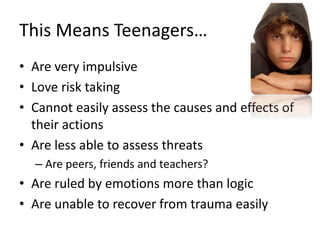
This Means Teenagers…
• Are very impulsive
• Love risk taking
• Cannot easily assess the causes and effects of
their actions
• Are less able to assess threats
– Are peers, friends and teachers?
• Are ruled by emotions more than logic
• Are unable to recover from trauma easily
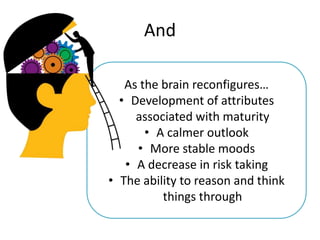
And
As the brain reconfigures…
• Development of attributes
associated with maturity
• A calmer outlook
• More stable moods
• A decrease in risk taking
• The ability to reason and think
things through

Behaviour for learning 2

  • 1.
    Behaviour for Learning WhyDo Students Misbehave?
  • 2.
    Behaviour for Learning Behaviourfor learning is a method by which a teacher creates a positive and productive learning environment for his or her students by preventing and effectively dealing with inappropriate behaviour.
  • 3.
    • Using thedry-wipe boards, list the possible reasons as to why learners might misbehave in your class? • Does the time of day or the day of week have any impact? Why don’t students do what we want them to?
  • 4.
    Why students don’tdo what you want them to? 1. They don’t know what to do. 2. They don’t know how to do it. 3. They don’t know why they should do it. 4. They aren’t suited or matched to the task. 5. There isn’t any consequence. 6. There isn’t any relevant feedback. 7. They get more attention by not doing it.
  • 5.
    What’s Going OnIn Their Heads? • Brain reconfiguration – “pruning” of brain cells • 11 – 25 (girls) & 12 – 25 (boys) – key phase • Shrinkage occurs, mostly in pre- frontal cortex (controls risk, logic etc.) in order to allow other areas maximum resources whilst they develop. [Geidd in Wallis, C. (2004) ‘What Makes Teens Tick?’ Time Magazine, 7th June, pp 54 – 61]
  • 6.
    This Means Teenagers… •Are very impulsive • Love risk taking • Cannot easily assess the causes and effects of their actions • Are less able to assess threats – Are peers, friends and teachers? • Are ruled by emotions more than logic • Are unable to recover from trauma easily
  • 7.
    And As the brainreconfigures… • Development of attributes associated with maturity • A calmer outlook • More stable moods • A decrease in risk taking • The ability to reason and think things through

Editor's Notes

  • #7 This is not an excuse, but it can explain why students behave the way they do – finding their place in the world…