Behaviour for Learning
What Works
&
What Doesn’t
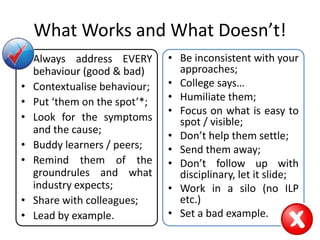
What Works and What Doesn’t!
• Always address EVERY
behaviour (good & bad)
• Contextualise behaviour;
• Put ‘them on the spot’*;
• Look for the symptoms
and the cause;
• Buddy learners / peers;
• Remind them of the
groundrules and what
industry expects;
• Share with colleagues;
• Lead by example.
• Be inconsistent with your
approaches;
• College says…
• Humiliate them;
• Focus on what is easy to
spot / visible;
• Don’t help them settle;
• Send them away;
• Don’t follow up with
disciplinary, let it slide;
• Work in a silo (no ILP
etc.)
• Set a bad example.
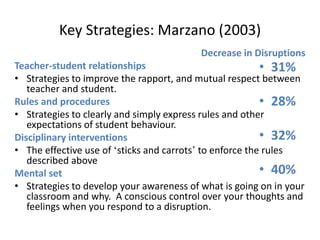
Key Strategies: Marzano (2003)
Decrease in Disruptions
Teacher-student relationships
• Strategies to improve the rapport, and mutual respect between
teacher and student.
Rules and procedures
• Strategies to clearly and simply express rules and other
expectations of student behaviour.
Disciplinary interventions
• The effective use of ‘sticks and carrots’ to enforce the rules
described above
Mental set
• Strategies to develop your awareness of what is going on in your
classroom and why. A conscious control over your thoughts and
feelings when you respond to a disruption.
• 31%
• 28%
• 32%
• 40%
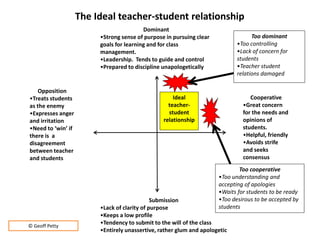
Dominant
•Strong sense of purpose in pursuing clear
goals for learning and for class
management.
•Leadership. Tends to guide and control
•Prepared to discipline unapologetically
Cooperative
•Great concern
for the needs and
opinions of
students.
•Helpful, friendly
•Avoids strife
and seeks
consensus
Opposition
•Treats students
as the enemy
•Expresses anger
and irritation
•Need to ‘win’ if
there is a
disagreement
between teacher
and students
Submission
•Lack of clarity of purpose
•Keeps a low profile
•Tendency to submit to the will of the class
•Entirely unassertive, rather glum and apologetic
Ideal
teacher-
student
relationship
Too dominant
•Too controlling
•Lack of concern for
students
•Teacher student
relations damaged
Too cooperative
•Too understanding and
accepting of apologies
•Waits for students to be ready
•Too desirous to be accepted by
students
The Ideal teacher-student relationship
© Geoff Petty
Task
• Read through the article provided (Rules of
Classroom Management, Preventing
Problems).
• Make a list of the TOP TEN tips that work best
for you (you can even add ones that are not
on the sheet).
• Then, discuss them in the forum (below)…

Behaviour for learning 4

  • 1.
    Behaviour for Learning WhatWorks & What Doesn’t
  • 2.
    What Works andWhat Doesn’t! • Always address EVERY behaviour (good & bad) • Contextualise behaviour; • Put ‘them on the spot’*; • Look for the symptoms and the cause; • Buddy learners / peers; • Remind them of the groundrules and what industry expects; • Share with colleagues; • Lead by example. • Be inconsistent with your approaches; • College says… • Humiliate them; • Focus on what is easy to spot / visible; • Don’t help them settle; • Send them away; • Don’t follow up with disciplinary, let it slide; • Work in a silo (no ILP etc.) • Set a bad example.
  • 3.
    Key Strategies: Marzano(2003) Decrease in Disruptions Teacher-student relationships • Strategies to improve the rapport, and mutual respect between teacher and student. Rules and procedures • Strategies to clearly and simply express rules and other expectations of student behaviour. Disciplinary interventions • The effective use of ‘sticks and carrots’ to enforce the rules described above Mental set • Strategies to develop your awareness of what is going on in your classroom and why. A conscious control over your thoughts and feelings when you respond to a disruption. • 31% • 28% • 32% • 40%
  • 4.
    Dominant •Strong sense ofpurpose in pursuing clear goals for learning and for class management. •Leadership. Tends to guide and control •Prepared to discipline unapologetically Cooperative •Great concern for the needs and opinions of students. •Helpful, friendly •Avoids strife and seeks consensus Opposition •Treats students as the enemy •Expresses anger and irritation •Need to ‘win’ if there is a disagreement between teacher and students Submission •Lack of clarity of purpose •Keeps a low profile •Tendency to submit to the will of the class •Entirely unassertive, rather glum and apologetic Ideal teacher- student relationship Too dominant •Too controlling •Lack of concern for students •Teacher student relations damaged Too cooperative •Too understanding and accepting of apologies •Waits for students to be ready •Too desirous to be accepted by students The Ideal teacher-student relationship © Geoff Petty
  • 5.
    Task • Read throughthe article provided (Rules of Classroom Management, Preventing Problems). • Make a list of the TOP TEN tips that work best for you (you can even add ones that are not on the sheet). • Then, discuss them in the forum (below)…

Editor's Notes

  • #5 Where do you sit?