GARIMA SINGH
MED COURSE 404
Behavioral Therapy
Table Contents
• Definition
• Introduction
• Types of Behavioral Therapy
• Techniques of Behavioral Therapy
• How it Helps?
• Benefits of Behavioral Therapy
• Things to Consider
• Conclusion
2
Definition
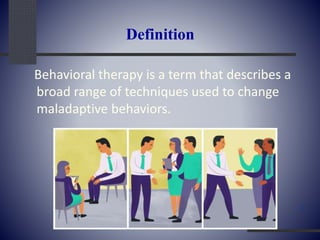
Behavioral therapy is a term that describes a
broad range of techniques used to change
maladaptive behaviors.
3
Introduction
• Behavioral therapy is rooted in the principles
of behaviorism, a school of thought focused on the
idea that we learn from our environment.
• Unlike the types of therapy that are rooted in insight
(such as psychoanalytic therapy and humanistic
therapies), behavioral therapy is action-based.
Because of this, behavioral therapy tends to be
highly focused
4
5
Types of Behavioral Therapy
• Applied behavior analysis uses operant
conditioning to shape and modify problematic
behaviors.
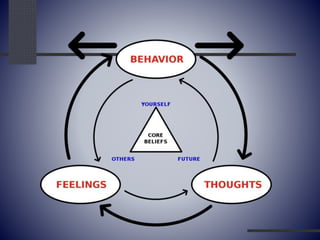
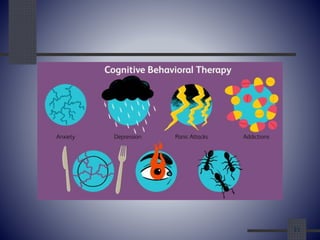
• Cognitive behavioral therapy (CBT) relies on
behavioral techniques, but adds a cognitive
element, focusing on the problematic
thoughts behind behaviors.
●●●
6
Types of Behavioral Therapy
• Cognitive behavioral play therapy utilizes play to
assess, prevent, or treat psychosocial challenges.
The therapist may use play to help a child learn
how to think and behave differently.
• Dialectical behavioral therapy (DBT) is a form of
CBT that utilizes both behavioral and cognitive
techniques to help people learn to manage their
emotions, cope with distress.
●●●
7
Types of Behavioral Therapy
• Exposure therapy utilizes behavioral techniques
to help people overcome their fears of
situations or objects.
• Rational emotive behavior therapy
(REBT) focuses on identifying negative or
destructive thoughts and feelings. People then
actively challenge those thoughts and replace
them with more rational, realistic ones.
8
Techniques of Behavioral Therapy
Classical conditioning
It involves forming associations between stimuli.
Previously neutral stimuli are paired with a
stimulus that naturally and automatically evokes a
response. After repeated pairings, an association is
formed and the previously neutral stimulus will
come to evoke the response on its own.
●●●
9
Techniques of Behavioral Therapy
Aversion therapy
This process involves pairing an undesirable
behavior with an aversive stimulus in the hope
that the unwanted behavior will eventually be
reduced. For example, someone with an alcohol
use disorder might take Antabuse (disulfiram), a
drug that causes severe symptoms.
●●●
10
Techniques of Behavioral Therapy
Flooding:
This process involves exposing people to fear-
invoking objects or situations intensely and
rapidly. It is often used to treat phobias. During
the process, the individual is prevented from
escaping or avoiding the situation.
●●●
11
Techniques of Behavioral Therapy
Flooding:
This process involves exposing people to fear-
invoking objects or situations intensely and
rapidly. It is often used to treat phobias.
During the process, the individual is prevented
from escaping or avoiding the situation.
●●●
12
Techniques of Behavioral Therapy
Systematic desensitization:
In this technique, people make a list of fears
and then learn to relax while concentrating on
these fears. Starting with the least fear-inducing
item and working their way to the most fear-
inducing item, people systematically confront
these fears under the guidance of a therapist.
●●●
13
Techniques of Behavioral Therapy
Operant Conditioning
Operant conditioning focuses on how
reinforcement and punishment can be utilized
to either increase or decrease the frequency of
a behavior. Behaviors followed by desirable
consequences are more likely to occur again in
the future, while those followed by negative
consequences become less likely to occur.
14
How it Helps?
Behavioral therapy can be utilized to treat a wide
range of psychological conditions and disorders,
including:
Bipolar disorder
 Alcohol and substance use disorders
 Anxiety
 Attention-deficit/hyperactivity disorder (ADHD)
 Autism spectrum disorders
●●●
15
How it Helps?
 Borderline personality disorder (BPD)
 Depression
 Eating disorders
 Panic disorder
 Phobias
 Obsessive-compulsive disorder (OCD)
16
Benefits of Behavioral Therapy
 Behavioral therapy is widely used and has been
shown to be effective in treating a number of
different conditions.
 Cognitive behavioral therapy, in particular, is often
considered the "gold standard" in the treatment of
many disorders, and cognitive behavioral play
therapy, specifically, can be effective for children
where other types of therapy aren’t
●●●
17
Benefits of Behavioral Therapy
CBT is most effective for the treatment of:
 Anger issues
 Anxiety
 Bulimia
 Depression
 Somatic symptom disorder
 Stress
 Substance abuse and relapse prevention
●●●
18
Things to Consider
• It's Not Enough for Complex Mental Health Conditions
When treating certain psychiatric disorders such as severe
depression and schizophrenia, behavioral therapy often
must be used in conjunction with other medical and
therapeutic treatments.
• It May Not Account for Underlying Problems
Behavioral treatments tend to focus on current problems
with functioning and may not fully appreciate or address
the underlying factors that are contributing to a mental
health problem.
●●●
19
Things to Consider
• It May Not Address the Whole Picture
Behavioral approaches are centered on the
individual working to change their behaviors.
Some of these approaches, however, often don't
address how situations and interpersonal
relationships might be contributing to a person's
problems.
20
21
Conclusion
Behaviour therapy is a treatment approach
originally derived from learning theory,
which seeks to solve problems and relieve
symptoms by changing behaviour and the
environmental contingencies which control
behaviour.
22
References
 Google.com
 Wikipedia.org
 Studymafia.org
 Slidespanda.com

Behavioral-Therapy-ppt.pptx

  • 1.
    GARIMA SINGH MED COURSE404 Behavioral Therapy
  • 2.
    Table Contents • Definition •Introduction • Types of Behavioral Therapy • Techniques of Behavioral Therapy • How it Helps? • Benefits of Behavioral Therapy • Things to Consider • Conclusion 2
  • 3.
    Definition Behavioral therapy isa term that describes a broad range of techniques used to change maladaptive behaviors. 3
  • 4.
    Introduction • Behavioral therapyis rooted in the principles of behaviorism, a school of thought focused on the idea that we learn from our environment. • Unlike the types of therapy that are rooted in insight (such as psychoanalytic therapy and humanistic therapies), behavioral therapy is action-based. Because of this, behavioral therapy tends to be highly focused 4
  • 5.
  • 6.
    Types of BehavioralTherapy • Applied behavior analysis uses operant conditioning to shape and modify problematic behaviors. • Cognitive behavioral therapy (CBT) relies on behavioral techniques, but adds a cognitive element, focusing on the problematic thoughts behind behaviors. ●●● 6
  • 7.
    Types of BehavioralTherapy • Cognitive behavioral play therapy utilizes play to assess, prevent, or treat psychosocial challenges. The therapist may use play to help a child learn how to think and behave differently. • Dialectical behavioral therapy (DBT) is a form of CBT that utilizes both behavioral and cognitive techniques to help people learn to manage their emotions, cope with distress. ●●● 7
  • 8.
    Types of BehavioralTherapy • Exposure therapy utilizes behavioral techniques to help people overcome their fears of situations or objects. • Rational emotive behavior therapy (REBT) focuses on identifying negative or destructive thoughts and feelings. People then actively challenge those thoughts and replace them with more rational, realistic ones. 8
  • 9.
    Techniques of BehavioralTherapy Classical conditioning It involves forming associations between stimuli. Previously neutral stimuli are paired with a stimulus that naturally and automatically evokes a response. After repeated pairings, an association is formed and the previously neutral stimulus will come to evoke the response on its own. ●●● 9
  • 10.
    Techniques of BehavioralTherapy Aversion therapy This process involves pairing an undesirable behavior with an aversive stimulus in the hope that the unwanted behavior will eventually be reduced. For example, someone with an alcohol use disorder might take Antabuse (disulfiram), a drug that causes severe symptoms. ●●● 10
  • 11.
    Techniques of BehavioralTherapy Flooding: This process involves exposing people to fear- invoking objects or situations intensely and rapidly. It is often used to treat phobias. During the process, the individual is prevented from escaping or avoiding the situation. ●●● 11
  • 12.
    Techniques of BehavioralTherapy Flooding: This process involves exposing people to fear- invoking objects or situations intensely and rapidly. It is often used to treat phobias. During the process, the individual is prevented from escaping or avoiding the situation. ●●● 12
  • 13.
    Techniques of BehavioralTherapy Systematic desensitization: In this technique, people make a list of fears and then learn to relax while concentrating on these fears. Starting with the least fear-inducing item and working their way to the most fear- inducing item, people systematically confront these fears under the guidance of a therapist. ●●● 13
  • 14.
    Techniques of BehavioralTherapy Operant Conditioning Operant conditioning focuses on how reinforcement and punishment can be utilized to either increase or decrease the frequency of a behavior. Behaviors followed by desirable consequences are more likely to occur again in the future, while those followed by negative consequences become less likely to occur. 14
  • 15.
    How it Helps? Behavioraltherapy can be utilized to treat a wide range of psychological conditions and disorders, including: Bipolar disorder  Alcohol and substance use disorders  Anxiety  Attention-deficit/hyperactivity disorder (ADHD)  Autism spectrum disorders ●●● 15
  • 16.
    How it Helps? Borderline personality disorder (BPD)  Depression  Eating disorders  Panic disorder  Phobias  Obsessive-compulsive disorder (OCD) 16
  • 17.
    Benefits of BehavioralTherapy  Behavioral therapy is widely used and has been shown to be effective in treating a number of different conditions.  Cognitive behavioral therapy, in particular, is often considered the "gold standard" in the treatment of many disorders, and cognitive behavioral play therapy, specifically, can be effective for children where other types of therapy aren’t ●●● 17
  • 18.
    Benefits of BehavioralTherapy CBT is most effective for the treatment of:  Anger issues  Anxiety  Bulimia  Depression  Somatic symptom disorder  Stress  Substance abuse and relapse prevention ●●● 18
  • 19.
    Things to Consider •It's Not Enough for Complex Mental Health Conditions When treating certain psychiatric disorders such as severe depression and schizophrenia, behavioral therapy often must be used in conjunction with other medical and therapeutic treatments. • It May Not Account for Underlying Problems Behavioral treatments tend to focus on current problems with functioning and may not fully appreciate or address the underlying factors that are contributing to a mental health problem. ●●● 19
  • 20.
    Things to Consider •It May Not Address the Whole Picture Behavioral approaches are centered on the individual working to change their behaviors. Some of these approaches, however, often don't address how situations and interpersonal relationships might be contributing to a person's problems. 20
  • 21.
  • 22.
    Conclusion Behaviour therapy isa treatment approach originally derived from learning theory, which seeks to solve problems and relieve symptoms by changing behaviour and the environmental contingencies which control behaviour. 22
  • 23.
    References  Google.com  Wikipedia.org Studymafia.org  Slidespanda.com