UNIT-4
MOTIVATION
The processes that account for an individual’s
intensity, direction, and persistence of effort toward
attaining a goal.
It is condition that is initiated by a physiological or
psychological deficiency or need in an individual, which
causes the individual to behave in a certain manner in
order to achieve a particular goal or incentive.
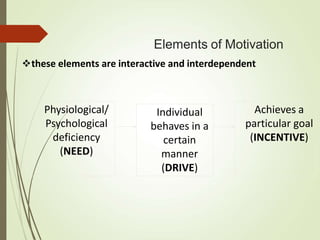
Elements of Motivation
Physiological/
Psychological
deficiency
(NEED)
Achieves a
particular goal
(INCENTIVE)
Individual
behaves in a
certain
manner
(DRIVE)
these elements are interactive and interdependent
Need : physiological or psychological deficiency
or imbalance in an individual will result in a need.
For e.g. hunger thirst
But psychological need may sometimes arise without
any deficiency or imbalance. e.g. strong need for
progress.
Drive: physiological drive is a condition which
causes a person to work in a particular direction.
Incentive : anything that mitigate the drive and
decrease the intensity of the drive
Early Theories of Motivation
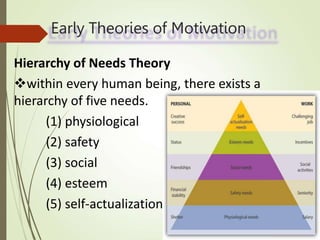
Hierarchy of Needs Theory
within every human being, there exists a
hierarchy of five needs.
(1) physiological
(2) safety
(3) social
(4) esteem
(5) self-actualization
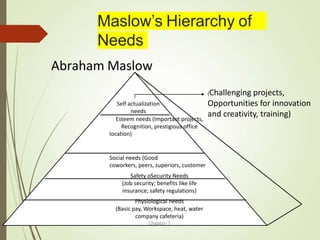
Maslow’s Hierarchy of
Needs
 Abraham Maslow
Self actualization
needs
Esteem needs (Important projects,
Recognition, prestigious office
location)
Social needs (Good
coworkers, peers, superiors, customer
Safety oSecurity Needs
(Job security; benefits like life
insurance; safety regulations)
Physiological needs
(Basic pay, Workspace, heat, water
company cafeteria)
Chapter-7
(Challenging projects,
Opportunities for innovation
and creativity, training)
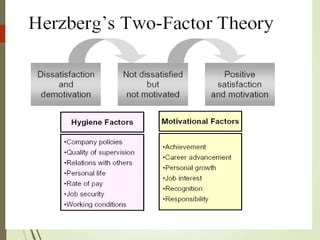
Two-Factor Theory
 Herzberg’s classification of needs as
hygiene factors and motivators.
 He conducted a study to find out the job
satisfaction and dissatisfaction factors
 Job satisfiers were associated with job
content and job dissatisfiers were related
to job context ( circumstances/ situation)
 satisfiers were called motivators and
dissatisfiers were called hygiene factors
Hygiene Factors (Needs): they are preventive in
nature they are responsible for preventing
dissatisfaction.
They are similar to lower level needs in Maslow’s
hierarchy
 Presence of able supervisors
 administrative policies of the org.
 Fair pay
 Good interpersonal relations
 Conducive working conditions
Once hygiene factors have been
addressed, organization can make use of
motivators to make people feel motivated and
satisfied
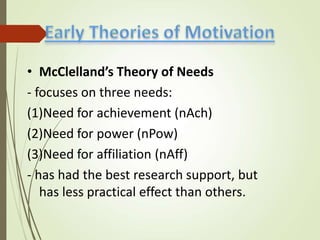
• McClelland’s Theory of Needs
- focuses on three needs:
(1)Need for achievement (nAch)
(2)Need for power (nPow)
(3)Need for affiliation (nAff)
- has had the best research support, but
has less practical effect than others.
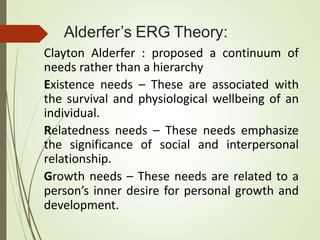
Alderfer’s ERG Theory:
 Clayton Alderfer : proposed a continuum of
needs rather than a hierarchy
 Existence needs – These are associated with
the survival and physiological wellbeing of an
individual.
 Relatedness needs – These needs emphasize
the significance of social and interpersonal
relationship.
 Growth needs – These needs are related to a
person’s inner desire for personal growth and
development.
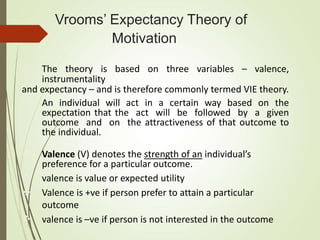
Vrooms’ Expectancy Theory of
Motivation
 The theory is based on three variables – valence,
instrumentality
and expectancy – and is therefore commonly termed VIE theory.
 An individual will act in a certain way based on the
expectation that the act will be followed by a given
outcome and on the attractiveness of that outcome to
the individual.
 Valence (V) denotes the strength of an individual’s
preference for a particular outcome.
 valence is value or expected utility
 Valence is +ve if person prefer to attain a particular
outcome
 valence is –ve if person is not interested in the outcome
• Reinforcement Theory
- reinforcement conditions behavior.
- people learn to behave to get something they
want or to avoid something they don’t want.
- behaviorism: people learn to associate
stimulus and response, but their conscious
awareness of this association is irrelevant.
- social-learning theory: behavior is a
function of consequences.
(1) attentional processes
(2) retention processes
(3) motor reproduction processes
(4) reinforcement processes
Equity Theory/Organizational Justice
- individuals compare their job inputs and
outputs with those of others and then
respond to eliminate any inequities.
- four referent comparisons: self-inside/
outside, other inside/outside.
JOB PERFORMANCE
Job performance is a commonly used, yet poorly defined
concept in industrial and organizational psychology, the
branch of psychology that deals with the workplace. It's also
part of Human Resources Management. It most commonly
refers to whether a person performs their job well. Despite
the confusion over how it should be exactly
defined, performance is an extremely important criterion
that relates to organizational outcomes and success. Among
the most commonly accepted theories of job performance
comes from the work of John P. Campbell and colleagues.
Coming from a psychological perspective, Campbell
describes job performance as an individual level variable.
That is, performance is something a single person does. This
differentiates it from more encompassing constructs such as
organizational performance or national performance which
are higher level variables.
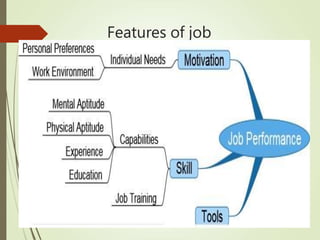
Features of job
performance
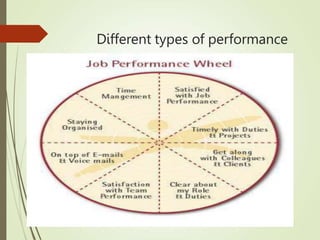
Different types of performance
LeadershipStyles
• Autocratic
(Authoritarian)
• Bureaucratic
• Democratic
• Coercive
• Transactional
• Transformational
• Laissez-Faire
19
20
Autocratic(Authoritarian)
• Manager keep hold of power (classical approach)
• Manager is decision-making authority
• Manager does not consult employees for input
• Subordinates expected to obey orders
without explanations
• Motivation provided through structured
rewards and punishments
When touse Autocratic
21
• New, untrained employees
• Employees do not respond to any
other leadership style
• High-volume production needs
• Limited time for decision making
• Manager’s power is challenged by
an employee
22
When toNottouseAutocratic
• Employees expect to have their opinions
heard
• Employees begin depending on their
manager to make all their decisions
• There is low employee morale, high
turnover and absenteeism and work
stoppage
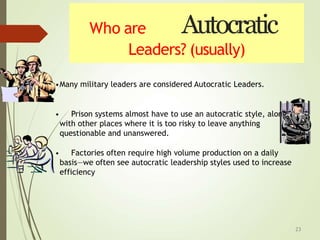
Who are Autocratic
Leaders? (usually)
•Many military leaders are considered Autocratic Leaders.
• Prison systems almost have to use an autocratic style, along
with other places where it is too risky to leave anything
questionable and unanswered.
• Factories often require high volume production on a daily
basis—we often see autocratic leadership styles used to increase
efficiency
23
24
Bureaucratic
• Manager manages “by the
book¨
• Everything must be done according to
procedure or policy
– When considering leadership traits,
Integrity is often listed as one of the most
valuable traits a leader could possess.
If it isn’t covered by the book, the
manager refers to the next level
above him or her
•
• Police officer more than leader
Whentouse
Bureaucratic
25
• Performing routine tasks
• Need for standards/procedures
• Use of dangerous or delicate equipment
• Safety or security training being conducted
• Tasks that require handling cash
26
When nottouse
Bureaucratic
• This style is ineffective when:
• Employees lose their interest in their
jobs and in their fellow workers.
• Employees do only what is expected of
them and no more.
Who are
Bureaucratic
Leaders?
Law enforcement absolutely
needs bureaucratic leaders
27
Anytime there is an exchange of money,
or someone is required to manage
money, we hope to have bureaucratic
leaders, or people with bureaucratic
skills in those positions
28
Democratic
• Often referred to as participative style
• Keeps employees informed
• Shares decision making and problem
solving responsibilities
• “Coach” who has the final say, but…
• Gathers information from staff
members before making decisions
– Because a democratic leader welcomes team input
and facilitates group discussion, it is often referred
to as a participative leadership style
29
DemocraticContinued
• Help employees evaluate their
own performance
•
•
Allows employees to establish goals
Encourages employees to grow on the job
and be promoted
•
•
Recognizes and encourages achievement
Can produce high quality and high quantity
work for long periods of time
When to use
Democratic
30
•
•
To keep employees informed
To encourage employees to share in
decision- making and problem-solving
• To provide opportunities for employees to
develop a high sense of personal growth
and job satisfaction
Complex problems that require a lots of
input To encourage team building and
participation.
•
•
31
When nottouseDemocratic
Democratic leadership should not be used
when:
• There is not enough time to get everyone’s
input.
• It’s easier and more cost-effective for the
manager to make the decision.
• The business can’t afford mistakes.
• The manager feels threatened by this type
of leadership.
• Employee safety is a critical concern.
32
Coercive
•
•
•
Power from a person’s authority to punish
Most obvious types of power a leader has.
Good leaders use coercive power only as
a last resort:
– In today’s sophisticated and complex
workplace, excessive use of coercive power
unleashes unpredictable and destabilizing forces
which can ultimately undermine the leader using
it.
When touseCoercive
33
• To meet very short term goals
• When left with no other choice
• In times of crisis or threats to the
survival of the organization at large,
coercion may come to the forefront
• In those types of situations, employees
must be fired, those who fail to
conform to the organizational goals
for survival will be most likely
candidates for termination
34
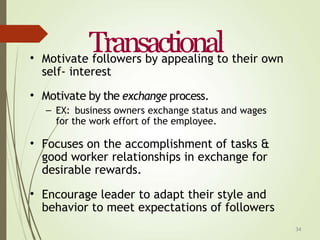
Transactional
• Motivate followers by appealing to their own
self- interest
• Motivate by the exchange process.
– EX: business owners exchange status and wages
for the work effort of the employee.
• Focuses on the accomplishment of tasks &
good worker relationships in exchange for
desirable rewards.
• Encourage leader to adapt their style and
behavior to meet expectations of followers
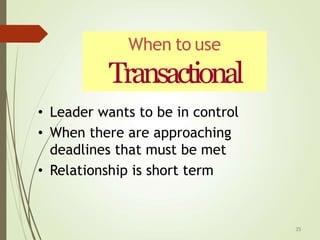
• Leader wants to be in control
• When there are approaching
deadlines that must be met
• Relationship is short term
When to use
Transactional
35
36
Transformational
•
•
Charismatic and visionary
Inspire followers to transcend their self-
interest for the organization
Appeal to followers' ideals and values
Inspire followers to think about problems
in new or different ways
Common strategies used to influence
followers include vision and framing
•
•
•
37
Transformationalcont.
•  Instils feelings of confidence, admiration and commitment
 Stimulates followers intellectually, arousing them to develop
new ways to think about problems.
 Uses contingent rewards to positively reinforce desirable
performances
 Flexible and innovative.
•
•
•
•
part of the organization and have
ownership to it
•
•
•
When leaders are building a sense of purpose
When the organization has a long term plan
When people need to be motivated
38
Transformation
When leaders want me
a
mb
lers to be an active
39
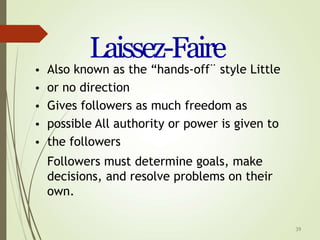
Laissez-Faire
•
•
•
•
•
Also known as the “hands-off¨ style Little
or no direction
Gives followers as much freedom as
possible All authority or power is given to
the followers
Followers must determine goals, make
decisions, and resolve problems on their
own.
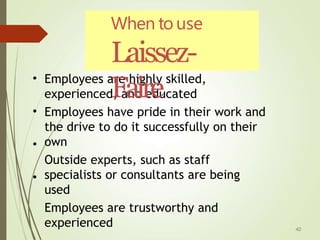
• Employees are highly skilled,
experienced, and educated
Employees have pride in their work and
the drive to do it successfully on their
own
Outside experts, such as staff
specialists or consultants are being
used
Employees are trustworthy and
experienced
•
•
•
When to use
Laissez-
Faire
40
41
When not to use Laissez-
e
This style should not be u
F
sed w
a
he
i
nr
:
•
•
•
It makes employees feel insecure at the unavailability of a
manager.
The manager cannot provide regular feedback to let
employees know how well they are doing.
Managers are unable to thank employees for their good
work.
The manager doesn’t understand his or her responsibilities
and is hoping the employees can cover for him or her.
•
•
• Some risks are involved with Laissez-Faire Leadership.
Followers may like them, but some people find events
around them confusing and chaotic. They also may feel that
the leader does not respect their time and energy. Most
importantly, they may not see where their contribution fits
and slowly become less committed and enthusiastic.
Definition of
Group
Stephen P. Robins: “two or more individuals, interacting
and interdependent, who have come together to
achieve particular objectives.”
G. C. Homans: “any number of people who share goals,
often communicate with each other over a period of
time, and are few enough so that each individual may
communicate with all the others, person-to-person.”
In the modern days of IT, pple need not physically come
together, but they communicate and interact with each
other. i.e., virtually coming together.
They strive for a common goal, which
becomes a bondage.
The members of the groups share their skills
and other resources and achieve their goals
through the integrated effort.
Thus, we can say that the group is a
‘combination of two or more pple with a
purpose of achieving their common and
shared goals through their integrated effort.’
Features/Characteristics of a
Group
1. Combination of two or more individuals.
2. Individuals are motivated to come closer physically, and/
or virtually for interaction.
3. They come closer to achieve their common and shared
goals.
4. Grp members achieve their common goals through
integrated efforts.
5. Perceive the group as a unified unit and stable structure.
6. Members contribute different inputs (skills, kn, effort, etc)
towards achievement of grp goals.
7. Reach agreement and disagreement through various
forms of interaction.
Need/Reasons for Formation of
Group
Formation of grps is necessary as humans are basically social beings.
Most pple prefer to live and work in grps.
Some reasons cld be:
1.Security
2.Empowerment through sharing of resources: exchange of skills, kn,
talents, values, etc.
3.Becoming a leader: pple with leadership skills can become leaders
to form the grps, lead the grps.
4.Synergy: outcome of the grp effort is greater than the sum of the
individual contributions of the group.
5.Goal attainment
6.Status
7.Affiliation Needs
8.Self-esteem
Types of
groups
 Different pple join grps with various purposes or due to the forces
of different factors.
– Hence different types of grps are formed
1. Formal Group: when two or more individuals join together as a grp
due to the official job structure and relationship in a org. ex: grp of
production managers, mtrls mngr, qlty control mngr,etc.
2. Informal Group: when two or more individuals join together as a
grp in order to satisfy their social needs but not due to official job
structure and org.l requirements. These are formed out of the
common interests, aptitudes, values, opinions, ideas and
characteristics of the pple. Ex: qlty circles.
3. Command Group: a grp of the superior and his/her subordinates.
i.e., it is a grp of individual employees and their manager to whom
they report. Ex: finance mngr and asst. finance mngrs.
4. Task Group: pple working together in order to accomplish a
particular task.
5. Interested Group:
6. Friendship Groups: pple with common characteristics like hard
working, work avoiding, smart working, status seeking, family
orientation, risk taking, etc.
7. Primary Groups: individuals with a feeling of comradeship, loyalty
and a commonsense of values form into a group. Ex: grp of family
members such as father, mother, brother and sister.
8. Coalitions: individuals from different grps form into an ad hoc
group in order to achieve a specific task or goals. Here the
individuals have dual membership, i.e., one in the original grp and
another in the coalition.
- the coalition gets dissolved once the goal is attained.
Stages of Group
Formation
1.Forming:
-characterised by uncertainty and confusion.
-members observe others, various events and issues and
decide what type
of behaviour is acceptable.
-thus members ‘test the waters’ during this stage and
decide within themselves as part of a group.
1.Storming:
-characterised by conflict and confrontation among the
group members.
-members accept the group, but there would be
conflict over the leadership.
-members know the hierarchy and chain of command
when the leader within the group is determined.
- this stage is complete when the members are clear about the
3.Norming:
-members settle, start cooperating and collaborating with each
other, develop close relationship among themselves, exhibit
cohesiveness and prefer to identify themselves with the
group.
- members formulate common goals and expectations of the
group.
4.Performing:
-group members exert all their energies towards functioning
and performing the tasks in order to attain the group goals.
5.Adjourning:
- attention is directed toward wrapping up activities.
- the group prepares for its disbandment.
but, this may cause worry to some due to loss of friendship
and effective leaders.
Groups @ the Work
Place
• Work place is more prominent for the
formation and development of groups.
• Groups are formed both officially (formal
groups) and
• unofficially (informal groups)at the work
place.
Formal
Groups
A formal grp is one that is deliberately created to
perform a specific task.
-mgmt formulates the grps.
- These are relatively permanent grps.
- However, they get changed whenever there are
changes in org structure, job structure, job design, etc.
- A hierarchy of authority exists with specified
members, rules and regulations.
- Rules, regulations, incentives and sanctions guide the
behaviour of grp.
Two types of formal
groups
1. Command/ Standing Task group:
 a permanently specified in the org.l structure and consists of a
 supervisor who exercises formal authority over subordinates.
2. Task Group:
 a temporary formal group, is created to solve specific pblms.
 - the grp comprises emp.es who work together to complete a
particular task or project, but who do not necessarily report to
the same supervisor.
 the emp.es belong to different depts.
 they stay together till the task is complete and once the work
Informal
Group
 grps are formed out of social interaction, social
needs, attitudes, likes and
dislikes, values, opinions, personality traits and
other psychological factors.
It is outside the officially prescribed
relationships, line of authority and
responsibilities of the org.
These grps are formed within the structure of the
org, but by the members themselves.
They are important in the org.s from the point of
view of their members and they have a great
utility to the org.
Theories of Group Formation
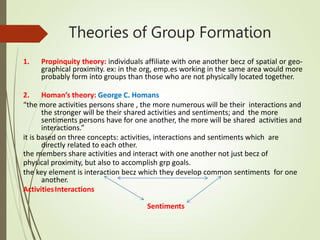
1. Propinquity theory: individuals affiliate with one another becz of spatial or geo-
graphical proximity. ex: in the org, emp.es working in the same area would more
probably form into groups than those who are not physically located together.
2. Homan’s theory: George C. Homans
“the more activities persons share , the more numerous will be their interactions and
the stronger will be their shared activities and sentiments; and the more
sentiments persons have for one another, the more will be shared activities and
interactions.”
it is based on three concepts: activities, interactions and sentiments which are
directly related to each other.
the members share activities and interact with one another not just becz of
physical proximity, but also to accomplish grp goals.
the key element is interaction becz which they develop common sentiments for one
another.
ActivitiesInteractions
Sentiments

3. Balance Theory: Theodore Newcomb
“persons are attracted to one another on the basis of similar
attitudes towards commonly relevant objects and goals. Once
a relationship is formed, it strive to maintain a systematical
balance b/w the attraction and the common attitudes. If an
imbalance occurs, attempts are made to restore the balance.
If the balance cannot be restored, the relationship dissolves.”
both propinquity and interaction play a role in the balance
theory.
 there must be a balance in the relationship b/w the
grp members for the grp to be formed and for its survival.
4. Exchange Theory:
based on reward-cost outcomes of interaction b/w pple.



 to be attracted towards a grp, a person thinks in terms
of what he will get in exchange of interaction with the grp
members.
a minimum +ve level (reward > cost) of an outcome must
exist in order for attraction or affiliation to take place.
rewards gratify needs and costs incur anxiety, frustrations,
embarrassment, etc.
propinquity, interaction and balance theory all have roles in
the exchange theory.
UNIT 4 OVERAL PPT.ppt

UNIT 4 OVERAL PPT.ppt

  • 1.
  • 2.
    MOTIVATION The processes thataccount for an individual’s intensity, direction, and persistence of effort toward attaining a goal. It is condition that is initiated by a physiological or psychological deficiency or need in an individual, which causes the individual to behave in a certain manner in order to achieve a particular goal or incentive.
  • 3.
    Elements of Motivation Physiological/ Psychological deficiency (NEED) Achievesa particular goal (INCENTIVE) Individual behaves in a certain manner (DRIVE) these elements are interactive and interdependent
  • 4.
    Need : physiologicalor psychological deficiency or imbalance in an individual will result in a need. For e.g. hunger thirst But psychological need may sometimes arise without any deficiency or imbalance. e.g. strong need for progress. Drive: physiological drive is a condition which causes a person to work in a particular direction. Incentive : anything that mitigate the drive and decrease the intensity of the drive
  • 5.
    Early Theories ofMotivation Hierarchy of Needs Theory within every human being, there exists a hierarchy of five needs. (1) physiological (2) safety (3) social (4) esteem (5) self-actualization
  • 6.
    Maslow’s Hierarchy of Needs Abraham Maslow Self actualization needs Esteem needs (Important projects, Recognition, prestigious office location) Social needs (Good coworkers, peers, superiors, customer Safety oSecurity Needs (Job security; benefits like life insurance; safety regulations) Physiological needs (Basic pay, Workspace, heat, water company cafeteria) Chapter-7 (Challenging projects, Opportunities for innovation and creativity, training)
  • 7.
    Two-Factor Theory  Herzberg’sclassification of needs as hygiene factors and motivators.  He conducted a study to find out the job satisfaction and dissatisfaction factors  Job satisfiers were associated with job content and job dissatisfiers were related to job context ( circumstances/ situation)  satisfiers were called motivators and dissatisfiers were called hygiene factors
  • 8.
    Hygiene Factors (Needs):they are preventive in nature they are responsible for preventing dissatisfaction. They are similar to lower level needs in Maslow’s hierarchy  Presence of able supervisors  administrative policies of the org.  Fair pay  Good interpersonal relations  Conducive working conditions Once hygiene factors have been addressed, organization can make use of motivators to make people feel motivated and satisfied
  • 10.
    • McClelland’s Theoryof Needs - focuses on three needs: (1)Need for achievement (nAch) (2)Need for power (nPow) (3)Need for affiliation (nAff) - has had the best research support, but has less practical effect than others.
  • 11.
    Alderfer’s ERG Theory: Clayton Alderfer : proposed a continuum of needs rather than a hierarchy  Existence needs – These are associated with the survival and physiological wellbeing of an individual.  Relatedness needs – These needs emphasize the significance of social and interpersonal relationship.  Growth needs – These needs are related to a person’s inner desire for personal growth and development.
  • 12.
    Vrooms’ Expectancy Theoryof Motivation  The theory is based on three variables – valence, instrumentality and expectancy – and is therefore commonly termed VIE theory.  An individual will act in a certain way based on the expectation that the act will be followed by a given outcome and on the attractiveness of that outcome to the individual.  Valence (V) denotes the strength of an individual’s preference for a particular outcome.  valence is value or expected utility  Valence is +ve if person prefer to attain a particular outcome  valence is –ve if person is not interested in the outcome
  • 13.
    • Reinforcement Theory -reinforcement conditions behavior. - people learn to behave to get something they want or to avoid something they don’t want. - behaviorism: people learn to associate stimulus and response, but their conscious awareness of this association is irrelevant.
  • 14.
    - social-learning theory:behavior is a function of consequences. (1) attentional processes (2) retention processes (3) motor reproduction processes (4) reinforcement processes
  • 15.
    Equity Theory/Organizational Justice -individuals compare their job inputs and outputs with those of others and then respond to eliminate any inequities. - four referent comparisons: self-inside/ outside, other inside/outside.
  • 16.
    JOB PERFORMANCE Job performanceis a commonly used, yet poorly defined concept in industrial and organizational psychology, the branch of psychology that deals with the workplace. It's also part of Human Resources Management. It most commonly refers to whether a person performs their job well. Despite the confusion over how it should be exactly defined, performance is an extremely important criterion that relates to organizational outcomes and success. Among the most commonly accepted theories of job performance comes from the work of John P. Campbell and colleagues. Coming from a psychological perspective, Campbell describes job performance as an individual level variable. That is, performance is something a single person does. This differentiates it from more encompassing constructs such as organizational performance or national performance which are higher level variables.
  • 17.
  • 18.
    Different types ofperformance
  • 19.
    LeadershipStyles • Autocratic (Authoritarian) • Bureaucratic •Democratic • Coercive • Transactional • Transformational • Laissez-Faire 19
  • 20.
    20 Autocratic(Authoritarian) • Manager keephold of power (classical approach) • Manager is decision-making authority • Manager does not consult employees for input • Subordinates expected to obey orders without explanations • Motivation provided through structured rewards and punishments
  • 21.
    When touse Autocratic 21 •New, untrained employees • Employees do not respond to any other leadership style • High-volume production needs • Limited time for decision making • Manager’s power is challenged by an employee
  • 22.
    22 When toNottouseAutocratic • Employeesexpect to have their opinions heard • Employees begin depending on their manager to make all their decisions • There is low employee morale, high turnover and absenteeism and work stoppage
  • 23.
    Who are Autocratic Leaders?(usually) •Many military leaders are considered Autocratic Leaders. • Prison systems almost have to use an autocratic style, along with other places where it is too risky to leave anything questionable and unanswered. • Factories often require high volume production on a daily basis—we often see autocratic leadership styles used to increase efficiency 23
  • 24.
    24 Bureaucratic • Manager manages“by the book¨ • Everything must be done according to procedure or policy – When considering leadership traits, Integrity is often listed as one of the most valuable traits a leader could possess. If it isn’t covered by the book, the manager refers to the next level above him or her • • Police officer more than leader
  • 25.
    Whentouse Bureaucratic 25 • Performing routinetasks • Need for standards/procedures • Use of dangerous or delicate equipment • Safety or security training being conducted • Tasks that require handling cash
  • 26.
    26 When nottouse Bureaucratic • Thisstyle is ineffective when: • Employees lose their interest in their jobs and in their fellow workers. • Employees do only what is expected of them and no more.
  • 27.
    Who are Bureaucratic Leaders? Law enforcementabsolutely needs bureaucratic leaders 27 Anytime there is an exchange of money, or someone is required to manage money, we hope to have bureaucratic leaders, or people with bureaucratic skills in those positions
  • 28.
    28 Democratic • Often referredto as participative style • Keeps employees informed • Shares decision making and problem solving responsibilities • “Coach” who has the final say, but… • Gathers information from staff members before making decisions – Because a democratic leader welcomes team input and facilitates group discussion, it is often referred to as a participative leadership style
  • 29.
    29 DemocraticContinued • Help employeesevaluate their own performance • • Allows employees to establish goals Encourages employees to grow on the job and be promoted • • Recognizes and encourages achievement Can produce high quality and high quantity work for long periods of time
  • 30.
    When to use Democratic 30 • • Tokeep employees informed To encourage employees to share in decision- making and problem-solving • To provide opportunities for employees to develop a high sense of personal growth and job satisfaction Complex problems that require a lots of input To encourage team building and participation. • •
  • 31.
    31 When nottouseDemocratic Democratic leadershipshould not be used when: • There is not enough time to get everyone’s input. • It’s easier and more cost-effective for the manager to make the decision. • The business can’t afford mistakes. • The manager feels threatened by this type of leadership. • Employee safety is a critical concern.
  • 32.
    32 Coercive • • • Power from aperson’s authority to punish Most obvious types of power a leader has. Good leaders use coercive power only as a last resort: – In today’s sophisticated and complex workplace, excessive use of coercive power unleashes unpredictable and destabilizing forces which can ultimately undermine the leader using it.
  • 33.
    When touseCoercive 33 • Tomeet very short term goals • When left with no other choice • In times of crisis or threats to the survival of the organization at large, coercion may come to the forefront • In those types of situations, employees must be fired, those who fail to conform to the organizational goals for survival will be most likely candidates for termination
  • 34.
    34 Transactional • Motivate followersby appealing to their own self- interest • Motivate by the exchange process. – EX: business owners exchange status and wages for the work effort of the employee. • Focuses on the accomplishment of tasks & good worker relationships in exchange for desirable rewards. • Encourage leader to adapt their style and behavior to meet expectations of followers
  • 35.
    • Leader wantsto be in control • When there are approaching deadlines that must be met • Relationship is short term When to use Transactional 35
  • 36.
    36 Transformational • • Charismatic and visionary Inspirefollowers to transcend their self- interest for the organization Appeal to followers' ideals and values Inspire followers to think about problems in new or different ways Common strategies used to influence followers include vision and framing • • •
  • 37.
    37 Transformationalcont. •  Instilsfeelings of confidence, admiration and commitment  Stimulates followers intellectually, arousing them to develop new ways to think about problems.  Uses contingent rewards to positively reinforce desirable performances  Flexible and innovative. • • •
  • 38.
    • part of theorganization and have ownership to it • • • When leaders are building a sense of purpose When the organization has a long term plan When people need to be motivated 38 Transformation When leaders want me a mb lers to be an active
  • 39.
    39 Laissez-Faire • • • • • Also known asthe “hands-off¨ style Little or no direction Gives followers as much freedom as possible All authority or power is given to the followers Followers must determine goals, make decisions, and resolve problems on their own.
  • 40.
    • Employees arehighly skilled, experienced, and educated Employees have pride in their work and the drive to do it successfully on their own Outside experts, such as staff specialists or consultants are being used Employees are trustworthy and experienced • • • When to use Laissez- Faire 40
  • 41.
    41 When not touse Laissez- e This style should not be u F sed w a he i nr : • • • It makes employees feel insecure at the unavailability of a manager. The manager cannot provide regular feedback to let employees know how well they are doing. Managers are unable to thank employees for their good work. The manager doesn’t understand his or her responsibilities and is hoping the employees can cover for him or her. • • • Some risks are involved with Laissez-Faire Leadership. Followers may like them, but some people find events around them confusing and chaotic. They also may feel that the leader does not respect their time and energy. Most importantly, they may not see where their contribution fits and slowly become less committed and enthusiastic.
  • 42.
    Definition of Group Stephen P.Robins: “two or more individuals, interacting and interdependent, who have come together to achieve particular objectives.” G. C. Homans: “any number of people who share goals, often communicate with each other over a period of time, and are few enough so that each individual may communicate with all the others, person-to-person.” In the modern days of IT, pple need not physically come together, but they communicate and interact with each other. i.e., virtually coming together.
  • 43.
    They strive fora common goal, which becomes a bondage. The members of the groups share their skills and other resources and achieve their goals through the integrated effort. Thus, we can say that the group is a ‘combination of two or more pple with a purpose of achieving their common and shared goals through their integrated effort.’
  • 44.
    Features/Characteristics of a Group 1.Combination of two or more individuals. 2. Individuals are motivated to come closer physically, and/ or virtually for interaction. 3. They come closer to achieve their common and shared goals. 4. Grp members achieve their common goals through integrated efforts. 5. Perceive the group as a unified unit and stable structure. 6. Members contribute different inputs (skills, kn, effort, etc) towards achievement of grp goals. 7. Reach agreement and disagreement through various forms of interaction.
  • 45.
    Need/Reasons for Formationof Group Formation of grps is necessary as humans are basically social beings. Most pple prefer to live and work in grps. Some reasons cld be: 1.Security 2.Empowerment through sharing of resources: exchange of skills, kn, talents, values, etc. 3.Becoming a leader: pple with leadership skills can become leaders to form the grps, lead the grps. 4.Synergy: outcome of the grp effort is greater than the sum of the individual contributions of the group. 5.Goal attainment 6.Status 7.Affiliation Needs 8.Self-esteem
  • 46.
    Types of groups  Differentpple join grps with various purposes or due to the forces of different factors. – Hence different types of grps are formed 1. Formal Group: when two or more individuals join together as a grp due to the official job structure and relationship in a org. ex: grp of production managers, mtrls mngr, qlty control mngr,etc. 2. Informal Group: when two or more individuals join together as a grp in order to satisfy their social needs but not due to official job structure and org.l requirements. These are formed out of the common interests, aptitudes, values, opinions, ideas and characteristics of the pple. Ex: qlty circles. 3. Command Group: a grp of the superior and his/her subordinates. i.e., it is a grp of individual employees and their manager to whom they report. Ex: finance mngr and asst. finance mngrs.
  • 47.
    4. Task Group:pple working together in order to accomplish a particular task. 5. Interested Group: 6. Friendship Groups: pple with common characteristics like hard working, work avoiding, smart working, status seeking, family orientation, risk taking, etc. 7. Primary Groups: individuals with a feeling of comradeship, loyalty and a commonsense of values form into a group. Ex: grp of family members such as father, mother, brother and sister. 8. Coalitions: individuals from different grps form into an ad hoc group in order to achieve a specific task or goals. Here the individuals have dual membership, i.e., one in the original grp and another in the coalition. - the coalition gets dissolved once the goal is attained.
  • 48.
    Stages of Group Formation 1.Forming: -characterisedby uncertainty and confusion. -members observe others, various events and issues and decide what type of behaviour is acceptable. -thus members ‘test the waters’ during this stage and decide within themselves as part of a group. 1.Storming: -characterised by conflict and confrontation among the group members. -members accept the group, but there would be conflict over the leadership. -members know the hierarchy and chain of command when the leader within the group is determined. - this stage is complete when the members are clear about the
  • 49.
    3.Norming: -members settle, startcooperating and collaborating with each other, develop close relationship among themselves, exhibit cohesiveness and prefer to identify themselves with the group. - members formulate common goals and expectations of the group. 4.Performing: -group members exert all their energies towards functioning and performing the tasks in order to attain the group goals. 5.Adjourning: - attention is directed toward wrapping up activities. - the group prepares for its disbandment. but, this may cause worry to some due to loss of friendship and effective leaders.
  • 50.
    Groups @ theWork Place • Work place is more prominent for the formation and development of groups. • Groups are formed both officially (formal groups) and • unofficially (informal groups)at the work place.
  • 51.
    Formal Groups A formal grpis one that is deliberately created to perform a specific task. -mgmt formulates the grps. - These are relatively permanent grps. - However, they get changed whenever there are changes in org structure, job structure, job design, etc. - A hierarchy of authority exists with specified members, rules and regulations. - Rules, regulations, incentives and sanctions guide the behaviour of grp.
  • 52.
    Two types offormal groups 1. Command/ Standing Task group:  a permanently specified in the org.l structure and consists of a  supervisor who exercises formal authority over subordinates. 2. Task Group:  a temporary formal group, is created to solve specific pblms.  - the grp comprises emp.es who work together to complete a particular task or project, but who do not necessarily report to the same supervisor.  the emp.es belong to different depts.  they stay together till the task is complete and once the work
  • 53.
    Informal Group  grps areformed out of social interaction, social needs, attitudes, likes and dislikes, values, opinions, personality traits and other psychological factors. It is outside the officially prescribed relationships, line of authority and responsibilities of the org. These grps are formed within the structure of the org, but by the members themselves. They are important in the org.s from the point of view of their members and they have a great utility to the org.
  • 54.
    Theories of GroupFormation 1. Propinquity theory: individuals affiliate with one another becz of spatial or geo- graphical proximity. ex: in the org, emp.es working in the same area would more probably form into groups than those who are not physically located together. 2. Homan’s theory: George C. Homans “the more activities persons share , the more numerous will be their interactions and the stronger will be their shared activities and sentiments; and the more sentiments persons have for one another, the more will be shared activities and interactions.” it is based on three concepts: activities, interactions and sentiments which are directly related to each other. the members share activities and interact with one another not just becz of physical proximity, but also to accomplish grp goals. the key element is interaction becz which they develop common sentiments for one another. ActivitiesInteractions Sentiments
  • 55.
     3. Balance Theory:Theodore Newcomb “persons are attracted to one another on the basis of similar attitudes towards commonly relevant objects and goals. Once a relationship is formed, it strive to maintain a systematical balance b/w the attraction and the common attitudes. If an imbalance occurs, attempts are made to restore the balance. If the balance cannot be restored, the relationship dissolves.” both propinquity and interaction play a role in the balance theory.  there must be a balance in the relationship b/w the grp members for the grp to be formed and for its survival.
  • 56.
    4. Exchange Theory: basedon reward-cost outcomes of interaction b/w pple.     to be attracted towards a grp, a person thinks in terms of what he will get in exchange of interaction with the grp members. a minimum +ve level (reward > cost) of an outcome must exist in order for attraction or affiliation to take place. rewards gratify needs and costs incur anxiety, frustrations, embarrassment, etc. propinquity, interaction and balance theory all have roles in the exchange theory.