NAME - Prachi Sharma
STUDENT ID - 8a45bd14
COURSE - Academic Writing
Email Id - sprachi728@gmail.com
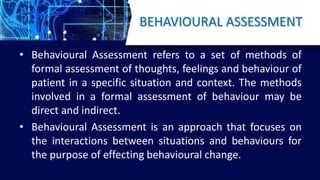
BEHAVIOURAL ASSESSMENT
• Behavioural Assessment refers to a set of methods of
formal assessment of thoughts, feelings and behaviour of
patient in a specific situation and context. The methods
involved in a formal assessment of behaviour may be
direct and indirect.
• Behavioural Assessment is an approach that focuses on
the interactions between situations and behaviours for
the purpose of effecting behavioural change.
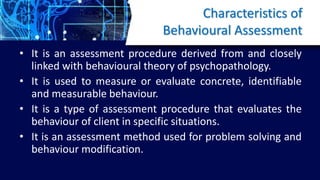
Characteristics of
Behavioural Assessment
• It is an assessment procedure derived from and closely
linked with behavioural theory of psychopathology.
• It is used to measure or evaluate concrete, identifiable
and measurable behaviour.
• It is a type of assessment procedure that evaluates the
behaviour of client in specific situations.
• It is an assessment method used for problem solving and
behaviour modification.
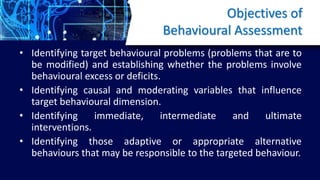
Objectives of
Behavioural Assessment
• Identifying target behavioural problems (problems that are to
be modified) and establishing whether the problems involve
behavioural excess or deficits.
• Identifying causal and moderating variables that influence
target behavioural dimension.
• Identifying immediate, intermediate and ultimate
interventions.
• Identifying those adaptive or appropriate alternative
behaviours that may be responsible to the targeted behaviour.
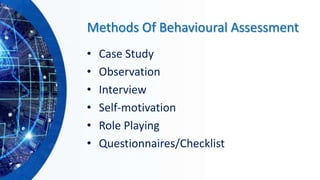
Methods Of Behavioural Assessment
• Case Study
• Observation
• Interview
• Self-motivation
• Role Playing
• Questionnaires/Checklist
1-Interview
In this method of behavioural assessment, the client is asked
questions by the interviewer and then he observes the
behaviour of the client on the questions asked in the
interview.
Types of Interview
Interviews are of two types –
a) Structured Interview- In this type of interview, the questions
are pre- determined and only those questions are asked to
the client.
b) In this type of interview, the questions are asked according to
the situation and condition of the client.
2- Observation
In this method of behavioural assessment, the
behaviour of the client is observed by the observer
without the knowledge of the client being observed.
Ways Of Observation
There are two ways of observation-
a) Naturalistic Observation- In this type of observation,
the behaviour of client is observed in his natural
environment like- school, home, office etc.
b) Controlled Observation- In this type of observation,
the behaviour of client is observed in lab or hospital
with some controlled factors.
3-Case Study
In this method of behavioural assessment, the
behaviour of the client is assessed on the basis of the
information collected about the client. In this
method a complete information about client's past
and future is collected.
4-Self-monitoring
In this method, the client self- monitors his
behaviour and then records it in a dairy to later
present it to the psychologist.
5-Role-playing
In this method, the client is generally placed in a
situation and is required to response to that social
stimuli. The situation can be just described or the
assistant can actually perform the part.
6-Questionnaires/Checklist
In this method, questionnaires/ checklist are given to
the client and he fills it up according to his thinking of
that situation. It can tell that how our client will react
in those situations.
Advantages of
Behavioural Assessment
• Behavioural assessment provides objective data for deciding
specific instructional content and strategies for intervention.
• Behavioural assessment leads directly to the formulation of
intervention strategies.
• Behavioural assessment can be undertaken in the setting in which
the concerned behaviour occurs or in simulated conditions
resembling the natural setting.
• Behavioural assessment is tailored to the unique characteristics of
the referred person and the targeted environment.
...Continued
• The continuity of behavioural assessment facilitates
determining the progress and evaluation of outcomes.
• Behavioural assessment has such variety of techniques
that these help in multifaceted assessment.
• Most behavioural assessment techniques can be
implemented by anyone with sufficient training and do
not require advanced degrees.
Limitations of
behavioural assessment
• Much of behavioural assessment methodology is not
standardised.
• Differing levels of specification of the concerned behaviours
may result in inconsistent data.
• Narrow definitions of behaviour may result in less consistency
in behavioural observation.
• Behavioural assessment methodology may appear rather easy
to apply. However if the psychologist or behaviourist is not
trained in the techniques, the assessment will be defective
and consequently the intervention will be ineffective.
Acknowledgment
I am very great full to all the lecturers who worked so hard in
making videos and PDF documents for us so that we can study
without any problem. This course is very helpful in near future
and I'm glad that I got an opportunity to attend this online
course through the platform of SWAYAM.
Thank you for all Guidance and support throughout the
course.
Course : Academic Writing
Application I’D : 8a45bd14
Swayam p pt

Swayam p pt

  • 1.
    NAME - PrachiSharma STUDENT ID - 8a45bd14 COURSE - Academic Writing Email Id - sprachi728@gmail.com
  • 2.
    BEHAVIOURAL ASSESSMENT • BehaviouralAssessment refers to a set of methods of formal assessment of thoughts, feelings and behaviour of patient in a specific situation and context. The methods involved in a formal assessment of behaviour may be direct and indirect. • Behavioural Assessment is an approach that focuses on the interactions between situations and behaviours for the purpose of effecting behavioural change.
  • 3.
    Characteristics of Behavioural Assessment •It is an assessment procedure derived from and closely linked with behavioural theory of psychopathology. • It is used to measure or evaluate concrete, identifiable and measurable behaviour. • It is a type of assessment procedure that evaluates the behaviour of client in specific situations. • It is an assessment method used for problem solving and behaviour modification.
  • 4.
    Objectives of Behavioural Assessment •Identifying target behavioural problems (problems that are to be modified) and establishing whether the problems involve behavioural excess or deficits. • Identifying causal and moderating variables that influence target behavioural dimension. • Identifying immediate, intermediate and ultimate interventions. • Identifying those adaptive or appropriate alternative behaviours that may be responsible to the targeted behaviour.
  • 5.
    Methods Of BehaviouralAssessment • Case Study • Observation • Interview • Self-motivation • Role Playing • Questionnaires/Checklist
  • 6.
    1-Interview In this methodof behavioural assessment, the client is asked questions by the interviewer and then he observes the behaviour of the client on the questions asked in the interview.
  • 7.
    Types of Interview Interviewsare of two types – a) Structured Interview- In this type of interview, the questions are pre- determined and only those questions are asked to the client. b) In this type of interview, the questions are asked according to the situation and condition of the client.
  • 8.
    2- Observation In thismethod of behavioural assessment, the behaviour of the client is observed by the observer without the knowledge of the client being observed.
  • 9.
    Ways Of Observation Thereare two ways of observation- a) Naturalistic Observation- In this type of observation, the behaviour of client is observed in his natural environment like- school, home, office etc. b) Controlled Observation- In this type of observation, the behaviour of client is observed in lab or hospital with some controlled factors.
  • 10.
    3-Case Study In thismethod of behavioural assessment, the behaviour of the client is assessed on the basis of the information collected about the client. In this method a complete information about client's past and future is collected.
  • 11.
    4-Self-monitoring In this method,the client self- monitors his behaviour and then records it in a dairy to later present it to the psychologist.
  • 12.
    5-Role-playing In this method,the client is generally placed in a situation and is required to response to that social stimuli. The situation can be just described or the assistant can actually perform the part.
  • 13.
    6-Questionnaires/Checklist In this method,questionnaires/ checklist are given to the client and he fills it up according to his thinking of that situation. It can tell that how our client will react in those situations.
  • 14.
    Advantages of Behavioural Assessment •Behavioural assessment provides objective data for deciding specific instructional content and strategies for intervention. • Behavioural assessment leads directly to the formulation of intervention strategies. • Behavioural assessment can be undertaken in the setting in which the concerned behaviour occurs or in simulated conditions resembling the natural setting. • Behavioural assessment is tailored to the unique characteristics of the referred person and the targeted environment.
  • 15.
    ...Continued • The continuityof behavioural assessment facilitates determining the progress and evaluation of outcomes. • Behavioural assessment has such variety of techniques that these help in multifaceted assessment. • Most behavioural assessment techniques can be implemented by anyone with sufficient training and do not require advanced degrees.
  • 16.
    Limitations of behavioural assessment •Much of behavioural assessment methodology is not standardised. • Differing levels of specification of the concerned behaviours may result in inconsistent data. • Narrow definitions of behaviour may result in less consistency in behavioural observation. • Behavioural assessment methodology may appear rather easy to apply. However if the psychologist or behaviourist is not trained in the techniques, the assessment will be defective and consequently the intervention will be ineffective.
  • 17.
    Acknowledgment I am verygreat full to all the lecturers who worked so hard in making videos and PDF documents for us so that we can study without any problem. This course is very helpful in near future and I'm glad that I got an opportunity to attend this online course through the platform of SWAYAM. Thank you for all Guidance and support throughout the course. Course : Academic Writing Application I’D : 8a45bd14