Behavioral Assessment
Presented By: RABIA JAVED IQBAL
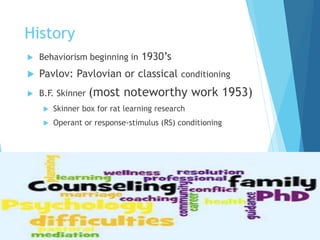
History
 Behaviorism beginning in 1930’s
 Pavlov: Pavlovian or classical conditioning
 B.F. Skinner (most noteworthy work 1953)
 Skinner box for rat learning research
 Operant or response-stimulus (RS) conditioning
Behavioral Assessment
Context in Clinical Psychology
 Grows from Behavior Theory / Learning
Theory
 Aspects of it can be easily combined
with other forms of assessment – very
common to do so
 Differs from traditional assessment
(clinical interview and testing) in 3 ways
Differences from
traditional assessment
1. Interested in samples of behavior, not
behavior as a sign of internal processes
2. Functional Analysis, a very concrete
method, is employed to understand
behavior
3. Assessment is an ongoing, active part of all
phases of treatment (not just always in the
back of clinician’s mind, as in other types
of treatment)
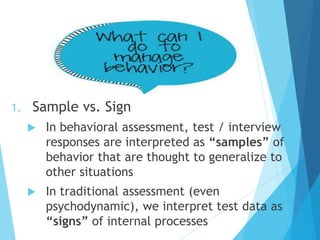
1. Sample vs. Sign
 In behavioral assessment, test / interview
responses are interpreted as “samples” of
behavior that are thought to generalize to
other situations
 In traditional assessment (even
psychodynamic), we interpret test data as
“signs” of internal processes
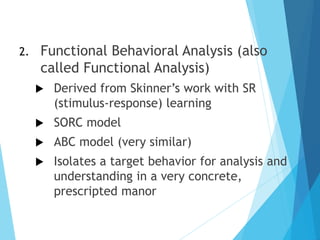
2. Functional Behavioral Analysis (also
called Functional Analysis)
 Derived from Skinner’s work with SR
(stimulus-response) learning
 SORC model
 ABC model (very similar)
 Isolates a target behavior for analysis and
understanding in a very concrete,
prescripted manor
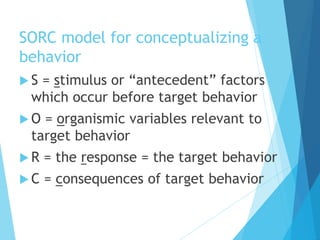
SORC model for conceptualizing a
behavior
 S = stimulus or “antecedent” factors
which occur before target behavior
 O = organismic variables relevant to
target behavior
 R = the response = the target behavior
 C = consequences of target behavior
Elaboration of “O”
Organismic
Physical / medical / physiological,
cognitive / psychological aspects
of the client, that are relevant to
treating the target behavior
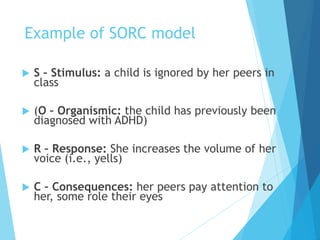
Example of SORC model
 S – Stimulus: a child is ignored by her peers in
class
 (O – Organismic: the child has previously been
diagnosed with ADHD)
 R – Response: She increases the volume of her
voice (i.e., yells)
 C – Consequences: her peers pay attention to
her, some role their eyes
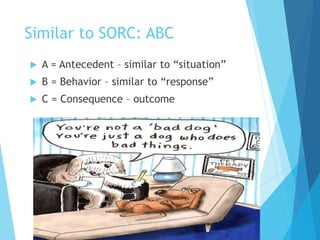
Similar to SORC: ABC
 A = Antecedent – similar to “situation”
 B = Behavior – similar to “response”
 C = Consequence – outcome
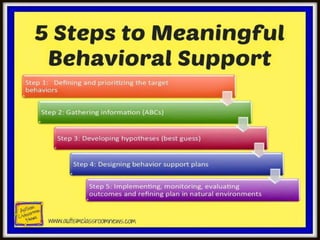
3. Is an ongoing & active process, through all
points of behavioral therapy: initial
assessment, therapy, and evaluation of
improvement
 Assessment is an ongoing process in almost all
clinical orientations, in that it’s almost always
in the “back” of clinician’s mind.
 Ex: Hmm, I thought Mr. Z had depression, but
now he’s exhibiting more anxious symptoms; I
wonder if this is more a mixed anxiety-
depression syndrome.
 In behavioral assessment, is a planned &
integral part of entire therapeutic process
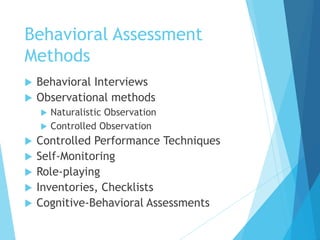
Behavioral Assessment
Methods
 Behavioral Interviews
 Observational methods
 Naturalistic Observation
 Controlled Observation
 Controlled Performance Techniques
 Self-Monitoring
 Role-playing
 Inventories, Checklists
 Cognitive-Behavioral Assessments
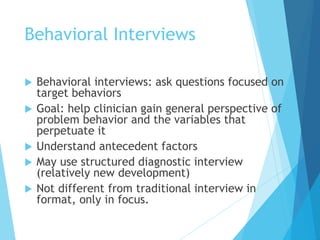
Behavioral Interviews
 Behavioral interviews: ask questions focused on
target behaviors
 Goal: help clinician gain general perspective of
problem behavior and the variables that
perpetuate it
 Understand antecedent factors
 May use structured diagnostic interview
(relatively new development)
 Not different from traditional interview in
format, only in focus.
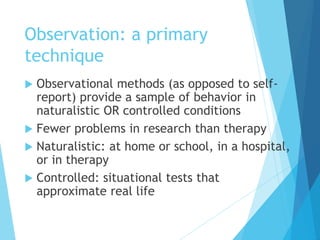
Observation: a primary
technique
 Observational methods (as opposed to self-
report) provide a sample of behavior in
naturalistic OR controlled conditions
 Fewer problems in research than therapy
 Naturalistic: at home or school, in a hospital,
or in therapy
 Controlled: situational tests that
approximate real life
Controlled Performance
Techniques
 Similar to controlled observational methods,
except that the observer interferes more
 do not approximate real life, but may be
analogous to or heighten aspects of real life
(pressure, interpersonal challenges, presence of
phobic stimuli)
 Contrived situations
 Potential for standardization across individuals
Self-monitoring techniques
 Have client observe their own behaviors,
thoughts, and emotions
 chance of bias?
 Typically more part of treatment than
assessment for this reason
 Clients keep list of observations in similar
fashion as SORC or ABC
 Dysfunctional Thought Record DTR is most
common of self-monitoring in clinical setting
Role Playing
 Controlled-setting for “safety”
 Provide a scenario for client to act out,
possibly with a clinical assistant or the
therapist
 Benefit: therapeutic since it’s practice in a
safe setting plus provides ongoing assessment
Inventories, checklists
 E.g., child behavior checklist CBCL
 Parent, peer, self, teacher rate on a list of
behaviors
 Usually multiple raters
 Questionnaire format
 Often have multiple “factors” in checklist
 E.g., aggressive, depressed, anxious behaviors
 Benefit: they offer a quantitative measure!
Cognitive-Behavioral
Assessments
 Add component of conscious & remembered
“thoughts” as an additional type of behavior to
assess
 Example: Beck Depression Inventory
 Asks questions about behaviors such as sleep,
appetite, decision making related to decision
 But also thoughts: negative thoughts about self,
thoughts about death, etc.
Challenges to validity and
reliability
 Reliability & validity influenced by
 complexity of behavior observed
 level of training, experience of observer(s)
 unit of analysis chosen & coding system used
 influence of observation on target (problematic)
behavior
 generalizability of observations to other
settings/situations

behavioral assessment in psychological testing

  • 1.
  • 2.
    History  Behaviorism beginningin 1930’s  Pavlov: Pavlovian or classical conditioning  B.F. Skinner (most noteworthy work 1953)  Skinner box for rat learning research  Operant or response-stimulus (RS) conditioning
  • 3.
    Behavioral Assessment Context inClinical Psychology  Grows from Behavior Theory / Learning Theory  Aspects of it can be easily combined with other forms of assessment – very common to do so  Differs from traditional assessment (clinical interview and testing) in 3 ways
  • 4.
    Differences from traditional assessment 1.Interested in samples of behavior, not behavior as a sign of internal processes 2. Functional Analysis, a very concrete method, is employed to understand behavior 3. Assessment is an ongoing, active part of all phases of treatment (not just always in the back of clinician’s mind, as in other types of treatment)
  • 5.
    1. Sample vs.Sign  In behavioral assessment, test / interview responses are interpreted as “samples” of behavior that are thought to generalize to other situations  In traditional assessment (even psychodynamic), we interpret test data as “signs” of internal processes
  • 6.
    2. Functional BehavioralAnalysis (also called Functional Analysis)  Derived from Skinner’s work with SR (stimulus-response) learning  SORC model  ABC model (very similar)  Isolates a target behavior for analysis and understanding in a very concrete, prescripted manor
  • 8.
    SORC model forconceptualizing a behavior  S = stimulus or “antecedent” factors which occur before target behavior  O = organismic variables relevant to target behavior  R = the response = the target behavior  C = consequences of target behavior
  • 9.
    Elaboration of “O” Organismic Physical/ medical / physiological, cognitive / psychological aspects of the client, that are relevant to treating the target behavior
  • 10.
    Example of SORCmodel  S – Stimulus: a child is ignored by her peers in class  (O – Organismic: the child has previously been diagnosed with ADHD)  R – Response: She increases the volume of her voice (i.e., yells)  C – Consequences: her peers pay attention to her, some role their eyes
  • 11.
    Similar to SORC:ABC  A = Antecedent – similar to “situation”  B = Behavior – similar to “response”  C = Consequence – outcome
  • 12.
    3. Is anongoing & active process, through all points of behavioral therapy: initial assessment, therapy, and evaluation of improvement  Assessment is an ongoing process in almost all clinical orientations, in that it’s almost always in the “back” of clinician’s mind.  Ex: Hmm, I thought Mr. Z had depression, but now he’s exhibiting more anxious symptoms; I wonder if this is more a mixed anxiety- depression syndrome.  In behavioral assessment, is a planned & integral part of entire therapeutic process
  • 13.
    Behavioral Assessment Methods  BehavioralInterviews  Observational methods  Naturalistic Observation  Controlled Observation  Controlled Performance Techniques  Self-Monitoring  Role-playing  Inventories, Checklists  Cognitive-Behavioral Assessments
  • 15.
    Behavioral Interviews  Behavioralinterviews: ask questions focused on target behaviors  Goal: help clinician gain general perspective of problem behavior and the variables that perpetuate it  Understand antecedent factors  May use structured diagnostic interview (relatively new development)  Not different from traditional interview in format, only in focus.
  • 16.
    Observation: a primary technique Observational methods (as opposed to self- report) provide a sample of behavior in naturalistic OR controlled conditions  Fewer problems in research than therapy  Naturalistic: at home or school, in a hospital, or in therapy  Controlled: situational tests that approximate real life
  • 17.
    Controlled Performance Techniques  Similarto controlled observational methods, except that the observer interferes more  do not approximate real life, but may be analogous to or heighten aspects of real life (pressure, interpersonal challenges, presence of phobic stimuli)  Contrived situations  Potential for standardization across individuals
  • 18.
    Self-monitoring techniques  Haveclient observe their own behaviors, thoughts, and emotions  chance of bias?  Typically more part of treatment than assessment for this reason  Clients keep list of observations in similar fashion as SORC or ABC  Dysfunctional Thought Record DTR is most common of self-monitoring in clinical setting
  • 19.
    Role Playing  Controlled-settingfor “safety”  Provide a scenario for client to act out, possibly with a clinical assistant or the therapist  Benefit: therapeutic since it’s practice in a safe setting plus provides ongoing assessment
  • 20.
    Inventories, checklists  E.g.,child behavior checklist CBCL  Parent, peer, self, teacher rate on a list of behaviors  Usually multiple raters  Questionnaire format  Often have multiple “factors” in checklist  E.g., aggressive, depressed, anxious behaviors  Benefit: they offer a quantitative measure!
  • 21.
    Cognitive-Behavioral Assessments  Add componentof conscious & remembered “thoughts” as an additional type of behavior to assess  Example: Beck Depression Inventory  Asks questions about behaviors such as sleep, appetite, decision making related to decision  But also thoughts: negative thoughts about self, thoughts about death, etc.
  • 22.
    Challenges to validityand reliability  Reliability & validity influenced by  complexity of behavior observed  level of training, experience of observer(s)  unit of analysis chosen & coding system used  influence of observation on target (problematic) behavior  generalizability of observations to other settings/situations