Photography“Are we using 1,000 words where a picture should be?” -Matt Thompson, newsless.org
Why add photos to stories?To reflect add emotion add colorgive a sense of a person or a placePeople are more likely to look at stories with photos.
First thing’s first -Hold the camera correctlyUse two handsYour right should hold the body of the cameraYour left should support the weight from below
The MomentFind the irregular in the every dayCatch the momentPatience PracticeThe decisive momentBy Henri Cartier-Bresson
Dead SpaceFill the frame“If your pictures aren’t good enough, you’re not close enough.” – war photographer Robert CapaAvoid head space or dead spacebad
Rule of ThirdsA.K.A. the golden ratioAvoid a perfectly centered photoMakes photos more balanced and interesting
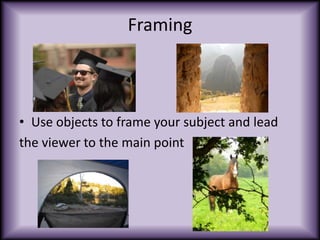
FramingUse objects to frame your subject and lead the viewer to the main point
PatternsA pattern of lines or shapes in your photos makes for a more interesting composition.
LightingIf your photos are too dark, use the flash, get closer or increase the shutter speed.Too bright? Turn off the flash, back off or decrease the shutter speed.
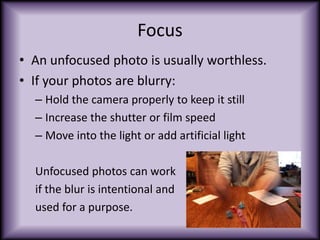
FocusAn unfocused photo is usually worthless. If your photos are blurry:Hold the camera properly to keep it stillIncrease the shutter or film speedMove into the light or add artificial lightUnfocused photos can work if the blur is intentional and used for a purpose.
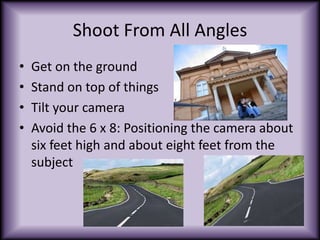
Shoot From All AnglesGet on the groundStand on top of thingsTilt your cameraAvoid the 6 x 8: Positioning the camera about six feet high and about eight feet from the subject
Three types of photos for a slideshowWide – give viewers perspectiveMedium – drill in on the purposeTight – capture the details
Tips and TricksWhen cropping through a body, don’t cut at the jointsDon’t take photos through glassDon’t shoot from behind – always get two eyes and an earMugging – when people pose for you, take those photos and erase them later
PRACTICEPracticePracticePracticePractice“The only reason anyone is a better photographer than you is that they’ve probably taken thousands more photos than you.” – Multimedia journalist Richard Koci HernandezThis PowerPoint presentation can be reproduced as long as credit is given to Karen McIntyre.

Beginning Photography

  • 1.
    Photography“Are we using1,000 words where a picture should be?” -Matt Thompson, newsless.org
  • 2.
    Why add photosto stories?To reflect add emotion add colorgive a sense of a person or a placePeople are more likely to look at stories with photos.
  • 3.
    First thing’s first-Hold the camera correctlyUse two handsYour right should hold the body of the cameraYour left should support the weight from below
  • 4.
    The MomentFind theirregular in the every dayCatch the momentPatience PracticeThe decisive momentBy Henri Cartier-Bresson
  • 5.
    Dead SpaceFill theframe“If your pictures aren’t good enough, you’re not close enough.” – war photographer Robert CapaAvoid head space or dead spacebad
  • 6.
    Rule of ThirdsA.K.A.the golden ratioAvoid a perfectly centered photoMakes photos more balanced and interesting
  • 7.
    FramingUse objects toframe your subject and lead the viewer to the main point
  • 8.
    PatternsA pattern oflines or shapes in your photos makes for a more interesting composition.
  • 9.
    LightingIf your photosare too dark, use the flash, get closer or increase the shutter speed.Too bright? Turn off the flash, back off or decrease the shutter speed.
  • 10.
    FocusAn unfocused photois usually worthless. If your photos are blurry:Hold the camera properly to keep it stillIncrease the shutter or film speedMove into the light or add artificial lightUnfocused photos can work if the blur is intentional and used for a purpose.
  • 11.
    Shoot From AllAnglesGet on the groundStand on top of thingsTilt your cameraAvoid the 6 x 8: Positioning the camera about six feet high and about eight feet from the subject
  • 12.
    Three types ofphotos for a slideshowWide – give viewers perspectiveMedium – drill in on the purposeTight – capture the details
  • 13.
    Tips and TricksWhencropping through a body, don’t cut at the jointsDon’t take photos through glassDon’t shoot from behind – always get two eyes and an earMugging – when people pose for you, take those photos and erase them later
  • 14.
    PRACTICEPracticePracticePracticePractice“The only reasonanyone is a better photographer than you is that they’ve probably taken thousands more photos than you.” – Multimedia journalist Richard Koci HernandezThis PowerPoint presentation can be reproduced as long as credit is given to Karen McIntyre.