Beet Root
Origin :
Europe, North Africa & West Asia
Botanical Name: Beta vulgaris sp vulgaris.
Family: Brassicaceae
Chromosome number 2n=18
Beet Root
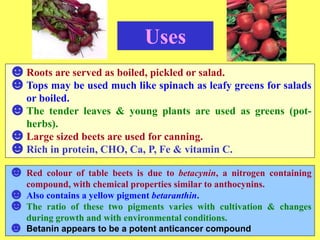
☻Roots are served as boiled, pickled or salad.
☻Tops may be used much like spinach as leafy greens for salads
or boiled.
☻The tender leaves & young plants are used as greens (pot-
herbs).
☻Large sized beets are used for canning.
☻Rich in protein, CHO, Ca, P, Fe & vitamin C.
☻Red colour of table beets is due to betacynin, a nitrogen containing
compound, with chemical properties similar to anthocynins.
☻Also contains a yellow pigment betaranthin.
☻The ratio of these two pigments varies with cultivation & changes
during growth and with environmental conditions.
☻ Betanin appears to be a potent anticancer compound
Uses
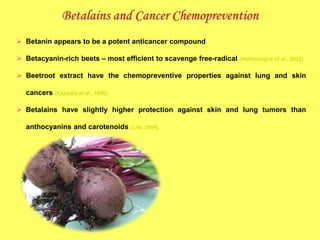
 Betanin appears to be a potent anticancer compound
 Betacyanin-rich beets – most efficient to scavenge free-radical (Wettasinghe et al., 2002)
 Beetroot extract have the chemopreventive properties against lung and skin
cancers (Kapadia et al., 1996)
 Betalains have slightly higher protection against skin and lung tumors than
anthocyanins and carotenoids (Lila, 2004)
♠Good beets are produced on a wide
variety of soils.
♠Deep, well drained loams or sandy loams
are considered best.
♠Sensitive to soil acidity.
♠A soil pH 6-7 is considered best for beet..
♠Beet is one of the few vegetables that can
be grown successfully on saline soils.
Soils
Climate
♥ Cool season crop that can tolerate mild frosts and light freezes.
♥ It grows best in the winters in the plains of India.
♥ Seed germination over a wide range of soil temperature (40-
85oF) but optimum germination occurs between 65 & 75 oF.
♥ Beets are very sensitive to low temperature & if exposed to
4.5oC – 10 oC for 15 days leads to bolting before the roots attain
marketable size.
♥ It grows well in warm weather but attains best colour, texture
and quality in a cool weather condition.
♥ Excessive hot weather causes ‘zoning’ – the appearance of
alternating light & dark red concentric circles in the rot.
♥ Under cool weather, the roots have a high sugar content, quality
roots with intense colour (18.3-21.1 oC).
♥ Beets require abundant sunshine for development of storage
roots.
Land Preparation
♥ The soils should be thoroughly prepared by ploughing 15-20 cm
deep followed by sufficient disking & hoeing to pulverize the clods.
♥ The soil surface should be smooth & loose & free from all clods
and trashes.
♥ Well rotten FYM or compost is also added at the time of land
preparation.
Sowing Period
North India Sept-Nov
South India July-Nov
In hills March-July end
♥ Seeds sown early when the temperature is high, may produce beets
with coarse and woody fresh and dull colour
Varieties
Deteroid Dark Red
Seed Rate & Spacing
Thinning
► Thinning is an essential operation in beet cultivation because the seed
ball is actually a fruit containing 2-6 seeds each of which may
germinate & produce a plant
► Generally, the plants emerge in groups unless segmented seed or
monogerm seed is used.
☻Beet seeds are sown directly in the field by sowing seed balls
that contain one of more seeds.
☻The seed balls are planted at a rate of 7-9 kg/ha in rows 45-60
cm apart and thinned later to an in-row spacing of 8-10 cm
☻Multigerm seeds or beet seed is a fruit containig usually 2-6
seeds.
Manures and Fertilizers
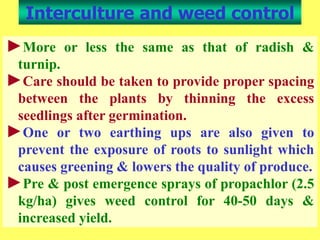
Farmyard
manure q/ha)
N P2O5 K2 O
(Kg/ha)
150-200 60-70 100-120 60-70
☻ Application method same as other root crops.
Open pollinated varieties
►More or less the same as that of radish &
turnip.
►Care should be taken to provide proper spacing
between the plants by thinning the excess
seedlings after germination.
►One or two earthing ups are also given to
prevent the exposure of roots to sunlight which
causes greening & lowers the quality of produce.
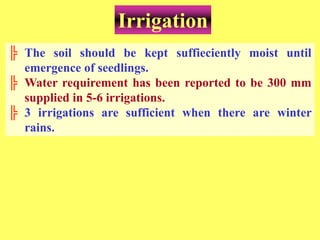
►Pre & post emergence sprays of propachlor (2.5
kg/ha) gives weed control for 40-50 days &
increased yield.
Interculture and weed control
Irrigation
╠ The soil should be kept suffieciently moist until
emergence of seedlings.
╠ Water requirement has been reported to be 300 mm
supplied in 5-6 irrigations.
╠ 3 irrigations are sufficient when there are winter
rains.
Harvesting
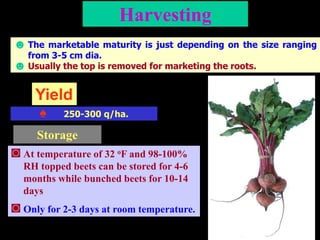
☻ The marketable maturity is just depending on the size ranging
from 3-5 cm dia.
☻ Usually the top is removed for marketing the roots.
Yield
♠ 250-300 q/ha.
Storage
◙ At temperature of 32 oF and 98-100%
RH topped beets can be stored for 4-6
months while bunched beets for 10-14
days
◙ Only for 2-3 days at room temperature.
PHYSIOLOGICAL DISORDERS
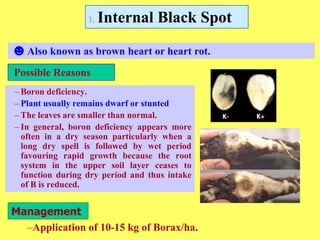
– Boron deficiency.
– Plant usually remains dwarf or stunted
– The leaves are smaller than normal.
– In general, boron deficiency appears more
often in a dry season particularly when a
long dry spell is followed by wet period
favouring rapid growth because the root
system in the upper soil layer ceases to
function during dry period and thus intake
of B is reduced.
Possible Reasons
1. Internal Black Spot
☻Also known as brown heart or heart rot.
Management
–Application of 10-15 kg of Borax/ha.

beetroot production technology vegetable crop

  • 1.
  • 2.
    Origin : Europe, NorthAfrica & West Asia Botanical Name: Beta vulgaris sp vulgaris. Family: Brassicaceae Chromosome number 2n=18 Beet Root
  • 3.
    ☻Roots are servedas boiled, pickled or salad. ☻Tops may be used much like spinach as leafy greens for salads or boiled. ☻The tender leaves & young plants are used as greens (pot- herbs). ☻Large sized beets are used for canning. ☻Rich in protein, CHO, Ca, P, Fe & vitamin C. ☻Red colour of table beets is due to betacynin, a nitrogen containing compound, with chemical properties similar to anthocynins. ☻Also contains a yellow pigment betaranthin. ☻The ratio of these two pigments varies with cultivation & changes during growth and with environmental conditions. ☻ Betanin appears to be a potent anticancer compound Uses
  • 4.
     Betanin appearsto be a potent anticancer compound  Betacyanin-rich beets – most efficient to scavenge free-radical (Wettasinghe et al., 2002)  Beetroot extract have the chemopreventive properties against lung and skin cancers (Kapadia et al., 1996)  Betalains have slightly higher protection against skin and lung tumors than anthocyanins and carotenoids (Lila, 2004)
  • 5.
    ♠Good beets areproduced on a wide variety of soils. ♠Deep, well drained loams or sandy loams are considered best. ♠Sensitive to soil acidity. ♠A soil pH 6-7 is considered best for beet.. ♠Beet is one of the few vegetables that can be grown successfully on saline soils. Soils
  • 6.
    Climate ♥ Cool seasoncrop that can tolerate mild frosts and light freezes. ♥ It grows best in the winters in the plains of India. ♥ Seed germination over a wide range of soil temperature (40- 85oF) but optimum germination occurs between 65 & 75 oF. ♥ Beets are very sensitive to low temperature & if exposed to 4.5oC – 10 oC for 15 days leads to bolting before the roots attain marketable size. ♥ It grows well in warm weather but attains best colour, texture and quality in a cool weather condition. ♥ Excessive hot weather causes ‘zoning’ – the appearance of alternating light & dark red concentric circles in the rot. ♥ Under cool weather, the roots have a high sugar content, quality roots with intense colour (18.3-21.1 oC). ♥ Beets require abundant sunshine for development of storage roots.
  • 7.
    Land Preparation ♥ Thesoils should be thoroughly prepared by ploughing 15-20 cm deep followed by sufficient disking & hoeing to pulverize the clods. ♥ The soil surface should be smooth & loose & free from all clods and trashes. ♥ Well rotten FYM or compost is also added at the time of land preparation. Sowing Period North India Sept-Nov South India July-Nov In hills March-July end ♥ Seeds sown early when the temperature is high, may produce beets with coarse and woody fresh and dull colour Varieties Deteroid Dark Red
  • 8.
    Seed Rate &Spacing Thinning ► Thinning is an essential operation in beet cultivation because the seed ball is actually a fruit containing 2-6 seeds each of which may germinate & produce a plant ► Generally, the plants emerge in groups unless segmented seed or monogerm seed is used. ☻Beet seeds are sown directly in the field by sowing seed balls that contain one of more seeds. ☻The seed balls are planted at a rate of 7-9 kg/ha in rows 45-60 cm apart and thinned later to an in-row spacing of 8-10 cm ☻Multigerm seeds or beet seed is a fruit containig usually 2-6 seeds.
  • 9.
    Manures and Fertilizers Farmyard manureq/ha) N P2O5 K2 O (Kg/ha) 150-200 60-70 100-120 60-70 ☻ Application method same as other root crops. Open pollinated varieties
  • 10.
    ►More or lessthe same as that of radish & turnip. ►Care should be taken to provide proper spacing between the plants by thinning the excess seedlings after germination. ►One or two earthing ups are also given to prevent the exposure of roots to sunlight which causes greening & lowers the quality of produce. ►Pre & post emergence sprays of propachlor (2.5 kg/ha) gives weed control for 40-50 days & increased yield. Interculture and weed control
  • 11.
    Irrigation ╠ The soilshould be kept suffieciently moist until emergence of seedlings. ╠ Water requirement has been reported to be 300 mm supplied in 5-6 irrigations. ╠ 3 irrigations are sufficient when there are winter rains.
  • 12.
    Harvesting ☻ The marketablematurity is just depending on the size ranging from 3-5 cm dia. ☻ Usually the top is removed for marketing the roots. Yield ♠ 250-300 q/ha. Storage ◙ At temperature of 32 oF and 98-100% RH topped beets can be stored for 4-6 months while bunched beets for 10-14 days ◙ Only for 2-3 days at room temperature.
  • 13.
  • 14.
    – Boron deficiency. –Plant usually remains dwarf or stunted – The leaves are smaller than normal. – In general, boron deficiency appears more often in a dry season particularly when a long dry spell is followed by wet period favouring rapid growth because the root system in the upper soil layer ceases to function during dry period and thus intake of B is reduced. Possible Reasons 1. Internal Black Spot ☻Also known as brown heart or heart rot. Management –Application of 10-15 kg of Borax/ha.