Sauce cookery
BEEF COOKERY
TECHNIQUE
BEEF COOKERY TECHNIQUE
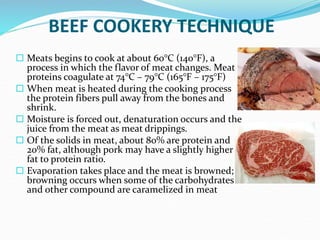
 Meats begins to cook at about 60°C (140°F), a
process in which the flavor of meat changes. Meat
proteins coagulate at 74°C – 79°C (165°F – 175°F)
 When meat is heated during the cooking process
the protein fibers pull away from the bones and
shrink.
 Moisture is forced out, denaturation occurs and the
juice from the meat as meat drippings.
 Of the solids in meat, about 80% are protein and
20% fat, although pork may have a slightly higher
fat to protein ratio.
 Evaporation takes place and the meat is browned;
browning occurs when some of the carbohydrates
and other compound are caramelized in meat
SELECTING COOKING METHOD
The method of cooking which is most suitable for a particular pieces of
meat will be decided by
 the kind of animal from which it comes,
 its condition and age (quality),
 its fat content, the part of the animal from which it comes and
 the size of the cut and its tenderness.
The effect desired and the preference of the person who is to eat the meat
are also considered in the selection of the cooking method.
We use the terms dry and moist heat cooking to differentiate between
cooking with and without moisture, moisture surrounding the meat as
liquid or steam as a principal heat transfer medium. Usually, tender meat
is cooked by dry heat methods and tough cut by moist heat methods.
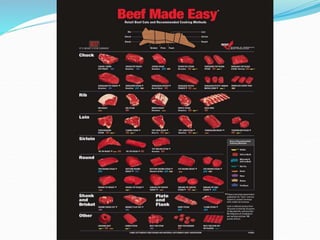
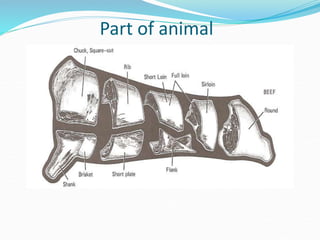
Part of animal
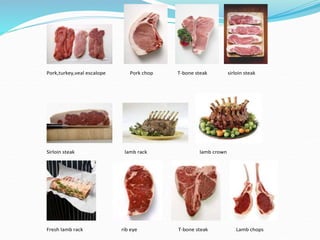
Pork,turkey,veal escalope Pork chop T-bone steak sirloin steak
Sirloin steak lamb rack lamb crown
Fresh lamb rack rib eye T-bone steak Lamb chops
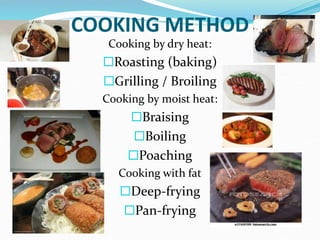
COOKING METHOD
Cooking by dry heat:
Roasting (baking)
Grilling / Broiling
Cooking by moist heat:
Braising
Boiling
Poaching
Cooking with fat
Deep-frying
Pan-frying
COOKING Cooking and preparation
 Roast beef cooked under high heat
 Method Description Grilling is cooking the beef over or under a high radiant heat
source, generally in excess of 650 °F (343 °C). This leads to searing of the surface of
the beef, which creates a flavorful crust. In the U.S.A., Australia, Canada, and the UK
grilling, particularly over charcoal, is sometimes known as barbecuing, often
shortened to BBQ. When cooked over charcoal, this method can also be called
Charbroiling. Broiling is similar to grilling, but specifically with the heat source
above the meat. Outside North America, this is known as grilling. Roasting is a way
of cooking meat in a hot oven, producing roast beef Liquid is not usually added; the
beef may be basted by fat on the top, or by spooning hot fat from the oven pan over
the top. A gravy may be made from the cooking juices, after skimming off excess fat.
Stirfrying is a typically Chinese and Asian way of cooking. Cooking oil with
flavourings such as garlic, ginger and onions are put in a very hot wok. Then slices of
meat are added, followed by ingredients which cook quicker: mixed vegetables, etc.
The dish is ready when the ingredients are 'just cooked'. Internal temperature
 Grilled or roast beef can be cooked to various degrees, from very rare to well done.
The degree of cooking corresponds to the temperature in the approximate center of
the meat, which can be measured with a meat thermometer.
 Very rare 115–125 °F (46–52 °C) Blood-red meat, soft, slightly juicy
 Rare 125–135 °F (52–57 °C) Red center, gray surface, soft, juicy
 Medium rare 135–145 °F (57–63 °C) Dark Pink throughout, gray-brown surface, very
juicy
 Medium 145–155 °F (63–68 °C) Pink center, becomes gray-brown towards surface
 Medium well 155–165 °F (68–74 °C) Thin line of pink, firm texture.
 Well done >165 °F (74 °C) Gray-brown throughout, tough texture.
COOKING AND HANDLING MEATS
Other Factors Influencing Choice of Cooking Method
 Fat content
 Barding: Tying slices of fat over the surface of meat to
protect them while roasting
 Larding: Inserting strips of fat with a larding needle
into meets low in marbling
TENDERNESS AND APPROPRIATE COOKING METHODS
(CONT’D)
MEAT PRERPARATION TERMINOLOGY
TRIMMING : To cut the unnecessary part and it will
have a nice shape
TRUSSING : to tied up the meat so the meat has a nice
form
MARINATE : to season and leave the meat for a few
minutes
BASTING : pouring fat during roasting process
SEARING : browning process before the meat is roasted
COOKING AND HANDLING MEATS
Fresh Meats
 Should be stored at 32ºF (0ºC) to 36ºF (2ºC).
 Allow for proper air circulation.
 Do not open vacuum packaged meats until ready to use.
 Keep meats separate in the cooler and avoid cross-
contamination.
 Use as quickly as possible; fresh meats keep well for only
two to four days.
STORAGE OF MEATS
COOKING AND HANDLING MEATS
Frozen Meats
 Should be stored at 0ºF (–18ºC) or colder.
 Wrap frozen meats well to prevent freezer burn.
 Recommended shelf life for meats at 0ºF (–18ºC).
 Beef, veal and lamb: 6 months
 Pork: 4 months (pork fat turns rancid easily in the
freezer)
 Defrost carefully in the refrigerator.
 Do not refreeze thawed meats.
STORAGE METHODS (CONT’D)
THANK YOU

Beef cookery technique

  • 1.
  • 2.
    BEEF COOKERY TECHNIQUE Meats begins to cook at about 60°C (140°F), a process in which the flavor of meat changes. Meat proteins coagulate at 74°C – 79°C (165°F – 175°F)  When meat is heated during the cooking process the protein fibers pull away from the bones and shrink.  Moisture is forced out, denaturation occurs and the juice from the meat as meat drippings.  Of the solids in meat, about 80% are protein and 20% fat, although pork may have a slightly higher fat to protein ratio.  Evaporation takes place and the meat is browned; browning occurs when some of the carbohydrates and other compound are caramelized in meat
  • 3.
    SELECTING COOKING METHOD Themethod of cooking which is most suitable for a particular pieces of meat will be decided by  the kind of animal from which it comes,  its condition and age (quality),  its fat content, the part of the animal from which it comes and  the size of the cut and its tenderness. The effect desired and the preference of the person who is to eat the meat are also considered in the selection of the cooking method. We use the terms dry and moist heat cooking to differentiate between cooking with and without moisture, moisture surrounding the meat as liquid or steam as a principal heat transfer medium. Usually, tender meat is cooked by dry heat methods and tough cut by moist heat methods.
  • 8.
  • 9.
    Pork,turkey,veal escalope Porkchop T-bone steak sirloin steak Sirloin steak lamb rack lamb crown Fresh lamb rack rib eye T-bone steak Lamb chops
  • 10.
    COOKING METHOD Cooking bydry heat: Roasting (baking) Grilling / Broiling Cooking by moist heat: Braising Boiling Poaching Cooking with fat Deep-frying Pan-frying
  • 11.
    COOKING Cooking andpreparation  Roast beef cooked under high heat  Method Description Grilling is cooking the beef over or under a high radiant heat source, generally in excess of 650 °F (343 °C). This leads to searing of the surface of the beef, which creates a flavorful crust. In the U.S.A., Australia, Canada, and the UK grilling, particularly over charcoal, is sometimes known as barbecuing, often shortened to BBQ. When cooked over charcoal, this method can also be called Charbroiling. Broiling is similar to grilling, but specifically with the heat source above the meat. Outside North America, this is known as grilling. Roasting is a way of cooking meat in a hot oven, producing roast beef Liquid is not usually added; the beef may be basted by fat on the top, or by spooning hot fat from the oven pan over the top. A gravy may be made from the cooking juices, after skimming off excess fat. Stirfrying is a typically Chinese and Asian way of cooking. Cooking oil with flavourings such as garlic, ginger and onions are put in a very hot wok. Then slices of meat are added, followed by ingredients which cook quicker: mixed vegetables, etc. The dish is ready when the ingredients are 'just cooked'. Internal temperature  Grilled or roast beef can be cooked to various degrees, from very rare to well done. The degree of cooking corresponds to the temperature in the approximate center of the meat, which can be measured with a meat thermometer.  Very rare 115–125 °F (46–52 °C) Blood-red meat, soft, slightly juicy  Rare 125–135 °F (52–57 °C) Red center, gray surface, soft, juicy  Medium rare 135–145 °F (57–63 °C) Dark Pink throughout, gray-brown surface, very juicy  Medium 145–155 °F (63–68 °C) Pink center, becomes gray-brown towards surface  Medium well 155–165 °F (68–74 °C) Thin line of pink, firm texture.  Well done >165 °F (74 °C) Gray-brown throughout, tough texture.
  • 12.
    COOKING AND HANDLINGMEATS Other Factors Influencing Choice of Cooking Method  Fat content  Barding: Tying slices of fat over the surface of meat to protect them while roasting  Larding: Inserting strips of fat with a larding needle into meets low in marbling TENDERNESS AND APPROPRIATE COOKING METHODS (CONT’D)
  • 13.
    MEAT PRERPARATION TERMINOLOGY TRIMMING: To cut the unnecessary part and it will have a nice shape TRUSSING : to tied up the meat so the meat has a nice form MARINATE : to season and leave the meat for a few minutes BASTING : pouring fat during roasting process SEARING : browning process before the meat is roasted
  • 14.
    COOKING AND HANDLINGMEATS Fresh Meats  Should be stored at 32ºF (0ºC) to 36ºF (2ºC).  Allow for proper air circulation.  Do not open vacuum packaged meats until ready to use.  Keep meats separate in the cooler and avoid cross- contamination.  Use as quickly as possible; fresh meats keep well for only two to four days. STORAGE OF MEATS
  • 15.
    COOKING AND HANDLINGMEATS Frozen Meats  Should be stored at 0ºF (–18ºC) or colder.  Wrap frozen meats well to prevent freezer burn.  Recommended shelf life for meats at 0ºF (–18ºC).  Beef, veal and lamb: 6 months  Pork: 4 months (pork fat turns rancid easily in the freezer)  Defrost carefully in the refrigerator.  Do not refreeze thawed meats. STORAGE METHODS (CONT’D)
  • 16.