Meat Dishes
Effects of
Heat on Meat
Effects of Heat on Meat
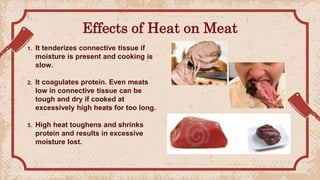
1. It tenderizes connective tissue if
moisture is present and cooking is
slow.
2. It coagulates protein. Even meats
low in connective tissue can be
tough and dry if cooked at
excessively high heats for too long.
3. High heat toughens and shrinks
protein and results in excessive
moisture lost.
Effects of Heat on Meat
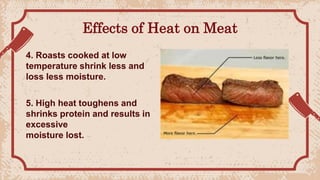
4. Roasts cooked at low
temperature shrink less and
loss less moisture.
5. High heat toughens and
shrinks protein and results in
excessive
moisture lost.
Methods of
Cooking meat
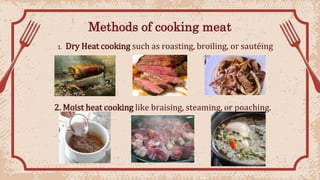
Methods of cooking meat
1. Dry Heat cooking such as roasting, broiling, or sautéing
2. Moist heat cooking like braising, steaming, or poaching.
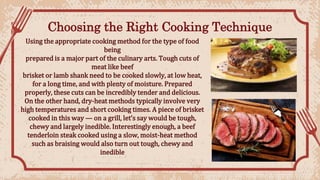
Choosing the Right Cooking Technique
Using the appropriate cooking method for the type of food
being
prepared is a major part of the culinary arts. Tough cuts of
meat like beef
brisket or lamb shank need to be cooked slowly, at low heat,
for a long time, and with plenty of moisture. Prepared
properly, these cuts can be incredibly tender and delicious.
On the other hand, dry-heat methods typically involve very
high temperatures and short cooking times. A piece of brisket
cooked in this way — on a grill, let’s say would be tough,
chewy and largely inedible. Interestingly enough, a beef
tenderloin steak cooked using a slow, moist-heat method
such as braising would also turn out tough, chewy and
inedible
Dry Heat Cooking
Dry heat cooking refers to any cooking technique where the heat is
transferred to the food item without using any moisture. Dry-heat
cooking typically involves high heat, with temperatures of 300°F or
hotter. Baking or roasting in an oven is a dry heat method because it
uses hot air to conduct the heat. Pan-searing a steak is considered dry-
heat cooking because the heat transfer takes place through the hot
metal of the pan.
Note: The browning of food (including the process by which meat is browned,
called the Maillard reaction) can only be achieved through dry-heat cooking.
Examples of dry-heat methods include:
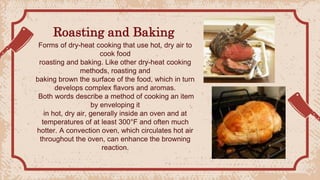
Roasting and Baking
Forms of dry-heat cooking that use hot, dry air to
cook food
roasting and baking. Like other dry-heat cooking
methods, roasting and
baking brown the surface of the food, which in turn
develops complex flavors and aromas.
Both words describe a method of cooking an item
by enveloping it
in hot, dry air, generally inside an oven and at
temperatures of at least 300°F and often much
hotter. A convection oven, which circulates hot air
throughout the oven, can enhance the browning
reaction.
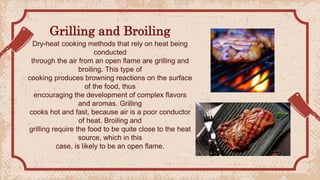
Grilling and Broiling
Dry-heat cooking methods that rely on heat being
conducted
through the air from an open flame are grilling and
broiling. This type of
cooking produces browning reactions on the surface
of the food, thus
encouraging the development of complex flavors
and aromas. Grilling
cooks hot and fast, because air is a poor conductor
of heat. Broiling and
grilling require the food to be quite close to the heat
source, which in this
case, is likely to be an open flame.
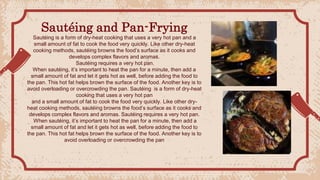
Sautéing and Pan-Frying
Sautéing is a form of dry-heat cooking that uses a very hot pan and a
small amount of fat to cook the food very quickly. Like other dry-heat
cooking methods, sautéing browns the food’s surface as it cooks and
develops complex flavors and aromas.
Sautéing requires a very hot pan.
When sautéing, it’s important to heat the pan for a minute, then add a
small amount of fat and let it gets hot as well, before adding the food to
the pan. This hot fat helps brown the surface of the food. Another key is to
avoid overloading or overcrowding the pan. Sautéing is a form of dry-heat
cooking that uses a very hot pan
and a small amount of fat to cook the food very quickly. Like other dry-
heat cooking methods, sautéing browns the food’s surface as it cooks and
develops complex flavors and aromas. Sautéing requires a very hot pan.
When sautéing, it’s important to heat the pan for a minute, then add a
small amount of fat and let it gets hot as well, before adding the food to
the pan. This hot fat helps brown the surface of the food. Another key is to
avoid overloading or overcrowding the pan
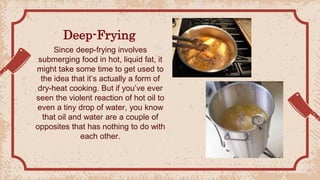
Deep-Frying
Since deep-frying involves
submerging food in hot, liquid fat, it
might take some time to get used to
the idea that it’s actually a form of
dry-heat cooking. But if you’ve ever
seen the violent reaction of hot oil to
even a tiny drop of water, you know
that oil and water are a couple of
opposites that has nothing to do with
each other.
Moist Heat Cooking
Moist heat cooking methods include
any technique that involves
cooking with moisture — whether it's
steam, water, stock, wine or some
other liquid. Cooking temperatures
are much lower, anywhere from
140°F to a maximum of 212°F,
because water doesn't get any hotter
than that. Examples of moist-heat
cooking methods include:
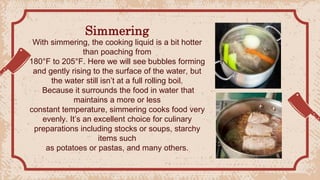
Simmering
With simmering, the cooking liquid is a bit hotter
than poaching from
180°F to 205°F. Here we will see bubbles forming
and gently rising to the surface of the water, but
the water still isn’t at a full rolling boil.
Because it surrounds the food in water that
maintains a more or less
constant temperature, simmering cooks food very
evenly. It’s an excellent choice for culinary
preparations including stocks or soups, starchy
items such
as potatoes or pastas, and many others.
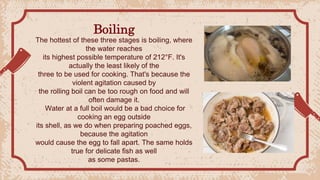
Boiling
The hottest of these three stages is boiling, where
the water reaches
its highest possible temperature of 212°F. It's
actually the least likely of the
three to be used for cooking. That's because the
violent agitation caused by
the rolling boil can be too rough on food and will
often damage it.
Water at a full boil would be a bad choice for
cooking an egg outside
its shell, as we do when preparing poached eggs,
because the agitation
would cause the egg to fall apart. The same holds
true for delicate fish as well
as some pastas.
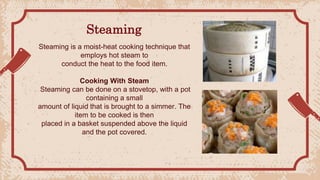
Steaming
Steaming is a moist-heat cooking technique that
employs hot steam to
conduct the heat to the food item.
Cooking With Steam
Steaming can be done on a stovetop, with a pot
containing a small
amount of liquid that is brought to a simmer. The
item to be cooked is then
placed in a basket suspended above the liquid
and the pot covered.
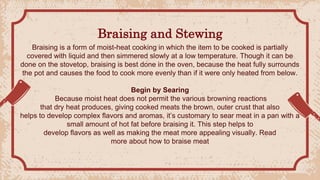
Braising and Stewing
Braising is a form of moist-heat cooking in which the item to be cooked is partially
covered with liquid and then simmered slowly at a low temperature. Though it can be
done on the stovetop, braising is best done in the oven, because the heat fully surrounds
the pot and causes the food to cook more evenly than if it were only heated from below.
Begin by Searing
Because moist heat does not permit the various browning reactions
that dry heat produces, giving cooked meats the brown, outer crust that also
helps to develop complex flavors and aromas, it’s customary to sear meat in a pan with a
small amount of hot fat before braising it. This step helps to
develop flavors as well as making the meat more appealing visually. Read
more about how to braise meat
Braising and Stewing
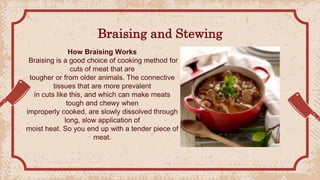
How Braising Works
Braising is a good choice of cooking method for
cuts of meat that are
tougher or from older animals. The connective
tissues that are more prevalent
in cuts like this, and which can make meats
tough and chewy when
improperly cooked, are slowly dissolved through
long, slow application of
moist heat. So you end up with a tender piece of
meat.
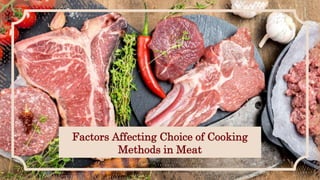
Factors Affecting Choice of Cooking
Methods in Meat
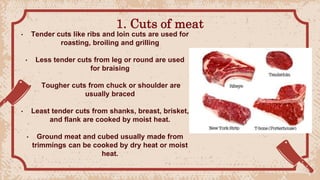
1. Cuts of meat
• Tender cuts like ribs and loin cuts are used for
roasting, broiling and grilling
• Less tender cuts from leg or round are used
for braising
• Tougher cuts from chuck or shoulder are
usually braced
• Least tender cuts from shanks, breast, brisket,
and flank are cooked by moist heat.
• Ground meat and cubed usually made from
trimmings can be cooked by dry heat or moist
heat.
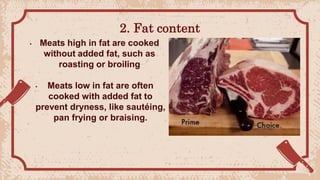
2. Fat content
• Meats high in fat are cooked
without added fat, such as
roasting or broiling
• Meats low in fat are often
cooked with added fat to
prevent dryness, like sautéing,
pan frying or braising.
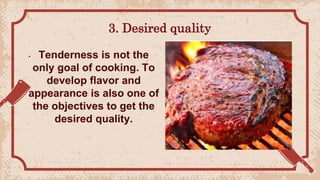
3. Desired quality
• Tenderness is not the
only goal of cooking. To
develop flavor and
appearance is also one of
the objectives to get the
desired quality.
Thank you
for listening

COOKERY 10.pptx

  • 1.
  • 2.
  • 3.
    Effects of Heaton Meat 1. It tenderizes connective tissue if moisture is present and cooking is slow. 2. It coagulates protein. Even meats low in connective tissue can be tough and dry if cooked at excessively high heats for too long. 3. High heat toughens and shrinks protein and results in excessive moisture lost.
  • 4.
    Effects of Heaton Meat 4. Roasts cooked at low temperature shrink less and loss less moisture. 5. High heat toughens and shrinks protein and results in excessive moisture lost.
  • 5.
  • 6.
    Methods of cookingmeat 1. Dry Heat cooking such as roasting, broiling, or sautéing 2. Moist heat cooking like braising, steaming, or poaching.
  • 7.
    Choosing the RightCooking Technique Using the appropriate cooking method for the type of food being prepared is a major part of the culinary arts. Tough cuts of meat like beef brisket or lamb shank need to be cooked slowly, at low heat, for a long time, and with plenty of moisture. Prepared properly, these cuts can be incredibly tender and delicious. On the other hand, dry-heat methods typically involve very high temperatures and short cooking times. A piece of brisket cooked in this way — on a grill, let’s say would be tough, chewy and largely inedible. Interestingly enough, a beef tenderloin steak cooked using a slow, moist-heat method such as braising would also turn out tough, chewy and inedible
  • 8.
    Dry Heat Cooking Dryheat cooking refers to any cooking technique where the heat is transferred to the food item without using any moisture. Dry-heat cooking typically involves high heat, with temperatures of 300°F or hotter. Baking or roasting in an oven is a dry heat method because it uses hot air to conduct the heat. Pan-searing a steak is considered dry- heat cooking because the heat transfer takes place through the hot metal of the pan. Note: The browning of food (including the process by which meat is browned, called the Maillard reaction) can only be achieved through dry-heat cooking. Examples of dry-heat methods include:
  • 9.
    Roasting and Baking Formsof dry-heat cooking that use hot, dry air to cook food roasting and baking. Like other dry-heat cooking methods, roasting and baking brown the surface of the food, which in turn develops complex flavors and aromas. Both words describe a method of cooking an item by enveloping it in hot, dry air, generally inside an oven and at temperatures of at least 300°F and often much hotter. A convection oven, which circulates hot air throughout the oven, can enhance the browning reaction.
  • 10.
    Grilling and Broiling Dry-heatcooking methods that rely on heat being conducted through the air from an open flame are grilling and broiling. This type of cooking produces browning reactions on the surface of the food, thus encouraging the development of complex flavors and aromas. Grilling cooks hot and fast, because air is a poor conductor of heat. Broiling and grilling require the food to be quite close to the heat source, which in this case, is likely to be an open flame.
  • 11.
    Sautéing and Pan-Frying Sautéingis a form of dry-heat cooking that uses a very hot pan and a small amount of fat to cook the food very quickly. Like other dry-heat cooking methods, sautéing browns the food’s surface as it cooks and develops complex flavors and aromas. Sautéing requires a very hot pan. When sautéing, it’s important to heat the pan for a minute, then add a small amount of fat and let it gets hot as well, before adding the food to the pan. This hot fat helps brown the surface of the food. Another key is to avoid overloading or overcrowding the pan. Sautéing is a form of dry-heat cooking that uses a very hot pan and a small amount of fat to cook the food very quickly. Like other dry- heat cooking methods, sautéing browns the food’s surface as it cooks and develops complex flavors and aromas. Sautéing requires a very hot pan. When sautéing, it’s important to heat the pan for a minute, then add a small amount of fat and let it gets hot as well, before adding the food to the pan. This hot fat helps brown the surface of the food. Another key is to avoid overloading or overcrowding the pan
  • 12.
    Deep-Frying Since deep-frying involves submergingfood in hot, liquid fat, it might take some time to get used to the idea that it’s actually a form of dry-heat cooking. But if you’ve ever seen the violent reaction of hot oil to even a tiny drop of water, you know that oil and water are a couple of opposites that has nothing to do with each other.
  • 13.
    Moist Heat Cooking Moistheat cooking methods include any technique that involves cooking with moisture — whether it's steam, water, stock, wine or some other liquid. Cooking temperatures are much lower, anywhere from 140°F to a maximum of 212°F, because water doesn't get any hotter than that. Examples of moist-heat cooking methods include:
  • 14.
    Simmering With simmering, thecooking liquid is a bit hotter than poaching from 180°F to 205°F. Here we will see bubbles forming and gently rising to the surface of the water, but the water still isn’t at a full rolling boil. Because it surrounds the food in water that maintains a more or less constant temperature, simmering cooks food very evenly. It’s an excellent choice for culinary preparations including stocks or soups, starchy items such as potatoes or pastas, and many others.
  • 15.
    Boiling The hottest ofthese three stages is boiling, where the water reaches its highest possible temperature of 212°F. It's actually the least likely of the three to be used for cooking. That's because the violent agitation caused by the rolling boil can be too rough on food and will often damage it. Water at a full boil would be a bad choice for cooking an egg outside its shell, as we do when preparing poached eggs, because the agitation would cause the egg to fall apart. The same holds true for delicate fish as well as some pastas.
  • 16.
    Steaming Steaming is amoist-heat cooking technique that employs hot steam to conduct the heat to the food item. Cooking With Steam Steaming can be done on a stovetop, with a pot containing a small amount of liquid that is brought to a simmer. The item to be cooked is then placed in a basket suspended above the liquid and the pot covered.
  • 17.
    Braising and Stewing Braisingis a form of moist-heat cooking in which the item to be cooked is partially covered with liquid and then simmered slowly at a low temperature. Though it can be done on the stovetop, braising is best done in the oven, because the heat fully surrounds the pot and causes the food to cook more evenly than if it were only heated from below. Begin by Searing Because moist heat does not permit the various browning reactions that dry heat produces, giving cooked meats the brown, outer crust that also helps to develop complex flavors and aromas, it’s customary to sear meat in a pan with a small amount of hot fat before braising it. This step helps to develop flavors as well as making the meat more appealing visually. Read more about how to braise meat
  • 18.
    Braising and Stewing HowBraising Works Braising is a good choice of cooking method for cuts of meat that are tougher or from older animals. The connective tissues that are more prevalent in cuts like this, and which can make meats tough and chewy when improperly cooked, are slowly dissolved through long, slow application of moist heat. So you end up with a tender piece of meat.
  • 19.
    Factors Affecting Choiceof Cooking Methods in Meat
  • 20.
    1. Cuts ofmeat • Tender cuts like ribs and loin cuts are used for roasting, broiling and grilling • Less tender cuts from leg or round are used for braising • Tougher cuts from chuck or shoulder are usually braced • Least tender cuts from shanks, breast, brisket, and flank are cooked by moist heat. • Ground meat and cubed usually made from trimmings can be cooked by dry heat or moist heat.
  • 21.
    2. Fat content •Meats high in fat are cooked without added fat, such as roasting or broiling • Meats low in fat are often cooked with added fat to prevent dryness, like sautéing, pan frying or braising.
  • 22.
    3. Desired quality •Tenderness is not the only goal of cooking. To develop flavor and appearance is also one of the objectives to get the desired quality.
  • 23.