Introduction to building
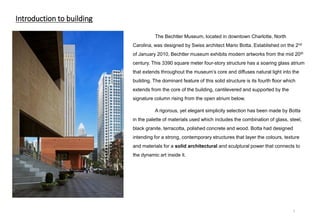
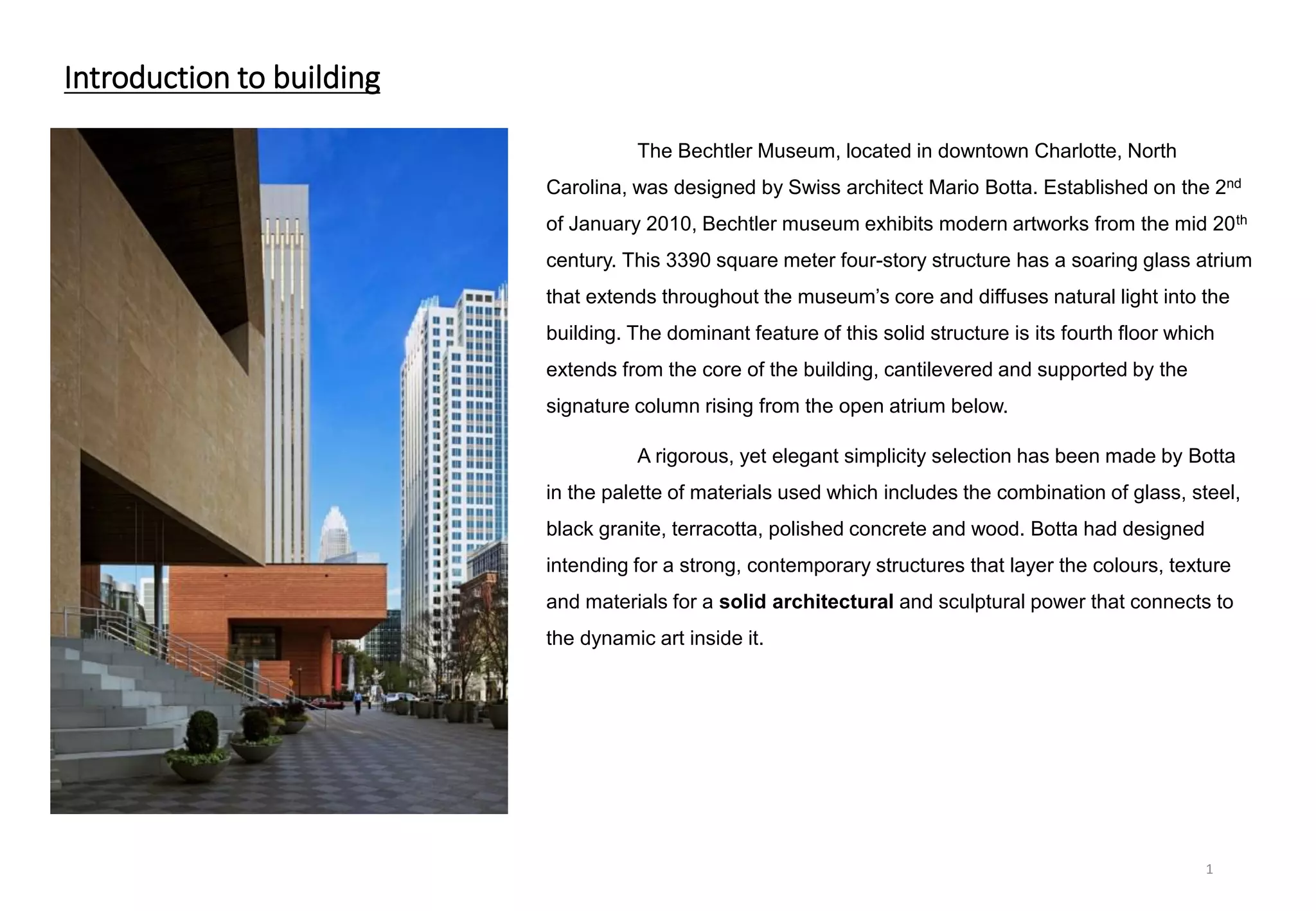
The Bechtler Museum, located in downtown Charlotte, North
Carolina, was designed by Swiss architect Mario Botta. Established on the 2nd
of January 2010, Bechtler museum exhibits modern artworks from the mid 20th
century. This 3390 square meter four-story structure has a soaring glass atrium
that extends throughout the museum’s core and diffuses natural light into the
building. The dominant feature of this solid structure is its fourth floor which
extends from the core of the building, cantilevered and supported by the
signature column rising from the open atrium below.
A rigorous, yet elegant simplicity selection has been made by Botta
in the palette of materials used which includes the combination of glass, steel,
black granite, terracotta, polished concrete and wood. Botta had designed
intending for a strong, contemporary structures that layer the colours, texture
and materials for a solid architectural and sculptural power that connects to
the dynamic art inside it.
1
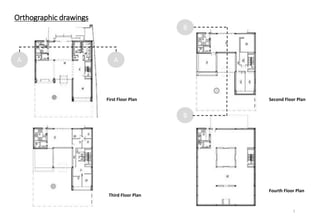
Orthographic drawings
Second Floor Plan
Third Floor Plan
Fourth Floor Plan
A A
First Floor Plan
B
B
2
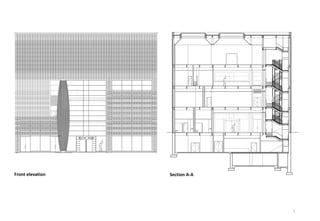
Front elevation Section A-A
3
1
2
4
5
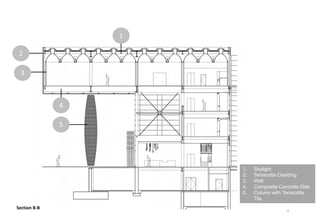
Section B-B
3
4
1. Skylight
2. Terracotta Cladding
3. Wall
4. Composite Concrete Slab
5. Column with Terracotta
Tile
Load Distributions
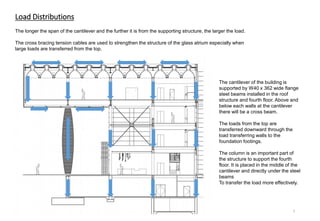
The cantilever of the building is
supported by W40 x 362 wide flange
steel beams installed in the roof
structure and fourth floor. Above and
below each walls at the cantilever
there will be a cross beam.
The loads from the top are
transferred downward through the
load transferring walls to the
foundation footings.
The column is an important part of
the structure to support the fourth
floor. It is placed in the middle of the
cantilever and directly under the steel
beams
To transfer the load more effectively.
The longer the span of the cantilever and the further it is from the supporting structure, the larger the load.
The cross bracing tension cables are used to strengthen the structure of the glass atrium especially when
large loads are transferred from the top.
5
Detailing
1. Skylight
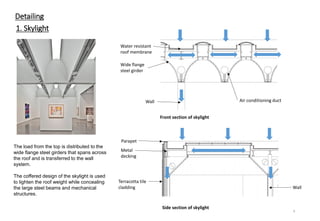
The load from the top is distributed to the
wide flange steel girders that spans across
the roof and is transferred to the wall
system.
The coffered design of the skylight is used
to lighten the roof weight while concealing
the large steel beams and mechanical
structures.
Front section of skylight
Side section of skylight
Air conditioning duct
Wide flange
steel girder
Water resistant
roof membrane
Wall
Terracotta tile
cladding
Metal
decking
Parapet
Wall
6
Detailing
2. Terracotta cladding
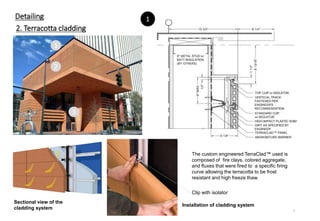
The custom engineered TerraClad™ used is
composed of fire clays, colored aggregate,
and fluxes that were fired to a specific firing
curve allowing the terracotta to be frost
resistant and high freeze thaw.
Sectional view of the
cladding system
1
2
3
1
Clip with isolator
Installation of cladding system
7
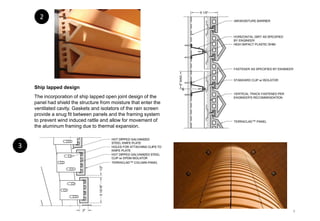
Ship lapped design
The incorporation of ship lapped open joint design of the
panel had shield the structure from moisture that enter the
ventilated cavity. Gaskets and isolators of the rain screen
provide a snug fit between panels and the framing system
to prevent wind induced rattle and allow for movement of
the aluminum framing due to thermal expansion.
2
3
8
Detailing
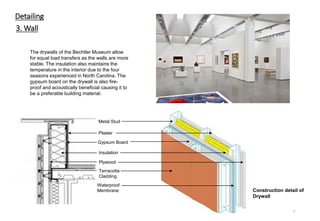
3. Wall
Gypsum Board
Insulation
Plaster
Plywood
The drywalls of the Bechtler Museum allow
for equal load transfers as the walls are more
stable. The insulation also maintains the
temperature in the interior due to the four
seasons experienced in North Carolina. The
gypsum board on the drywall is also fire-
proof and acoustically beneficial causing it to
be a preferable building material.
9
Construction detail of
Drywall
Terracotta
Cladding
Waterproof
Membrane
Metal Stud
Granite Flooring
Concrete
Wide flange steel
girder
C-Channel
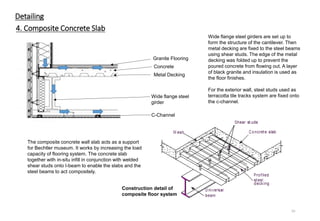
4. Composite Concrete Slab
Metal Decking
The composite concrete wall slab acts as a support
for Bechtler museum. It works by increasing the load
capacity of flooring system. The concrete slab
together with in-situ infill in conjunction with welded
shear studs onto I-beam to enable the slabs and the
steel beams to act compositely.
Construction detail of
composite floor system
10
Detailing
Wide flange steel girders are set up to
form the structure of the cantilever. Then
metal decking are fixed to the steel beams
using shear studs. The edge of the metal
decking was folded up to prevent the
poured concrete from flowing out. A layer
of black granite and insulation is used as
the floor finishes.
For the exterior wall, steel studs used as
terracotta tile tracks system are fixed onto
the c-channel.
Detailing
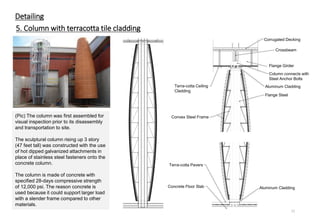
5. Column with terracotta tile cladding
(Pic) The column was first assembled for
visual inspection prior to its disassembly
and transportation to site.
The sculptural column rising up 3 story
(47 feet tall) was constructed with the use
of hot dipped galvanized attachments in
place of stainless steel fasteners onto the
concrete column.
The column is made of concrete with
specified 28-days compressive strength
of 12,000 psi. The reason concrete is
used because it could support larger load
with a slender frame compared to other
materials.
Corrugated Decking
Crossbeam
Flange Girder
Flange Steel
Terra-cotta Pavers
Concrete Floor Slab Aluminum Cladding
Convex Steel Frame
Aluminum Cladding
Column connects with
Steel Anchor Bolts
Terra-cotta Ceiling
Cladding
11
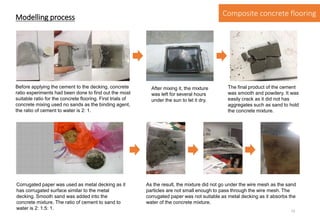
Before applying the cement to the decking, concrete
ratio experiments had been done to find out the most
suitable ratio for the concrete flooring. First trials of
concrete mixing used no sands as the binding agent,
the ratio of cement to water is 2: 1.
After mixing it, the mixture
was left for several hours
under the sun to let it dry.
The final product of the cement
was smooth and powdery. It was
easily crack as it did not has
aggregates such as sand to hold
the concrete mixture.
Corrugated paper was used as metal decking as it
has corrugated surface similar to the metal
decking. Smooth sand was added into the
concrete mixture. The ratio of cement to sand to
water is 2: 1.5: 1.
As the result, the mixture did not go under the wire mesh as the sand
particles are not small enough to pass through the wire mesh. The
corrugated paper was not suitable as metal decking as it absorbs the
water of the concrete mixture.
Modelling process Composite concrete flooring
12
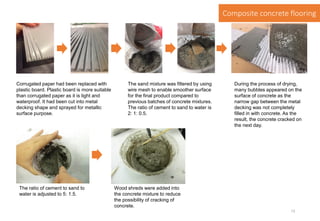
Corrugated paper had been replaced with
plastic board. Plastic board is more suitable
than corrugated paper as it is light and
waterproof. It had been cut into metal
decking shape and sprayed for metallic
surface purpose.
The sand mixture was filtered by using
wire mesh to enable smoother surface
for the final product compared to
previous batches of concrete mixtures.
The ratio of cement to sand to water is
2: 1: 0.5.
During the process of drying,
many bubbles appeared on the
surface of concrete as the
narrow gap between the metal
decking was not completely
filled in with concrete. As the
result, the concrete cracked on
the next day.
The ratio of cement to sand to
water is adjusted to 5: 1.5.
Wood shreds were added into
the concrete mixture to reduce
the possibility of cracking of
concrete.
Composite concrete flooring
13
Metal Decking Process
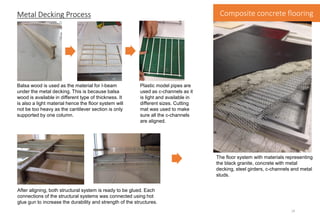
Balsa wood is used as the material for I-beam
under the metal decking. This is because balsa
wood is available in different type of thickness. It
is also a light material hence the floor system will
not be too heavy as the cantilever section is only
supported by one column.
After aligning, both structural system is ready to be glued. Each
connections of the structural systems was connected using hot
glue gun to increase the durability and strength of the structures.
Plastic model pipes are
used as c-channels as it
is light and available in
different sizes. Cutting
mat was used to make
sure all the c-channels
are aligned.
The floor system with materials representing
the black granite, concrete with metal
decking, steel girders, c-channels and metal
studs.
Composite concrete flooring
14
Column making
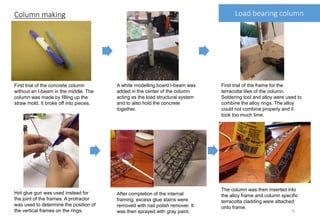
A white modelling board I-beam was
added in the center of the column
acting as the load structural system
and to also hold the concrete
together.
First trial of the concrete column
without an I-beam in the middle. The
column was made by filling up the
straw mold. It broke off into pieces.
First trial of the frame for the
terracotta tiles of the column.
Soldering tool and alloy were used to
combine the alloy rings. The alloy
could not combine properly and it
took too much time.
Hot glue gun was used instead for
the joint of the frames. A protractor
was used to determine the position of
the vertical frames on the rings.
Load bearing column
After completion of the internal
framing, excess glue stains were
removed with nail polish remover. It
was then sprayed with gray paint.
The column was then inserted into
the alloy frame and column specific
terracotta cladding were attached
onto frame.
15
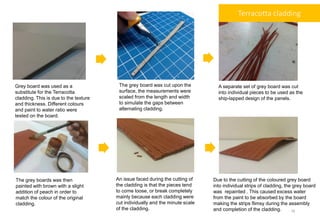
Grey board was used as a
substitute for the Terracotta
cladding. This is due to the texture
and thickness. Different colours
and paint to water ratio were
tested on the board.
The grey board was cut upon the
surface, the measurements were
scaled from the length and width
to simulate the gaps between
alternating cladding.
A separate set of grey board was cut
into individual pieces to be used as the
ship-lapped design of the panels.
The grey boards was then
painted with brown with a slight
addition of peach in order to
match the colour of the original
cladding.
An issue faced during the cutting of
the cladding is that the pieces tend
to come loose, or break completely
mainly because each cladding were
cut individually and the minute scale
of the cladding.
Due to the cutting of the coloured grey board
into individual strips of cladding, the grey board
was repainted . This caused excess water
from the paint to be absorbed by the board
making the strips flimsy during the assembly
and completion of the cladding.
Terracotta cladding
16
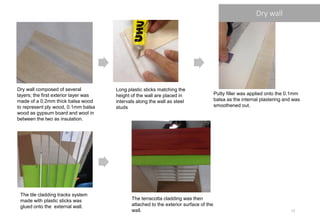
Dry wall composed of several
layers; the first exterior layer was
made of a 0.2mm thick balsa wood
to represent ply wood, 0.1mm balsa
wood as gypsum board and wool in
between the two as insulation.
Long plastic sticks matching the
height of the wall are placed in
intervals along the wall as steel
studs
Putty filler was applied onto the 0.1mm
balsa as the internal plastering and was
smoothened out.
The tile cladding tracks system
made with plastic sticks was
glued onto the external wall.
The terracotta cladding was then
attached to the exterior surface of the
wall.
Dry wall
17
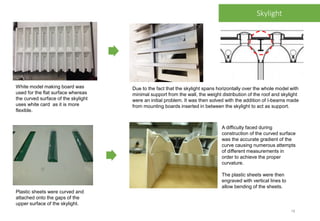
White model making board was
used for the flat surface whereas
the curved surface of the skylight
uses white card as it is more
flexible.
Plastic sheets were curved and
attached onto the gaps of the
upper surface of the skylight.
A difficulty faced during
construction of the curved surface
was the accurate gradient of the
curve causing numerous attempts
of different measurements in
order to achieve the proper
curvature.
The plastic sheets were then
engraved with vertical lines to
allow bending of the sheets.
Due to the fact that the skylight spans horizontally over the whole model with
minimal support from the wall, the weight distribution of the roof and skylight
were an initial problem. It was then solved with the addition of I-beams made
from mounting boards inserted in between the skylight to act as support.
Skylight
18
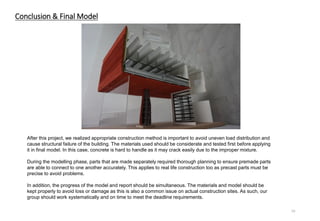
After this project, we realized appropriate construction method is important to avoid uneven load distribution and
cause structural failure of the building. The materials used should be considerate and tested first before applying
it in final model. In this case, concrete is hard to handle as it may crack easily due to the improper mixture.
During the modelling phase, parts that are made separately required thorough planning to ensure premade parts
are able to connect to one another accurately. This applies to real life construction too as precast parts must be
precise to avoid problems.
In addition, the progress of the model and report should be simultaneous. The materials and model should be
kept properly to avoid loss or damage as this is also a common issue on actual construction sites. As such, our
group should work systematically and on time to meet the deadline requirements.
19
Conclusion & Final Model
Architecture Week, (2010). Bechtler Museum. [image] Available at: http://www.architectureweek.com/2010/0407/design_4-3.html [Accessed
14 Jun. 2014].
Architecture Week, (2010). Bechtler Museum by Botta. [image] Available at: http://www.architectureweek.com/2010/0217/design_1-2.html
[Accessed 13 Jun. 2014].
ArchwebDWG, (2014). Bechtler Museum of Modern Art. [image] Available at:
http://www.archweb.it/dwg/arch_arredi_famosi/mario_botta/Bechtler_Museum/Bechtler_museum_dwg.htm [Accessed 10 Jun. 2014].
Bechtler Museum of Modern Art. (n.d.). 1st ed. [ebook] Available at: http://www.kingguinn.com/libraries/portfolio/publications/317.pdf
[Accessed 13 Jun. 2014].
Boston Valley Terra Cotta. (2014). 1st ed. [ebook] Institute. Available at:
http://www.swrionline.org/UserFiles/File/Fall09/Project%20Showcase%20Presentations/Architectural%20Terra%20Cotta%20Ventilated%20
Ceramic%20Screen%20Wall%20Systems%20by%20Sheri%20Carter.pdf [Accessed 14 Jun. 2014].
Innovative Manufacturing in Architectural Ceramics. (n.d.). 1st ed. [ebook] New York: Boston Valley. Available at: http://www.triton-
ca.com/pdf_files/BV_TerraClad%20Design%20Guide.pdf [Accessed 13 Jun. 2014].
Steelconstruction.info, (2014). Acoustic performance of floors. [online] Available at:
http://www.steelconstruction.info/Acoustic_performance_of_floors [Accessed 15 Jun. 2014].
Worldarchitecturemap.org, (2014). WAM | Bechtler Museum of Modern Art | Charlotte. [online] Available at:
http://www.worldarchitecturemap.org/buildings/bechtler-museum-of-modern-art [Accessed 15 Jun. 2014].
Reference
20

Bechtler Museum Construction

  • 1.
    Introduction to building TheBechtler Museum, located in downtown Charlotte, North Carolina, was designed by Swiss architect Mario Botta. Established on the 2nd of January 2010, Bechtler museum exhibits modern artworks from the mid 20th century. This 3390 square meter four-story structure has a soaring glass atrium that extends throughout the museum’s core and diffuses natural light into the building. The dominant feature of this solid structure is its fourth floor which extends from the core of the building, cantilevered and supported by the signature column rising from the open atrium below. A rigorous, yet elegant simplicity selection has been made by Botta in the palette of materials used which includes the combination of glass, steel, black granite, terracotta, polished concrete and wood. Botta had designed intending for a strong, contemporary structures that layer the colours, texture and materials for a solid architectural and sculptural power that connects to the dynamic art inside it. 1
  • 2.
    Orthographic drawings Second FloorPlan Third Floor Plan Fourth Floor Plan A A First Floor Plan B B 2
  • 3.
  • 4.
    1 2 4 5 Section B-B 3 4 1. Skylight 2.Terracotta Cladding 3. Wall 4. Composite Concrete Slab 5. Column with Terracotta Tile
  • 5.
    Load Distributions The cantileverof the building is supported by W40 x 362 wide flange steel beams installed in the roof structure and fourth floor. Above and below each walls at the cantilever there will be a cross beam. The loads from the top are transferred downward through the load transferring walls to the foundation footings. The column is an important part of the structure to support the fourth floor. It is placed in the middle of the cantilever and directly under the steel beams To transfer the load more effectively. The longer the span of the cantilever and the further it is from the supporting structure, the larger the load. The cross bracing tension cables are used to strengthen the structure of the glass atrium especially when large loads are transferred from the top. 5
  • 6.
    Detailing 1. Skylight The loadfrom the top is distributed to the wide flange steel girders that spans across the roof and is transferred to the wall system. The coffered design of the skylight is used to lighten the roof weight while concealing the large steel beams and mechanical structures. Front section of skylight Side section of skylight Air conditioning duct Wide flange steel girder Water resistant roof membrane Wall Terracotta tile cladding Metal decking Parapet Wall 6
  • 7.
    Detailing 2. Terracotta cladding Thecustom engineered TerraClad™ used is composed of fire clays, colored aggregate, and fluxes that were fired to a specific firing curve allowing the terracotta to be frost resistant and high freeze thaw. Sectional view of the cladding system 1 2 3 1 Clip with isolator Installation of cladding system 7
  • 8.
    Ship lapped design Theincorporation of ship lapped open joint design of the panel had shield the structure from moisture that enter the ventilated cavity. Gaskets and isolators of the rain screen provide a snug fit between panels and the framing system to prevent wind induced rattle and allow for movement of the aluminum framing due to thermal expansion. 2 3 8
  • 9.
    Detailing 3. Wall Gypsum Board Insulation Plaster Plywood Thedrywalls of the Bechtler Museum allow for equal load transfers as the walls are more stable. The insulation also maintains the temperature in the interior due to the four seasons experienced in North Carolina. The gypsum board on the drywall is also fire- proof and acoustically beneficial causing it to be a preferable building material. 9 Construction detail of Drywall Terracotta Cladding Waterproof Membrane Metal Stud
  • 10.
    Granite Flooring Concrete Wide flangesteel girder C-Channel 4. Composite Concrete Slab Metal Decking The composite concrete wall slab acts as a support for Bechtler museum. It works by increasing the load capacity of flooring system. The concrete slab together with in-situ infill in conjunction with welded shear studs onto I-beam to enable the slabs and the steel beams to act compositely. Construction detail of composite floor system 10 Detailing Wide flange steel girders are set up to form the structure of the cantilever. Then metal decking are fixed to the steel beams using shear studs. The edge of the metal decking was folded up to prevent the poured concrete from flowing out. A layer of black granite and insulation is used as the floor finishes. For the exterior wall, steel studs used as terracotta tile tracks system are fixed onto the c-channel.
  • 11.
    Detailing 5. Column withterracotta tile cladding (Pic) The column was first assembled for visual inspection prior to its disassembly and transportation to site. The sculptural column rising up 3 story (47 feet tall) was constructed with the use of hot dipped galvanized attachments in place of stainless steel fasteners onto the concrete column. The column is made of concrete with specified 28-days compressive strength of 12,000 psi. The reason concrete is used because it could support larger load with a slender frame compared to other materials. Corrugated Decking Crossbeam Flange Girder Flange Steel Terra-cotta Pavers Concrete Floor Slab Aluminum Cladding Convex Steel Frame Aluminum Cladding Column connects with Steel Anchor Bolts Terra-cotta Ceiling Cladding 11
  • 12.
    Before applying thecement to the decking, concrete ratio experiments had been done to find out the most suitable ratio for the concrete flooring. First trials of concrete mixing used no sands as the binding agent, the ratio of cement to water is 2: 1. After mixing it, the mixture was left for several hours under the sun to let it dry. The final product of the cement was smooth and powdery. It was easily crack as it did not has aggregates such as sand to hold the concrete mixture. Corrugated paper was used as metal decking as it has corrugated surface similar to the metal decking. Smooth sand was added into the concrete mixture. The ratio of cement to sand to water is 2: 1.5: 1. As the result, the mixture did not go under the wire mesh as the sand particles are not small enough to pass through the wire mesh. The corrugated paper was not suitable as metal decking as it absorbs the water of the concrete mixture. Modelling process Composite concrete flooring 12
  • 13.
    Corrugated paper hadbeen replaced with plastic board. Plastic board is more suitable than corrugated paper as it is light and waterproof. It had been cut into metal decking shape and sprayed for metallic surface purpose. The sand mixture was filtered by using wire mesh to enable smoother surface for the final product compared to previous batches of concrete mixtures. The ratio of cement to sand to water is 2: 1: 0.5. During the process of drying, many bubbles appeared on the surface of concrete as the narrow gap between the metal decking was not completely filled in with concrete. As the result, the concrete cracked on the next day. The ratio of cement to sand to water is adjusted to 5: 1.5. Wood shreds were added into the concrete mixture to reduce the possibility of cracking of concrete. Composite concrete flooring 13
  • 14.
    Metal Decking Process Balsawood is used as the material for I-beam under the metal decking. This is because balsa wood is available in different type of thickness. It is also a light material hence the floor system will not be too heavy as the cantilever section is only supported by one column. After aligning, both structural system is ready to be glued. Each connections of the structural systems was connected using hot glue gun to increase the durability and strength of the structures. Plastic model pipes are used as c-channels as it is light and available in different sizes. Cutting mat was used to make sure all the c-channels are aligned. The floor system with materials representing the black granite, concrete with metal decking, steel girders, c-channels and metal studs. Composite concrete flooring 14
  • 15.
    Column making A whitemodelling board I-beam was added in the center of the column acting as the load structural system and to also hold the concrete together. First trial of the concrete column without an I-beam in the middle. The column was made by filling up the straw mold. It broke off into pieces. First trial of the frame for the terracotta tiles of the column. Soldering tool and alloy were used to combine the alloy rings. The alloy could not combine properly and it took too much time. Hot glue gun was used instead for the joint of the frames. A protractor was used to determine the position of the vertical frames on the rings. Load bearing column After completion of the internal framing, excess glue stains were removed with nail polish remover. It was then sprayed with gray paint. The column was then inserted into the alloy frame and column specific terracotta cladding were attached onto frame. 15
  • 16.
    Grey board wasused as a substitute for the Terracotta cladding. This is due to the texture and thickness. Different colours and paint to water ratio were tested on the board. The grey board was cut upon the surface, the measurements were scaled from the length and width to simulate the gaps between alternating cladding. A separate set of grey board was cut into individual pieces to be used as the ship-lapped design of the panels. The grey boards was then painted with brown with a slight addition of peach in order to match the colour of the original cladding. An issue faced during the cutting of the cladding is that the pieces tend to come loose, or break completely mainly because each cladding were cut individually and the minute scale of the cladding. Due to the cutting of the coloured grey board into individual strips of cladding, the grey board was repainted . This caused excess water from the paint to be absorbed by the board making the strips flimsy during the assembly and completion of the cladding. Terracotta cladding 16
  • 17.
    Dry wall composedof several layers; the first exterior layer was made of a 0.2mm thick balsa wood to represent ply wood, 0.1mm balsa wood as gypsum board and wool in between the two as insulation. Long plastic sticks matching the height of the wall are placed in intervals along the wall as steel studs Putty filler was applied onto the 0.1mm balsa as the internal plastering and was smoothened out. The tile cladding tracks system made with plastic sticks was glued onto the external wall. The terracotta cladding was then attached to the exterior surface of the wall. Dry wall 17
  • 18.
    White model makingboard was used for the flat surface whereas the curved surface of the skylight uses white card as it is more flexible. Plastic sheets were curved and attached onto the gaps of the upper surface of the skylight. A difficulty faced during construction of the curved surface was the accurate gradient of the curve causing numerous attempts of different measurements in order to achieve the proper curvature. The plastic sheets were then engraved with vertical lines to allow bending of the sheets. Due to the fact that the skylight spans horizontally over the whole model with minimal support from the wall, the weight distribution of the roof and skylight were an initial problem. It was then solved with the addition of I-beams made from mounting boards inserted in between the skylight to act as support. Skylight 18
  • 19.
    After this project,we realized appropriate construction method is important to avoid uneven load distribution and cause structural failure of the building. The materials used should be considerate and tested first before applying it in final model. In this case, concrete is hard to handle as it may crack easily due to the improper mixture. During the modelling phase, parts that are made separately required thorough planning to ensure premade parts are able to connect to one another accurately. This applies to real life construction too as precast parts must be precise to avoid problems. In addition, the progress of the model and report should be simultaneous. The materials and model should be kept properly to avoid loss or damage as this is also a common issue on actual construction sites. As such, our group should work systematically and on time to meet the deadline requirements. 19 Conclusion & Final Model
  • 20.
    Architecture Week, (2010).Bechtler Museum. [image] Available at: http://www.architectureweek.com/2010/0407/design_4-3.html [Accessed 14 Jun. 2014]. Architecture Week, (2010). Bechtler Museum by Botta. [image] Available at: http://www.architectureweek.com/2010/0217/design_1-2.html [Accessed 13 Jun. 2014]. ArchwebDWG, (2014). Bechtler Museum of Modern Art. [image] Available at: http://www.archweb.it/dwg/arch_arredi_famosi/mario_botta/Bechtler_Museum/Bechtler_museum_dwg.htm [Accessed 10 Jun. 2014]. Bechtler Museum of Modern Art. (n.d.). 1st ed. [ebook] Available at: http://www.kingguinn.com/libraries/portfolio/publications/317.pdf [Accessed 13 Jun. 2014]. Boston Valley Terra Cotta. (2014). 1st ed. [ebook] Institute. Available at: http://www.swrionline.org/UserFiles/File/Fall09/Project%20Showcase%20Presentations/Architectural%20Terra%20Cotta%20Ventilated%20 Ceramic%20Screen%20Wall%20Systems%20by%20Sheri%20Carter.pdf [Accessed 14 Jun. 2014]. Innovative Manufacturing in Architectural Ceramics. (n.d.). 1st ed. [ebook] New York: Boston Valley. Available at: http://www.triton- ca.com/pdf_files/BV_TerraClad%20Design%20Guide.pdf [Accessed 13 Jun. 2014]. Steelconstruction.info, (2014). Acoustic performance of floors. [online] Available at: http://www.steelconstruction.info/Acoustic_performance_of_floors [Accessed 15 Jun. 2014]. Worldarchitecturemap.org, (2014). WAM | Bechtler Museum of Modern Art | Charlotte. [online] Available at: http://www.worldarchitecturemap.org/buildings/bechtler-museum-of-modern-art [Accessed 15 Jun. 2014]. Reference 20