BDC 101
CHAPTER 2
FINANCIAL ACCOUNTING 1
ACCOUNTING EQUATION AND
DOUBLE ENTRY SYSTEM
SCHOOL OF ACCOUNTING & FINANCE
FACULTY OF BUSINESS AND MANAGEMENT
PREPARED BY:
NORAL HIDAYAH ALWI
Slide 2 of 31
TOPIC
CHAPTER 2: ACCOUNTING EQUATION AND DOUBLE ENTRY SYSTEM
LEARNING OUTCOMES
At the end of this chapter, students will be able to:
 Classify of assets, liabilities and owner’s equity
 Describe the accounting equation
 Identify the implication of business transaction on the accounting ledgers
 Illustrate the accounting entries for assets, liabilities and owner’s equity
Slide 3 of 31
TOPIC
CHAPTER 2: ACCOUNTING EQUATION AND DOUBLE ENTRY SYSTEM
TOPIC OUTLINES
2.1 Accounting Cycle
2.2 Accounting Equation
2.3 Classification of Accounts
2.4 Double Entry System
2.5 Summary of Debit Credit
2.6 Class Activities
2.6.1 Question 1
2.6.2 Question 2
2.6.3 Question 3
Slide 4 of 31
TOPIC
CHAPTER 2: ACCOUNTING EQUATION AND DOUBLE ENTRY SYSTEM
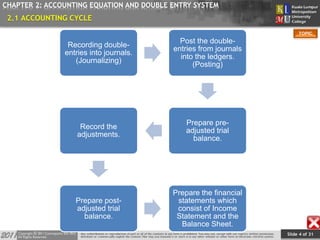
2.1 ACCOUNTING CYCLE
Recording double-
entries into journals.
(Journalizing)
Post the double-
entries from journals
into the ledgers.
(Posting)
Prepare pre-
adjusted trial
balance.
Record the
adjustments.
Prepare post-
adjusted trial
balance.
Prepare the financial
statements which
consist of Income
Statement and the
Balance Sheet.
Slide 5 of 31
TOPIC
CHAPTER 2: ACCOUNTING EQUATION AND DOUBLE ENTRY SYSTEM
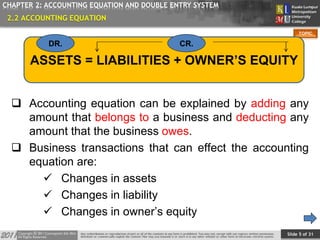
 Accounting equation can be explained by adding any
amount that belongs to a business and deducting any
amount that the business owes.
 Business transactions that can effect the accounting
equation are:
 Changes in assets
 Changes in liability
 Changes in owner’s equity
ASSETS = LIABILITIES + OWNER’S EQUITY
DR. CR.
2.2 ACCOUNTING EQUATION
Slide 6 of 31
TOPIC
CHAPTER 2: ACCOUNTING EQUATION AND DOUBLE ENTRY SYSTEM
• If the equation is expanded then it becomes….
ASSETS = (OPENING CAPITAL + NET PROFIT-
DRAWINGS) + LIABILITIES
and…..
ASSETS = (OPENING CAPITAL
+[REVENUES –EXPENSES]-
DRAWINGS) + LIABILITIES
2.2 ACCOUNTING EQUATION
Slide 7 of 31
TOPIC
CHAPTER 2: ACCOUNTING EQUATION AND DOUBLE ENTRY SYSTEM
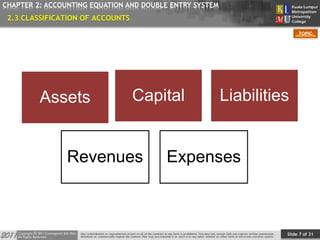
Assets LiabilitiesCapital
ExpensesRevenues
2.3 CLASSIFICATION OF ACCOUNTS
Slide 8 of 31
TOPIC
CHAPTER 2: ACCOUNTING EQUATION AND DOUBLE ENTRY SYSTEM
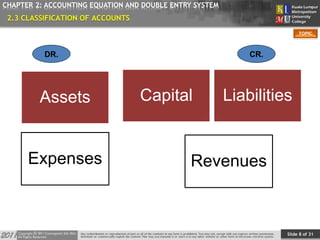
Assets LiabilitiesCapital
Expenses Revenues
DR. CR.
2.3 CLASSIFICATION OF ACCOUNTS
Slide 9 of 31
TOPIC
CHAPTER 2: ACCOUNTING EQUATION AND DOUBLE ENTRY SYSTEM
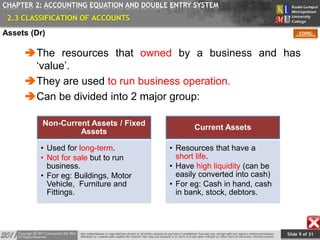
The resources that owned by a business and has
‘value’.
They are used to run business operation.
Can be divided into 2 major group:
Non-Current Assets / Fixed
Assets
• Used for long-term.
• Not for sale but to run
business.
• For eg: Buildings, Motor
Vehicle, Furniture and
Fittings.
Current Assets
• Resources that have a
short life.
• Have high liquidity (can be
easily converted into cash)
• For eg: Cash in hand, cash
in bank, stock, debtors.
2.3 CLASSIFICATION OF ACCOUNTS
Assets (Dr)
Slide 10 of 31
TOPIC
CHAPTER 2: ACCOUNTING EQUATION AND DOUBLE ENTRY SYSTEM
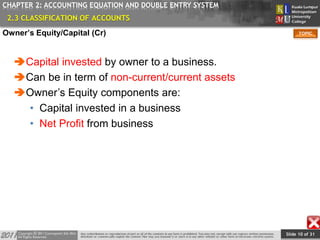
Capital invested by owner to a business.
Can be in term of non-current/current assets
Owner’s Equity components are:
• Capital invested in a business
• Net Profit from business
2.3 CLASSIFICATION OF ACCOUNTS
Owner’s Equity/Capital (Cr)
Slide 11 of 31
TOPIC
CHAPTER 2: ACCOUNTING EQUATION AND DOUBLE ENTRY SYSTEM
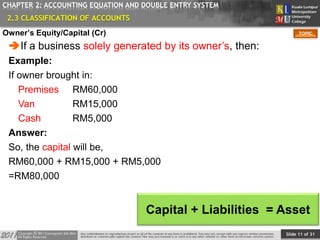
If a business solely generated by its owner’s, then:
Example:
If owner brought in:
Premises RM60,000
Van RM15,000
Cash RM5,000
Answer:
So, the capital will be,
RM60,000 + RM15,000 + RM5,000
=RM80,000
Capital + Liabilities = Asset
2.3 CLASSIFICATION OF ACCOUNTS
Owner’s Equity/Capital (Cr)
Slide 12 of 31
TOPIC
CHAPTER 2: ACCOUNTING EQUATION AND DOUBLE ENTRY SYSTEM
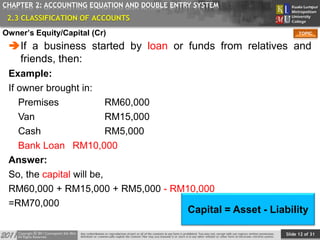
If a business started by loan or funds from relatives and
friends, then:
Example:
If owner brought in:
Premises RM60,000
Van RM15,000
Cash RM5,000
Bank Loan RM10,000
Answer:
So, the capital will be,
RM60,000 + RM15,000 + RM5,000 - RM10,000
=RM70,000
Capital = Asset - Liability
2.3 CLASSIFICATION OF ACCOUNTS
Owner’s Equity/Capital (Cr)
Slide 13 of 31
TOPIC
CHAPTER 2: ACCOUNTING EQUATION AND DOUBLE ENTRY SYSTEM
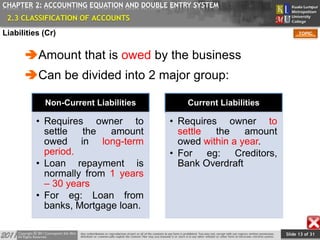
Amount that is owed by the business
Can be divided into 2 major group:
Non-Current Liabilities
• Requires owner to
settle the amount
owed in long-term
period.
• Loan repayment is
normally from 1 years
– 30 years
• For eg: Loan from
banks, Mortgage loan.
Current Liabilities
• Requires owner to
settle the amount
owed within a year.
• For eg: Creditors,
Bank Overdraft
2.3 CLASSIFICATION OF ACCOUNTS
Liabilities (Cr)
Slide 14 of 31
TOPIC
CHAPTER 2: ACCOUNTING EQUATION AND DOUBLE ENTRY SYSTEM
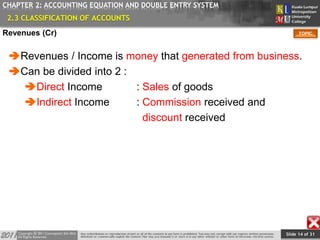
Revenues / Income is money that generated from business.
Can be divided into 2 :
Direct Income : Sales of goods
Indirect Income : Commission received and
discount received
2.3 CLASSIFICATION OF ACCOUNTS
Revenues (Cr)
Slide 15 of 31
TOPIC
CHAPTER 2: ACCOUNTING EQUATION AND DOUBLE ENTRY SYSTEM
Expenses are a business spending in order
to produce output.
Can be divided into 2:
Direct Expenses: Purchases of goods
Indirect Expenses: Rental, salary, utilities
paid, discount allowed
2.3 CLASSIFICATION OF ACCOUNTS
Expenses (Dr)
Slide 16 of 31
TOPIC
CHAPTER 2: ACCOUNTING EQUATION AND DOUBLE ENTRY SYSTEM
Double entry system is the process of recording each
business transactions into two different ledgers.
The amount will be same in that two different accounts but
one be debited and another one credited.
This system is the concept of:
When one party gives, another party will receive
When an amount is given, the same amount will be received
Therefore, double entry system in accounting principal (for
cash):
Receiving account – debited
Giving account - credited
2.4 DOUBLE ENTRY SYSTEM
Slide 17 of 31
TOPIC
CHAPTER 2: ACCOUNTING EQUATION AND DOUBLE ENTRY SYSTEM
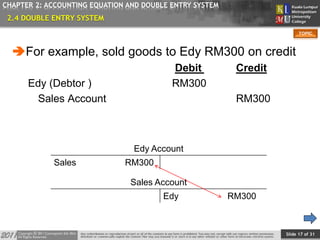
For example, sold goods to Edy RM300 on credit
Debit Credit
Edy (Debtor ) RM300
Sales Account RM300
Edy Account
Sales RM300
Sales Account
Edy RM300
2.4 DOUBLE ENTRY SYSTEM
Slide 18 of 31
TOPIC
CHAPTER 2: ACCOUNTING EQUATION AND DOUBLE ENTRY SYSTEM
• From the accounting equation, ‘debit’ (Dr.) if..
Asset  (increase)
Capital  (decrease)
Liabilities  (decrease)
• From the accounting equation, ‘credit’ (Cr.) if..
Asset  (decrease)
Capital  (increase)
Liabilities  (increase)
Balance Sheet item
2.4 DOUBLE ENTRY SYSTEM
Slide 19 of 31
TOPIC
CHAPTER 2: ACCOUNTING EQUATION AND DOUBLE ENTRY SYSTEM
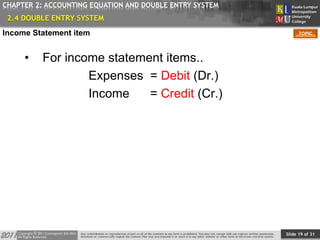
• For income statement items..
Expenses = Debit (Dr.)
Income = Credit (Cr.)
Income Statement item
2.4 DOUBLE ENTRY SYSTEM
Slide 20 of 31
TOPIC
CHAPTER 2: ACCOUNTING EQUATION AND DOUBLE ENTRY SYSTEM
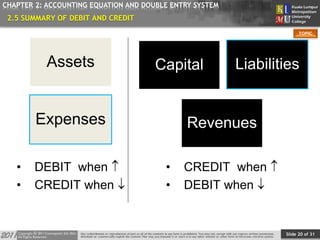
Assets
Expenses
Capital Liabilities
Revenues
• DEBIT when 
• CREDIT when 
• CREDIT when 
• DEBIT when 
2.5 SUMMARY OF DEBIT AND CREDIT
Slide 21 of 31
TOPIC
CHAPTER 2: ACCOUNTING EQUATION AND DOUBLE ENTRY SYSTEM
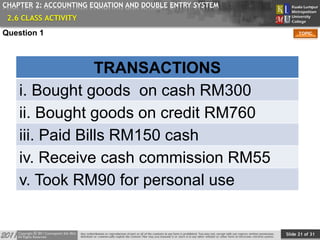
TRANSACTIONS
i. Bought goods on cash RM300
ii. Bought goods on credit RM760
iii. Paid Bills RM150 cash
iv. Receive cash commission RM55
v. Took RM90 for personal use
2.6 CLASS ACTIVITY
Question 1
Slide 22 of 31
TOPIC
CHAPTER 2: ACCOUNTING EQUATION AND DOUBLE ENTRY SYSTEM
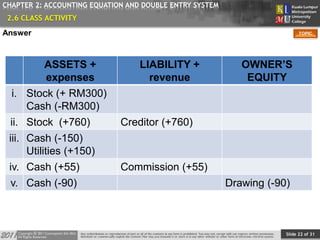
ASSETS +
expenses
LIABILITY +
revenue
OWNER’S
EQUITY
i. Stock (+ RM300)
Cash (-RM300)
ii. Stock (+760) Creditor (+760)
iii. Cash (-150)
Utilities (+150)
iv. Cash (+55) Commission (+55)
v. Cash (-90) Drawing (-90)
2.6 CLASS ACTIVITY
Answer
Slide 23 of 31
TOPIC
CHAPTER 2: ACCOUNTING EQUATION AND DOUBLE ENTRY SYSTEM
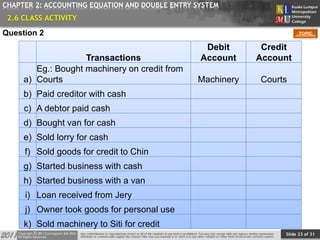
Transactions
Debit
Account
Credit
Account
a)
Eg.: Bought machinery on credit from
Courts Machinery Courts
b) Paid creditor with cash
c) A debtor paid cash
d) Bought van for cash
e) Sold lorry for cash
f) Sold goods for credit to Chin
g) Started business with cash
h) Started business with a van
i) Loan received from Jery
j) Owner took goods for personal use
k) Sold machinery to Siti for credit
2.6 CLASS ACTIVITY
Question 2
Slide 24 of 31
TOPIC
CHAPTER 2: ACCOUNTING EQUATION AND DOUBLE ENTRY SYSTEM
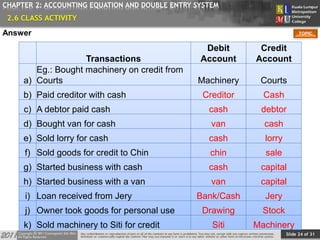
Transactions
Debit
Account
Credit
Account
a)
Eg.: Bought machinery on credit from
Courts Machinery Courts
b) Paid creditor with cash Creditor Cash
c) A debtor paid cash cash debtor
d) Bought van for cash van cash
e) Sold lorry for cash cash lorry
f) Sold goods for credit to Chin chin sale
g) Started business with cash cash capital
h) Started business with a van van capital
i) Loan received from Jery Bank/Cash Jery
j) Owner took goods for personal use Drawing Stock
k) Sold machinery to Siti for credit Siti Machinery
2.6 CLASS ACTIVITY
Answer
Slide 25 of 31
TOPIC
CHAPTER 2: ACCOUNTING EQUATION AND DOUBLE ENTRY SYSTEM
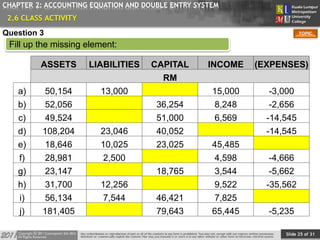
ASSETS LIABILITIES CAPITAL INCOME (EXPENSES)
RM
a) 50,154 13,000 15,000 -3,000
b) 52,056 36,254 8,248 -2,656
c) 49,524 51,000 6,569 -14,545
d) 108,204 23,046 40,052 -14,545
e) 18,646 10,025 23,025 45,485
f) 28,981 2,500 4,598 -4,666
g) 23,147 18,765 3,544 -5,662
h) 31,700 12,256 9,522 -35,562
i) 56,134 7,544 46,421 7,825
j) 181,405 79,643 65,445 -5,235
Fill up the missing element:
2.6 CLASS ACTIVITY
Question 3
Slide 26 of 31
TOPIC
CHAPTER 2: ACCOUNTING EQUATION AND DOUBLE ENTRY SYSTEM
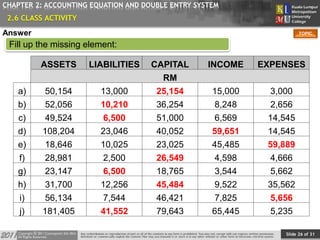
ASSETS LIABILITIES CAPITAL INCOME EXPENSES
RM
a) 50,154 13,000 25,154 15,000 3,000
b) 52,056 10,210 36,254 8,248 2,656
c) 49,524 6,500 51,000 6,569 14,545
d) 108,204 23,046 40,052 59,651 14,545
e) 18,646 10,025 23,025 45,485 59,889
f) 28,981 2,500 26,549 4,598 4,666
g) 23,147 6,500 18,765 3,544 5,662
h) 31,700 12,256 45,484 9,522 35,562
i) 56,134 7,544 46,421 7,825 5,656
j) 181,405 41,552 79,643 65,445 5,235
Fill up the missing element:
2.6 CLASS ACTIVITY
Answer
Slide 27 of 31
TOPIC
CHAPTER 2: ACCOUNTING EQUATION AND DOUBLE ENTRY SYSTEM
SUMMARY
 There are 5 categories in accounting, assets, liabilities, owner’s equity (Balance
Sheet), Revenue and Expenses (Income Statement)
 Accounting equation can be described as
Asset = Liability + Owners Equity
Asset + Expenses = Liability + Owners Equity + Income
Slide 28 of 31
TOPIC
CHAPTER 2: ACCOUNTING EQUATION AND DOUBLE ENTRY SYSTEM
NEXT SESSION PREVIEW
 CHAPTER 3
DOCUMENTS USED IN BUSINESS TRANSACTIONS AND ACCOUNTING
CYCLE
Slide 29 of 31
TOPIC
CHAPTER 2: ACCOUNTING EQUATION AND DOUBLE ENTRY SYSTEM
REFERENCES
 Business Accounting I, 11th Edition Frank Wood and Alan Sangster, ISBN 13:
978-0-273-71212-1, FT Prentice Hall, Harlow © 2008
Slide 30 of 31
TOPIC
CHAPTER 2: ACCOUNTING EQUATION AND DOUBLE ENTRY SYSTEM
APPENDIX
Slide 31 of 31
TOPIC
CHAPTER 2: ACCOUNTING EQUATION AND DOUBLE ENTRY SYSTEM
THE END

Bdc 101 02

  • 1.
    BDC 101 CHAPTER 2 FINANCIALACCOUNTING 1 ACCOUNTING EQUATION AND DOUBLE ENTRY SYSTEM SCHOOL OF ACCOUNTING & FINANCE FACULTY OF BUSINESS AND MANAGEMENT PREPARED BY: NORAL HIDAYAH ALWI
  • 2.
    Slide 2 of31 TOPIC CHAPTER 2: ACCOUNTING EQUATION AND DOUBLE ENTRY SYSTEM LEARNING OUTCOMES At the end of this chapter, students will be able to:  Classify of assets, liabilities and owner’s equity  Describe the accounting equation  Identify the implication of business transaction on the accounting ledgers  Illustrate the accounting entries for assets, liabilities and owner’s equity
  • 3.
    Slide 3 of31 TOPIC CHAPTER 2: ACCOUNTING EQUATION AND DOUBLE ENTRY SYSTEM TOPIC OUTLINES 2.1 Accounting Cycle 2.2 Accounting Equation 2.3 Classification of Accounts 2.4 Double Entry System 2.5 Summary of Debit Credit 2.6 Class Activities 2.6.1 Question 1 2.6.2 Question 2 2.6.3 Question 3
  • 4.
    Slide 4 of31 TOPIC CHAPTER 2: ACCOUNTING EQUATION AND DOUBLE ENTRY SYSTEM 2.1 ACCOUNTING CYCLE Recording double- entries into journals. (Journalizing) Post the double- entries from journals into the ledgers. (Posting) Prepare pre- adjusted trial balance. Record the adjustments. Prepare post- adjusted trial balance. Prepare the financial statements which consist of Income Statement and the Balance Sheet.
  • 5.
    Slide 5 of31 TOPIC CHAPTER 2: ACCOUNTING EQUATION AND DOUBLE ENTRY SYSTEM  Accounting equation can be explained by adding any amount that belongs to a business and deducting any amount that the business owes.  Business transactions that can effect the accounting equation are:  Changes in assets  Changes in liability  Changes in owner’s equity ASSETS = LIABILITIES + OWNER’S EQUITY DR. CR. 2.2 ACCOUNTING EQUATION
  • 6.
    Slide 6 of31 TOPIC CHAPTER 2: ACCOUNTING EQUATION AND DOUBLE ENTRY SYSTEM • If the equation is expanded then it becomes…. ASSETS = (OPENING CAPITAL + NET PROFIT- DRAWINGS) + LIABILITIES and….. ASSETS = (OPENING CAPITAL +[REVENUES –EXPENSES]- DRAWINGS) + LIABILITIES 2.2 ACCOUNTING EQUATION
  • 7.
    Slide 7 of31 TOPIC CHAPTER 2: ACCOUNTING EQUATION AND DOUBLE ENTRY SYSTEM Assets LiabilitiesCapital ExpensesRevenues 2.3 CLASSIFICATION OF ACCOUNTS
  • 8.
    Slide 8 of31 TOPIC CHAPTER 2: ACCOUNTING EQUATION AND DOUBLE ENTRY SYSTEM Assets LiabilitiesCapital Expenses Revenues DR. CR. 2.3 CLASSIFICATION OF ACCOUNTS
  • 9.
    Slide 9 of31 TOPIC CHAPTER 2: ACCOUNTING EQUATION AND DOUBLE ENTRY SYSTEM The resources that owned by a business and has ‘value’. They are used to run business operation. Can be divided into 2 major group: Non-Current Assets / Fixed Assets • Used for long-term. • Not for sale but to run business. • For eg: Buildings, Motor Vehicle, Furniture and Fittings. Current Assets • Resources that have a short life. • Have high liquidity (can be easily converted into cash) • For eg: Cash in hand, cash in bank, stock, debtors. 2.3 CLASSIFICATION OF ACCOUNTS Assets (Dr)
  • 10.
    Slide 10 of31 TOPIC CHAPTER 2: ACCOUNTING EQUATION AND DOUBLE ENTRY SYSTEM Capital invested by owner to a business. Can be in term of non-current/current assets Owner’s Equity components are: • Capital invested in a business • Net Profit from business 2.3 CLASSIFICATION OF ACCOUNTS Owner’s Equity/Capital (Cr)
  • 11.
    Slide 11 of31 TOPIC CHAPTER 2: ACCOUNTING EQUATION AND DOUBLE ENTRY SYSTEM If a business solely generated by its owner’s, then: Example: If owner brought in: Premises RM60,000 Van RM15,000 Cash RM5,000 Answer: So, the capital will be, RM60,000 + RM15,000 + RM5,000 =RM80,000 Capital + Liabilities = Asset 2.3 CLASSIFICATION OF ACCOUNTS Owner’s Equity/Capital (Cr)
  • 12.
    Slide 12 of31 TOPIC CHAPTER 2: ACCOUNTING EQUATION AND DOUBLE ENTRY SYSTEM If a business started by loan or funds from relatives and friends, then: Example: If owner brought in: Premises RM60,000 Van RM15,000 Cash RM5,000 Bank Loan RM10,000 Answer: So, the capital will be, RM60,000 + RM15,000 + RM5,000 - RM10,000 =RM70,000 Capital = Asset - Liability 2.3 CLASSIFICATION OF ACCOUNTS Owner’s Equity/Capital (Cr)
  • 13.
    Slide 13 of31 TOPIC CHAPTER 2: ACCOUNTING EQUATION AND DOUBLE ENTRY SYSTEM Amount that is owed by the business Can be divided into 2 major group: Non-Current Liabilities • Requires owner to settle the amount owed in long-term period. • Loan repayment is normally from 1 years – 30 years • For eg: Loan from banks, Mortgage loan. Current Liabilities • Requires owner to settle the amount owed within a year. • For eg: Creditors, Bank Overdraft 2.3 CLASSIFICATION OF ACCOUNTS Liabilities (Cr)
  • 14.
    Slide 14 of31 TOPIC CHAPTER 2: ACCOUNTING EQUATION AND DOUBLE ENTRY SYSTEM Revenues / Income is money that generated from business. Can be divided into 2 : Direct Income : Sales of goods Indirect Income : Commission received and discount received 2.3 CLASSIFICATION OF ACCOUNTS Revenues (Cr)
  • 15.
    Slide 15 of31 TOPIC CHAPTER 2: ACCOUNTING EQUATION AND DOUBLE ENTRY SYSTEM Expenses are a business spending in order to produce output. Can be divided into 2: Direct Expenses: Purchases of goods Indirect Expenses: Rental, salary, utilities paid, discount allowed 2.3 CLASSIFICATION OF ACCOUNTS Expenses (Dr)
  • 16.
    Slide 16 of31 TOPIC CHAPTER 2: ACCOUNTING EQUATION AND DOUBLE ENTRY SYSTEM Double entry system is the process of recording each business transactions into two different ledgers. The amount will be same in that two different accounts but one be debited and another one credited. This system is the concept of: When one party gives, another party will receive When an amount is given, the same amount will be received Therefore, double entry system in accounting principal (for cash): Receiving account – debited Giving account - credited 2.4 DOUBLE ENTRY SYSTEM
  • 17.
    Slide 17 of31 TOPIC CHAPTER 2: ACCOUNTING EQUATION AND DOUBLE ENTRY SYSTEM For example, sold goods to Edy RM300 on credit Debit Credit Edy (Debtor ) RM300 Sales Account RM300 Edy Account Sales RM300 Sales Account Edy RM300 2.4 DOUBLE ENTRY SYSTEM
  • 18.
    Slide 18 of31 TOPIC CHAPTER 2: ACCOUNTING EQUATION AND DOUBLE ENTRY SYSTEM • From the accounting equation, ‘debit’ (Dr.) if.. Asset  (increase) Capital  (decrease) Liabilities  (decrease) • From the accounting equation, ‘credit’ (Cr.) if.. Asset  (decrease) Capital  (increase) Liabilities  (increase) Balance Sheet item 2.4 DOUBLE ENTRY SYSTEM
  • 19.
    Slide 19 of31 TOPIC CHAPTER 2: ACCOUNTING EQUATION AND DOUBLE ENTRY SYSTEM • For income statement items.. Expenses = Debit (Dr.) Income = Credit (Cr.) Income Statement item 2.4 DOUBLE ENTRY SYSTEM
  • 20.
    Slide 20 of31 TOPIC CHAPTER 2: ACCOUNTING EQUATION AND DOUBLE ENTRY SYSTEM Assets Expenses Capital Liabilities Revenues • DEBIT when  • CREDIT when  • CREDIT when  • DEBIT when  2.5 SUMMARY OF DEBIT AND CREDIT
  • 21.
    Slide 21 of31 TOPIC CHAPTER 2: ACCOUNTING EQUATION AND DOUBLE ENTRY SYSTEM TRANSACTIONS i. Bought goods on cash RM300 ii. Bought goods on credit RM760 iii. Paid Bills RM150 cash iv. Receive cash commission RM55 v. Took RM90 for personal use 2.6 CLASS ACTIVITY Question 1
  • 22.
    Slide 22 of31 TOPIC CHAPTER 2: ACCOUNTING EQUATION AND DOUBLE ENTRY SYSTEM ASSETS + expenses LIABILITY + revenue OWNER’S EQUITY i. Stock (+ RM300) Cash (-RM300) ii. Stock (+760) Creditor (+760) iii. Cash (-150) Utilities (+150) iv. Cash (+55) Commission (+55) v. Cash (-90) Drawing (-90) 2.6 CLASS ACTIVITY Answer
  • 23.
    Slide 23 of31 TOPIC CHAPTER 2: ACCOUNTING EQUATION AND DOUBLE ENTRY SYSTEM Transactions Debit Account Credit Account a) Eg.: Bought machinery on credit from Courts Machinery Courts b) Paid creditor with cash c) A debtor paid cash d) Bought van for cash e) Sold lorry for cash f) Sold goods for credit to Chin g) Started business with cash h) Started business with a van i) Loan received from Jery j) Owner took goods for personal use k) Sold machinery to Siti for credit 2.6 CLASS ACTIVITY Question 2
  • 24.
    Slide 24 of31 TOPIC CHAPTER 2: ACCOUNTING EQUATION AND DOUBLE ENTRY SYSTEM Transactions Debit Account Credit Account a) Eg.: Bought machinery on credit from Courts Machinery Courts b) Paid creditor with cash Creditor Cash c) A debtor paid cash cash debtor d) Bought van for cash van cash e) Sold lorry for cash cash lorry f) Sold goods for credit to Chin chin sale g) Started business with cash cash capital h) Started business with a van van capital i) Loan received from Jery Bank/Cash Jery j) Owner took goods for personal use Drawing Stock k) Sold machinery to Siti for credit Siti Machinery 2.6 CLASS ACTIVITY Answer
  • 25.
    Slide 25 of31 TOPIC CHAPTER 2: ACCOUNTING EQUATION AND DOUBLE ENTRY SYSTEM ASSETS LIABILITIES CAPITAL INCOME (EXPENSES) RM a) 50,154 13,000 15,000 -3,000 b) 52,056 36,254 8,248 -2,656 c) 49,524 51,000 6,569 -14,545 d) 108,204 23,046 40,052 -14,545 e) 18,646 10,025 23,025 45,485 f) 28,981 2,500 4,598 -4,666 g) 23,147 18,765 3,544 -5,662 h) 31,700 12,256 9,522 -35,562 i) 56,134 7,544 46,421 7,825 j) 181,405 79,643 65,445 -5,235 Fill up the missing element: 2.6 CLASS ACTIVITY Question 3
  • 26.
    Slide 26 of31 TOPIC CHAPTER 2: ACCOUNTING EQUATION AND DOUBLE ENTRY SYSTEM ASSETS LIABILITIES CAPITAL INCOME EXPENSES RM a) 50,154 13,000 25,154 15,000 3,000 b) 52,056 10,210 36,254 8,248 2,656 c) 49,524 6,500 51,000 6,569 14,545 d) 108,204 23,046 40,052 59,651 14,545 e) 18,646 10,025 23,025 45,485 59,889 f) 28,981 2,500 26,549 4,598 4,666 g) 23,147 6,500 18,765 3,544 5,662 h) 31,700 12,256 45,484 9,522 35,562 i) 56,134 7,544 46,421 7,825 5,656 j) 181,405 41,552 79,643 65,445 5,235 Fill up the missing element: 2.6 CLASS ACTIVITY Answer
  • 27.
    Slide 27 of31 TOPIC CHAPTER 2: ACCOUNTING EQUATION AND DOUBLE ENTRY SYSTEM SUMMARY  There are 5 categories in accounting, assets, liabilities, owner’s equity (Balance Sheet), Revenue and Expenses (Income Statement)  Accounting equation can be described as Asset = Liability + Owners Equity Asset + Expenses = Liability + Owners Equity + Income
  • 28.
    Slide 28 of31 TOPIC CHAPTER 2: ACCOUNTING EQUATION AND DOUBLE ENTRY SYSTEM NEXT SESSION PREVIEW  CHAPTER 3 DOCUMENTS USED IN BUSINESS TRANSACTIONS AND ACCOUNTING CYCLE
  • 29.
    Slide 29 of31 TOPIC CHAPTER 2: ACCOUNTING EQUATION AND DOUBLE ENTRY SYSTEM REFERENCES  Business Accounting I, 11th Edition Frank Wood and Alan Sangster, ISBN 13: 978-0-273-71212-1, FT Prentice Hall, Harlow © 2008
  • 30.
    Slide 30 of31 TOPIC CHAPTER 2: ACCOUNTING EQUATION AND DOUBLE ENTRY SYSTEM APPENDIX
  • 31.
    Slide 31 of31 TOPIC CHAPTER 2: ACCOUNTING EQUATION AND DOUBLE ENTRY SYSTEM THE END