A Concepts Based Introduction
to Financial Accounting
1A Concepts Based Introduction
to Financial Accounting
2A Concepts Based Introduction
to Financial Accounting
The latest edition has the following changes
•	Legislation updates i.e. Companies Act
•	Teaching and learning improvements: chapter opener which summarises main elements
of each chapter - learning path tools at the beginning of each chapter and extracts from
published financial statements (business focus, dashboard [how to navigate the content],
learning outcomes and overview of topics
•	More key definitions in the text
•	More pause and reflect scenarios in each chapter
•	Transactional analysis diagram – which shows how transactions are accounted for ito the
accounting equation, whether they are Dr or Cr, how they are journalized and posted in
T-accounts
•	Real-life application: concepts in context
3A Concepts Based Introduction
to Financial Accounting
1. Key pedagogical features
4A Concepts Based Introduction
to Financial Accounting
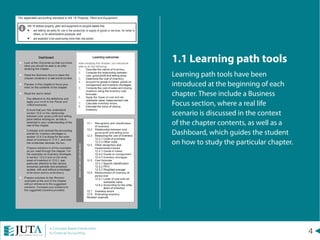
1.1 Learning path tools
Learning path tools have been
introduced at the beginning of each
chapter. These include a Business
Focus section, where a real life
scenario is discussed in the context
of the chapter contents, as well as a
Dashboard, which guides the student
on how to study the particular chapter.
5A Concepts Based Introduction
to Financial Accounting
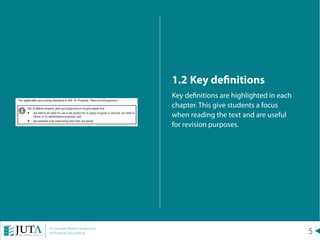
1.2	Key definitions
Key definitions are highlighted in each
chapter. This give students a focus
when reading the text and are useful
for revision purposes.
6A Concepts Based Introduction
to Financial Accounting
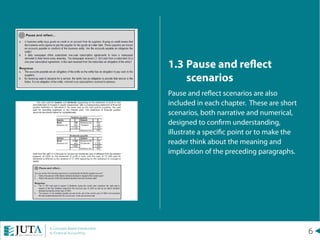
1.3	Pause and reflect
scenarios
Pause and reflect scenarios are also
included in each chapter. These are short
scenarios, both narrative and numerical,
designed to confirm understanding,
illustrate a specific point or to make the
reader think about the meaning and
implication of the preceding paragraphs.
7A Concepts Based Introduction
to Financial Accounting
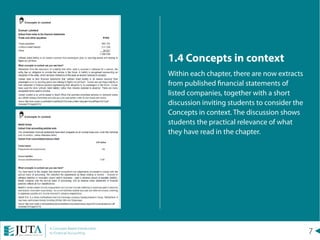
1.4 Concepts in context
Within each chapter, there are now extracts
from published financial statements of
listed companies, together with a short
discussion inviting students to consider the
Concepts in context. The discussion shows
students the practical relevance of what
they have read in the chapter.
8A Concepts Based Introduction
to Financial Accounting
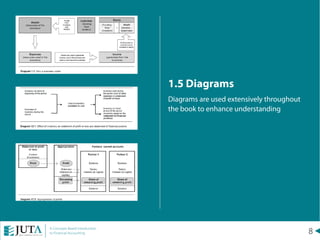
1.5 Diagrams
Diagrams are used extensively throughout
the book to enhance understanding
9A Concepts Based Introduction
to Financial Accounting
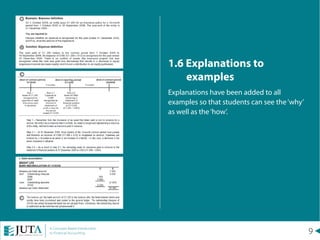
1.6 Explanations to
examples
Explanations have been added to all
examples so that students can see the‘why’
as well as the‘how’.
10A Concepts Based Introduction
to Financial Accounting
2. The Smart Concepts case study
11A Concepts Based Introduction
to Financial Accounting
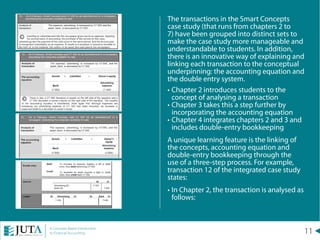
The transactions in the Smart Concepts
case study (that runs from chapters 2 to
7) have been grouped into distinct sets to
make the case study more manageable and
understandable to students. In addition,
there is an innovative way of explaining and
linking each transaction to the conceptual
underpinning: the accounting equation and
the double entry system.
•	Chapter 2 introduces students to the
concept of analysing a transaction
•	Chapter 3 takes this a step further by
incorporating the accounting equation
•	Chapter 4 integrates chapters 2 and 3 and
includes double-entry bookkeeping
A unique learning feature is the linking of
the concepts, accounting equation and
double-entry bookkeeping through the
use of a three-step process. For example,
transaction 12 of the integrated case study
states:
•	In Chapter 2, the transaction is analysed as
follows:
12A Concepts Based Introduction
to Financial Accounting
3. Lecturers’support material
13A Concepts Based Introduction
to Financial Accounting
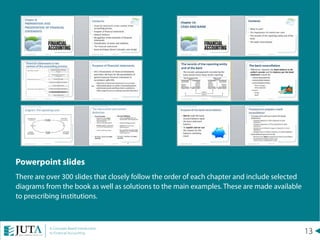
Powerpoint slides
There are over 300 slides that closely follow the order of each chapter and include selected
diagrams from the book as well as solutions to the main examples. These are made available
to prescribing institutions.
14A Concepts Based Introduction
to Financial Accounting
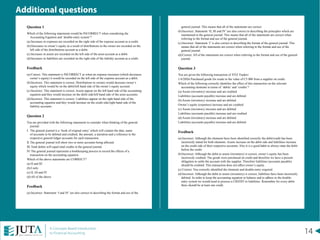
Question 1
Which of the following statements would be INCORRECT when considering the
Accounting Equation and ‘double-entry system’?
(a)	Increases in expenses are recorded on the right side of the expense account as a credit.
(b)	Decreases in owner’s equity as a result of distributions to the owner are recorded on the
left side of the distributions account as a debit.
(c)	Increases in assets are recorded on the left side of the asset account as a debit.
(d)	Increases in liabilities are recorded on the right side of the liability account as a credit.
Feedback
(a)	Correct. This statement is INCORRECT as when an expense increases (which decreases
owner’s equity) it would be recorded on the left side of the expense account as a debit.
(b)	Incorrect. This statement is correct. Distributions to owners would decrease owner’s
equity which would be on the debit/left hand side of the owner’s equity account.
(c)	Incorrect. This statement is correct. Assets appear on the left hand side of the accounting
equation and they would increase on the debit side/left hand side of the asset accounts.
(d)	Incorrect. This statement is correct. Liabilities appear on the right hand side of the
accounting equation and they would increase on the credit side/right hand side of the
liability accounts.
Question 2
You are provided with the following statements to consider when thinking of the general
journal:
I.	 The general journal is a ‘book of original entry’ which will contain the date, name
of accounts to be debited and credited, the amount, a narration and a reference to the
respective general ledger accounts for each transaction.
II.	The general journal will show two or more accounts being affected.
III.	Total debits will equal total credits in the general journal.
IV.	The general journal represents a bookkeeping process to record the effects of a
transaction on the accounting equation.
Which of the above statements are CORRECT?
(a)	II and III
(b)	I only
(c)	II, III and IV
(d)	All of the above
Feedback
(a)	Incorrect. Statement ‘I and IV’ are also correct in describing the format and use of the
general journal. This means that all of the statements are correct.
(b)	Incorrect. Statement ‘II, III and IV’ are also correct in describing the principles which are
maintained in the general journal. This means that all of the statements are correct when
referring to the format and use of the general journal.
(c)	Incorrect. Statement ‘I’ is also correct in describing the format of the general journal. This
means that all of the statements are correct when referring to the format and use of the
general journal.
(d)	Correct. All of the statements are correct when referring to the format and use of the general
journal.
Question 3
You are given the following transaction of XYZ Traders:
1/4/20X6 Purchased goods for resale to the value of C5 000 from a supplier on credit.
Which of the following correctly identifies the effect of this transaction on the relevant
accounting elements in terms of ‘debits’ and ‘credits’?
(a)	Assets (inventory) increase and are credited
Liabilities (accounts payable) increase and are debited
(b)	Assets (inventory) increase and are debited
Owner’s equity (expenses) increase and are credited
(c)	Assets (inventory) increase and are debited
Liabilities (accounts payable) increase and are credited
(d)	Assets (inventory) increase and are debited
Liabilities (accounts payable) increase and are debited
Feedback
(a)	Incorrect. Although the elements have been identified correctly the debit/credit has been
incorrectly stated for both elements. Assets increase on the debit side and liabilities increase
on the credit side of their respective accounts. Also it is a good habit to always state the debit
before the credit.
(b)	Incorrect. Although the debit to assets (inventory) is correct, owner’s equity has been
incorrectly credited. The goods were purchased on credit and therefore we have a present
obligation to settle the account with the supplier. Therefore liabilities (accounts payable)
should be credited. This transaction does not affect owner’s equity.
(c)	Correct. You correctly identified the elements and double-entry required.
(d)	Incorrect. Although the debit to assets (inventory) is correct, liabilities have been incorrectly
debited. In order to keep the accounting equation in balance and to adhere to the double-
entry system we would need to process a CREDIT to liabilities. Remember for every debit
there should be at least one credit.
Additional questions
A Concepts Based Introduction to Financial Accounting

A Concepts Based Introduction to Financial Accounting

  • 1.
    A Concepts BasedIntroduction to Financial Accounting
  • 2.
    1A Concepts BasedIntroduction to Financial Accounting
  • 3.
    2A Concepts BasedIntroduction to Financial Accounting The latest edition has the following changes • Legislation updates i.e. Companies Act • Teaching and learning improvements: chapter opener which summarises main elements of each chapter - learning path tools at the beginning of each chapter and extracts from published financial statements (business focus, dashboard [how to navigate the content], learning outcomes and overview of topics • More key definitions in the text • More pause and reflect scenarios in each chapter • Transactional analysis diagram – which shows how transactions are accounted for ito the accounting equation, whether they are Dr or Cr, how they are journalized and posted in T-accounts • Real-life application: concepts in context
  • 4.
    3A Concepts BasedIntroduction to Financial Accounting 1. Key pedagogical features
  • 5.
    4A Concepts BasedIntroduction to Financial Accounting 1.1 Learning path tools Learning path tools have been introduced at the beginning of each chapter. These include a Business Focus section, where a real life scenario is discussed in the context of the chapter contents, as well as a Dashboard, which guides the student on how to study the particular chapter.
  • 6.
    5A Concepts BasedIntroduction to Financial Accounting 1.2 Key definitions Key definitions are highlighted in each chapter. This give students a focus when reading the text and are useful for revision purposes.
  • 7.
    6A Concepts BasedIntroduction to Financial Accounting 1.3 Pause and reflect scenarios Pause and reflect scenarios are also included in each chapter. These are short scenarios, both narrative and numerical, designed to confirm understanding, illustrate a specific point or to make the reader think about the meaning and implication of the preceding paragraphs.
  • 8.
    7A Concepts BasedIntroduction to Financial Accounting 1.4 Concepts in context Within each chapter, there are now extracts from published financial statements of listed companies, together with a short discussion inviting students to consider the Concepts in context. The discussion shows students the practical relevance of what they have read in the chapter.
  • 9.
    8A Concepts BasedIntroduction to Financial Accounting 1.5 Diagrams Diagrams are used extensively throughout the book to enhance understanding
  • 10.
    9A Concepts BasedIntroduction to Financial Accounting 1.6 Explanations to examples Explanations have been added to all examples so that students can see the‘why’ as well as the‘how’.
  • 11.
    10A Concepts BasedIntroduction to Financial Accounting 2. The Smart Concepts case study
  • 12.
    11A Concepts BasedIntroduction to Financial Accounting The transactions in the Smart Concepts case study (that runs from chapters 2 to 7) have been grouped into distinct sets to make the case study more manageable and understandable to students. In addition, there is an innovative way of explaining and linking each transaction to the conceptual underpinning: the accounting equation and the double entry system. • Chapter 2 introduces students to the concept of analysing a transaction • Chapter 3 takes this a step further by incorporating the accounting equation • Chapter 4 integrates chapters 2 and 3 and includes double-entry bookkeeping A unique learning feature is the linking of the concepts, accounting equation and double-entry bookkeeping through the use of a three-step process. For example, transaction 12 of the integrated case study states: • In Chapter 2, the transaction is analysed as follows:
  • 13.
    12A Concepts BasedIntroduction to Financial Accounting 3. Lecturers’support material
  • 14.
    13A Concepts BasedIntroduction to Financial Accounting Powerpoint slides There are over 300 slides that closely follow the order of each chapter and include selected diagrams from the book as well as solutions to the main examples. These are made available to prescribing institutions.
  • 15.
    14A Concepts BasedIntroduction to Financial Accounting Question 1 Which of the following statements would be INCORRECT when considering the Accounting Equation and ‘double-entry system’? (a) Increases in expenses are recorded on the right side of the expense account as a credit. (b) Decreases in owner’s equity as a result of distributions to the owner are recorded on the left side of the distributions account as a debit. (c) Increases in assets are recorded on the left side of the asset account as a debit. (d) Increases in liabilities are recorded on the right side of the liability account as a credit. Feedback (a) Correct. This statement is INCORRECT as when an expense increases (which decreases owner’s equity) it would be recorded on the left side of the expense account as a debit. (b) Incorrect. This statement is correct. Distributions to owners would decrease owner’s equity which would be on the debit/left hand side of the owner’s equity account. (c) Incorrect. This statement is correct. Assets appear on the left hand side of the accounting equation and they would increase on the debit side/left hand side of the asset accounts. (d) Incorrect. This statement is correct. Liabilities appear on the right hand side of the accounting equation and they would increase on the credit side/right hand side of the liability accounts. Question 2 You are provided with the following statements to consider when thinking of the general journal: I. The general journal is a ‘book of original entry’ which will contain the date, name of accounts to be debited and credited, the amount, a narration and a reference to the respective general ledger accounts for each transaction. II. The general journal will show two or more accounts being affected. III. Total debits will equal total credits in the general journal. IV. The general journal represents a bookkeeping process to record the effects of a transaction on the accounting equation. Which of the above statements are CORRECT? (a) II and III (b) I only (c) II, III and IV (d) All of the above Feedback (a) Incorrect. Statement ‘I and IV’ are also correct in describing the format and use of the general journal. This means that all of the statements are correct. (b) Incorrect. Statement ‘II, III and IV’ are also correct in describing the principles which are maintained in the general journal. This means that all of the statements are correct when referring to the format and use of the general journal. (c) Incorrect. Statement ‘I’ is also correct in describing the format of the general journal. This means that all of the statements are correct when referring to the format and use of the general journal. (d) Correct. All of the statements are correct when referring to the format and use of the general journal. Question 3 You are given the following transaction of XYZ Traders: 1/4/20X6 Purchased goods for resale to the value of C5 000 from a supplier on credit. Which of the following correctly identifies the effect of this transaction on the relevant accounting elements in terms of ‘debits’ and ‘credits’? (a) Assets (inventory) increase and are credited Liabilities (accounts payable) increase and are debited (b) Assets (inventory) increase and are debited Owner’s equity (expenses) increase and are credited (c) Assets (inventory) increase and are debited Liabilities (accounts payable) increase and are credited (d) Assets (inventory) increase and are debited Liabilities (accounts payable) increase and are debited Feedback (a) Incorrect. Although the elements have been identified correctly the debit/credit has been incorrectly stated for both elements. Assets increase on the debit side and liabilities increase on the credit side of their respective accounts. Also it is a good habit to always state the debit before the credit. (b) Incorrect. Although the debit to assets (inventory) is correct, owner’s equity has been incorrectly credited. The goods were purchased on credit and therefore we have a present obligation to settle the account with the supplier. Therefore liabilities (accounts payable) should be credited. This transaction does not affect owner’s equity. (c) Correct. You correctly identified the elements and double-entry required. (d) Incorrect. Although the debit to assets (inventory) is correct, liabilities have been incorrectly debited. In order to keep the accounting equation in balance and to adhere to the double- entry system we would need to process a CREDIT to liabilities. Remember for every debit there should be at least one credit. Additional questions