Introduction to
Scientific
Investigation
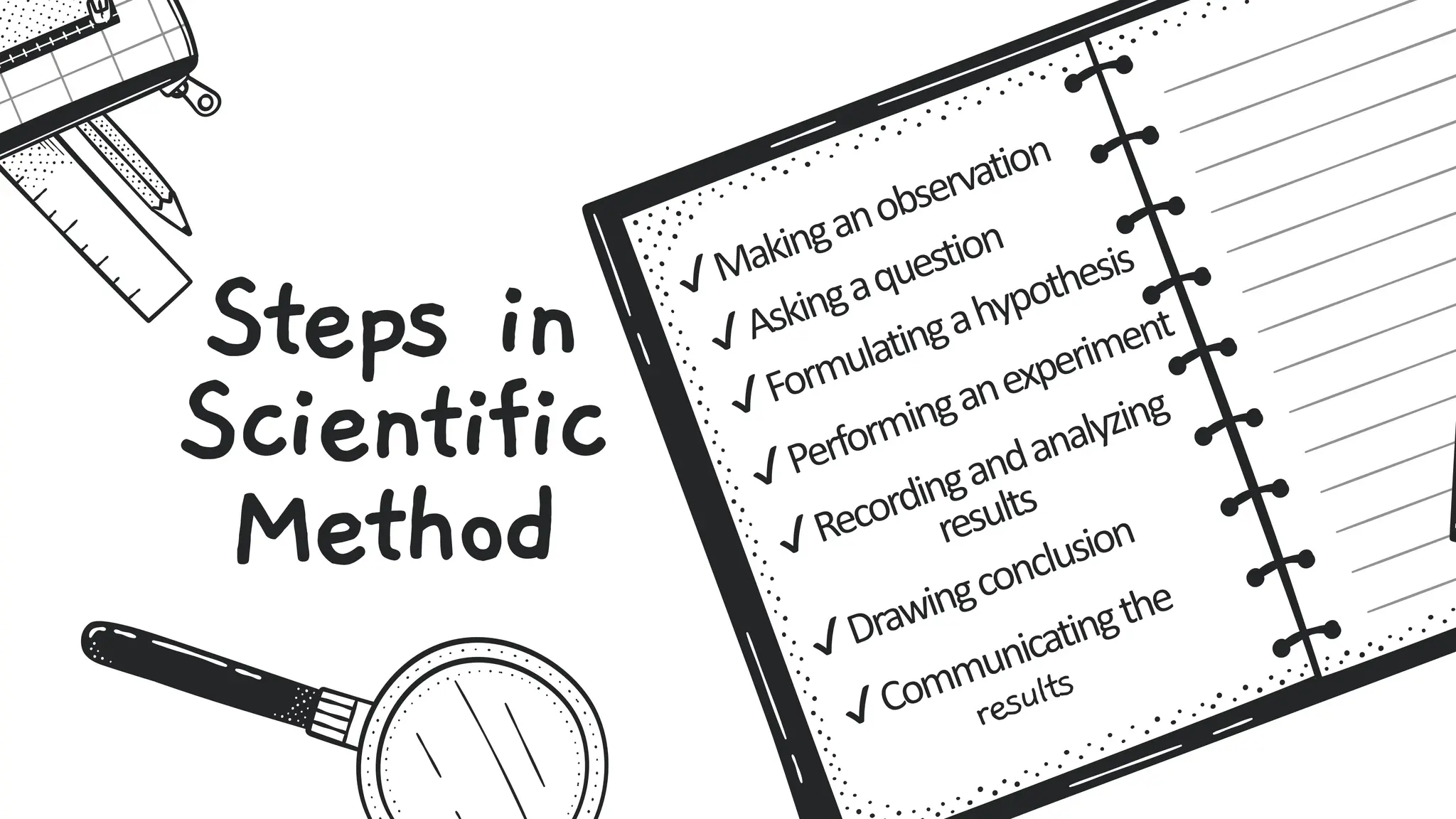
Steps in
Scientific
Method
• Making an Observation
Observation is the process of
getting information about the
things around you.
Qualitative
Observations
Quantitative
Observations
✓ Gathering of data using the senses.
• Sight • Taste
• Smell • Hearing
• Touch
✓ It is a subjective method of
gathering information as it
depends on the researcher’s
sensory organs.
✓ Does not use or without
numerical values.
✓ An objective method of data
analysis that measures research
variables in terms of quantity
hence; it is usually associated
with values that can be counted
such as age, weight,
volume, and scale.
✓ Uses numerical data
OBSERVATION: The tomato plant that is placed in an area with sunlight has a lot of fruits.
On the other hand, the tomato plant that is placed on a shaded area has lesser fruits.
2. Asking a Question
✓ A problem is a question that you
want to solve or the things you want
to discover.
✓ Develop a question or problem that
can be solved through
experimentation.
✓ Usually a “How” or “Why” type of
question. Everything starts with an
observation and what you perceive
with your senses.
QUESTION/PROBLEM: Why is the tomato plant located where there is sunlight have more
fruits than the tomato plant located on a place where there is little amount of sunlight?
3. Formulating a Hypothesis
✓ A hypothesis is an educated guess, a
tentative answer, or a potential
answer to the question or problem
asked.
✓ A proposed answer to your question
✓ Usually written in the “if-then”
format
HYPOTHESIS: If tomato plant is placed in an area where there is enough sunlight, then it
will produce more fruits.
4. Performing an Experiment
✓ An experiment is a series of tests
used to verify the hypothesis.
✓ This includes variables (quantity that
is changed during the experiment or
being measured)
THREE TYPES OF VARIABLES
❑ Independent variable
❑ Dependent variable
❑ Controlled variable
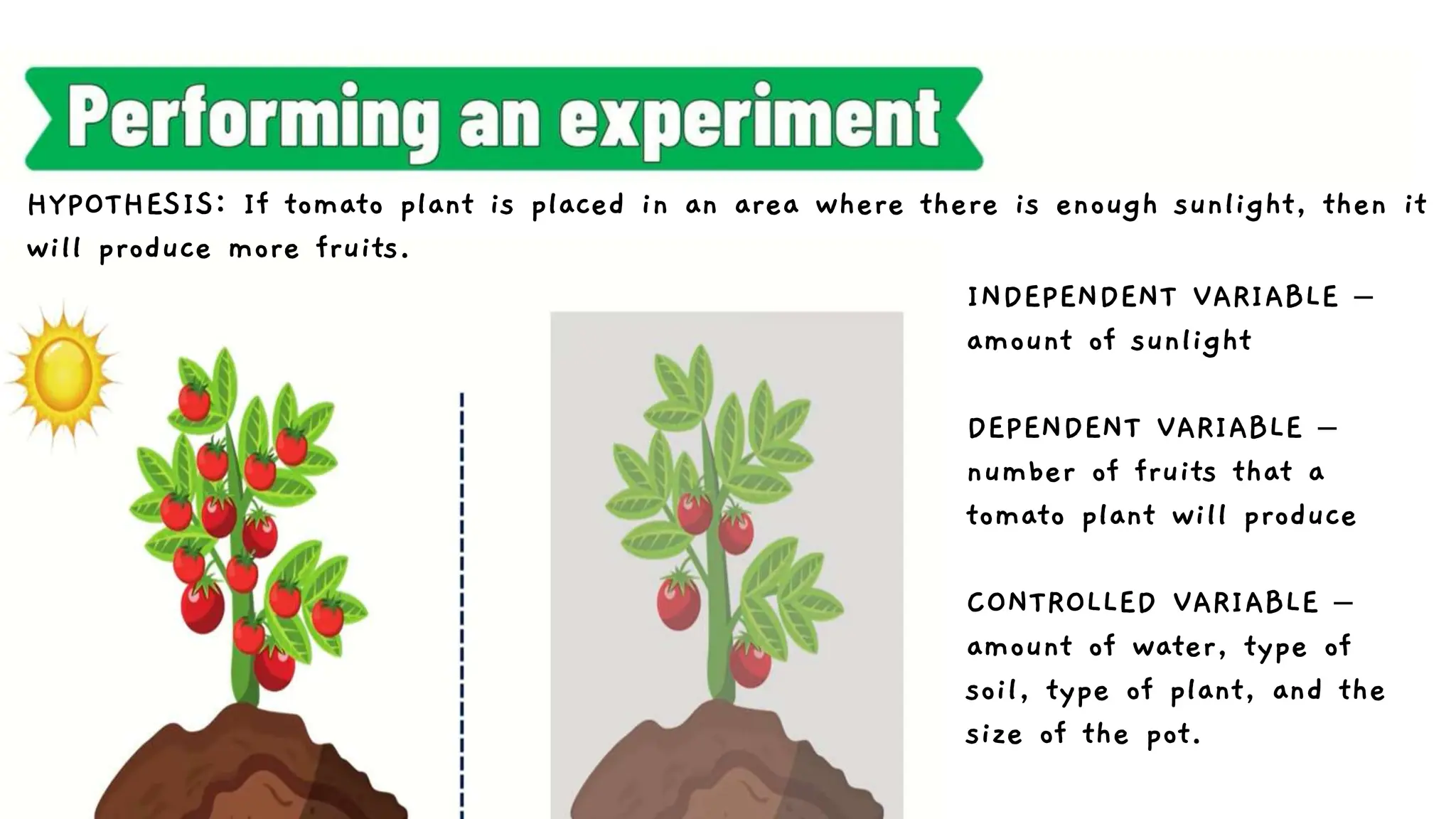
HYPOTHESIS: If tomato plant is placed in an area where there is enough sunlight, then it
will produce more fruits.
INDEPENDENT VARIABLE –
amount of sunlight
DEPENDENT VARIABLE –
number of fruits that a
tomato plant will produce
CONTROLLED VARIABLE –
amount of water, type of
soil, type of plant, and the
size of the pot.
5. Recording and Analyzing
Results
✓ This step is where you will report,
interpret, and explain what happened
in your experiment.
✓ Data are the information that
you gathered in your experiment.
6. Drawing a Conclusion
✓ Conclusion is the summary of the
results you gathered in your
experiment.
✓ This will give you an answer if your
hypothesis is correct or not.
✓ If the hypothesis is correct, this may
be the answer to your problem. If
not, you need to repeat the
experiment or think of a new
approach to improve your procedure.s
CONCLUSION: Plants such as tomato plant that are placed in an area with enough amount
of sunlight produce more fruits than those plants placed in less amount of sunlight.
7. Communicating the Result
✓ Informing others about the results of
the experiment.
✓ Publishing on scientific journals,
presenting using a poster, or
presenting at a conference.

Scientific-Method.pdfScientific-Method.p

  • 1.
  • 4.
  • 5.
    • Making anObservation Observation is the process of getting information about the things around you.
  • 6.
    Qualitative Observations Quantitative Observations ✓ Gathering ofdata using the senses. • Sight • Taste • Smell • Hearing • Touch ✓ It is a subjective method of gathering information as it depends on the researcher’s sensory organs. ✓ Does not use or without numerical values. ✓ An objective method of data analysis that measures research variables in terms of quantity hence; it is usually associated with values that can be counted such as age, weight, volume, and scale. ✓ Uses numerical data
  • 7.
    OBSERVATION: The tomatoplant that is placed in an area with sunlight has a lot of fruits. On the other hand, the tomato plant that is placed on a shaded area has lesser fruits.
  • 8.
    2. Asking aQuestion ✓ A problem is a question that you want to solve or the things you want to discover. ✓ Develop a question or problem that can be solved through experimentation. ✓ Usually a “How” or “Why” type of question. Everything starts with an observation and what you perceive with your senses.
  • 9.
    QUESTION/PROBLEM: Why isthe tomato plant located where there is sunlight have more fruits than the tomato plant located on a place where there is little amount of sunlight?
  • 10.
    3. Formulating aHypothesis ✓ A hypothesis is an educated guess, a tentative answer, or a potential answer to the question or problem asked. ✓ A proposed answer to your question ✓ Usually written in the “if-then” format
  • 11.
    HYPOTHESIS: If tomatoplant is placed in an area where there is enough sunlight, then it will produce more fruits.
  • 12.
    4. Performing anExperiment ✓ An experiment is a series of tests used to verify the hypothesis. ✓ This includes variables (quantity that is changed during the experiment or being measured) THREE TYPES OF VARIABLES ❑ Independent variable ❑ Dependent variable ❑ Controlled variable
  • 13.
    HYPOTHESIS: If tomatoplant is placed in an area where there is enough sunlight, then it will produce more fruits. INDEPENDENT VARIABLE – amount of sunlight DEPENDENT VARIABLE – number of fruits that a tomato plant will produce CONTROLLED VARIABLE – amount of water, type of soil, type of plant, and the size of the pot.
  • 14.
    5. Recording andAnalyzing Results ✓ This step is where you will report, interpret, and explain what happened in your experiment. ✓ Data are the information that you gathered in your experiment.
  • 15.
    6. Drawing aConclusion ✓ Conclusion is the summary of the results you gathered in your experiment. ✓ This will give you an answer if your hypothesis is correct or not. ✓ If the hypothesis is correct, this may be the answer to your problem. If not, you need to repeat the experiment or think of a new approach to improve your procedure.s
  • 16.
    CONCLUSION: Plants suchas tomato plant that are placed in an area with enough amount of sunlight produce more fruits than those plants placed in less amount of sunlight.
  • 17.
    7. Communicating theResult ✓ Informing others about the results of the experiment. ✓ Publishing on scientific journals, presenting using a poster, or presenting at a conference.