



PRESENTATION ONPRESENTATION ON
BCG Matrix & Porter’s Five forcesBCG Matrix & Porter’s Five forces
SUBMITTED TO
NAME OF TEACHER :SHARMIN AHKTER
DEP. OF FINANCE
PORT CITY INTERNATIONAL UNIVERSITY
 Submitted By
Name of Group:The Corporators
Program: BBA

Name ID
1.Shifuddin Nishad 00805574
2. Md. Sazzad Hossain 00805546
3.Rifat karim 00805567
4.MD.Sajjad Islam faisal 00805544
5.MD.Ariful Islam 00805569
6.Farhan Naim Oni 00805592
Boston consulting group
(bcg)
• It’s a Growth-
Share Matrix
which is a
portfolio planning
model developed
by BRUCE
HENDERSON
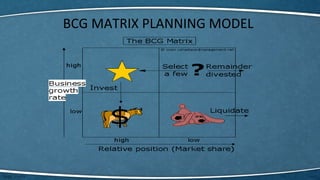
BCG MATRIX PLANNING MODEL
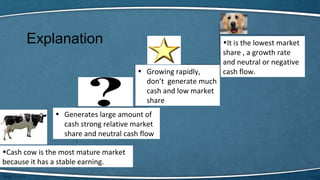
•Cash cow is the most mature market
because it has a stable earning.
• Growing rapidly,
don’t generate much
cash and low market
share
•It is the lowest market
share , a growth rate
and neutral or negative
cash flow.
• Generates large amount of
cash strong relative market
share and neutral cash flow
Explanation
BENEFITS
• BCG matrix is simple & easy to understand
• It helps to quickly & simply screen the opportunity open to
you, & help you think about how you can make the most of
them.
• It is used to identify how corporate cash resources can best
be used to maximize company’s future growth &
profitability.
LIMITATION
• BCG matrix uses only two dimensions relative market
share & market growth rate.
• Problem of getting data on market share & market
growth
• High market share does not mean profits all time.
• Business with market share can be profitable too.
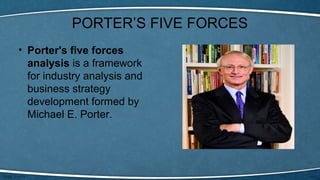
PORTER’S FIVE FORCES
• Porter's five forces
analysis is a framework
for industry analysis and
business strategy
development formed by
Michael E. Porter.
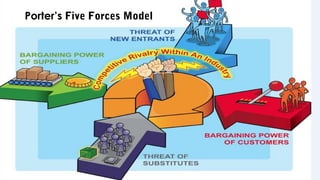
Porter’s Five Forces Model
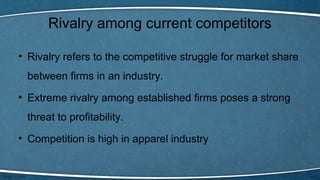
Rivalry among current competitors
• Rivalry refers to the competitive struggle for market share
between firms in an industry.
• Extreme rivalry among established firms poses a strong
threat to profitability.
• Competition is high in apparel industry
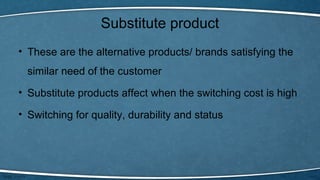
Substitute product
• These are the alternative products/ brands satisfying the
similar need of the customer
• Substitute products affect when the switching cost is high
• Switching for quality, durability and status
Threat of Substitute: Examples
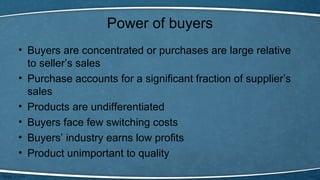
Power of buyers
• Buyers are concentrated or purchases are large relative
to seller’s sales
• Purchase accounts for a significant fraction of supplier’s
sales
• Products are undifferentiated
• Buyers face few switching costs
• Buyers’ industry earns low profits
• Product unimportant to quality
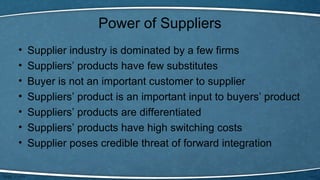
Power of Suppliers
• Supplier industry is dominated by a few firms
• Suppliers’ products have few substitutes
• Buyer is not an important customer to supplier
• Suppliers’ product is an important input to buyers’ product
• Suppliers’ products are differentiated
• Suppliers’ products have high switching costs
• Supplier poses credible threat of forward integration
Threat of New Entrants
• Economies of Scale
• Product Differentiation
• Capital Requirements
• Switching Costs
• Access to Distribution Channels
• Cost Disadvantages Independent of Scale
• Government Policy
Bcg matrix &; porter's five forces model

Bcg matrix &; porter's five forces model

  • 1.
    PRESENTATION ONPRESENTATION ON BCGMatrix & Porter’s Five forcesBCG Matrix & Porter’s Five forces
  • 2.
    SUBMITTED TO NAME OFTEACHER :SHARMIN AHKTER DEP. OF FINANCE PORT CITY INTERNATIONAL UNIVERSITY  Submitted By Name of Group:The Corporators Program: BBA  Name ID 1.Shifuddin Nishad 00805574 2. Md. Sazzad Hossain 00805546 3.Rifat karim 00805567 4.MD.Sajjad Islam faisal 00805544 5.MD.Ariful Islam 00805569 6.Farhan Naim Oni 00805592
  • 3.
    Boston consulting group (bcg) •It’s a Growth- Share Matrix which is a portfolio planning model developed by BRUCE HENDERSON
  • 4.
  • 5.
    •Cash cow isthe most mature market because it has a stable earning. • Growing rapidly, don’t generate much cash and low market share •It is the lowest market share , a growth rate and neutral or negative cash flow. • Generates large amount of cash strong relative market share and neutral cash flow Explanation
  • 6.
    BENEFITS • BCG matrixis simple & easy to understand • It helps to quickly & simply screen the opportunity open to you, & help you think about how you can make the most of them. • It is used to identify how corporate cash resources can best be used to maximize company’s future growth & profitability.
  • 7.
    LIMITATION • BCG matrixuses only two dimensions relative market share & market growth rate. • Problem of getting data on market share & market growth • High market share does not mean profits all time. • Business with market share can be profitable too.
  • 8.
    PORTER’S FIVE FORCES •Porter's five forces analysis is a framework for industry analysis and business strategy development formed by Michael E. Porter.
  • 9.
  • 10.
    Rivalry among currentcompetitors • Rivalry refers to the competitive struggle for market share between firms in an industry. • Extreme rivalry among established firms poses a strong threat to profitability. • Competition is high in apparel industry
  • 11.
    Substitute product • Theseare the alternative products/ brands satisfying the similar need of the customer • Substitute products affect when the switching cost is high • Switching for quality, durability and status
  • 12.
  • 13.
    Power of buyers •Buyers are concentrated or purchases are large relative to seller’s sales • Purchase accounts for a significant fraction of supplier’s sales • Products are undifferentiated • Buyers face few switching costs • Buyers’ industry earns low profits • Product unimportant to quality
  • 14.
    Power of Suppliers •Supplier industry is dominated by a few firms • Suppliers’ products have few substitutes • Buyer is not an important customer to supplier • Suppliers’ product is an important input to buyers’ product • Suppliers’ products are differentiated • Suppliers’ products have high switching costs • Supplier poses credible threat of forward integration
  • 15.
    Threat of NewEntrants • Economies of Scale • Product Differentiation • Capital Requirements • Switching Costs • Access to Distribution Channels • Cost Disadvantages Independent of Scale • Government Policy