Michael Porter …
“Anindustry’s profit potential
is largely determined by the
intensity of competitive
intensity of competitive
rivalry
rivalry within that industry.”
Portfolio Analysis …
…Strategy at the time (1970s)
was focused on two
two
dimensions
dimensions of the portfolio
grids …
… Industry Attractiveness
Industry Attractiveness
… Competitive Position
Competitive Position
Structural reasons why
…
…some industries were profitable
* Firm concentration
* Established cost advantages
* Product differentiation
* Economies of scale
8.
Structural reasons …
…all represented barriers to
barriers to
entry
entry in certain industries,
thus allowing those
industries to be more
more
profitable
profitable than others.
9.
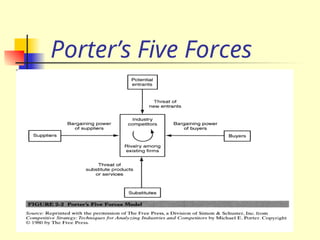
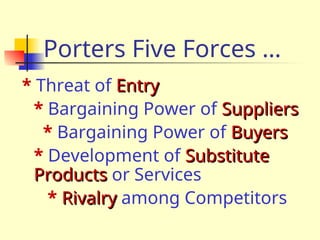
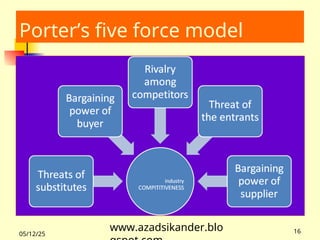
Porters Five Forces…
* Threat of Entry
Entry
* Bargaining Power of Suppliers
Suppliers
* Bargaining Power of Buyers
Buyers
* Development of Substitute
Substitute
Products
Products or Services
* Rivalry
Rivalry among Competitors
10.
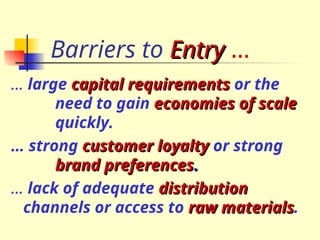
Barriers to Entry
Entry…
… large capital requirements
capital requirements or the
need to gain economies of scale
economies of scale
quickly.
… strong customer loyalty
customer loyalty or strong
brand preferences
brand preferences.
.
… lack of adequate distribution
distribution
channels or access to raw materials
raw materials.
11.
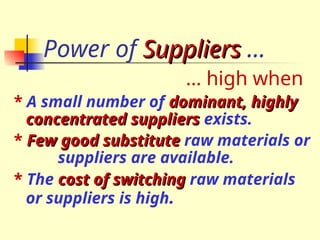
Power of Suppliers
Suppliers…
… high when
* A small number of dominant, highly
dominant, highly
concentrated suppliers
concentrated suppliers exists.
* Few good substitute
Few good substitute raw materials or
suppliers are available.
* The cost of switching
cost of switching raw materials
or suppliers is high.
12.
Power of Buyers
Buyers…
… high when
* Customers are concentrated
concentrated, large
large or
buy in volume
buy in volume .
* The products being purchased are
standard
standard or undifferentiated
undifferentiated making it
easy to switch
easy to switch to other suppliers.
* Customers’ purchases represent a major
major
portion
portion of the sellers’ total revenue.
13.
Substitute
Substitute products …
…competitive strength high
when
* The relative price
relative price of substitute
products declines
declines .
* Consumers’ switching costs decline
switching costs decline.
* Competitors plan to increase market
increase market
penetration
penetration or production capacity
production capacity.
14.
Rivalry
Rivalry among competitors
…intensity increases as
* The number
number of competitors increases
increases
or they become equal in size
equal in size.
* Demand for the industry’s products
declines
declines or industry growth slows
industry growth slows.
* Fixed costs
Fixed costs or barriers to leaving
barriers to leaving the
industry are high
high.
15.
Summary
Summary …
As rivalryamong competing
firms intensifies
intensifies, industry
profits decline
decline, in some cases
to the point where an
industry becomes inherently
inherently
unattractive
unattractive.
05/12/25 17
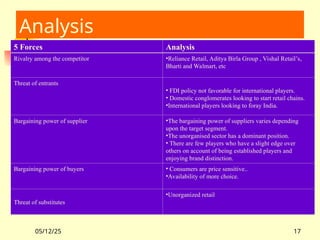
Analysis
5 ForcesAnalysis
Rivalry among the competitor •Reliance Retail, Aditya Birla Group , Vishal Retail’s,
Bharti and Walmart, etc
Threat of entrants
• FDI policy not favorable for international players.
• Domestic conglomerates looking to start retail chains.
•International players looking to foray India.
Bargaining power of supplier •The bargaining power of suppliers varies depending
upon the target segment.
•The unorganised sector has a dominant position.
• There are few players who have a slight edge over
others on account of being established players and
enjoying brand distinction.
Bargaining power of buyers • Consumers are price sensitive..
•Availability of more choice.
Threat of substitutes
•Unorganized retail