LAKSHMI NARAIN COLLEG OF
TECHNILOGY
SESSION :
2014-2015
A PRESENTATION ON :
CONCRETE
SUBMITTED TO : SUBMITTED BY :
ER. ANKIT SIR PRADHAN RISHI SHARMA
PANKAJ MANDELA
PRAGYA JAIN
PRACHI SEN
PREM GOUR
What is concrete ?
Concrete is a composite material
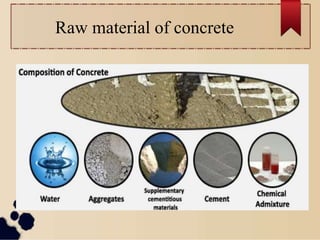
composed mainly of water, aggregate,
and cement. Often, additives and
reinforcements (such as rebar) are
included in the mixture to achieve the
desired physical properties of the
finished material
Uses of concrete
Concrete is widely used for making architectural
structures, foundations, brick/block walls, pavements,
bridges/overpasses, highways, runways, parking
structures, dams, pools/reservoirs, pipes, footings for
gates, fences and poles and even boats
Concrete is used in large quantities almost everywhere
society has a need for infrastructure.
Concrete is used in large quantities almost everywhere mankind has a need for infrastructure.
Raw material of concrete
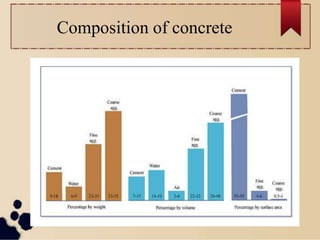
Composition of concrete
Types of concrete
Normal concrete
High Strength Concrete
High Performance Concrete
Light Weight Concrete
Self Compacting Concrete
Normal concrete
The concrete in which common ingredients i.e. aggregate,
water, cement are used is known as normal concrete.
It has a setting time of 30 - 90 minutes depending upon
moisture in atmosphere, fineness of cement etc.
The development of the strength starts after 7 days the
common strength values is 10 MPa (1450 psi) to 40 MPa (5800
psi). At about 28 days 75 - 80% of the total strength is attained.
Almost at 90 days 95% of the strength is achieved.
High strength concrete
Compressive strength of high strength concrete mix is usually greater
than 6,000 pounds per square inch.
High strength concrete is made by lowering the water cement (W/C)
ratio to 0.35 or lower.
Often silica fume is added to prevent the formation of free calcium
hydroxide crystals in the cement, which might reduce the strength at
the cement aggregate bond.
Low w/c ratios and the use of silica fume make concrete mixes
significantly less workable, which is particularly likely to be a
problem in high-strength concrete applications where dense rebar
cages are likely to be used.
Aggregate must be selected carefully for high strength mixes
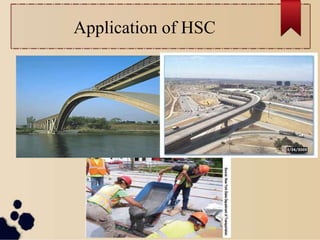
Application of HSC
Light weight concrete
The concrete which has substantially lower mass per
unit volume then the concrete made of ordinary
ingredients is called lightweight concrete. The
aggregates used are lighter in weight.
Density of light weight concrete is 240 kg/m³ (15pcf) -
1850 kg/m³ (115 pcf).
Strength of light weight concrete blocks varies from 7
MPa (1000 psi) - 40 MPa (5800 psi).
Some times Air Entrained Admixtures are also added
to it giving resistance to freezing and thawing along
with strength.
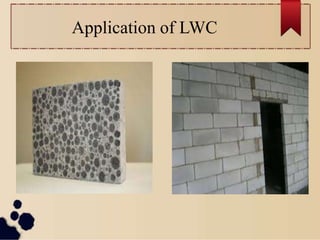
Application of LWC
Self compacting concrete
The concrete where no vibration is required. The
concrete is compacted due to its own weight
It is also called self consolidated concrete or flowing
concrete
It can be also categorized as high performance
concrete as the ingredients are the same, but in this
type of concrete workability is increased
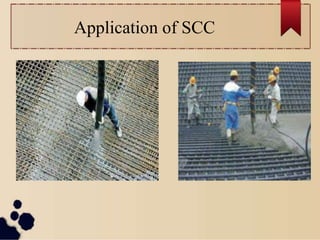
Application of SCC
Thank You All !!

Cement

  • 1.
    LAKSHMI NARAIN COLLEGOF TECHNILOGY SESSION : 2014-2015 A PRESENTATION ON : CONCRETE SUBMITTED TO : SUBMITTED BY : ER. ANKIT SIR PRADHAN RISHI SHARMA PANKAJ MANDELA PRAGYA JAIN PRACHI SEN PREM GOUR
  • 2.
    What is concrete? Concrete is a composite material composed mainly of water, aggregate, and cement. Often, additives and reinforcements (such as rebar) are included in the mixture to achieve the desired physical properties of the finished material
  • 3.
    Uses of concrete Concreteis widely used for making architectural structures, foundations, brick/block walls, pavements, bridges/overpasses, highways, runways, parking structures, dams, pools/reservoirs, pipes, footings for gates, fences and poles and even boats Concrete is used in large quantities almost everywhere society has a need for infrastructure. Concrete is used in large quantities almost everywhere mankind has a need for infrastructure.
  • 4.
  • 5.
  • 6.
    Types of concrete Normalconcrete High Strength Concrete High Performance Concrete Light Weight Concrete Self Compacting Concrete
  • 7.
    Normal concrete The concretein which common ingredients i.e. aggregate, water, cement are used is known as normal concrete. It has a setting time of 30 - 90 minutes depending upon moisture in atmosphere, fineness of cement etc. The development of the strength starts after 7 days the common strength values is 10 MPa (1450 psi) to 40 MPa (5800 psi). At about 28 days 75 - 80% of the total strength is attained. Almost at 90 days 95% of the strength is achieved.
  • 8.
    High strength concrete Compressivestrength of high strength concrete mix is usually greater than 6,000 pounds per square inch. High strength concrete is made by lowering the water cement (W/C) ratio to 0.35 or lower. Often silica fume is added to prevent the formation of free calcium hydroxide crystals in the cement, which might reduce the strength at the cement aggregate bond. Low w/c ratios and the use of silica fume make concrete mixes significantly less workable, which is particularly likely to be a problem in high-strength concrete applications where dense rebar cages are likely to be used. Aggregate must be selected carefully for high strength mixes
  • 9.
  • 10.
    Light weight concrete Theconcrete which has substantially lower mass per unit volume then the concrete made of ordinary ingredients is called lightweight concrete. The aggregates used are lighter in weight. Density of light weight concrete is 240 kg/m³ (15pcf) - 1850 kg/m³ (115 pcf). Strength of light weight concrete blocks varies from 7 MPa (1000 psi) - 40 MPa (5800 psi). Some times Air Entrained Admixtures are also added to it giving resistance to freezing and thawing along with strength.
  • 11.
  • 12.
    Self compacting concrete Theconcrete where no vibration is required. The concrete is compacted due to its own weight It is also called self consolidated concrete or flowing concrete It can be also categorized as high performance concrete as the ingredients are the same, but in this type of concrete workability is increased
  • 13.
  • 14.