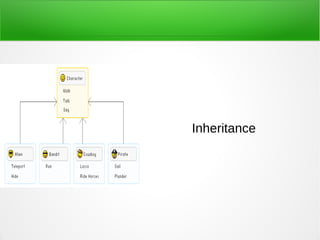
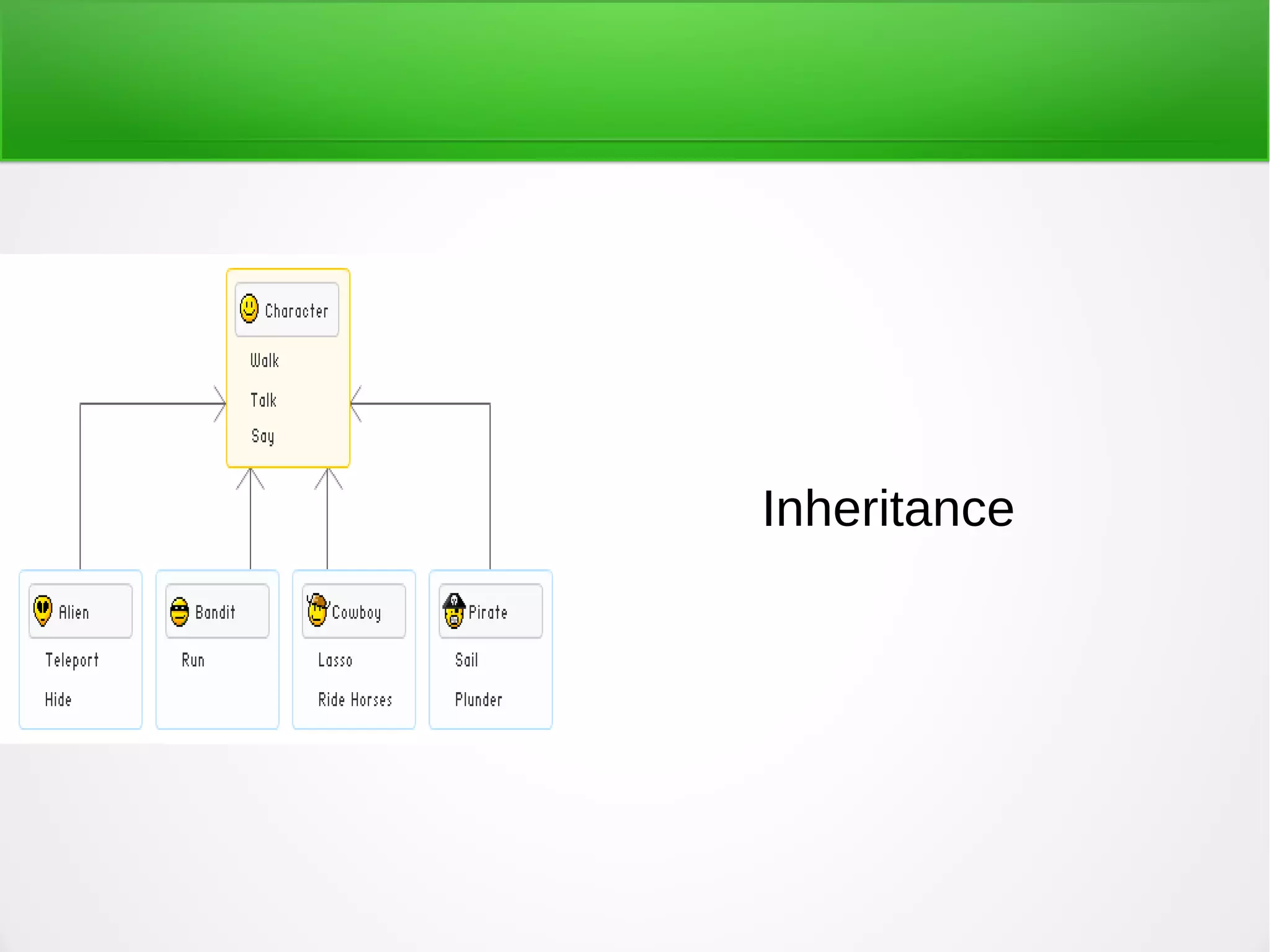
Inheritance
Definition
In object-oriented programming, inheritance
enables new objects to take on the properties of
existing objects. A class that is used as the basis
for inheritance is called a superclass or base
class
Inheritance is a good choice when
● Your inheritance hierarchy represents an "is-a"
relationship and not a "has-a" relationship.
● You can reuse code from the base classes.
● You need to apply the same class and methods to
different data types.
● The class hierarchy is reasonably shallow, and other
developers are not likely to add many more levels.
● You want to make global changes to derived classes
by changing a base class.
Types
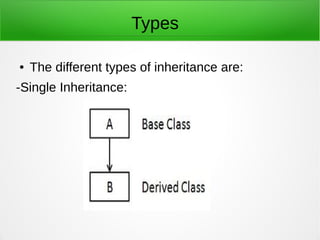
● The different types of inheritance are:
-Single Inheritance:
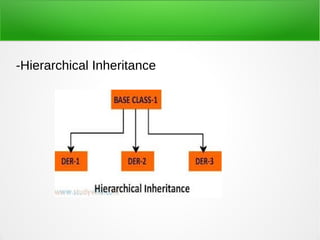
-Hierarchical Inheritance
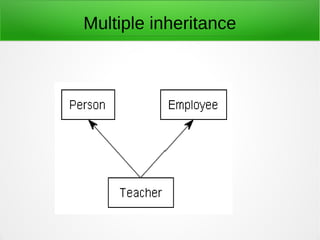
Multiple inheritance
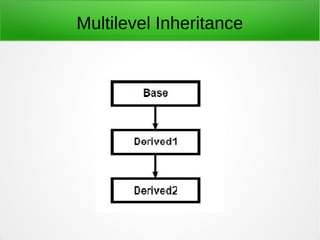
Multilevel Inheritance
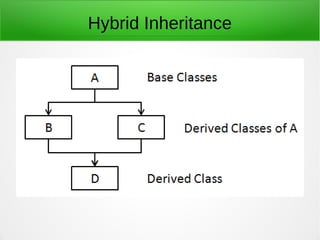
Hybrid Inheritance
Advantages
● Reusability -- facility to use public methods of base
class without rewriting the same
● Extensibility -- extending the base class logic as per
business logic of the derived class
● Data hiding -- base class can decide to keep some data
private so that it cannot be altered by the derived class
● Overriding--With inheritance, we will be able to override
the methods of the base class so that meaningful
implementation of the base class method can be
designed in the derived class.
Disadvantages
● Main disadvantage of using inheritance is that the two classes (base
and inherited class) get tightly coupled.
● This means one cannot be used independent of each other.
● Also with time, during maintenance adding new features both base as
well as derived classes are required to be changed. If a method
signature is changed then we will be affected in both cases (inheritance
& composition)
● If a method is deleted in the "super class" or aggregate, then we will
have to re-factor in case of using that method
THANK YOU!

Inheritance

  • 1.
  • 2.
    Definition In object-oriented programming,inheritance enables new objects to take on the properties of existing objects. A class that is used as the basis for inheritance is called a superclass or base class
  • 3.
    Inheritance is agood choice when ● Your inheritance hierarchy represents an "is-a" relationship and not a "has-a" relationship. ● You can reuse code from the base classes. ● You need to apply the same class and methods to different data types. ● The class hierarchy is reasonably shallow, and other developers are not likely to add many more levels. ● You want to make global changes to derived classes by changing a base class.
  • 4.
    Types ● The differenttypes of inheritance are: -Single Inheritance:
  • 5.
  • 6.
  • 7.
  • 8.
  • 9.
    Advantages ● Reusability --facility to use public methods of base class without rewriting the same ● Extensibility -- extending the base class logic as per business logic of the derived class ● Data hiding -- base class can decide to keep some data private so that it cannot be altered by the derived class ● Overriding--With inheritance, we will be able to override the methods of the base class so that meaningful implementation of the base class method can be designed in the derived class.
  • 10.
    Disadvantages ● Main disadvantageof using inheritance is that the two classes (base and inherited class) get tightly coupled. ● This means one cannot be used independent of each other. ● Also with time, during maintenance adding new features both base as well as derived classes are required to be changed. If a method signature is changed then we will be affected in both cases (inheritance & composition) ● If a method is deleted in the "super class" or aggregate, then we will have to re-factor in case of using that method
  • 11.