1 
MGU-BCA-103-First Semester – Basic Statistics 
MCQs 
UNIT 1 BASICS OF STATISTICS AND STATISTICAL DATA 
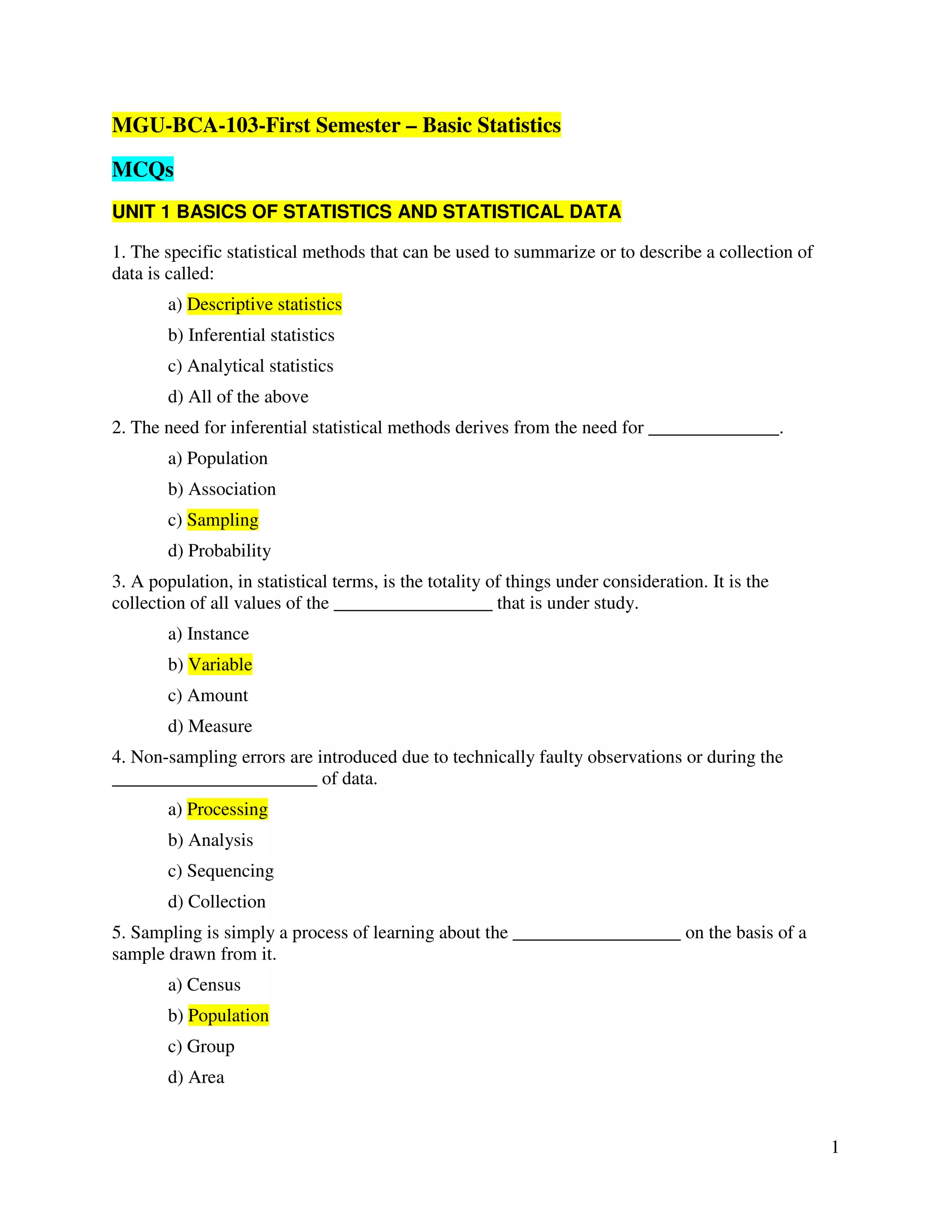
1. The specific statistical methods that can be used to summarize or to describe a collection of 
data is called: 
a) Descriptive statistics 
b) Inferential statistics 
c) Analytical statistics 
d) All of the above 
2. The need for inferential statistical methods derives from the need for ______________. 
a) Population 
b) Association 
c) Sampling 
d) Probability 
3. A population, in statistical terms, is the totality of things under consideration. It is the 
collection of all values of the _________________ that is under study. 
a) Instance 
b) Variable 
c) Amount 
d) Measure 
4. Non-sampling errors are introduced due to technically faulty observations or during the 
______________________ of data. 
a) Processing 
b) Analysis 
c) Sequencing 
d) Collection 
5. Sampling is simply a process of learning about the __________________ on the basis of a 
sample drawn from it. 
a) Census 
b) Population 
c) Group 
d) Area
2 
6. Numerical facts are usually subjected to statistical analysis with a view to helping a decision-maker 
make wise decisions in the face of ___________________. 
a) Interpreting 
b) Uncertainty 
c) Summarizing 
d) Organizing 
7. In statistics, ___________________________ classification includes data according to the 
time period in which the items under consideration occurred. 
a) Chronological 
b) Alphabetical 
c) Geographical 
d) Topological 
8. Data is simply the numerical results of any scientific__________________. 
a) Analysis 
b) Researches 
c) Observation 
d) Measurement 
9. The ________________ process would be required to ensure that the data is complete and as 
required. 
a) Tabulation 
b) Analysis 
c) Editing 
d) Ordering 
10. A sample is a portion of the ________________ population that is considered for study and 
analysis. 
a) Selected 
b) Total 
c) Fixed 
d) Random 
11. The method of sampling, in which the choice of sample items depends exclusively on the 
judgement of the investigator is termed as ________________________. 
a) Convenience sampling 
b) Quota sampling 
c) Systematic sampling
3 
d) Judgement sampling 
12. Both the sampling as well as the non-sampling errors must be reduced to a minimum in order 
to get as representative a sample of the ___________________ as possible. 
a) Group 
b) Region 
c) Population 
d) Universe 
13. The larger the size of the population, the ___________________ should be the sample size. 
a) Smaller 
b) Larger 
c) Accurate 
d) Fixed 
14. When the data is to be processed by computers, then it must be coded and converted into the 
____________________ ___________________. 
a) English language 
b) Regional language 
c) Statistical language 
d) Computer language 
15. A variable is any characteristic which can assume ____________________ values. 
a) Different 
b) Similar 
c) Fixed 
d) Assumed 
16. The basic objective of a sample is to draw ____________________ about the population 
from which such sample is drawn. 
a) Conclusion 
b) Characteristics 
c) Inferences 
d) Parameters 
17. In ___________________ type of classification, the data is grouped together according to 
some distinguished characteristic or attribute, such as religion, sex, age, national origin, and so 
on. 
a) Quantitative 
b) Chronological
4 
c) Qualitative 
d) All of the above 
18. A _____________________ variable is a variable whose values can theoretically take on an 
infinite number of values within a given range of values. 
a) Continuous 
b) Discrete 
c) Random 
d) Both (a) and (b) 
19. A perfect random number table would be one in which every digit has been entered 
_______________. 
a) Chronologically 
b) Sequentially 
c) Randomly 
d) Arbitrarily 
20. The _________________ random variables yield categorical responses so that the responses 
fit into one category or another. 
a) Quantitative 
b) Discrete 
c) Continuous 
d) Qualitative 
21. For a sample to be truly representative of the population, it must truly be________________. 
a) Fixed 
b) Random 
c) Specific 
d) Casual 
22. A ______________ ______________ is a phenomenon of interest in which the observed 
outcomes of an activity are entirely by chance, are absolutely unpredictable and may differ from 
response to response. 
a) Discrete variable 
b) Continuous variable 
c) Random variable 
d) All of the above 
23. By definition of randomness, each ________________ ______________ has the same 
chance of being considered.
5 
a) Possible entity 
b) Probable entity 
c) Random entity 
d) Observed entity 
24. Before any procedures for _____________ _________________ are established, the purpose 
and the scope of the study must be clearly specified. 
a) Data analysis 
b) Data tabulation 
c) Data collection 
d) Data selection 
25. Adequacy of data is to be judged in the light of the requirements of the survey and the 
geographical areas covered by the __________________ data. 
a) Collected 
b) Available 
c) Organized 
d) Tabulated 
26. If the sample is truly representative of the population, then the characteristics of the sample 
can be considered to be the same as those of the _______________ population. 
a) Fixed 
b) Selected 
c) Random 
d) Entire 
27. Statistical inference deals with methods of inferring or drawing ___________________ 
about the characteristics of the population based upon the results of the sample taken from the 
same population. 
a) Details 
b) Decisions 
c) Conclusions 
d) Samples 
28. If the sample size is too small, it may not _______________ represent the population or the 
universe as it is known, thus leading to incorrect inferences. 
a) Appropriately 
b) Reliably 
c) Homogeneously
6 
d) Heterogeneously 
29. Editing would also help eliminate inconsistencies or obvious errors due to _______________ 
treatment. 
a) Characteristic 
b) Arithmetical 
c) Calculation 
d) Tabulation 
30. When an investigator uses the data which has already been collected by others, such data is 
called _______________ _________. 
a) Primary data 
b) Collected data 
c) Processed data 
d) Secondary data 
31. In the case of the questionnaire method of gathering data, it should be made certain that all 
the questions have been _____________________. 
a) Read 
b) Interpreted 
c) Answered 
d) All of the above 
32. _____________________ provides various types of statistical information of either 
qualitative or quantitative nature. 
a) Sampling 
b) Tabulation 
c) Observation 
d) Editing 
33. In statistics, ____________________classification groups the data according to locational 
differences among the items. 
a) Chronological 
b) Geographical 
c) Regional 
d) Alphabetical 
34. The degree of randomness of selection would depend upon the process of selecting the items 
from the ________________________. 
a) Population
7 
b) Region 
c) Sample 
d) Data 
35. A _____________________ sample is obtained by selecting convenient population units 
a) Random 
b) Quota 
c) Stratified 
d) Convenience 
36. A __________________ sample is formed by selecting one unit at random and then selecting 
additional units at evenly spaced intervals until the sample has been formed. 
a) Stratified 
b) Systematic 
c) Judgement 
d) Random 
37. The sampling errors arise due to drawing faulty inferences about the __________________ 
based upon the results of the samples. 
a) Sample 
b) Survey 
c) Population 
d) Census 
38. A summary measure that describes any given characteristic of the population is known as a 
__________________. 
a) Parameter 
b) Information 
c) Inference 
d) Statistics 
39. ________________ means separating items according to similar characteristics and grouping 
them into various classes. 
a) Tabulation 
b) Editing 
c) Separation 
d) Classification
8 
40. _____________________ is one which is collected by the investigator himself for the 
purpose of a specific inquiry or study. 
a) Secondary data 
b) Primary data 
c) Statistical data 
d) Published data 
UNIT 2 ANALYSIS OF STATISTICAL DATA 
1. In chronological classification, the data is classified on the basis of: 
a) Time 
b) Money 
c) Location 
d) Quality 
2. The classification of data according to location is what classification: 
a) Chronological 
b) Quantitative 
c) Qualitative 
d) Geographical 
3. The magnitude of the class is the: 
a) The product of lower limit and upper limit 
b) The sum of lower limit and upper limit 
c) The difference of upper limit and lower limit 
d) None of these 
4. A function very similar to that of sorting letters in a post office is: 
a) Mean 
b) Standard deviation 
c) Classification 
d) Mean deviation 
5. The value lying half way between the upper limit and lower limit of the class is: 
a) Class interval 
b) Mid point
9 
c) Frequency 
d) None of the above 
6. The classes in which the lower limit or the upper limit is not specified are known as: 
a) Open end classes 
b) Close end classes 
c) Inclusive classes 
d) Exclusive classes 
7. Classes in which upper limits are excluded from the respective classes and are included in 
the immediate next class are: 
a) Open end classes 
b) Close end classes 
c) Inclusive classes 
d) Exclusive classes 
8. If the class mid points in a frequency distribution of age of a group of persons are 25, 32, 39, 
46, 53 and 60. The size of class interval is: 
a) 5 
b) 7 
c) 8 
d) 6 
9. The number of observations in a particular class is called: 
a) Width of the class 
b) Class mark 
c) Frequency 
d) None of the above 
10. If the mid points of the classes are 16, 24, 32, 40, and so on, then the magnitude of the class 
interval is: 
a) 8 
b) 9 
c) 7 
d) 6
10 
11. The first step in tabulation is: 
a) Foot note 
b) Source note 
c) Captions 
d) Classification 
12. A systematic arrangement of data in rows and columns is: 
a) Table 
b) Tabulation 
c) Body 
d) All the above 
13. The numerical information in a statistical table is called the: 
a) Table 
b) Foot note 
c) Source note 
d) Body 
14. In a statistical table the row headings are referred to as: 
a) Source note 
b) Captions 
c) Stubs 
d) Body 
15. In the statistical table column headings are called: 
a) Stubs 
b) Captions 
c) Source note 
d) None of these 
16. If the class mid points in a frequency distribution of a group of persons are: 125, 132, 139, 
146, 153, 160, 167, 174, 181 pounds, then the size of the class is: 
a) 6
11 
b) 8 
c) 7 
d) 9 
17. The different types of samplings are: 
a) Probability 
b) Judgement 
c) Mixed 
d) All the above 
18. Two dimensional diagrams used in surface diagrams are: 
a) Squares 
b) Pie diagrams 
c) Circles 
d) All the above 
19. One dimensional diagram is: 
a) Line diagram 
b) Rectangles 
c) Cubes 
d) Squares 
20. Type of bar diagram is: 
a) Pictogram 
b) Sub divided diagram 
c) Line diagrams 
d) Pie diagram 
21. The most commonly used device of presenting business and economic data is: 
a) Pie diagrams 
b) Pictograms 
c) Bar diagrams 
d) Line diagrams 
22. A pie diagram is also called: 
a) Pictogram
12 
b) Angular diagram 
c) Line diagram 
d) Bar diagram 
23. In volume diagram the three dimensions which are taken into account are: 
a) Length, weight, breadth 
b) Height, weight, breadth 
c) Length, height, breadth 
d) Length, weight, height 
24. The median of a frequency distribution is found graphically with the help of: 
a) Histogram 
b) Frequency curve 
c) Frequency polygon 
d) Ogive 
25. The mode of a frequency distribution can be determined graphically by: 
a) Histogram 
b) Frequency curve 
c) Frequency polygon 
d) Ogive 
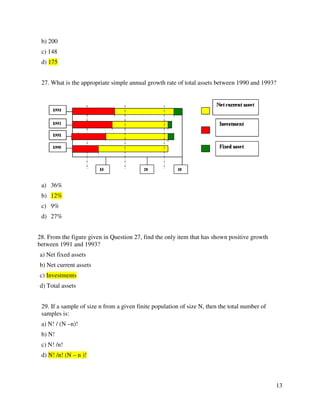
26. Find the median of the given ogive: 
a) 150
13 
b) 200 
c) 148 
d) 175 
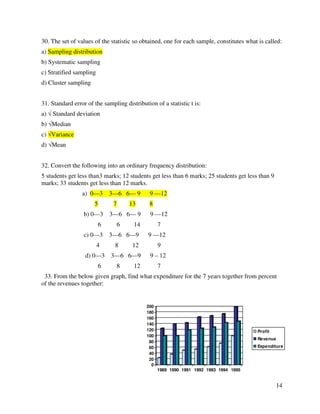
27. What is the appropriate simple annual growth rate of total assets between 1990 and 1993? 
a) 36% 
b) 12% 
c) 9% 
d) 27% 
28. From the figure given in Question 27, find the only item that has shown positive growth 
between 1991 and 1993? 
a) Net fixed assets 
b) Net current assets 
c) Investments 
d) Total assets 
29. If a sample of size n from a given finite population of size N, then the total number of 
samples is: 
a) N! / (N –n)! 
b) N! 
c) N! /n! 
d) N! /n! (N – n )!
30. The set of values of the statistic so obtained, one for each sample, constitutes what is called: 
a) Sampling distribution 
b) Systematic sampling 
c) Stratified sampling 
d) Cluster sampling 
14 
31. Standard error of the sampling distribution of a statistic t is: 
a)  Standard deviation 
b) Median 
c) Variance 
d) Mean 
32. Convert the following into an ordinary frequency distribution: 
5 students get less than3 marks; 12 students get less than 6 marks; 25 students get less than 9 
marks; 33 students get less than 12 marks. 
a) 0—3 3—6 6— 9 9 —12 
5 7 13 8 
b) 0—3 3—6 6— 9 9 —12 
6 6 14 7 
c) 0—3 3—6 6—9 9 —12 
4 8 12 9 
d) 0—3 3—6 6—9 9 – 12 
6 8 12 7 
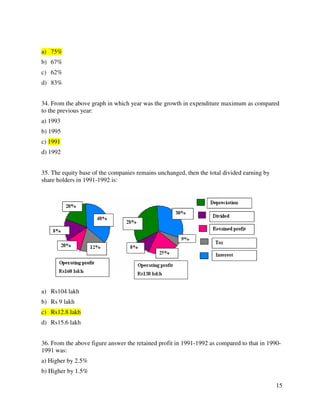
33. From the below given graph, find what expenditure for the 7 years together from percent 
of the revenues together: 
200 
180 
160 
140 
120 
100 
80 
60 
40 
20 
0 
1989 1990 1991 1992 1993 1994 1995 
Profit 
Revenue 
Expenditure
15 
a) 75% 
b) 67% 
c) 62% 
d) 83% 
34. From the above graph in which year was the growth in expenditure maximum as compared 
to the previous year: 
a) 1993 
b) 1995 
c) 1991 
d) 1992 
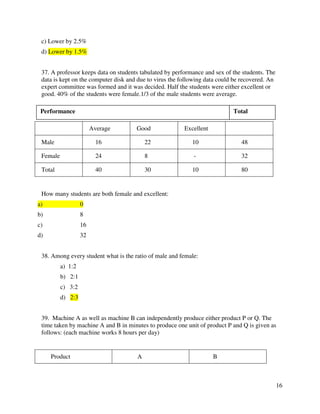
35. The equity base of the companies remains unchanged, then the total divided earning by 
share holders in 1991-1992 is: 
a) Rs104 lakh 
b) Rs 9 lakh 
c) Rs12.8 lakh 
d) Rs15.6 lakh 
36. From the above figure answer the retained profit in 1991-1992 as compared to that in 1990- 
1991 was: 
a) Higher by 2.5% 
b) Higher by 1.5%
16 
c) Lower by 2.5% 
d) Lower by 1.5% 
37. A professor keeps data on students tabulated by performance and sex of the students. The 
data is kept on the computer disk and due to virus the following data could be recovered. An 
expert committee was formed and it was decided. Half the students were either excellent or 
good. 40% of the students were female.1/3 of the male students were average. 
Performance Total 
Average Good Excellent 
Male 16 22 10 48 
Female 24 8 - 32 
Total 40 30 10 80 
How many students are both female and excellent: 
a) 0 
b) 8 
c) 16 
d) 32 
38. Among every student what is the ratio of male and female: 
a) 1:2 
b) 2:1 
c) 3:2 
d) 2:3 
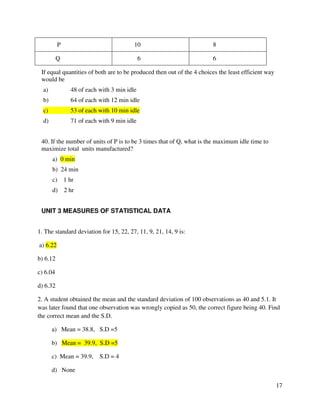
39. Machine A as well as machine B can independently produce either product P or Q. The 
time taken by machine A and B in minutes to produce one unit of product P and Q is given as 
follows: (each machine works 8 hours per day) 
Product A B
17 
P 10 8 
Q 6 6 
If equal quantities of both are to be produced then out of the 4 choices the least efficient way 
would be 
a) 48 of each with 3 min idle 
b) 64 of each with 12 min idle 
c) 53 of each with 10 min idle 
d) 71 of each with 9 min idle 
40. If the number of units of P is to be 3 times that of Q, what is the maximum idle time to 
maximize total units manufactured? 
a) 0 min 
b) 24 min 
c) 1 hr 
d) 2 hr 
UNIT 3 MEASURES OF STATISTICAL DATA 
1. The standard deviation for 15, 22, 27, 11, 9, 21, 14, 9 is: 
a) 6.22 
b) 6.12 
c) 6.04 
d) 6.32 
2. A student obtained the mean and the standard deviation of 100 observations as 40 and 5.1. It 
was later found that one observation was wrongly copied as 50, the correct figure being 40. Find 
the correct mean and the S.D. 
a) Mean = 38.8, S.D =5 
b) Mean = 39.9, S.D =5 
c) Mean = 39.9, S.D = 4 
d) None
18 
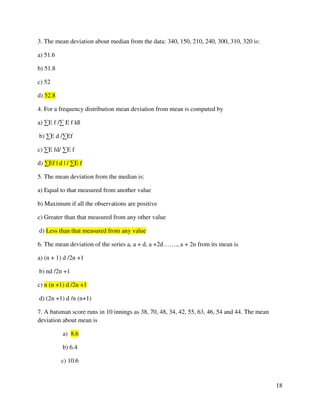
3. The mean deviation about median from the data: 340, 150, 210, 240, 300, 310, 320 is: 
a) 51.6 
b) 51.8 
c) 52 
d) 52.8 
4. For a frequency distribution mean deviation from mean is computed by 
a) E f / E f |d| 
b) E d /Ef 
c) E fd/ E f 
d) Ef | d | / E f 
5. The mean deviation from the median is: 
a) Equal to that measured from another value 
b) Maximum if all the observations are positive 
c) Greater than that measured from any other value 
d) Less than that measured from any value 
6. The mean deviation of the series a, a + d, a +2d……., a + 2n from its mean is 
a) (n + 1) d /2n +1 
b) nd /2n +1 
c) n (n +1) d /2n +1 
d) (2n +1) d /n (n+1) 
7. A batsman score runs in 10 innings as 38, 70, 48, 34, 42, 55, 63, 46, 54 and 44. The mean 
deviation about mean is 
a) 8.6 
b) 6.4 
c) 10.6
19 
d) 7.6 
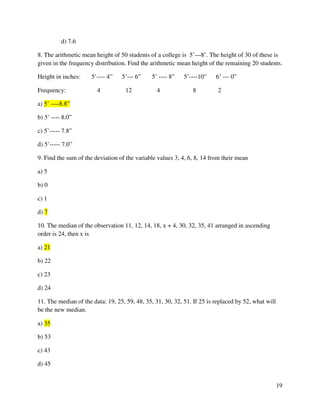
8. The arithmetic mean height of 50 students of a college is 5’---8’. The height of 30 of these is 
given in the frequency distribution. Find the arithmetic mean height of the remaining 20 students. 
Height in inches: 5’---- 4” 5’--- 6” 5’ ---- 8” 5’----10” 6’ --- 0” 
Frequency: 4 12 4 8 2 
a) 5’ ----8.8” 
b) 5’ ---- 8.0” 
c) 5’----- 7.8” 
d) 5’----- 7.0” 
9. Find the sum of the deviation of the variable values 3, 4, 6, 8, 14 from their mean 
a) 5 
b) 0 
c) 1 
d) 7 
10. The median of the observation 11, 12, 14, 18, x + 4, 30, 32, 35, 41 arranged in ascending 
order is 24, then x is 
a) 21 
b) 22 
c) 23 
d) 24 
11. The median of the data: 19, 25, 59, 48, 35, 31, 30, 32, 51. If 25 is replaced by 52, what will 
be the new median. 
a) 35 
b) 53 
c) 43 
d) 45
20 
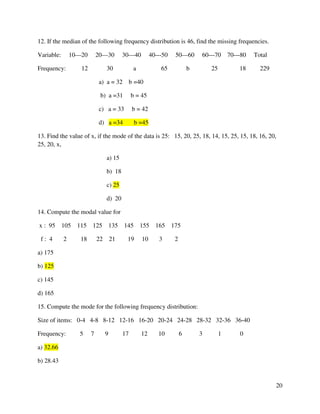
12. If the median of the following frequency distribution is 46, find the missing frequencies. 
Variable: 10—20 20—30 30—40 40---50 50—60 60---70 70---80 Total 
Frequency: 12 30 a 65 b 25 18 229 
a) a = 32 b =40 
b) a =31 b = 45 
c) a = 33 b = 42 
d) a =34 b =45 
13. Find the value of x, if the mode of the data is 25: 15, 20, 25, 18, 14, 15, 25, 15, 18, 16, 20, 
25, 20, x, 
a) 15 
b) 18 
c) 25 
d) 20 
14. Compute the modal value for 
x : 95 105 115 125 135 145 155 165 175 
f : 4 2 18 22 21 19 10 3 2 
a) 175 
b) 125 
c) 145 
d) 165 
15. Compute the mode for the following frequency distribution: 
Size of items: 0-4 4-8 8-12 12-16 16-20 20-24 24-28 28-32 32-36 36-40 
Frequency: 5 7 9 17 12 10 6 3 1 0 
a) 32.66 
b) 28.43
21 
c) 24.87 
d) 31.65 
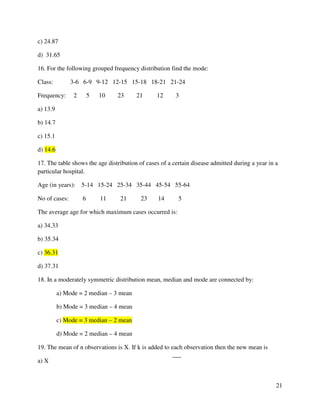
16. For the following grouped frequency distribution find the mode: 
Class: 3-6 6-9 9-12 12-15 15-18 18-21 21-24 
Frequency: 2 5 10 23 21 12 3 
a) 13.9 
b) 14.7 
c) 15.1 
d) 14.6 
17. The table shows the age distribution of cases of a certain disease admitted during a year in a 
particular hospital. 
Age (in years): 5-14 15-24 25-34 35-44 45-54 55-64 
No of cases: 6 11 21 23 14 5 
The average age for which maximum cases occurred is: 
a) 34.33 
b) 35.34 
c) 36.31 
d) 37.31 
18. In a moderately symmetric distribution mean, median and mode are connected by: 
a) Mode = 2 median – 3 mean 
b) Mode = 3 median – 4 mean 
c) Mode = 3 median – 2 mean 
d) Mode = 2 median – 4 mean 
19. The mean of n observations is X. If k is added to each observation then the new mean is 
a) X
22 
b) X + k 
c) X –k 
d) kX 
20. The mean of n observations is X. If each observation is multiplied by k, the mean of new 
observation is: 
a) kX 
b) X /k 
c) X +k 
d) X – k 
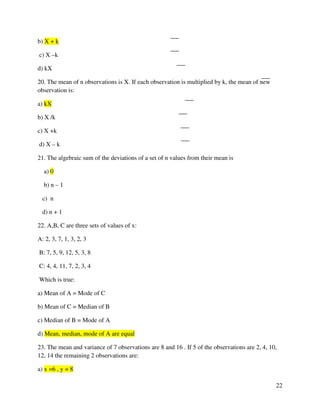
21. The algebraic sum of the deviations of a set of n values from their mean is 
a) 0 
b) n – 1 
c) n 
d) n + 1 
22. A,B, C are three sets of values of x: 
A: 2, 3, 7, 1, 3, 2, 3 
B: 7, 5, 9, 12, 5, 3, 8 
C: 4, 4, 11, 7, 2, 3, 4 
Which is true: 
a) Mean of A = Mode of C 
b) Mean of C = Median of B 
c) Median of B = Mode of A 
d) Mean, median, mode of A are equal 
23. The mean and variance of 7 observations are 8 and 16 . If 5 of the observations are 2, 4, 10, 
12, 14 the remaining 2 observations are: 
a) x =6 , y = 8
23 
b) x=5, y=7 
c) x=7 , y=3 
d) None of these 
24. The variance of 15 observations is 4. If each observation is increased by 9, the variance of 
the resulting observation is: 
a) 2 
b) 3 
c) 4 
d) 5 
25. The mean of 5 observations is 4.4 and their variance is 8.24. If 3 of the observations are 1, 2, 
6. The other 2 observations are: 
a) 9, 4 
b) 7, 8 
c) 6, 5 
d) 4, 8 
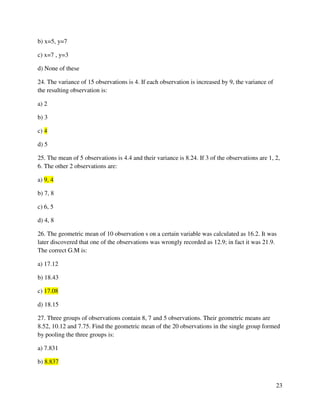
26. The geometric mean of 10 observation s on a certain variable was calculated as 16.2. It was 
later discovered that one of the observations was wrongly recorded as 12.9; in fact it was 21.9. 
The correct G.M is: 
a) 17.12 
b) 18.43 
c) 17.08 
d) 18.15 
27. Three groups of observations contain 8, 7 and 5 observations. Their geometric means are 
8.52, 10.12 and 7.75. Find the geometric mean of the 20 observations in the single group formed 
by pooling the three groups is: 
a) 7.831 
b) 8.837
24 
c) 9.643 
d) 6.438 
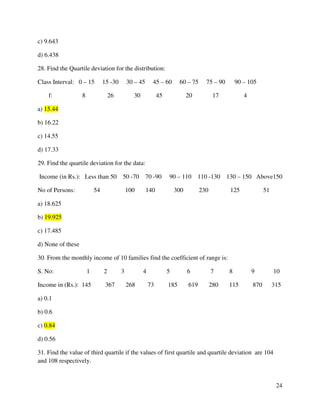
28. Find the Quartile deviation for the distribution: 
Class Interval: 0 – 15 15 -30 30 – 45 45 – 60 60 – 75 75 – 90 90 – 105 
f: 8 26 30 45 20 17 4 
a) 15.44 
b) 16.22 
c) 14.55 
d) 17.33 
29. Find the quartile deviation for the data: 
Income (in Rs.): Less than 50 50 -70 70 -90 90 – 110 110 -130 130 – 150 Above150 
No of Persons: 54 100 140 300 230 125 51 
a) 18.625 
b) 19.925 
c) 17.485 
d) None of these 
30. From the monthly income of 10 families find the coefficient of range is: 
S. No: 1 2 3 4 5 6 7 8 9 10 
Income in (Rs.): 145 367 268 73 185 619 280 115 870 315 
a) 0.1 
b) 0.6 
c) 0.84 
d) 0.56 
31. Find the value of third quartile if the values of first quartile and quartile deviation are 104 
and 108 respectively.
25 
a) 130 
b) 140 
c) 120 
d) 110 
32. Age distribution of 200 employees of a firm is given below and calculate semi inter quartile 
range = (Q3 – Q1 ) /2 of the distribution: 
Age in Years (less than): 25 30 35 40 45 50 55 
No of Employees: 10 25 75 130 170 189 200 
a) 4.75 years 
b) 4.25 years 
c) 4 years 
d) None of these 
33. Find the lower quartile for the distribution 
Wages: 0 – 10 10 – 20 20 – 30 30 - 40 40 – 50 
No of Workers: 22 38 46 35 20 
a) 13.80 
b) 12.56 
c) 14.803 
d) None of the above 
34. Find the Mean deviation from the Mean for the following 
Class Interval: 0 – 10 10 – 20 20 – 30 30 – 40 40 -50 50 – 60 60 – 70 
Frequency: 8 12 10 8 3 2 7 
a) 14 
b) 12 
c) 15
26 
d) 16 
35. Mean deviation which is calculated is minimum at: 
a) Mean 
b) Median 
c) Mode 
d) All the three 
36. Initially there were 9 workers, all being paid a uniform wage. Later a 10th worker is added to 
the list whose wage rate is Rs. 20 less than for others. The standard deviations of wages for the 
group of 10 workers are: 
a) 5 
b) 4 
c) 7 
d) 6 
37. Twenty passengers were found ticketless on a bus. The sum of squares and the standard 
deviation of the amount found in their pockets were Rs.2,000 and Rs.6. If the total fine imposed 
on these passengers is equal to the total amount recovered from them and fine imposed is 
uniform, what is the amount each one has to pay as fine? 
a) 5 
b) 6 
c) 8 
d) 9 
38. For any discrete distribution standard deviation is not less than 
a) Mean deviation from mean 
b) Mean deviation from median 
c) Mode 
d) None of these
27 
39. Mean of 10 items is 50 and S.D is 14. Find the sum of squares of all items 
a) 26543 
b) 26960 
c) 27814 
d) 27453 
40. Find the range for the following data 
14, 16, 16, 14, 22, 13, 15, 24, 12, 23, 14, 20, 17, 21, 22, 18, 18, 19, 20, 17, 16, 15, 11, 12, 21, 20, 
17, 18, 19, 23. 
a) 13 
b) 12 
c) 14 
d) 16 
UNIT 4 PERMUTATIONS, COMBINATIONS AND PROBABILITY 
1. A five digit number is formed using digits 1,3 5, 7 and 9without repeating any one of 
them. What is the sum of all such possible numbers? 
a) 6666600 
b) 6666660 
c) 6666666 
d) None of these 
2. 139 persons have signed for an elimination tournament. All players are to be paired up 
for the first round, but because 139 is an odd number one player gets a bye, which 
promotes him to the second round, without actually playing in the first round. The pairing 
continues on the next round, with a bye to any player left over. If the schedule is planned 
so that a minimum number of matches is required to determine the champion, the number 
of matches which must be played is 
a) 136 
b) 137 
c) 138 
d) 139 
3. A box contains 6 red balls, 7 green balls and 5 blue balls. Each ball is of different size. 
The probability that the red ball selected is the smallest red ball is 
a) 1/8
28 
b) 1/3 
c) 1/6 
d) 2/3 
4. Boxes numbered 1,2,3,4 and 5 are kept in a row, and they which are to be filled with either a 
red ball or a blue ball, such that no two adjacent boxes can be filled with blue balls. Then how 
many different arrangements are possible, given that all balls of given colour are exactly 
identical in all respect? 
a) 8 
b) 10 
c) 154 
d) 22 
5. For a scholarship, at the most n candidates out of 2n + 1 can be selected. If the number of 
different ways of selection of at least one candidate is 63, the maximum number of 
candidates that can be selected for the scholarship is 
a) 3 
b) 4 
c) 6 
d) 5 
6. Ten points are marked on a straight line and 11 points are marked on another straight line. 
How many triangles can be constructed with vertices from among the above points? 
a) 495 
b) 550 
c) 1045 
d) 2475 
7. There are three cities A, B and C. Each of these cities is connected with the other two 
cities by at least one direct road. If a traveler wants to go from one city (origin) to 
another city (destination), she can do so either by traversing a road connecting the two 
cities directly, or by traversing two roads, the first connecting the origin to the third city 
and the second connecting the third city to the destination. In all, there are 33routes 
from A to B (including those via C), Similarly, there are 23 routes from B to C 
(including those via A). How many roads are there from A to C directly? 
a) 6 
b) 3 
c) 5 
d) 10
29 
8. One red flag, three white flags and two blue flags are arranged in line such that 
i) No two adjacent flags are of the same colour. 
ii) The flags at the two ends of the line are of different colours. 
In how many different ways the flag be arranged? 
a) 6 
b) 4 
c) 10 
d) 2 
9. Each of the 11 letters A. H, I, M, O, T, U, V, W, X and Z appears same hen looked at in 
the mirror. They are called symmetric letters. Other letters in the alphabet are 
asymmetric letters. How many four letter computer passwords can be formed using only 
the symmetric letters ( no repetition allowed) 
a) 7920 
b) 330 
c) 146.40 
d) 419430 
10. An intelligence agency forms a code of two distinct digits selected from 0, 1, 2,……, 9 
such that the first digit of the code is non zero. The code, handwritten on the slip, can 
create confusion, when read upside down for example the code 91 can be read as 16. 
How many codes are there for which no such confusion can arise? 
a) 80 
b) 78 
c) 71 
d) 69 
11. The set of all possible outcomes of a random experiment is known as 
a) Permutation 
b) Combination 
c) Probability 
d) Sample space 
12. A card is drawn from a well shuffled pack of playing cards. Find the probability that it is 
either a diamond or a king 
a) 4/26 
b) 4/13 
c) 17/52 
d) 16/13
30 
13. Let A and B be the two possible outcomes of an experiment and suppose P(A) = 0.4 
P(AUB) =0.7 and P(B) =p. For what choice of p are A and B mutually exclusive? 
a) 0.5 
b) 0.2 
c) 0.3 
d) 0.6 
14. Probability that a man will be alive 25 years hence is 0.3 and the probability that his 
wife will be alive 25 years hence is 0.4. Find the probability that 25 years hence only the 
man will be alive will be 
a) 0.12 
b) 0.18 
c) 0.28 
d) 0.42 
15. A box of nine golf gloves contains two left-handed and seven right handed gloves. If 
three gloves are selected without replacement, what is the probability that all of them are left 
handed? 
a) 1 
b) 0 
c) 7/18 
d) 49/81 
16. A lady declares that by taking a cup of tea, she can discriminate whether the milk or tea 
infusion was added to the cup. It is proposed to test this assertion by means of an experiment 
with 12 cups of tea, 6 made in one way and 6 in the other, and presenting them to the lady 
for judgement in a random order. The probability that on the null hypothesis that the lady 
has no discrimination power, she would judge correctly all the 12 cups, it being known to 
her that 6 are of each kind would be 
a) 924 
b) 1/925 
c) 1/924 
d) 925 
17. A restaurant serves two special dishes A and B to its customers consisting of 60% men 
and 40% women. 80% of men order dish A and the rest B. 70% of women order B and the 
rest A. In what ratio of A to B should the restaurant prepare the two dishes?
31 
a) 3:2 
b) 2:3 
c) 1:2 
d) 2:1 
18. A card is drawn at random from a well shuffled pack of cards. The probability that it is 
heart or a queen is 
a) 4/13 
b) 11/52 
c) ½ 
d) 1/52 
19. A piece of electronic equipment has two essential parts A and B. In the past, part A 
failed 30% of the times, part B failed 20% of the times and both failed simultaneously 5% of 
the times. Assuming that both parts must operate to enable the equipment to function, the 
probability that the equipment will function is 
a) 0.1 
b) 0.52 
c) 0.55 
d) 0.15 
20. In a certain college, the students engage in sports in the following proportion Football 
(F): 60% of all students Basketball (B): 50% of all students. Both football and basketball: 
30% of all students. If a student is selected at random the probability that he will play 
neither sports is 
a) 0.8 
b) 0.10 
c) 0.7 
d) 0.20 
21. If P(A) =1/4, P(B) =2/5 and P(AUB) =1/2 find P(Ac U Bc ), where A and B are two non 
mutually exclusive events connected with a random experiment E and Ac is the complement 
event of A. 
a) 0.85 
b) 0.58 
c) 0.80 
d) 0.50 
22. The result of an examination given to a class on three papers A, B and C are 40% failed 
in paper A, 30% failed in B, 25% failed in paper C, 15% failed in paper A and B both. 12%
32 
failed in B and C both, 10% failed in A and C both, 3% failed in A, B and C. What is the 
probability of a randomly selected candidates passing in all three papers? 
a) 0.6 
b) 0.39 
c) 0.56 
d) 0.42 
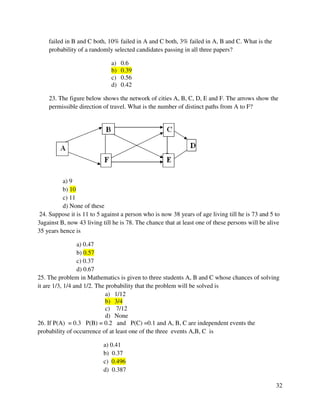
23. The figure below shows the network of cities A, B, C, D, E and F. The arrows show the 
permissible direction of travel. What is the number of distinct paths from A to F? 
a) 9 
b) 10 
c) 11 
d) None of these 
24. Suppose it is 11 to 5 against a person who is now 38 years of age living till he is 73 and 5 to 
3against B, now 43 living till he is 78. The chance that at least one of these persons will be alive 
35 years hence is 
a) 0.47 
b) 0.57 
c) 0.37 
d) 0.67 
25. The problem in Mathematics is given to three students A, B and C whose chances of solving 
it are 1/3, 1/4 and 1/2. The probability that the problem will be solved is 
a) 1/12 
b) 3/4 
c) 7/12 
d) None 
26. If P(A) = 0.3 P(B) = 0.2 and P(C) =0.1 and A, B, C are independent events the 
probability of occurrence of at least one of the three events A,B, C is 
a) 0.41 
b) 0.37 
c) 0.496 
d) 0.387
27. A speaks the truth 3 times out of 4, and B 7 times out of 10; They both assert that a white 
ball has been drawn from a bag containing 6 balls of different colour. The truth in the assertion is 
33 
a) 35/36 
b) 36/43 
c) 25/36 
d) 63/43 
28. Three urns are given, each containing red and white balls. Urn 1: 6 red balls and 4 white, Urn 
2: 2 red and 6 white, Urn3: 1 red and 8 white. An urn is chosen at random and a ball is drawn 
from this urn. The ball is red. The probability that the urn chosen was urn 1 is 
a) 196/173 
b) 173/196 
c) 173/198 
d) 198/173 
29. A doctor is to visit a patient. The probability that he will come by car taxi scooter or by other 
means of transport are 0.3, 0.2, 0.1 and 0.4. The probabilities that he will be late are 1/4, 1/3 and 
½, if he comes by car taxi and scooter. But if he comes by other means of transport he will not be 
late. When he arrives he is late. Therefore the probability that he comes by car are 
a) 1/2 
b) 0 
c) 1/4 
d) 1 
30. What is the chance that a leap year selected at random will contain 53 Sundays? 
a) 2/7 
b) 3/7 
c) 1/7 
d) 5/7 
31. Out of all the 2-digit integers between 1 and 200, a 2- digit number has to be selected at 
random. What is the probability that the selected number is not divisible by 7? 
a) 11/90 
b) 33/90 
c) 55/90 
d) 77/90 
32. Amarnath appears in an exam that has 4 subjects. The chance he passes an individual 
subject’s test is 0.8. The probability that he will pass in at least one of the subjects is 
a) 0.99984 
b) 0.9984
34 
c) 0.0004 
d) None of these 
33. A box contains 2 tennis , 3 cricket and 4 squash balls. Three balls are drawn in succession 
with replacement. What is the probability that all are cricket balls: 
a) 1/27 
b) 2/27 
c) 3/27 
d) 1/9 
34. In a garden 40% of the flowers are roses and the rest are carnations. If 25% of the roses and 
10% of the carnations are red the probability that a red flower selected at random is a rose is 
a) 5/8 
b) 2/8 
c) 7/8 
d) 3/8 
35. Three of the 6 vertices if a regular hexagon are chosen at random. The probability that the 
triangle with these vertices is equilateral is 
a) 1/10 
b) 4/10 
c) 3/10 
d) 1/5 
36. What is the value of n(P(P(P(ø)))) 
a) 3 elements 
b) 4 elements 
c) 8 elements 
d) 5 elements 
37. In how many ways can 10 identical presents be distributed among 6 children so that each 
child gets at least one present ? 
a) 15 C6 
b) 16 C6 
c) 9 C5 
d) 610 
38. There are 6 pups and 4 cats. In how many can they be seated in a row so that no cats sit 
together:
35 
a) 6 ! 6 X 6 ! 6 
b) 10!/4!6! 
c) 6! X 7P4 
d) 6!7! 
39. There are V lines parallel to the X axis and W lines parallel to the Y axis. How many 
rectangles can be formed with the intersection of these lines? 
a) vP2 .w P2 
b) vC2 . w C2 
c) vwC2 
d) None of these 
40. From 4 men and 4 women a committee of 5 is to be formed. Find the number of ways of 
doing so if the committee consists of a president, a vice president and three secretaries? 
a) 720 
b) 450 
c) 1120 
d) None of these 
UNIT 5 RANDOM VARIABLES AND DISTRIBUTION FUNCTIONS 
1. If the probability density of X is given by f(x) = 2xe-x² for x0 
0 elsewhere 
and Y = X2 
The probability density of Y is 
a) g(y) = e-y for y  0 and g(y) elsewhere 
b) g(y) = ey for y  0 and g(y) = 0 
c) g(y) = e-y for y 0 and g(y)  0 
d) None of these 
2. If X has the uniform density with the parameters  = 0 and  = 1. Find the probability density 
of the random variable Y = X 
a) g(y) = y for 0  y  1 and g(y) = 0 elsewhere 
b) g(y) = 2y for 0  y  1 and g(y) = 0 elsewhere 
c) g(y) = 2y for 0  y  1 and g(y) = 0 elsewhere 
d) None of these
36 
3. If X1 and X2 are independent random variables having exponential densities with the 
parameters a and b the probability density of Y = X1+ X2 when a  b 
a) f(y) = 1/a+b. (e-y/a – e-y/b ) for y  0 and f(y) = 0 elsewhere 
b) f(y) = 1/a-b. (e-y/a – e-y/b ) for y  0 and f(y) = 1 elsewhere 
c) f(y) = 1/a-b. (e-y/a – e-y/b ) for y  0 and f(y) = 0 elsewhere 
d) None of these 
4. If X is the number of head obtained in 4 tosses of a balanced coin then find the probability 
distribution of the random variable Z = (X-2)2 
a) z 0 1 4 
h(z) 3/8 4/8 1/8 
b) z 0 1 4 
h(z) 1/8 4/8 1/8 
c) z 0 1 4 
h(z) 3/8 2/8 1/8 
d) z 0 1 4 
h(z) 3/8 7/8 1/8 
5. If the joint density of X1 and X2 is given by 
f(x, x2 ) = 6e-3x1 -2x2 for x1  0 x2  0 
0 elsewhere 
Find the probability density of Y = X1+ X2 
a) f(y) = 6(ey – e-3y ) for y  0 elsewhere f(y) = 0 
b) f(y) = 6(e-2y – e-3y ) for y  0 elsewhere f(y) = 0 
c) f(y) = 6(e-2y – e-y ) for y  0 elsewhere f(y) = 1 
d) f(y) = 6(e-2y – e-y/2 ) for y  0 elsewhere f(y) = 0 
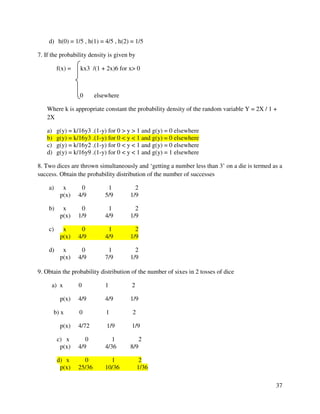
6. If X has a hypergeometric distribution with M = 3, N = 6 and n = 2, find the probability 
distribution of Y, the number of successes minus the number of failures 
a) h(0) = 1/5 , h(1) = 3/5 , h(2) = 1/5 
b) h(0) = 2/5 , h(1) = 3/8 , h(2) = 1/5 
c) h(0) = 9/5 , h(1) = 3/5 , h(2) = 1/5
37 
d) h(0) = 1/5 , h(1) = 4/5 , h(2) = 1/5 
7. If the probability density is given by 
f(x) = kx3 /(1 + 2x)6 for x 0 
0 elsewhere 
Where k is appropriate constant the probability density of the random variable Y = 2X / 1 + 
2X 
a) g(y) = k/16y3 .(1-y) for 0  y  1 and g(y) = 0 elsewhere 
b) g(y) = k/16y3 .(1-y) for 0  y  1 and g(y) = 0 elsewhere 
c) g(y) = k/16y2 .(1-y) for 0  y  1 and g(y) = 0 elsewhere 
d) g(y) = k/16y9 .(1-y) for 0  y  1 and g(y) = 1 elsewhere 
8. Two dices are thrown simultaneously and ‘getting a number less than 3’ on a die is termed as a 
success. Obtain the probability distribution of the number of successes 
a) x 0 1 2 
p(x) 4/9 5/9 1/9 
b) x 0 1 2 
p(x) 1/9 4/9 1/9 
c) x 0 1 2 
p(x) 4/9 4/9 1/9 
d) x 0 1 2 
p(x) 4/9 7/9 1/9 
9. Obtain the probability distribution of the number of sixes in 2 tosses of dice 
a) x 0 1 2 
p(x) 4/9 4/9 1/9 
b) x 0 1 2 
p(x) 4/72 1/9 1/9 
c) x 0 1 2 
p(x) 4/9 4/36 8/9 
d) x 0 1 2 
p(x) 25/36 10/36 1/36
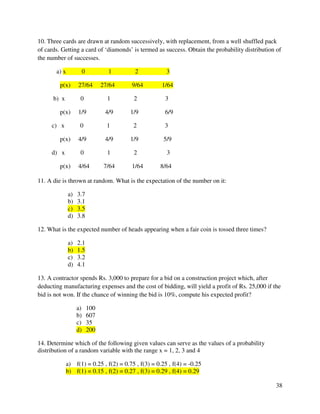
10. Three cards are drawn at random successively, with replacement, from a well shuffled pack 
of cards. Getting a card of ‘diamonds’ is termed as success. Obtain the probability distribution of 
the number of successes. 
38 
a) x 0 1 2 3 
p(x) 27/64 27/64 9/64 1/64 
b) x 0 1 2 3 
p(x) 1/9 4/9 1/9 6/9 
c) x 0 1 2 3 
p(x) 4/9 4/9 1/9 5/9 
d) x 0 1 2 3 
p(x) 4/64 7/64 1/64 8/64 
11. A die is thrown at random. What is the expectation of the number on it: 
a) 3.7 
b) 3.1 
c) 3.5 
d) 3.8 
12. What is the expected number of heads appearing when a fair coin is tossed three times? 
a) 2.1 
b) 1.5 
c) 3.2 
d) 4.1 
13. A contractor spends Rs. 3,000 to prepare for a bid on a construction project which, after 
deducting manufacturing expenses and the cost of bidding, will yield a profit of Rs. 25,000 if the 
bid is not won. If the chance of winning the bid is 10%, compute his expected profit? 
a) 100 
b) 607 
c) 35 
d) 200 
14. Determine which of the following given values can serve as the values of a probability 
distribution of a random variable with the range x = 1, 2, 3 and 4 
a) f(1) = 0.25 , f(2) = 0.75 , f(3) = 0.25 , f(4) = -0.25 
b) f(1) = 0.15 , f(2) = 0.27 , f(3) = 0.29 , f(4) = 0.29
39 
c) f(1) = 1/19 , f(2) = 10/19 , f(3) = 2/19 , f(4) = 5/19 
d) None of these 
15. For what values of k can f(x) = (1-k) kx 
a) 0k1 
b) k=0 
c) k1 
d) None of these 
16. From a bag containing 4 white and 6 red balls, three balls are drawn at random and if each 
white ball drawn carries a reward of Rs4 and each red ball Rs6, find the expected reward of the 
draw 
a) Rs14.8 
b) Rs15.6 
c) Rs31 
d) Rs16 
17. A lot of 12 television sets include 2 with white chords. If 3 of the sets are chosen at random 
for shipment to the hotel, how many sets with white chords can the shipper expect to send to the 
hotel 
a) 0 
b) 1 
c) 1/2 
d) All of the above 
18. The joint probability density function 
f(x,y) = 3/5x(y+x) for 0x1 0y2 
0 elsewhere 
Of 2 random variables X and Y, find P[(X,Y)€A] where A is the region (x,y)/0  x, ½, 1y2 
a) 11/65 
b) 11/80 
c) 10/76 
d) 67/80 
19. E(x2) = 91/6. Find the value of E(2 x2+1) is 
a) 92/3 
b) 91/3
40 
c) 90/3 
d) 94/3 
20. If the probability density of X is given by 
f(x) = 2(1-x) for 0x1 
0 elsewhere 
To evaluate E[(2X+1)2] 
a) 2 
b) 1 
c) 4 
d) 3 
21. If X has the probability density 
f(x) = ex for x0 
0 elsewhere 
Find the expected value of g(X) = e3x/4 
a) 1 
b) 2 
c) 3 
d) 4 
22. Given that X has the probability distribution f(x) = 1/8(3/x) for x = 0, 1, 2 and 3, find the 
moment-generating function of this random variable and use it to determine μ1`and μ2 ` 
a) 0 
b) 3/2 
c) 1/2 
d) 1 
23. For any random variable for which E(x) exists find the value of μ0 
a) 0 
b) -1 
c) 2 
d) 1
41 
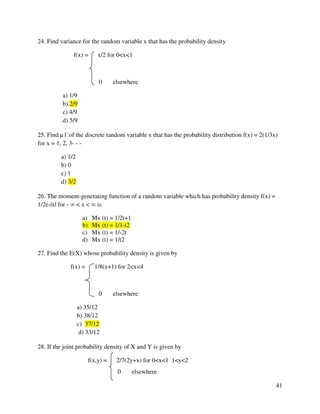
24. Find variance for the random variable x that has the probability density 
f(x) = x/2 for 0x1 
0 elsewhere 
a) 1/9 
b) 2/9 
c) 4/9 
d) 5/9 
25. Find μ1`of the discrete random variable x that has the probability distribution f(x) = 2(1/3x) 
for x = 1, 2, 3- - - 
a) 1/2 
b) 0 
c) 1 
d) 3/2 
26. The moment-generating function of a random variable which has probability density f(x) = 
1/2e-|x| for -   x   is 
a) Mx (t) = 1/2t+1 
b) Mx (t) = 1/1-t2 
c) Mx (t) = 1/-2t 
d) Mx (t) = 1/t2 
27. Find the E(X) whose probability density is given by 
f(x) = 1/8(x+1) for 2x4 
0 elsewhere 
a) 35/12 
b) 38/12 
c) 37/12 
d) 33/12 
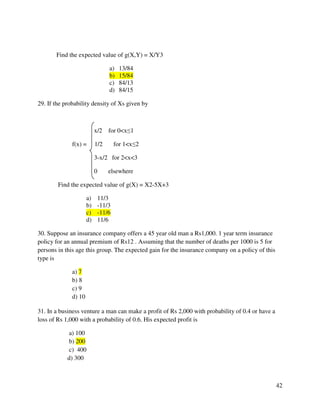
28. If the joint probability density of X and Y is given by 
f(x,y) = 2/7(2y+x) for 0x1 1y2 
0 elsewhere
42 
Find the expected value of g(X,Y) = X/Y3 
a) 13/84 
b) 15/84 
c) 84/13 
d) 84/15 
29. If the probability density of Xs given by 
x/2 for 0x1 
f(x) = 1/2 for 1x2 
3-x/2 for 2x3 
0 elsewhere 
Find the expected value of g(X) = X2-5X+3 
a) 11/3 
b) -11/3 
c) -11/6 
d) 11/6 
30. Suppose an insurance company offers a 45 year old man a Rs1,000. 1 year term insurance 
policy for an annual premium of Rs12 . Assuming that the number of deaths per 1000 is 5 for 
persons in this age this group. The expected gain for the insurance company on a policy of this 
type is 
a) 7 
b) 8 
c) 9 
d) 10 
31. In a business venture a man can make a profit of Rs 2,000 with probability of 0.4 or have a 
loss of Rs 1,000 with a probability of 0.6. His expected profit is 
a) 100 
b) 200 
c) 400 
d) 300
43 
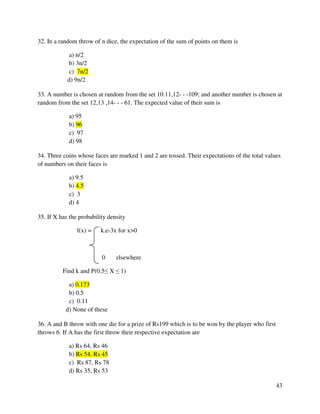
32. In a random throw of n dice, the expectation of the sum of points on them is 
a) n/2 
b) 3n/2 
c) 7n/2 
d) 9n/2 
33. A number is chosen at random from the set 10.11,12- - -109; and another number is chosen at 
random from the set 12,13 ,14- - - 61. The expected value of their sum is 
a) 95 
b) 96 
c) 97 
d) 98 
34. Three coins whose faces are marked 1 and 2 are tossed. Their expectations of the total values 
of numbers on their faces is 
a) 9.5 
b) 4.5 
c) 3 
d) 4 
35. If X has the probability density 
f(x) = k.e-3x for x0 
0 elsewhere 
Find k and P(0.5 X  1) 
a) 0.173 
b) 0.5 
c) 0.11 
d) None of these 
36. A and B throw with one die for a prize of Rs199 which is to be won by the player who first 
throws 6. If A has the first throw their respective expectation are 
a) Rs 64, Rs 46 
b) Rs 54, Rs 45 
c) Rs 87, Rs 78 
d) Rs 35, Rs 53
44 
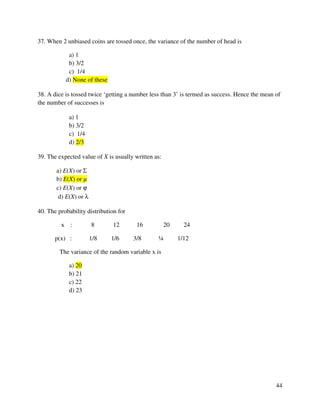
37. When 2 unbiased coins are tossed once, the variance of the number of head is 
a) 1 
b) 3/2 
c) 1/4 
d) None of these 
38. A dice is tossed twice ‘getting a number less than 3’ is termed as success. Hence the mean of 
the number of successes is 
a) 1 
b) 3/2 
c) 1/4 
d) 2/3 
39. The expected value of X is usually written as: 
a) E(X) or S 
b) E(X) or μ 
c) E(X) or j 
d) E(X) or l 
40. The probability distribution for 
x : 8 12 16 20 24 
p(x) : 1/8 1/6 3/8 ¼ 1/12 
The variance of the random variable x is 
a) 20 
b) 21 
c) 22 
d) 23

Bca business statistics

  • 1.
    1 MGU-BCA-103-First Semester– Basic Statistics MCQs UNIT 1 BASICS OF STATISTICS AND STATISTICAL DATA 1. The specific statistical methods that can be used to summarize or to describe a collection of data is called: a) Descriptive statistics b) Inferential statistics c) Analytical statistics d) All of the above 2. The need for inferential statistical methods derives from the need for ______________. a) Population b) Association c) Sampling d) Probability 3. A population, in statistical terms, is the totality of things under consideration. It is the collection of all values of the _________________ that is under study. a) Instance b) Variable c) Amount d) Measure 4. Non-sampling errors are introduced due to technically faulty observations or during the ______________________ of data. a) Processing b) Analysis c) Sequencing d) Collection 5. Sampling is simply a process of learning about the __________________ on the basis of a sample drawn from it. a) Census b) Population c) Group d) Area
  • 2.
    2 6. Numericalfacts are usually subjected to statistical analysis with a view to helping a decision-maker make wise decisions in the face of ___________________. a) Interpreting b) Uncertainty c) Summarizing d) Organizing 7. In statistics, ___________________________ classification includes data according to the time period in which the items under consideration occurred. a) Chronological b) Alphabetical c) Geographical d) Topological 8. Data is simply the numerical results of any scientific__________________. a) Analysis b) Researches c) Observation d) Measurement 9. The ________________ process would be required to ensure that the data is complete and as required. a) Tabulation b) Analysis c) Editing d) Ordering 10. A sample is a portion of the ________________ population that is considered for study and analysis. a) Selected b) Total c) Fixed d) Random 11. The method of sampling, in which the choice of sample items depends exclusively on the judgement of the investigator is termed as ________________________. a) Convenience sampling b) Quota sampling c) Systematic sampling
  • 3.
    3 d) Judgementsampling 12. Both the sampling as well as the non-sampling errors must be reduced to a minimum in order to get as representative a sample of the ___________________ as possible. a) Group b) Region c) Population d) Universe 13. The larger the size of the population, the ___________________ should be the sample size. a) Smaller b) Larger c) Accurate d) Fixed 14. When the data is to be processed by computers, then it must be coded and converted into the ____________________ ___________________. a) English language b) Regional language c) Statistical language d) Computer language 15. A variable is any characteristic which can assume ____________________ values. a) Different b) Similar c) Fixed d) Assumed 16. The basic objective of a sample is to draw ____________________ about the population from which such sample is drawn. a) Conclusion b) Characteristics c) Inferences d) Parameters 17. In ___________________ type of classification, the data is grouped together according to some distinguished characteristic or attribute, such as religion, sex, age, national origin, and so on. a) Quantitative b) Chronological
  • 4.
    4 c) Qualitative d) All of the above 18. A _____________________ variable is a variable whose values can theoretically take on an infinite number of values within a given range of values. a) Continuous b) Discrete c) Random d) Both (a) and (b) 19. A perfect random number table would be one in which every digit has been entered _______________. a) Chronologically b) Sequentially c) Randomly d) Arbitrarily 20. The _________________ random variables yield categorical responses so that the responses fit into one category or another. a) Quantitative b) Discrete c) Continuous d) Qualitative 21. For a sample to be truly representative of the population, it must truly be________________. a) Fixed b) Random c) Specific d) Casual 22. A ______________ ______________ is a phenomenon of interest in which the observed outcomes of an activity are entirely by chance, are absolutely unpredictable and may differ from response to response. a) Discrete variable b) Continuous variable c) Random variable d) All of the above 23. By definition of randomness, each ________________ ______________ has the same chance of being considered.
  • 5.
    5 a) Possibleentity b) Probable entity c) Random entity d) Observed entity 24. Before any procedures for _____________ _________________ are established, the purpose and the scope of the study must be clearly specified. a) Data analysis b) Data tabulation c) Data collection d) Data selection 25. Adequacy of data is to be judged in the light of the requirements of the survey and the geographical areas covered by the __________________ data. a) Collected b) Available c) Organized d) Tabulated 26. If the sample is truly representative of the population, then the characteristics of the sample can be considered to be the same as those of the _______________ population. a) Fixed b) Selected c) Random d) Entire 27. Statistical inference deals with methods of inferring or drawing ___________________ about the characteristics of the population based upon the results of the sample taken from the same population. a) Details b) Decisions c) Conclusions d) Samples 28. If the sample size is too small, it may not _______________ represent the population or the universe as it is known, thus leading to incorrect inferences. a) Appropriately b) Reliably c) Homogeneously
  • 6.
    6 d) Heterogeneously 29. Editing would also help eliminate inconsistencies or obvious errors due to _______________ treatment. a) Characteristic b) Arithmetical c) Calculation d) Tabulation 30. When an investigator uses the data which has already been collected by others, such data is called _______________ _________. a) Primary data b) Collected data c) Processed data d) Secondary data 31. In the case of the questionnaire method of gathering data, it should be made certain that all the questions have been _____________________. a) Read b) Interpreted c) Answered d) All of the above 32. _____________________ provides various types of statistical information of either qualitative or quantitative nature. a) Sampling b) Tabulation c) Observation d) Editing 33. In statistics, ____________________classification groups the data according to locational differences among the items. a) Chronological b) Geographical c) Regional d) Alphabetical 34. The degree of randomness of selection would depend upon the process of selecting the items from the ________________________. a) Population
  • 7.
    7 b) Region c) Sample d) Data 35. A _____________________ sample is obtained by selecting convenient population units a) Random b) Quota c) Stratified d) Convenience 36. A __________________ sample is formed by selecting one unit at random and then selecting additional units at evenly spaced intervals until the sample has been formed. a) Stratified b) Systematic c) Judgement d) Random 37. The sampling errors arise due to drawing faulty inferences about the __________________ based upon the results of the samples. a) Sample b) Survey c) Population d) Census 38. A summary measure that describes any given characteristic of the population is known as a __________________. a) Parameter b) Information c) Inference d) Statistics 39. ________________ means separating items according to similar characteristics and grouping them into various classes. a) Tabulation b) Editing c) Separation d) Classification
  • 8.
    8 40. _____________________is one which is collected by the investigator himself for the purpose of a specific inquiry or study. a) Secondary data b) Primary data c) Statistical data d) Published data UNIT 2 ANALYSIS OF STATISTICAL DATA 1. In chronological classification, the data is classified on the basis of: a) Time b) Money c) Location d) Quality 2. The classification of data according to location is what classification: a) Chronological b) Quantitative c) Qualitative d) Geographical 3. The magnitude of the class is the: a) The product of lower limit and upper limit b) The sum of lower limit and upper limit c) The difference of upper limit and lower limit d) None of these 4. A function very similar to that of sorting letters in a post office is: a) Mean b) Standard deviation c) Classification d) Mean deviation 5. The value lying half way between the upper limit and lower limit of the class is: a) Class interval b) Mid point
  • 9.
    9 c) Frequency d) None of the above 6. The classes in which the lower limit or the upper limit is not specified are known as: a) Open end classes b) Close end classes c) Inclusive classes d) Exclusive classes 7. Classes in which upper limits are excluded from the respective classes and are included in the immediate next class are: a) Open end classes b) Close end classes c) Inclusive classes d) Exclusive classes 8. If the class mid points in a frequency distribution of age of a group of persons are 25, 32, 39, 46, 53 and 60. The size of class interval is: a) 5 b) 7 c) 8 d) 6 9. The number of observations in a particular class is called: a) Width of the class b) Class mark c) Frequency d) None of the above 10. If the mid points of the classes are 16, 24, 32, 40, and so on, then the magnitude of the class interval is: a) 8 b) 9 c) 7 d) 6
  • 10.
    10 11. Thefirst step in tabulation is: a) Foot note b) Source note c) Captions d) Classification 12. A systematic arrangement of data in rows and columns is: a) Table b) Tabulation c) Body d) All the above 13. The numerical information in a statistical table is called the: a) Table b) Foot note c) Source note d) Body 14. In a statistical table the row headings are referred to as: a) Source note b) Captions c) Stubs d) Body 15. In the statistical table column headings are called: a) Stubs b) Captions c) Source note d) None of these 16. If the class mid points in a frequency distribution of a group of persons are: 125, 132, 139, 146, 153, 160, 167, 174, 181 pounds, then the size of the class is: a) 6
  • 11.
    11 b) 8 c) 7 d) 9 17. The different types of samplings are: a) Probability b) Judgement c) Mixed d) All the above 18. Two dimensional diagrams used in surface diagrams are: a) Squares b) Pie diagrams c) Circles d) All the above 19. One dimensional diagram is: a) Line diagram b) Rectangles c) Cubes d) Squares 20. Type of bar diagram is: a) Pictogram b) Sub divided diagram c) Line diagrams d) Pie diagram 21. The most commonly used device of presenting business and economic data is: a) Pie diagrams b) Pictograms c) Bar diagrams d) Line diagrams 22. A pie diagram is also called: a) Pictogram
  • 12.
    12 b) Angulardiagram c) Line diagram d) Bar diagram 23. In volume diagram the three dimensions which are taken into account are: a) Length, weight, breadth b) Height, weight, breadth c) Length, height, breadth d) Length, weight, height 24. The median of a frequency distribution is found graphically with the help of: a) Histogram b) Frequency curve c) Frequency polygon d) Ogive 25. The mode of a frequency distribution can be determined graphically by: a) Histogram b) Frequency curve c) Frequency polygon d) Ogive 26. Find the median of the given ogive: a) 150
  • 13.
    13 b) 200 c) 148 d) 175 27. What is the appropriate simple annual growth rate of total assets between 1990 and 1993? a) 36% b) 12% c) 9% d) 27% 28. From the figure given in Question 27, find the only item that has shown positive growth between 1991 and 1993? a) Net fixed assets b) Net current assets c) Investments d) Total assets 29. If a sample of size n from a given finite population of size N, then the total number of samples is: a) N! / (N –n)! b) N! c) N! /n! d) N! /n! (N – n )!
  • 14.
    30. The setof values of the statistic so obtained, one for each sample, constitutes what is called: a) Sampling distribution b) Systematic sampling c) Stratified sampling d) Cluster sampling 14 31. Standard error of the sampling distribution of a statistic t is: a) Standard deviation b) Median c) Variance d) Mean 32. Convert the following into an ordinary frequency distribution: 5 students get less than3 marks; 12 students get less than 6 marks; 25 students get less than 9 marks; 33 students get less than 12 marks. a) 0—3 3—6 6— 9 9 —12 5 7 13 8 b) 0—3 3—6 6— 9 9 —12 6 6 14 7 c) 0—3 3—6 6—9 9 —12 4 8 12 9 d) 0—3 3—6 6—9 9 – 12 6 8 12 7 33. From the below given graph, find what expenditure for the 7 years together from percent of the revenues together: 200 180 160 140 120 100 80 60 40 20 0 1989 1990 1991 1992 1993 1994 1995 Profit Revenue Expenditure
  • 15.
    15 a) 75% b) 67% c) 62% d) 83% 34. From the above graph in which year was the growth in expenditure maximum as compared to the previous year: a) 1993 b) 1995 c) 1991 d) 1992 35. The equity base of the companies remains unchanged, then the total divided earning by share holders in 1991-1992 is: a) Rs104 lakh b) Rs 9 lakh c) Rs12.8 lakh d) Rs15.6 lakh 36. From the above figure answer the retained profit in 1991-1992 as compared to that in 1990- 1991 was: a) Higher by 2.5% b) Higher by 1.5%
  • 16.
    16 c) Lowerby 2.5% d) Lower by 1.5% 37. A professor keeps data on students tabulated by performance and sex of the students. The data is kept on the computer disk and due to virus the following data could be recovered. An expert committee was formed and it was decided. Half the students were either excellent or good. 40% of the students were female.1/3 of the male students were average. Performance Total Average Good Excellent Male 16 22 10 48 Female 24 8 - 32 Total 40 30 10 80 How many students are both female and excellent: a) 0 b) 8 c) 16 d) 32 38. Among every student what is the ratio of male and female: a) 1:2 b) 2:1 c) 3:2 d) 2:3 39. Machine A as well as machine B can independently produce either product P or Q. The time taken by machine A and B in minutes to produce one unit of product P and Q is given as follows: (each machine works 8 hours per day) Product A B
  • 17.
    17 P 108 Q 6 6 If equal quantities of both are to be produced then out of the 4 choices the least efficient way would be a) 48 of each with 3 min idle b) 64 of each with 12 min idle c) 53 of each with 10 min idle d) 71 of each with 9 min idle 40. If the number of units of P is to be 3 times that of Q, what is the maximum idle time to maximize total units manufactured? a) 0 min b) 24 min c) 1 hr d) 2 hr UNIT 3 MEASURES OF STATISTICAL DATA 1. The standard deviation for 15, 22, 27, 11, 9, 21, 14, 9 is: a) 6.22 b) 6.12 c) 6.04 d) 6.32 2. A student obtained the mean and the standard deviation of 100 observations as 40 and 5.1. It was later found that one observation was wrongly copied as 50, the correct figure being 40. Find the correct mean and the S.D. a) Mean = 38.8, S.D =5 b) Mean = 39.9, S.D =5 c) Mean = 39.9, S.D = 4 d) None
  • 18.
    18 3. Themean deviation about median from the data: 340, 150, 210, 240, 300, 310, 320 is: a) 51.6 b) 51.8 c) 52 d) 52.8 4. For a frequency distribution mean deviation from mean is computed by a) E f / E f |d| b) E d /Ef c) E fd/ E f d) Ef | d | / E f 5. The mean deviation from the median is: a) Equal to that measured from another value b) Maximum if all the observations are positive c) Greater than that measured from any other value d) Less than that measured from any value 6. The mean deviation of the series a, a + d, a +2d……., a + 2n from its mean is a) (n + 1) d /2n +1 b) nd /2n +1 c) n (n +1) d /2n +1 d) (2n +1) d /n (n+1) 7. A batsman score runs in 10 innings as 38, 70, 48, 34, 42, 55, 63, 46, 54 and 44. The mean deviation about mean is a) 8.6 b) 6.4 c) 10.6
  • 19.
    19 d) 7.6 8. The arithmetic mean height of 50 students of a college is 5’---8’. The height of 30 of these is given in the frequency distribution. Find the arithmetic mean height of the remaining 20 students. Height in inches: 5’---- 4” 5’--- 6” 5’ ---- 8” 5’----10” 6’ --- 0” Frequency: 4 12 4 8 2 a) 5’ ----8.8” b) 5’ ---- 8.0” c) 5’----- 7.8” d) 5’----- 7.0” 9. Find the sum of the deviation of the variable values 3, 4, 6, 8, 14 from their mean a) 5 b) 0 c) 1 d) 7 10. The median of the observation 11, 12, 14, 18, x + 4, 30, 32, 35, 41 arranged in ascending order is 24, then x is a) 21 b) 22 c) 23 d) 24 11. The median of the data: 19, 25, 59, 48, 35, 31, 30, 32, 51. If 25 is replaced by 52, what will be the new median. a) 35 b) 53 c) 43 d) 45
  • 20.
    20 12. Ifthe median of the following frequency distribution is 46, find the missing frequencies. Variable: 10—20 20—30 30—40 40---50 50—60 60---70 70---80 Total Frequency: 12 30 a 65 b 25 18 229 a) a = 32 b =40 b) a =31 b = 45 c) a = 33 b = 42 d) a =34 b =45 13. Find the value of x, if the mode of the data is 25: 15, 20, 25, 18, 14, 15, 25, 15, 18, 16, 20, 25, 20, x, a) 15 b) 18 c) 25 d) 20 14. Compute the modal value for x : 95 105 115 125 135 145 155 165 175 f : 4 2 18 22 21 19 10 3 2 a) 175 b) 125 c) 145 d) 165 15. Compute the mode for the following frequency distribution: Size of items: 0-4 4-8 8-12 12-16 16-20 20-24 24-28 28-32 32-36 36-40 Frequency: 5 7 9 17 12 10 6 3 1 0 a) 32.66 b) 28.43
  • 21.
    21 c) 24.87 d) 31.65 16. For the following grouped frequency distribution find the mode: Class: 3-6 6-9 9-12 12-15 15-18 18-21 21-24 Frequency: 2 5 10 23 21 12 3 a) 13.9 b) 14.7 c) 15.1 d) 14.6 17. The table shows the age distribution of cases of a certain disease admitted during a year in a particular hospital. Age (in years): 5-14 15-24 25-34 35-44 45-54 55-64 No of cases: 6 11 21 23 14 5 The average age for which maximum cases occurred is: a) 34.33 b) 35.34 c) 36.31 d) 37.31 18. In a moderately symmetric distribution mean, median and mode are connected by: a) Mode = 2 median – 3 mean b) Mode = 3 median – 4 mean c) Mode = 3 median – 2 mean d) Mode = 2 median – 4 mean 19. The mean of n observations is X. If k is added to each observation then the new mean is a) X
  • 22.
    22 b) X+ k c) X –k d) kX 20. The mean of n observations is X. If each observation is multiplied by k, the mean of new observation is: a) kX b) X /k c) X +k d) X – k 21. The algebraic sum of the deviations of a set of n values from their mean is a) 0 b) n – 1 c) n d) n + 1 22. A,B, C are three sets of values of x: A: 2, 3, 7, 1, 3, 2, 3 B: 7, 5, 9, 12, 5, 3, 8 C: 4, 4, 11, 7, 2, 3, 4 Which is true: a) Mean of A = Mode of C b) Mean of C = Median of B c) Median of B = Mode of A d) Mean, median, mode of A are equal 23. The mean and variance of 7 observations are 8 and 16 . If 5 of the observations are 2, 4, 10, 12, 14 the remaining 2 observations are: a) x =6 , y = 8
  • 23.
    23 b) x=5,y=7 c) x=7 , y=3 d) None of these 24. The variance of 15 observations is 4. If each observation is increased by 9, the variance of the resulting observation is: a) 2 b) 3 c) 4 d) 5 25. The mean of 5 observations is 4.4 and their variance is 8.24. If 3 of the observations are 1, 2, 6. The other 2 observations are: a) 9, 4 b) 7, 8 c) 6, 5 d) 4, 8 26. The geometric mean of 10 observation s on a certain variable was calculated as 16.2. It was later discovered that one of the observations was wrongly recorded as 12.9; in fact it was 21.9. The correct G.M is: a) 17.12 b) 18.43 c) 17.08 d) 18.15 27. Three groups of observations contain 8, 7 and 5 observations. Their geometric means are 8.52, 10.12 and 7.75. Find the geometric mean of the 20 observations in the single group formed by pooling the three groups is: a) 7.831 b) 8.837
  • 24.
    24 c) 9.643 d) 6.438 28. Find the Quartile deviation for the distribution: Class Interval: 0 – 15 15 -30 30 – 45 45 – 60 60 – 75 75 – 90 90 – 105 f: 8 26 30 45 20 17 4 a) 15.44 b) 16.22 c) 14.55 d) 17.33 29. Find the quartile deviation for the data: Income (in Rs.): Less than 50 50 -70 70 -90 90 – 110 110 -130 130 – 150 Above150 No of Persons: 54 100 140 300 230 125 51 a) 18.625 b) 19.925 c) 17.485 d) None of these 30. From the monthly income of 10 families find the coefficient of range is: S. No: 1 2 3 4 5 6 7 8 9 10 Income in (Rs.): 145 367 268 73 185 619 280 115 870 315 a) 0.1 b) 0.6 c) 0.84 d) 0.56 31. Find the value of third quartile if the values of first quartile and quartile deviation are 104 and 108 respectively.
  • 25.
    25 a) 130 b) 140 c) 120 d) 110 32. Age distribution of 200 employees of a firm is given below and calculate semi inter quartile range = (Q3 – Q1 ) /2 of the distribution: Age in Years (less than): 25 30 35 40 45 50 55 No of Employees: 10 25 75 130 170 189 200 a) 4.75 years b) 4.25 years c) 4 years d) None of these 33. Find the lower quartile for the distribution Wages: 0 – 10 10 – 20 20 – 30 30 - 40 40 – 50 No of Workers: 22 38 46 35 20 a) 13.80 b) 12.56 c) 14.803 d) None of the above 34. Find the Mean deviation from the Mean for the following Class Interval: 0 – 10 10 – 20 20 – 30 30 – 40 40 -50 50 – 60 60 – 70 Frequency: 8 12 10 8 3 2 7 a) 14 b) 12 c) 15
  • 26.
    26 d) 16 35. Mean deviation which is calculated is minimum at: a) Mean b) Median c) Mode d) All the three 36. Initially there were 9 workers, all being paid a uniform wage. Later a 10th worker is added to the list whose wage rate is Rs. 20 less than for others. The standard deviations of wages for the group of 10 workers are: a) 5 b) 4 c) 7 d) 6 37. Twenty passengers were found ticketless on a bus. The sum of squares and the standard deviation of the amount found in their pockets were Rs.2,000 and Rs.6. If the total fine imposed on these passengers is equal to the total amount recovered from them and fine imposed is uniform, what is the amount each one has to pay as fine? a) 5 b) 6 c) 8 d) 9 38. For any discrete distribution standard deviation is not less than a) Mean deviation from mean b) Mean deviation from median c) Mode d) None of these
  • 27.
    27 39. Meanof 10 items is 50 and S.D is 14. Find the sum of squares of all items a) 26543 b) 26960 c) 27814 d) 27453 40. Find the range for the following data 14, 16, 16, 14, 22, 13, 15, 24, 12, 23, 14, 20, 17, 21, 22, 18, 18, 19, 20, 17, 16, 15, 11, 12, 21, 20, 17, 18, 19, 23. a) 13 b) 12 c) 14 d) 16 UNIT 4 PERMUTATIONS, COMBINATIONS AND PROBABILITY 1. A five digit number is formed using digits 1,3 5, 7 and 9without repeating any one of them. What is the sum of all such possible numbers? a) 6666600 b) 6666660 c) 6666666 d) None of these 2. 139 persons have signed for an elimination tournament. All players are to be paired up for the first round, but because 139 is an odd number one player gets a bye, which promotes him to the second round, without actually playing in the first round. The pairing continues on the next round, with a bye to any player left over. If the schedule is planned so that a minimum number of matches is required to determine the champion, the number of matches which must be played is a) 136 b) 137 c) 138 d) 139 3. A box contains 6 red balls, 7 green balls and 5 blue balls. Each ball is of different size. The probability that the red ball selected is the smallest red ball is a) 1/8
  • 28.
    28 b) 1/3 c) 1/6 d) 2/3 4. Boxes numbered 1,2,3,4 and 5 are kept in a row, and they which are to be filled with either a red ball or a blue ball, such that no two adjacent boxes can be filled with blue balls. Then how many different arrangements are possible, given that all balls of given colour are exactly identical in all respect? a) 8 b) 10 c) 154 d) 22 5. For a scholarship, at the most n candidates out of 2n + 1 can be selected. If the number of different ways of selection of at least one candidate is 63, the maximum number of candidates that can be selected for the scholarship is a) 3 b) 4 c) 6 d) 5 6. Ten points are marked on a straight line and 11 points are marked on another straight line. How many triangles can be constructed with vertices from among the above points? a) 495 b) 550 c) 1045 d) 2475 7. There are three cities A, B and C. Each of these cities is connected with the other two cities by at least one direct road. If a traveler wants to go from one city (origin) to another city (destination), she can do so either by traversing a road connecting the two cities directly, or by traversing two roads, the first connecting the origin to the third city and the second connecting the third city to the destination. In all, there are 33routes from A to B (including those via C), Similarly, there are 23 routes from B to C (including those via A). How many roads are there from A to C directly? a) 6 b) 3 c) 5 d) 10
  • 29.
    29 8. Onered flag, three white flags and two blue flags are arranged in line such that i) No two adjacent flags are of the same colour. ii) The flags at the two ends of the line are of different colours. In how many different ways the flag be arranged? a) 6 b) 4 c) 10 d) 2 9. Each of the 11 letters A. H, I, M, O, T, U, V, W, X and Z appears same hen looked at in the mirror. They are called symmetric letters. Other letters in the alphabet are asymmetric letters. How many four letter computer passwords can be formed using only the symmetric letters ( no repetition allowed) a) 7920 b) 330 c) 146.40 d) 419430 10. An intelligence agency forms a code of two distinct digits selected from 0, 1, 2,……, 9 such that the first digit of the code is non zero. The code, handwritten on the slip, can create confusion, when read upside down for example the code 91 can be read as 16. How many codes are there for which no such confusion can arise? a) 80 b) 78 c) 71 d) 69 11. The set of all possible outcomes of a random experiment is known as a) Permutation b) Combination c) Probability d) Sample space 12. A card is drawn from a well shuffled pack of playing cards. Find the probability that it is either a diamond or a king a) 4/26 b) 4/13 c) 17/52 d) 16/13
  • 30.
    30 13. LetA and B be the two possible outcomes of an experiment and suppose P(A) = 0.4 P(AUB) =0.7 and P(B) =p. For what choice of p are A and B mutually exclusive? a) 0.5 b) 0.2 c) 0.3 d) 0.6 14. Probability that a man will be alive 25 years hence is 0.3 and the probability that his wife will be alive 25 years hence is 0.4. Find the probability that 25 years hence only the man will be alive will be a) 0.12 b) 0.18 c) 0.28 d) 0.42 15. A box of nine golf gloves contains two left-handed and seven right handed gloves. If three gloves are selected without replacement, what is the probability that all of them are left handed? a) 1 b) 0 c) 7/18 d) 49/81 16. A lady declares that by taking a cup of tea, she can discriminate whether the milk or tea infusion was added to the cup. It is proposed to test this assertion by means of an experiment with 12 cups of tea, 6 made in one way and 6 in the other, and presenting them to the lady for judgement in a random order. The probability that on the null hypothesis that the lady has no discrimination power, she would judge correctly all the 12 cups, it being known to her that 6 are of each kind would be a) 924 b) 1/925 c) 1/924 d) 925 17. A restaurant serves two special dishes A and B to its customers consisting of 60% men and 40% women. 80% of men order dish A and the rest B. 70% of women order B and the rest A. In what ratio of A to B should the restaurant prepare the two dishes?
  • 31.
    31 a) 3:2 b) 2:3 c) 1:2 d) 2:1 18. A card is drawn at random from a well shuffled pack of cards. The probability that it is heart or a queen is a) 4/13 b) 11/52 c) ½ d) 1/52 19. A piece of electronic equipment has two essential parts A and B. In the past, part A failed 30% of the times, part B failed 20% of the times and both failed simultaneously 5% of the times. Assuming that both parts must operate to enable the equipment to function, the probability that the equipment will function is a) 0.1 b) 0.52 c) 0.55 d) 0.15 20. In a certain college, the students engage in sports in the following proportion Football (F): 60% of all students Basketball (B): 50% of all students. Both football and basketball: 30% of all students. If a student is selected at random the probability that he will play neither sports is a) 0.8 b) 0.10 c) 0.7 d) 0.20 21. If P(A) =1/4, P(B) =2/5 and P(AUB) =1/2 find P(Ac U Bc ), where A and B are two non mutually exclusive events connected with a random experiment E and Ac is the complement event of A. a) 0.85 b) 0.58 c) 0.80 d) 0.50 22. The result of an examination given to a class on three papers A, B and C are 40% failed in paper A, 30% failed in B, 25% failed in paper C, 15% failed in paper A and B both. 12%
  • 32.
    32 failed inB and C both, 10% failed in A and C both, 3% failed in A, B and C. What is the probability of a randomly selected candidates passing in all three papers? a) 0.6 b) 0.39 c) 0.56 d) 0.42 23. The figure below shows the network of cities A, B, C, D, E and F. The arrows show the permissible direction of travel. What is the number of distinct paths from A to F? a) 9 b) 10 c) 11 d) None of these 24. Suppose it is 11 to 5 against a person who is now 38 years of age living till he is 73 and 5 to 3against B, now 43 living till he is 78. The chance that at least one of these persons will be alive 35 years hence is a) 0.47 b) 0.57 c) 0.37 d) 0.67 25. The problem in Mathematics is given to three students A, B and C whose chances of solving it are 1/3, 1/4 and 1/2. The probability that the problem will be solved is a) 1/12 b) 3/4 c) 7/12 d) None 26. If P(A) = 0.3 P(B) = 0.2 and P(C) =0.1 and A, B, C are independent events the probability of occurrence of at least one of the three events A,B, C is a) 0.41 b) 0.37 c) 0.496 d) 0.387
  • 33.
    27. A speaksthe truth 3 times out of 4, and B 7 times out of 10; They both assert that a white ball has been drawn from a bag containing 6 balls of different colour. The truth in the assertion is 33 a) 35/36 b) 36/43 c) 25/36 d) 63/43 28. Three urns are given, each containing red and white balls. Urn 1: 6 red balls and 4 white, Urn 2: 2 red and 6 white, Urn3: 1 red and 8 white. An urn is chosen at random and a ball is drawn from this urn. The ball is red. The probability that the urn chosen was urn 1 is a) 196/173 b) 173/196 c) 173/198 d) 198/173 29. A doctor is to visit a patient. The probability that he will come by car taxi scooter or by other means of transport are 0.3, 0.2, 0.1 and 0.4. The probabilities that he will be late are 1/4, 1/3 and ½, if he comes by car taxi and scooter. But if he comes by other means of transport he will not be late. When he arrives he is late. Therefore the probability that he comes by car are a) 1/2 b) 0 c) 1/4 d) 1 30. What is the chance that a leap year selected at random will contain 53 Sundays? a) 2/7 b) 3/7 c) 1/7 d) 5/7 31. Out of all the 2-digit integers between 1 and 200, a 2- digit number has to be selected at random. What is the probability that the selected number is not divisible by 7? a) 11/90 b) 33/90 c) 55/90 d) 77/90 32. Amarnath appears in an exam that has 4 subjects. The chance he passes an individual subject’s test is 0.8. The probability that he will pass in at least one of the subjects is a) 0.99984 b) 0.9984
  • 34.
    34 c) 0.0004 d) None of these 33. A box contains 2 tennis , 3 cricket and 4 squash balls. Three balls are drawn in succession with replacement. What is the probability that all are cricket balls: a) 1/27 b) 2/27 c) 3/27 d) 1/9 34. In a garden 40% of the flowers are roses and the rest are carnations. If 25% of the roses and 10% of the carnations are red the probability that a red flower selected at random is a rose is a) 5/8 b) 2/8 c) 7/8 d) 3/8 35. Three of the 6 vertices if a regular hexagon are chosen at random. The probability that the triangle with these vertices is equilateral is a) 1/10 b) 4/10 c) 3/10 d) 1/5 36. What is the value of n(P(P(P(ø)))) a) 3 elements b) 4 elements c) 8 elements d) 5 elements 37. In how many ways can 10 identical presents be distributed among 6 children so that each child gets at least one present ? a) 15 C6 b) 16 C6 c) 9 C5 d) 610 38. There are 6 pups and 4 cats. In how many can they be seated in a row so that no cats sit together:
  • 35.
    35 a) 6! 6 X 6 ! 6 b) 10!/4!6! c) 6! X 7P4 d) 6!7! 39. There are V lines parallel to the X axis and W lines parallel to the Y axis. How many rectangles can be formed with the intersection of these lines? a) vP2 .w P2 b) vC2 . w C2 c) vwC2 d) None of these 40. From 4 men and 4 women a committee of 5 is to be formed. Find the number of ways of doing so if the committee consists of a president, a vice president and three secretaries? a) 720 b) 450 c) 1120 d) None of these UNIT 5 RANDOM VARIABLES AND DISTRIBUTION FUNCTIONS 1. If the probability density of X is given by f(x) = 2xe-x² for x0 0 elsewhere and Y = X2 The probability density of Y is a) g(y) = e-y for y 0 and g(y) elsewhere b) g(y) = ey for y 0 and g(y) = 0 c) g(y) = e-y for y 0 and g(y) 0 d) None of these 2. If X has the uniform density with the parameters = 0 and = 1. Find the probability density of the random variable Y = X a) g(y) = y for 0 y 1 and g(y) = 0 elsewhere b) g(y) = 2y for 0 y 1 and g(y) = 0 elsewhere c) g(y) = 2y for 0 y 1 and g(y) = 0 elsewhere d) None of these
  • 36.
    36 3. IfX1 and X2 are independent random variables having exponential densities with the parameters a and b the probability density of Y = X1+ X2 when a b a) f(y) = 1/a+b. (e-y/a – e-y/b ) for y 0 and f(y) = 0 elsewhere b) f(y) = 1/a-b. (e-y/a – e-y/b ) for y 0 and f(y) = 1 elsewhere c) f(y) = 1/a-b. (e-y/a – e-y/b ) for y 0 and f(y) = 0 elsewhere d) None of these 4. If X is the number of head obtained in 4 tosses of a balanced coin then find the probability distribution of the random variable Z = (X-2)2 a) z 0 1 4 h(z) 3/8 4/8 1/8 b) z 0 1 4 h(z) 1/8 4/8 1/8 c) z 0 1 4 h(z) 3/8 2/8 1/8 d) z 0 1 4 h(z) 3/8 7/8 1/8 5. If the joint density of X1 and X2 is given by f(x, x2 ) = 6e-3x1 -2x2 for x1 0 x2 0 0 elsewhere Find the probability density of Y = X1+ X2 a) f(y) = 6(ey – e-3y ) for y 0 elsewhere f(y) = 0 b) f(y) = 6(e-2y – e-3y ) for y 0 elsewhere f(y) = 0 c) f(y) = 6(e-2y – e-y ) for y 0 elsewhere f(y) = 1 d) f(y) = 6(e-2y – e-y/2 ) for y 0 elsewhere f(y) = 0 6. If X has a hypergeometric distribution with M = 3, N = 6 and n = 2, find the probability distribution of Y, the number of successes minus the number of failures a) h(0) = 1/5 , h(1) = 3/5 , h(2) = 1/5 b) h(0) = 2/5 , h(1) = 3/8 , h(2) = 1/5 c) h(0) = 9/5 , h(1) = 3/5 , h(2) = 1/5
  • 37.
    37 d) h(0)= 1/5 , h(1) = 4/5 , h(2) = 1/5 7. If the probability density is given by f(x) = kx3 /(1 + 2x)6 for x 0 0 elsewhere Where k is appropriate constant the probability density of the random variable Y = 2X / 1 + 2X a) g(y) = k/16y3 .(1-y) for 0 y 1 and g(y) = 0 elsewhere b) g(y) = k/16y3 .(1-y) for 0 y 1 and g(y) = 0 elsewhere c) g(y) = k/16y2 .(1-y) for 0 y 1 and g(y) = 0 elsewhere d) g(y) = k/16y9 .(1-y) for 0 y 1 and g(y) = 1 elsewhere 8. Two dices are thrown simultaneously and ‘getting a number less than 3’ on a die is termed as a success. Obtain the probability distribution of the number of successes a) x 0 1 2 p(x) 4/9 5/9 1/9 b) x 0 1 2 p(x) 1/9 4/9 1/9 c) x 0 1 2 p(x) 4/9 4/9 1/9 d) x 0 1 2 p(x) 4/9 7/9 1/9 9. Obtain the probability distribution of the number of sixes in 2 tosses of dice a) x 0 1 2 p(x) 4/9 4/9 1/9 b) x 0 1 2 p(x) 4/72 1/9 1/9 c) x 0 1 2 p(x) 4/9 4/36 8/9 d) x 0 1 2 p(x) 25/36 10/36 1/36
  • 38.
    10. Three cardsare drawn at random successively, with replacement, from a well shuffled pack of cards. Getting a card of ‘diamonds’ is termed as success. Obtain the probability distribution of the number of successes. 38 a) x 0 1 2 3 p(x) 27/64 27/64 9/64 1/64 b) x 0 1 2 3 p(x) 1/9 4/9 1/9 6/9 c) x 0 1 2 3 p(x) 4/9 4/9 1/9 5/9 d) x 0 1 2 3 p(x) 4/64 7/64 1/64 8/64 11. A die is thrown at random. What is the expectation of the number on it: a) 3.7 b) 3.1 c) 3.5 d) 3.8 12. What is the expected number of heads appearing when a fair coin is tossed three times? a) 2.1 b) 1.5 c) 3.2 d) 4.1 13. A contractor spends Rs. 3,000 to prepare for a bid on a construction project which, after deducting manufacturing expenses and the cost of bidding, will yield a profit of Rs. 25,000 if the bid is not won. If the chance of winning the bid is 10%, compute his expected profit? a) 100 b) 607 c) 35 d) 200 14. Determine which of the following given values can serve as the values of a probability distribution of a random variable with the range x = 1, 2, 3 and 4 a) f(1) = 0.25 , f(2) = 0.75 , f(3) = 0.25 , f(4) = -0.25 b) f(1) = 0.15 , f(2) = 0.27 , f(3) = 0.29 , f(4) = 0.29
  • 39.
    39 c) f(1)= 1/19 , f(2) = 10/19 , f(3) = 2/19 , f(4) = 5/19 d) None of these 15. For what values of k can f(x) = (1-k) kx a) 0k1 b) k=0 c) k1 d) None of these 16. From a bag containing 4 white and 6 red balls, three balls are drawn at random and if each white ball drawn carries a reward of Rs4 and each red ball Rs6, find the expected reward of the draw a) Rs14.8 b) Rs15.6 c) Rs31 d) Rs16 17. A lot of 12 television sets include 2 with white chords. If 3 of the sets are chosen at random for shipment to the hotel, how many sets with white chords can the shipper expect to send to the hotel a) 0 b) 1 c) 1/2 d) All of the above 18. The joint probability density function f(x,y) = 3/5x(y+x) for 0x1 0y2 0 elsewhere Of 2 random variables X and Y, find P[(X,Y)€A] where A is the region (x,y)/0 x, ½, 1y2 a) 11/65 b) 11/80 c) 10/76 d) 67/80 19. E(x2) = 91/6. Find the value of E(2 x2+1) is a) 92/3 b) 91/3
  • 40.
    40 c) 90/3 d) 94/3 20. If the probability density of X is given by f(x) = 2(1-x) for 0x1 0 elsewhere To evaluate E[(2X+1)2] a) 2 b) 1 c) 4 d) 3 21. If X has the probability density f(x) = ex for x0 0 elsewhere Find the expected value of g(X) = e3x/4 a) 1 b) 2 c) 3 d) 4 22. Given that X has the probability distribution f(x) = 1/8(3/x) for x = 0, 1, 2 and 3, find the moment-generating function of this random variable and use it to determine μ1`and μ2 ` a) 0 b) 3/2 c) 1/2 d) 1 23. For any random variable for which E(x) exists find the value of μ0 a) 0 b) -1 c) 2 d) 1
  • 41.
    41 24. Findvariance for the random variable x that has the probability density f(x) = x/2 for 0x1 0 elsewhere a) 1/9 b) 2/9 c) 4/9 d) 5/9 25. Find μ1`of the discrete random variable x that has the probability distribution f(x) = 2(1/3x) for x = 1, 2, 3- - - a) 1/2 b) 0 c) 1 d) 3/2 26. The moment-generating function of a random variable which has probability density f(x) = 1/2e-|x| for - x is a) Mx (t) = 1/2t+1 b) Mx (t) = 1/1-t2 c) Mx (t) = 1/-2t d) Mx (t) = 1/t2 27. Find the E(X) whose probability density is given by f(x) = 1/8(x+1) for 2x4 0 elsewhere a) 35/12 b) 38/12 c) 37/12 d) 33/12 28. If the joint probability density of X and Y is given by f(x,y) = 2/7(2y+x) for 0x1 1y2 0 elsewhere
  • 42.
    42 Find theexpected value of g(X,Y) = X/Y3 a) 13/84 b) 15/84 c) 84/13 d) 84/15 29. If the probability density of Xs given by x/2 for 0x1 f(x) = 1/2 for 1x2 3-x/2 for 2x3 0 elsewhere Find the expected value of g(X) = X2-5X+3 a) 11/3 b) -11/3 c) -11/6 d) 11/6 30. Suppose an insurance company offers a 45 year old man a Rs1,000. 1 year term insurance policy for an annual premium of Rs12 . Assuming that the number of deaths per 1000 is 5 for persons in this age this group. The expected gain for the insurance company on a policy of this type is a) 7 b) 8 c) 9 d) 10 31. In a business venture a man can make a profit of Rs 2,000 with probability of 0.4 or have a loss of Rs 1,000 with a probability of 0.6. His expected profit is a) 100 b) 200 c) 400 d) 300
  • 43.
    43 32. Ina random throw of n dice, the expectation of the sum of points on them is a) n/2 b) 3n/2 c) 7n/2 d) 9n/2 33. A number is chosen at random from the set 10.11,12- - -109; and another number is chosen at random from the set 12,13 ,14- - - 61. The expected value of their sum is a) 95 b) 96 c) 97 d) 98 34. Three coins whose faces are marked 1 and 2 are tossed. Their expectations of the total values of numbers on their faces is a) 9.5 b) 4.5 c) 3 d) 4 35. If X has the probability density f(x) = k.e-3x for x0 0 elsewhere Find k and P(0.5 X 1) a) 0.173 b) 0.5 c) 0.11 d) None of these 36. A and B throw with one die for a prize of Rs199 which is to be won by the player who first throws 6. If A has the first throw their respective expectation are a) Rs 64, Rs 46 b) Rs 54, Rs 45 c) Rs 87, Rs 78 d) Rs 35, Rs 53
  • 44.
    44 37. When2 unbiased coins are tossed once, the variance of the number of head is a) 1 b) 3/2 c) 1/4 d) None of these 38. A dice is tossed twice ‘getting a number less than 3’ is termed as success. Hence the mean of the number of successes is a) 1 b) 3/2 c) 1/4 d) 2/3 39. The expected value of X is usually written as: a) E(X) or S b) E(X) or μ c) E(X) or j d) E(X) or l 40. The probability distribution for x : 8 12 16 20 24 p(x) : 1/8 1/6 3/8 ¼ 1/12 The variance of the random variable x is a) 20 b) 21 c) 22 d) 23