Bayonne Packaging Case Study
MPE-14, NMIMS
Bayonne Packaging, Inc. is a printer and paper converter company
Executive Summary
Industry Vertical – Specialty Packaging
Manufactures customized packaging for industrial customers
Specialized in innovative packaging solutions along with full service from design to final delivery
They also work closely with customers to develop the design as per their need
Competitive Strengths: Beautiful product, great designs, classy printing, handling of innovative
and difficult package design and the ability to fold and glue the complex blanks
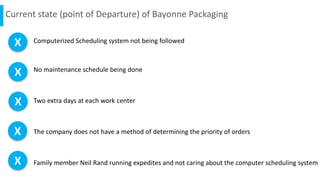
Computerized Scheduling system not being followed
Current state (point of Departure) of Bayonne Packaging
X
X
X
X
X
No maintenance schedule being done
Two extra days at each work center
Family member Neil Rand running expedites and not caring about the computer scheduling system
The company does not have a method of determining the priority of orders
51%
of the orders are late for
Oct’11
Scrap and customer rejects
are very high, eliminating
profitability
incurred a loss in October
2011 for the first time in
past ten years
Problem Statement – Delivery, Quality leading to Net Loss
1.5% -7.2%
Financial Analysis
0.50%
1.50%
0.00%
1.00%
2.00%
3.00%
4.00%
5.00%
Customer Rejections
Oct-09 Oct-11
72.11%
55.30%
90.70%
64.90%
0.00%
10.00%
20.00%
30.00%
40.00%
50.00%
60.00%
70.00%
80.00%
90.00%
100.00%
Cost Of Goods Sold & Cost Of Shipped Material
Oct-09 Oct-11
This has happened
because the company
has reduced its profit
margin in order to
increase its sales volume
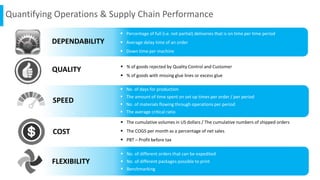
Quantifying Operations & Supply Chain Performance
 Percentage of full (i.e. not partial) deliveries that is on time per time period
 Average delay time of an order
 Down time per machine
DEPENDABILITY
 % of goods rejected by Quality Control and Customer
 % of goods with missing glue lines or excess glue
QUALITY
 No. of days for production
 The amount of time spent on set up times per order / per period
 No. of materials flowing through operations per period
 The average critical ratio
SPEED
 The cumulative volumes in US dollars / The cumulative numbers of shipped orders
 The COGS per month as a percentage of net sales
 PBT – Profit before tax
COST
 No. of different orders that can be expedited
 No. of different packages possible to print
 Benchmarking
FLEXIBILITY
Capacity Utilization at various work Centers
Sl .No Machine
Total Hours Per
machine
Number of
Machines
Combined
Running times
Theoretical
running times
Capacity Utilization
per work center
1 Composition 255 1 255 347 73.49%
2 Jagenburg Sheeter 279 1 279 347 80.40%
3 Heidelberg Press 348 2 696 694 100.29%
4 Bobst Die-Cut 272 2 544 694 78.39%
5 Int. Roy / Queen F& G 156 3 468 1041 44.96%
6 Int. Staude F&G 179 4 716 1388 51.59%
7 Int. 3A window/ patch 145 2 290 694 41.79%
Heildeberg press is the bottleneck with capacity utilization of 100.29%
Number of working hours in October'11 is 347 hours
Capacity in pieces of the Die-cut center in three cases
Order size (pieces) 30,000
Time per sheet 0.0075
Time per sheet (1 sheet = 3 piece) 0.0025
Time to process order (30000 piece * Time per piece) 75 Minutes
Set up time 2,5 hrs 150 Minutes
Total minutes per order 225 Minutes
15 hours per day is 900 Minutes
Total capacity of Die-cut center 4 Orders
Total capacity of Die-cut center in pieces 120,000 Pieces
Order size (pieces) 30,000
Time per sheet 0.0075
Time per sheet (1 sheet = 3 piece) 0.0025
gang 2 orders in a batch, number of pieces in batch 60,000
Time to process order (60000 piece * Time per piece) 150 Minutes
Set up time 2,5 hrs 150 Minutes
Total minutes per batch 300 Minutes
15 hours per day is 900 Minutes
Total capacity of Die-cut center 4 Orders
Total capacity of Die-cut center in orders 6 Orders
Total capacity of Die-cut center in pieces 180,000 Pieces
All orders are ganged
Time per sheet 0.0075
Time per sheet (1 sheet = 3 piece) 0.0025
Total minutes per day 900 Minutes
Minutes required for one required set up 150 Minutes
Remaining available minutes for running orders 750 Minutes
Number of pieces possible per day 300,000 Pieces
Number of orders possible per day 10 Orders
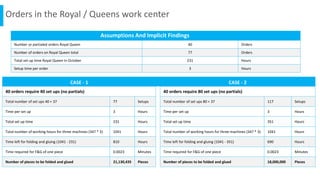
Orders in the Royal / Queens work center
Number or partialed orders Royal Queen 40 Orders
Number of orders on Royal Queen total 77 Orders
Total set up time Royal Queen in October 231 Hours
Setup time per order 3 Hours
40 orders require 40 set ups (no partials)
Total number of set ups 40 + 37 77 Setups
Time per set up 3 Hours
Total set up time 231 Hours
Total number of working hours for three machines (347 * 3) 1041 Hours
Time left for folding and gluing (1041 - 231) 810 Hours
Time required for F&G of one piece 0.0023 Minutes
Number of pieces to be folded and glued 21,130,435 Pieces
40 orders require 80 set ups (no partials)
Total number of set ups 80 + 37 117 Setups
Time per set up 3 Hours
Total set up time 351 Hours
Total number of working hours for three machines (347 * 3) 1041 Hours
Time left for folding and gluing (1041 - 351) 690 Hours
Time required for F&G of one piece 0.0023 Minutes
Number of pieces to be folded and glued 18,000,000 Pieces
Assumptions And Implicit Findings
CASE - 1 CASE - 2
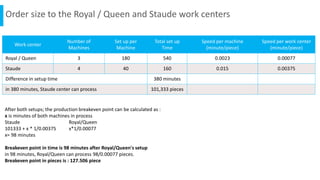
Order size to the Royal / Queen and Staude work centers
Work center
Number of
Machines
Set up per
Machine
Total set up
Time
Speed per machine
(minute/piece)
Speed per work center
(minute/piece)
Royal / Queen 3 180 540 0.0023 0.00077
Staude 4 40 160 0.015 0.00375
Difference in setup time 380 minutes
in 380 minutes, Staude center can process 101,333 pieces
After both setups; the production breakeven point can be calculated as :
x is minutes of both machines in process
Staude Royal/Queen
101333 + x * 1/0.00375 x*1/0.00077
x= 98 minutes
Breakeven point in time is 98 minutes after Royal/Queen's setup
in 98 minutes, Royal/Queen can process 98/0.00077 pieces.
Breakeven point in pieces is : 127.506 piece
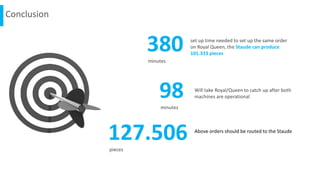
Conclusion
set up time needed to set up the same order
on Royal Queen, the Staude can produce
101.333 pieces
Will take Royal/Queen to catch up after both
machines are operational
Above orders should be routed to the Staude
380minutes
98minutes
127.506pieces
Recommendations Focused on Effectiveness and Efficiency
 Increase capacity by allowing for
overtime
 Daily meetings
 Prioritizing orders (e.g. red flags for
rush orders) and weigh the
consequences of rush orders for the
remaining orders, therewith
optimizing the number of rush
orders
 Increase / improve maintenance on
machines in order to increase quality
 Manage variability better by managing of
demand e.g. introducing price reductions
for bulk orders
 Increase capacity by widening the bottle
neck (e.g. extra shift on the Heidelberg
press)
 Introduce pre-Work Order Jacket – a
report that is sent to other departments
when the prior department starts working
on and order. This way, the later
department knows what orders are on the
way in couple of days.
 Increase capacity by investing in
additional equipment
 Introduce a companywide ERP
system in order to schedule
production in reliable, achievable
way that is adhered to by all
departments (including sales). This
should result in fewer rush orders,
fewer partial orders and less
unnecessary set up time.
SHORT TERM
(0–3 MONTHS)
MID TERM
(3–9 MONTHS)
LONG TERM
(9+ MONTHS)
THANKS

Bayonne packaging Case Study Analysis

  • 1.
    Bayonne Packaging CaseStudy MPE-14, NMIMS
  • 2.
    Bayonne Packaging, Inc.is a printer and paper converter company Executive Summary Industry Vertical – Specialty Packaging Manufactures customized packaging for industrial customers Specialized in innovative packaging solutions along with full service from design to final delivery They also work closely with customers to develop the design as per their need Competitive Strengths: Beautiful product, great designs, classy printing, handling of innovative and difficult package design and the ability to fold and glue the complex blanks
  • 3.
    Computerized Scheduling systemnot being followed Current state (point of Departure) of Bayonne Packaging X X X X X No maintenance schedule being done Two extra days at each work center Family member Neil Rand running expedites and not caring about the computer scheduling system The company does not have a method of determining the priority of orders
  • 4.
    51% of the ordersare late for Oct’11 Scrap and customer rejects are very high, eliminating profitability incurred a loss in October 2011 for the first time in past ten years Problem Statement – Delivery, Quality leading to Net Loss 1.5% -7.2%
  • 5.
    Financial Analysis 0.50% 1.50% 0.00% 1.00% 2.00% 3.00% 4.00% 5.00% Customer Rejections Oct-09Oct-11 72.11% 55.30% 90.70% 64.90% 0.00% 10.00% 20.00% 30.00% 40.00% 50.00% 60.00% 70.00% 80.00% 90.00% 100.00% Cost Of Goods Sold & Cost Of Shipped Material Oct-09 Oct-11 This has happened because the company has reduced its profit margin in order to increase its sales volume
  • 6.
    Quantifying Operations &Supply Chain Performance  Percentage of full (i.e. not partial) deliveries that is on time per time period  Average delay time of an order  Down time per machine DEPENDABILITY  % of goods rejected by Quality Control and Customer  % of goods with missing glue lines or excess glue QUALITY  No. of days for production  The amount of time spent on set up times per order / per period  No. of materials flowing through operations per period  The average critical ratio SPEED  The cumulative volumes in US dollars / The cumulative numbers of shipped orders  The COGS per month as a percentage of net sales  PBT – Profit before tax COST  No. of different orders that can be expedited  No. of different packages possible to print  Benchmarking FLEXIBILITY
  • 7.
    Capacity Utilization atvarious work Centers Sl .No Machine Total Hours Per machine Number of Machines Combined Running times Theoretical running times Capacity Utilization per work center 1 Composition 255 1 255 347 73.49% 2 Jagenburg Sheeter 279 1 279 347 80.40% 3 Heidelberg Press 348 2 696 694 100.29% 4 Bobst Die-Cut 272 2 544 694 78.39% 5 Int. Roy / Queen F& G 156 3 468 1041 44.96% 6 Int. Staude F&G 179 4 716 1388 51.59% 7 Int. 3A window/ patch 145 2 290 694 41.79% Heildeberg press is the bottleneck with capacity utilization of 100.29% Number of working hours in October'11 is 347 hours
  • 8.
    Capacity in piecesof the Die-cut center in three cases Order size (pieces) 30,000 Time per sheet 0.0075 Time per sheet (1 sheet = 3 piece) 0.0025 Time to process order (30000 piece * Time per piece) 75 Minutes Set up time 2,5 hrs 150 Minutes Total minutes per order 225 Minutes 15 hours per day is 900 Minutes Total capacity of Die-cut center 4 Orders Total capacity of Die-cut center in pieces 120,000 Pieces Order size (pieces) 30,000 Time per sheet 0.0075 Time per sheet (1 sheet = 3 piece) 0.0025 gang 2 orders in a batch, number of pieces in batch 60,000 Time to process order (60000 piece * Time per piece) 150 Minutes Set up time 2,5 hrs 150 Minutes Total minutes per batch 300 Minutes 15 hours per day is 900 Minutes Total capacity of Die-cut center 4 Orders Total capacity of Die-cut center in orders 6 Orders Total capacity of Die-cut center in pieces 180,000 Pieces All orders are ganged Time per sheet 0.0075 Time per sheet (1 sheet = 3 piece) 0.0025 Total minutes per day 900 Minutes Minutes required for one required set up 150 Minutes Remaining available minutes for running orders 750 Minutes Number of pieces possible per day 300,000 Pieces Number of orders possible per day 10 Orders
  • 9.
    Orders in theRoyal / Queens work center Number or partialed orders Royal Queen 40 Orders Number of orders on Royal Queen total 77 Orders Total set up time Royal Queen in October 231 Hours Setup time per order 3 Hours 40 orders require 40 set ups (no partials) Total number of set ups 40 + 37 77 Setups Time per set up 3 Hours Total set up time 231 Hours Total number of working hours for three machines (347 * 3) 1041 Hours Time left for folding and gluing (1041 - 231) 810 Hours Time required for F&G of one piece 0.0023 Minutes Number of pieces to be folded and glued 21,130,435 Pieces 40 orders require 80 set ups (no partials) Total number of set ups 80 + 37 117 Setups Time per set up 3 Hours Total set up time 351 Hours Total number of working hours for three machines (347 * 3) 1041 Hours Time left for folding and gluing (1041 - 351) 690 Hours Time required for F&G of one piece 0.0023 Minutes Number of pieces to be folded and glued 18,000,000 Pieces Assumptions And Implicit Findings CASE - 1 CASE - 2
  • 10.
    Order size tothe Royal / Queen and Staude work centers Work center Number of Machines Set up per Machine Total set up Time Speed per machine (minute/piece) Speed per work center (minute/piece) Royal / Queen 3 180 540 0.0023 0.00077 Staude 4 40 160 0.015 0.00375 Difference in setup time 380 minutes in 380 minutes, Staude center can process 101,333 pieces After both setups; the production breakeven point can be calculated as : x is minutes of both machines in process Staude Royal/Queen 101333 + x * 1/0.00375 x*1/0.00077 x= 98 minutes Breakeven point in time is 98 minutes after Royal/Queen's setup in 98 minutes, Royal/Queen can process 98/0.00077 pieces. Breakeven point in pieces is : 127.506 piece
  • 11.
    Conclusion set up timeneeded to set up the same order on Royal Queen, the Staude can produce 101.333 pieces Will take Royal/Queen to catch up after both machines are operational Above orders should be routed to the Staude 380minutes 98minutes 127.506pieces
  • 12.
    Recommendations Focused onEffectiveness and Efficiency  Increase capacity by allowing for overtime  Daily meetings  Prioritizing orders (e.g. red flags for rush orders) and weigh the consequences of rush orders for the remaining orders, therewith optimizing the number of rush orders  Increase / improve maintenance on machines in order to increase quality  Manage variability better by managing of demand e.g. introducing price reductions for bulk orders  Increase capacity by widening the bottle neck (e.g. extra shift on the Heidelberg press)  Introduce pre-Work Order Jacket – a report that is sent to other departments when the prior department starts working on and order. This way, the later department knows what orders are on the way in couple of days.  Increase capacity by investing in additional equipment  Introduce a companywide ERP system in order to schedule production in reliable, achievable way that is adhered to by all departments (including sales). This should result in fewer rush orders, fewer partial orders and less unnecessary set up time. SHORT TERM (0–3 MONTHS) MID TERM (3–9 MONTHS) LONG TERM (9+ MONTHS)
  • 13.