Ayed Alqarta | @aqarta

IT Security Consultant
   Malware trends in 2012
   Malware Stats: State of Kuwait
   How Malware infiltrates Enterprise Today
   Effective Malware Mitigations
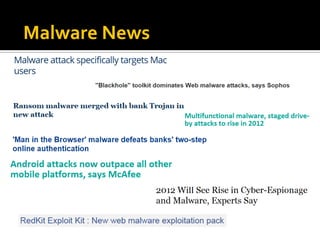
Malware Newsws
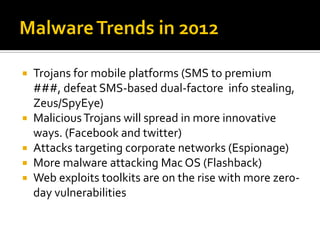
   Trojans for mobile platforms (SMS to premium
    ###, defeat SMS-based dual-factore info stealing,
    Zeus/SpyEye)
   Malicious Trojans will spread in more innovative
    ways. (Facebook and twitter)
   Attacks targeting corporate networks (Espionage)
   More malware attacking Mac OS (Flashback)
   Web exploits toolkits are on the rise with more zer0-
    day vulnerabilities
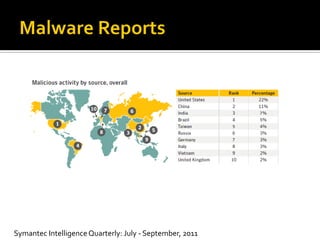
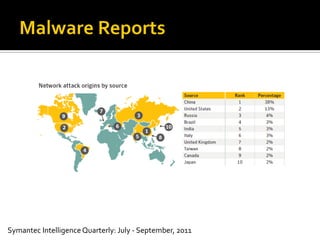
Symantec Intelligence Quarterly: July - September, 2011
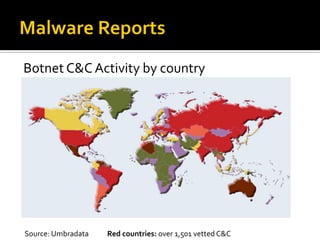
Botnet C&C Activity by country


Source: Umbradata   Red countries: over 1,501 vetted C&C
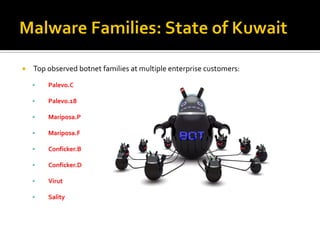
   Top observed botnet families at multiple enterprise customers:

       Palevo.C

       Palevo.18

       Mariposa.P

       Mariposa.F

       Conficker.B

       Conficker.D

       Virut

       Sality
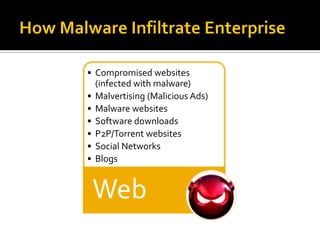
• Compromised websites
  (infected with malware)
• Malvertising (Malicious Ads)
• Malware websites
• Software downloads
• P2P/Torrent websites
• Social Networks
• Blogs


 Web
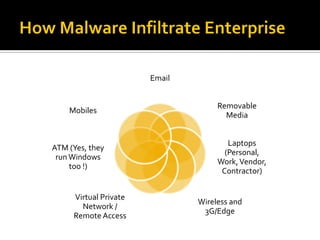
Email


                                    Removable
    Mobiles
                                      Media


                                       Laptops
ATM (Yes, they
                                      (Personal,
 run Windows
                                    Work, Vendor,
     too !)
                                     Contractor)


     Virtual Private
                               Wireless and
       Network /
                                3G/Edge
     Remote Access
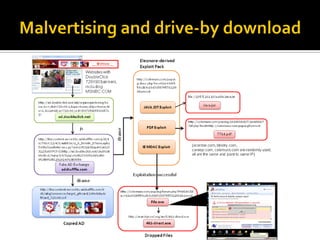
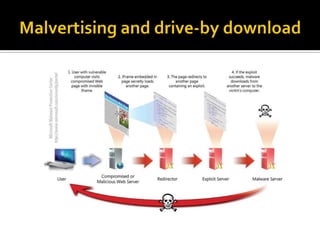
Malvertising (from "malicious advertising") is the use of online
advertising to spread malware.
Internet advertisement networks provide attackers with an effective
venue for targeting numerous computers through malicious banner
ads.
Such malvertisements may take the form of Flash programs that look
like regular ads, but contain code that attacks the visitor's system
directly or redirects the browser to a malicious website.
Malicious ads can also be implemented without Flash by simply
redirecting the destination of the ad after the launch of the
campaign.
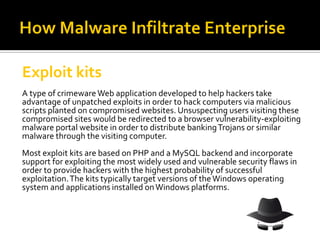
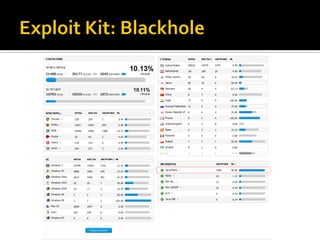
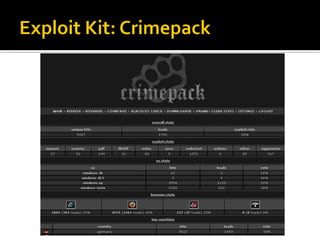
Exploit kits
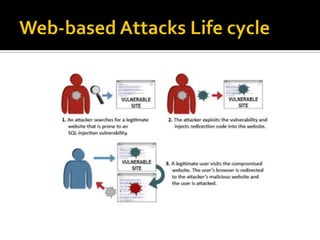
A type of crimeware Web application developed to help hackers take
advantage of unpatched exploits in order to hack computers via malicious
scripts planted on compromised websites. Unsuspecting users visiting these
compromised sites would be redirected to a browser vulnerability-exploiting
malware portal website in order to distribute banking Trojans or similar
malware through the visiting computer.
Most exploit kits are based on PHP and a MySQL backend and incorporate
support for exploiting the most widely used and vulnerable security flaws in
order to provide hackers with the highest probability of successful
exploitation. The kits typically target versions of the Windows operating
system and applications installed on Windows platforms.
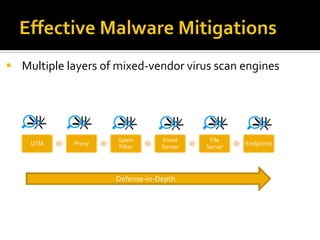
 Multiple layers of mixed-vendor virus scan engines


                     Spam       Email     File
    UTM     Proxy                                 Endpoints
                     Filter     Server   Server


                    Defense-in-Depth
   Device & Application control
     Block removable drives like “USB Flash” disks to
      prevent AutoRun attacks.
     If not possible, only allow documents and trusted
      files to run from USB, except executables.
     Disable the “Auto Play” functionality in Windows.
     Consider using “Secure Flash disk”, which has
      onboard antivirus scan engine to protect it against
      malware.
   Device & Application control
     Use App control solution (standalone / apart of
      endpoint security) to lockdown critical systems.
     App control policy can protect against all kind of
      malware including zer0-day, since there is no need
      for signatures (Whitelisting).
   Patch management (OS/Browsers/Apps)
     Be up-to-date with latest patch related information from
        various source
       Download patches and run extensive tests to validate the
        authenticity and accuracy of patches
       Install security and critical patches/service packs for OS
        and 3rd party applications.
       Maintain a testing environment to test patches before
        approving them to production systems.
       Generate reports of various patch management tasks
       Monitor the patching progress in the enterprise
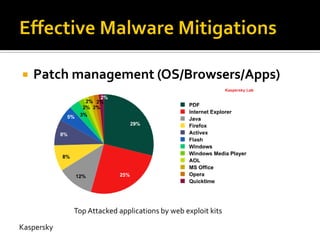
   Patch management (OS/Browsers/Apps)


            Top Attacked applications by web exploit kits

Kaspersky
Patch management (3d Party Apps)
•   Java Run Time Environment (JRE)
•   Adobe Reader, Acrobat, Air, Shockwave Player, Flash Player
•   Mozilla Firefox
•   Mozilla Thunderbird
•   Google Chrome
•   Apple Safari, iTunes, QuickTime
•   Microsoft Internet Explorer
•   Microsoft Office
•   RealNetworks RealPlayer
   Vulnerabilities Research Resources

       http://technet.microsoft.com/en-us/security/bulletin
       http://www.kb.cert.org/vuls/
       http://secunia.com/community/advisories/
       http://www.symantec.com/security_response/landing/vulnerabi
        lities.jsp
       http://tools.cisco.com/security/center/publicationListing
       http://www.vupen.com/english/security-advisories/
       http://www.us-cert.gov/current/
       http://www.adobe.com/support/security/
       http://www.verisigninc.com/en_US/products-and-
        services/network-intelligence-availability/idefense/public-
        vulnerability-reports/index.xhtml
   Web filtering
     Block access to malicious domains (Malware, Phishing, Botnet C&C,
        Compromised Websites, Malware hosting, Advertisements,
        Pornography, Dynamic DNS, Social Networks Games, Computer
        Software, Uncategorized)
       Proxy must include an antivirus/antispyware engine to scan
        downloaded files
       Block downloading suspicious files (.exe, .cmd, .pif, .bat, .scr, .dll, .sys)
       Generate reports and warn top policy violators
       Manually block domains/URLs which are not-categoriezed by vendor
        (blocklist)
   Geo-based filtering (top-malware hosting
    countries)
     Block inbound/outbound to these countries (China, Russia, Korea,
      Brazil, Thailand, Taiwan, Japan, Poland, Peru)
     Logs (UTM/Proxy) will help detecting possible infections
     This filtering will stop/decrease (SPAM, Malware, Malicious websites,
      Phishing)
     A proactive security technique to prevent threats
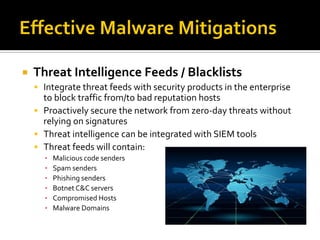
   Threat Intelligence Feeds / Blacklists
     Integrate threat feeds with security products in the enterprise
      to block traffic from/to bad reputation hosts
     Proactively secure the network from zer0-day threats without
      relying on signatures
     Threat intelligence can be integrated with SIEM tools
     Threat feeds will contain:
      ▪   Malicious code senders
      ▪   Spam senders
      ▪   Phishing senders
      ▪   Botnet C&C servers
      ▪   Compromised Hosts
      ▪   Malware Domains
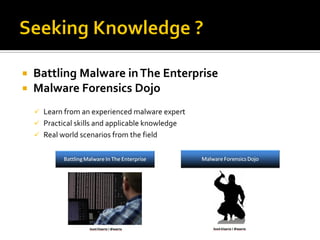
   Battling Malware in The Enterprise
   Malware Forensics Dojo
     Learn from an experienced malware expert
     Practical skills and applicable knowledge
     Real world scenarios from the field
Thank you
@aqarta    a.qarta@gmail.com

Battling Malware In The Enterprise

  • 1.
    Ayed Alqarta |@aqarta IT Security Consultant
  • 2.
    Malware trends in 2012  Malware Stats: State of Kuwait  How Malware infiltrates Enterprise Today  Effective Malware Mitigations
  • 3.
  • 4.
    Trojans for mobile platforms (SMS to premium ###, defeat SMS-based dual-factore info stealing, Zeus/SpyEye)  Malicious Trojans will spread in more innovative ways. (Facebook and twitter)  Attacks targeting corporate networks (Espionage)  More malware attacking Mac OS (Flashback)  Web exploits toolkits are on the rise with more zer0- day vulnerabilities
  • 5.
    Symantec Intelligence Quarterly:July - September, 2011
  • 6.
    Symantec Intelligence Quarterly:July - September, 2011
  • 7.
    Botnet C&C Activityby country Source: Umbradata Red countries: over 1,501 vetted C&C
  • 8.
    Top observed botnet families at multiple enterprise customers:  Palevo.C  Palevo.18  Mariposa.P  Mariposa.F  Conficker.B  Conficker.D  Virut  Sality
  • 9.
    • Compromised websites (infected with malware) • Malvertising (Malicious Ads) • Malware websites • Software downloads • P2P/Torrent websites • Social Networks • Blogs Web
  • 10.
    Email Removable Mobiles Media Laptops ATM (Yes, they (Personal, run Windows Work, Vendor, too !) Contractor) Virtual Private Wireless and Network / 3G/Edge Remote Access
  • 11.
    Malvertising (from "maliciousadvertising") is the use of online advertising to spread malware. Internet advertisement networks provide attackers with an effective venue for targeting numerous computers through malicious banner ads. Such malvertisements may take the form of Flash programs that look like regular ads, but contain code that attacks the visitor's system directly or redirects the browser to a malicious website. Malicious ads can also be implemented without Flash by simply redirecting the destination of the ad after the launch of the campaign.
  • 14.
    Exploit kits A typeof crimeware Web application developed to help hackers take advantage of unpatched exploits in order to hack computers via malicious scripts planted on compromised websites. Unsuspecting users visiting these compromised sites would be redirected to a browser vulnerability-exploiting malware portal website in order to distribute banking Trojans or similar malware through the visiting computer. Most exploit kits are based on PHP and a MySQL backend and incorporate support for exploiting the most widely used and vulnerable security flaws in order to provide hackers with the highest probability of successful exploitation. The kits typically target versions of the Windows operating system and applications installed on Windows platforms.
  • 18.
     Multiple layersof mixed-vendor virus scan engines Spam Email File UTM Proxy Endpoints Filter Server Server Defense-in-Depth
  • 19.
    Device & Application control  Block removable drives like “USB Flash” disks to prevent AutoRun attacks.  If not possible, only allow documents and trusted files to run from USB, except executables.  Disable the “Auto Play” functionality in Windows.  Consider using “Secure Flash disk”, which has onboard antivirus scan engine to protect it against malware.
  • 20.
    Device & Application control  Use App control solution (standalone / apart of endpoint security) to lockdown critical systems.  App control policy can protect against all kind of malware including zer0-day, since there is no need for signatures (Whitelisting).
  • 21.
    Patch management (OS/Browsers/Apps)  Be up-to-date with latest patch related information from various source  Download patches and run extensive tests to validate the authenticity and accuracy of patches  Install security and critical patches/service packs for OS and 3rd party applications.  Maintain a testing environment to test patches before approving them to production systems.  Generate reports of various patch management tasks  Monitor the patching progress in the enterprise
  • 22.
    Patch management (OS/Browsers/Apps) Top Attacked applications by web exploit kits Kaspersky
  • 23.
    Patch management (3dParty Apps) • Java Run Time Environment (JRE) • Adobe Reader, Acrobat, Air, Shockwave Player, Flash Player • Mozilla Firefox • Mozilla Thunderbird • Google Chrome • Apple Safari, iTunes, QuickTime • Microsoft Internet Explorer • Microsoft Office • RealNetworks RealPlayer
  • 24.
    Vulnerabilities Research Resources  http://technet.microsoft.com/en-us/security/bulletin  http://www.kb.cert.org/vuls/  http://secunia.com/community/advisories/  http://www.symantec.com/security_response/landing/vulnerabi lities.jsp  http://tools.cisco.com/security/center/publicationListing  http://www.vupen.com/english/security-advisories/  http://www.us-cert.gov/current/  http://www.adobe.com/support/security/  http://www.verisigninc.com/en_US/products-and- services/network-intelligence-availability/idefense/public- vulnerability-reports/index.xhtml
  • 25.
    Web filtering  Block access to malicious domains (Malware, Phishing, Botnet C&C, Compromised Websites, Malware hosting, Advertisements, Pornography, Dynamic DNS, Social Networks Games, Computer Software, Uncategorized)  Proxy must include an antivirus/antispyware engine to scan downloaded files  Block downloading suspicious files (.exe, .cmd, .pif, .bat, .scr, .dll, .sys)  Generate reports and warn top policy violators  Manually block domains/URLs which are not-categoriezed by vendor (blocklist)
  • 26.
    Geo-based filtering (top-malware hosting countries)  Block inbound/outbound to these countries (China, Russia, Korea, Brazil, Thailand, Taiwan, Japan, Poland, Peru)  Logs (UTM/Proxy) will help detecting possible infections  This filtering will stop/decrease (SPAM, Malware, Malicious websites, Phishing)  A proactive security technique to prevent threats
  • 27.
    Threat Intelligence Feeds / Blacklists  Integrate threat feeds with security products in the enterprise to block traffic from/to bad reputation hosts  Proactively secure the network from zer0-day threats without relying on signatures  Threat intelligence can be integrated with SIEM tools  Threat feeds will contain: ▪ Malicious code senders ▪ Spam senders ▪ Phishing senders ▪ Botnet C&C servers ▪ Compromised Hosts ▪ Malware Domains
  • 28.
    Battling Malware in The Enterprise  Malware Forensics Dojo  Learn from an experienced malware expert  Practical skills and applicable knowledge  Real world scenarios from the field
  • 29.
    Thank you @aqarta a.qarta@gmail.com