Animal distribution
Dr.Thejass P
Asst.Professor of Zoology
Govt.College Madappally
• Earth has an amazing diversity of life.
• However all these species are not distributed uniformly all over the earth.
• Instead they are localised or restricted to specific areas or regions called
ranges.
• Each species has its own range of distribution.
• There are various reasons for this uneven distribution.
Kinds of animal distribution
• There are two major kinds of animal distribution.
1) Spatial distribution or distribution in space and
2) Geological distribution or distribution in time.
Spatial distribution
• This is the distribution of animals in the different parts of the world.
• it is of two kinds-
a) geographical (horizontal or surfacial) distribution and
b) bathymetric ( vertical or altitudinal) distribution.
Geographical distribution
• This is the horizontal distribution of animals in different geographical regions
and natural habitats of the Earth surface.
• The study of the geographical distribution of animals is called Zoogeography.
• Based on the geographical distribution of vertebrates, the earth surface is
divided into distinct regions called zoogeographical realms.
Bathymetric distribution
• This is the vertical distribution of animals on land and in water.
• It is of three kinds-
i) Geobiotic
ii) Halobiotic and
iii) Limnobiotic.
• Geobiotic distribution is the vertical distribution on land.
• Halobiotic distribution is the vertical distribution in marine waters and
• Limnobiotic distribution is the vertical distribution in inland freshwater
bodies.
Geobiotic realm consists of several subdivisions, known as biomes.
Examples are deserts, forests, grasslands, tundras, Caves etc.
Halobiotic realm includes oceans, seas, estuaries etc.
Limnobiotic realm includes lakes, ponds, reservoirs, rivers, streams etc.
Geological or durational distribution
• This is the distribution of animals in the geological past.
• So it is related to the evolutionary history of life on earth.
• It is revealed by the study of fossils.
Patterns of animal distribution
• Based on the extent of geographical distribution, animal
distribution can be classified into four types-
• 1) Cosmopolitan ( universal, worldwide or continuous)
• 2) Discontinuous ( disjunctive)
• 3) Isolated and
• 4) Bipolar
Cosmopolitan distribution
• Also called universal, worldwide or continuous distribution.
• It is the distribution in which the members of a species are present all
over the world.
• Such animals are capable of adjusting to a wide range of environmental
conditions.
• Animal species having a wide range and enjoying cosmopolitan
distribution with tolerance and adaptations to a wide variety of
environmental conditions are called eurytopic species.
• Those found in restricted regions with limited range of adaptation to
environmental conditions are called stenotopic species.
• Eurytopic species are endowed with a wide variety of adaptation and
adjustments to diverse environmental conditions.
• So, they can thrive under different environmental conditions, migrate
to long distances and cross natural barriers.
• On the other hand, stenotopic species are adapted only to a particular
type of environment.
• So they can thrive only in a specific environment, cannot migrate to
other environments and cannot cross natural barriers.
• The best example of eurytopic species is human being.
• Other examples are green mussel, brine shrimp, bats, rats, cuckoos,
hawks etc.
• Stenotopic species include sluggish, sessile or sedentary forms.
Discontinuous distribution
• Also called disjunctive distribution.
• This is the distribution in which the members of the same or closely related
species are distributed in local, widely separated and geographically
unconnected or discontinuous regions.
Reasons for discontinuous distribution
• The animal species exhibiting discontinuous distribution today are believed
to have had a continuous distribution in the past.
• Various hypotheses have been proposed to explain the reasons for
discontinuous distribution.
• One of the seemingly valid explanations is that of Darlington.
• He suggested three mechanisms:
1) Migration of land animals across water to reach oceanic islands.
2) Continental Drift and submergence of land bridges (isthmus)
separating the originally connected or continuous regions.
3) Extinction of animals in those areas which are in between the regions
of their current distribution.
• Discontinuous distribution could be due to various other factual, such as
climatic changes, predation pressure, natural calamities, diseases, formation
of new barriers due to geological changes, etc.
Examples of discontinuous distribution
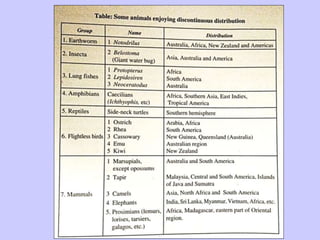
• Notodrilus, Peripatus, Belostoma, lung fishes, flightless birds, pouched
mammals, Prosimians, tapiridae, camelidae, etc. are some of the examples
of discontinuous distribution
Peripatus
• One of most popular examples of discontinuous distribution is Peripatus".
• It is a genus of Onychophora (velvet worms).
• It is said to be a living fossil because it has been unchanged for
approximately 570 million years.
• Members of this genus are distributed in different parts of the world which
have no geographical proximity and continuity.
• They are found in America, Africa, India, Malaya, New Zealand and East
Indies.
Camelidae
• Another example is family Camelidae (camels and llamas).
• While camels are distributed in Asia and Africa, their relatives, llamas, are
found only in South America.
• The origin of the family was in North America.
• From there, they migrated to Asia across the shallow Bering Straits and
thence to Africa and South America through the Isthmus of Panama.
Camelidae
• But later on, they became restricted to the areas of their present
distribution due to various ecological changes like submergence of the
Isthmus of Panama.
• Prolonged isolation led to the evolution of the ancient camelids to the
present day camel and llama.
Isolated distribution
• Type of distribution in which animals are found exclusively in the
isolated regions of the earth.
• So such isolated animals are confined to certain areas only and are not
found anywhere else.
• Most of these animals are primitive and are often known as living
fossils.
• The reason for their survival could be the absence of competitors and
predators in their area of distribution.
• They are present in very few numbers.
• From a conservative point of view, they are very important because any
change in their habitat could lead to their extinction.
Isolated distribution
• Typical examples are
Sphenodon of New Zealand
Duck-billed Platypus of Australia and Tasmania
Echidna (Tachyglossus) of Australia, Tasmania and New Guinea and
The Marsupial Opossum of Americas.
• The ancient Anapsid crustaceans living in the fresh waters of Australia
and Tasmania are invertebrate examples
Bipolar distribution
• Distribution of animals exclusively in the polar arctic (north pole) and
Antarctic (south pole) regions with no representatives elsewhere in the
regions in between, is known as Bipolar distribution.
• The Challenger Expedition of 1872-76 played a major role in exposing
bipolar distribution.
• The ship commanded by Captain George Nares, sailed from Portsmouth,
England, on December 21, 1872.
• Under the scientific supervision of Thomson, it travelled nearly 70,000
miles surveying and exploring.
• The result was the Report of The Scientific Results of the Exploring
Voyage of HMS Challenger during the years 1873-76 which catalogued
4,000 previously unknown species of animals.
Bipolar distribution
Examples
(i)Cnidaria-Lampira, Myriothela, Grammaria
(ii) Mollusca -Limacina, Clione.
(III) Urochordata - Didemus albidum
(IV) Pisces - Oncorhynchus (Pacific salmon), Lamna cornubika (shark).
• Bipolar animals are now considered to be the relics of previously
cosmopolitan fauna.
• Another view is that these animals migrated to the polar regions from the
intermediate zones and then underwent adaptive radiation there, getting
adapted to the highly varied and extreme climatic conditions.
Thank you

Animal distribution

  • 1.
    Animal distribution Dr.Thejass P Asst.Professorof Zoology Govt.College Madappally
  • 2.
    • Earth hasan amazing diversity of life. • However all these species are not distributed uniformly all over the earth. • Instead they are localised or restricted to specific areas or regions called ranges. • Each species has its own range of distribution. • There are various reasons for this uneven distribution.
  • 3.
    Kinds of animaldistribution • There are two major kinds of animal distribution. 1) Spatial distribution or distribution in space and 2) Geological distribution or distribution in time.
  • 4.
    Spatial distribution • Thisis the distribution of animals in the different parts of the world. • it is of two kinds- a) geographical (horizontal or surfacial) distribution and b) bathymetric ( vertical or altitudinal) distribution.
  • 5.
    Geographical distribution • Thisis the horizontal distribution of animals in different geographical regions and natural habitats of the Earth surface. • The study of the geographical distribution of animals is called Zoogeography. • Based on the geographical distribution of vertebrates, the earth surface is divided into distinct regions called zoogeographical realms.
  • 6.
    Bathymetric distribution • Thisis the vertical distribution of animals on land and in water. • It is of three kinds- i) Geobiotic ii) Halobiotic and iii) Limnobiotic. • Geobiotic distribution is the vertical distribution on land. • Halobiotic distribution is the vertical distribution in marine waters and • Limnobiotic distribution is the vertical distribution in inland freshwater bodies.
  • 7.
    Geobiotic realm consistsof several subdivisions, known as biomes. Examples are deserts, forests, grasslands, tundras, Caves etc. Halobiotic realm includes oceans, seas, estuaries etc. Limnobiotic realm includes lakes, ponds, reservoirs, rivers, streams etc.
  • 8.
    Geological or durationaldistribution • This is the distribution of animals in the geological past. • So it is related to the evolutionary history of life on earth. • It is revealed by the study of fossils.
  • 9.
    Patterns of animaldistribution • Based on the extent of geographical distribution, animal distribution can be classified into four types- • 1) Cosmopolitan ( universal, worldwide or continuous) • 2) Discontinuous ( disjunctive) • 3) Isolated and • 4) Bipolar
  • 10.
    Cosmopolitan distribution • Alsocalled universal, worldwide or continuous distribution. • It is the distribution in which the members of a species are present all over the world. • Such animals are capable of adjusting to a wide range of environmental conditions. • Animal species having a wide range and enjoying cosmopolitan distribution with tolerance and adaptations to a wide variety of environmental conditions are called eurytopic species. • Those found in restricted regions with limited range of adaptation to environmental conditions are called stenotopic species.
  • 11.
    • Eurytopic speciesare endowed with a wide variety of adaptation and adjustments to diverse environmental conditions. • So, they can thrive under different environmental conditions, migrate to long distances and cross natural barriers. • On the other hand, stenotopic species are adapted only to a particular type of environment. • So they can thrive only in a specific environment, cannot migrate to other environments and cannot cross natural barriers. • The best example of eurytopic species is human being. • Other examples are green mussel, brine shrimp, bats, rats, cuckoos, hawks etc. • Stenotopic species include sluggish, sessile or sedentary forms.
  • 12.
    Discontinuous distribution • Alsocalled disjunctive distribution. • This is the distribution in which the members of the same or closely related species are distributed in local, widely separated and geographically unconnected or discontinuous regions.
  • 13.
    Reasons for discontinuousdistribution • The animal species exhibiting discontinuous distribution today are believed to have had a continuous distribution in the past. • Various hypotheses have been proposed to explain the reasons for discontinuous distribution. • One of the seemingly valid explanations is that of Darlington. • He suggested three mechanisms: 1) Migration of land animals across water to reach oceanic islands. 2) Continental Drift and submergence of land bridges (isthmus) separating the originally connected or continuous regions. 3) Extinction of animals in those areas which are in between the regions of their current distribution. • Discontinuous distribution could be due to various other factual, such as climatic changes, predation pressure, natural calamities, diseases, formation of new barriers due to geological changes, etc.
  • 14.
    Examples of discontinuousdistribution • Notodrilus, Peripatus, Belostoma, lung fishes, flightless birds, pouched mammals, Prosimians, tapiridae, camelidae, etc. are some of the examples of discontinuous distribution Peripatus • One of most popular examples of discontinuous distribution is Peripatus". • It is a genus of Onychophora (velvet worms). • It is said to be a living fossil because it has been unchanged for approximately 570 million years. • Members of this genus are distributed in different parts of the world which have no geographical proximity and continuity. • They are found in America, Africa, India, Malaya, New Zealand and East Indies.
  • 15.
    Camelidae • Another exampleis family Camelidae (camels and llamas). • While camels are distributed in Asia and Africa, their relatives, llamas, are found only in South America. • The origin of the family was in North America. • From there, they migrated to Asia across the shallow Bering Straits and thence to Africa and South America through the Isthmus of Panama.
  • 16.
    Camelidae • But lateron, they became restricted to the areas of their present distribution due to various ecological changes like submergence of the Isthmus of Panama. • Prolonged isolation led to the evolution of the ancient camelids to the present day camel and llama.
  • 18.
    Isolated distribution • Typeof distribution in which animals are found exclusively in the isolated regions of the earth. • So such isolated animals are confined to certain areas only and are not found anywhere else. • Most of these animals are primitive and are often known as living fossils. • The reason for their survival could be the absence of competitors and predators in their area of distribution. • They are present in very few numbers. • From a conservative point of view, they are very important because any change in their habitat could lead to their extinction.
  • 19.
    Isolated distribution • Typicalexamples are Sphenodon of New Zealand Duck-billed Platypus of Australia and Tasmania Echidna (Tachyglossus) of Australia, Tasmania and New Guinea and The Marsupial Opossum of Americas. • The ancient Anapsid crustaceans living in the fresh waters of Australia and Tasmania are invertebrate examples
  • 20.
    Bipolar distribution • Distributionof animals exclusively in the polar arctic (north pole) and Antarctic (south pole) regions with no representatives elsewhere in the regions in between, is known as Bipolar distribution. • The Challenger Expedition of 1872-76 played a major role in exposing bipolar distribution. • The ship commanded by Captain George Nares, sailed from Portsmouth, England, on December 21, 1872. • Under the scientific supervision of Thomson, it travelled nearly 70,000 miles surveying and exploring. • The result was the Report of The Scientific Results of the Exploring Voyage of HMS Challenger during the years 1873-76 which catalogued 4,000 previously unknown species of animals.
  • 21.
    Bipolar distribution Examples (i)Cnidaria-Lampira, Myriothela,Grammaria (ii) Mollusca -Limacina, Clione. (III) Urochordata - Didemus albidum (IV) Pisces - Oncorhynchus (Pacific salmon), Lamna cornubika (shark). • Bipolar animals are now considered to be the relics of previously cosmopolitan fauna. • Another view is that these animals migrated to the polar regions from the intermediate zones and then underwent adaptive radiation there, getting adapted to the highly varied and extreme climatic conditions.
  • 22.