Bath University AI Research
Seminar
AI, Technicity and Souls:
Military AI and Automation
Context
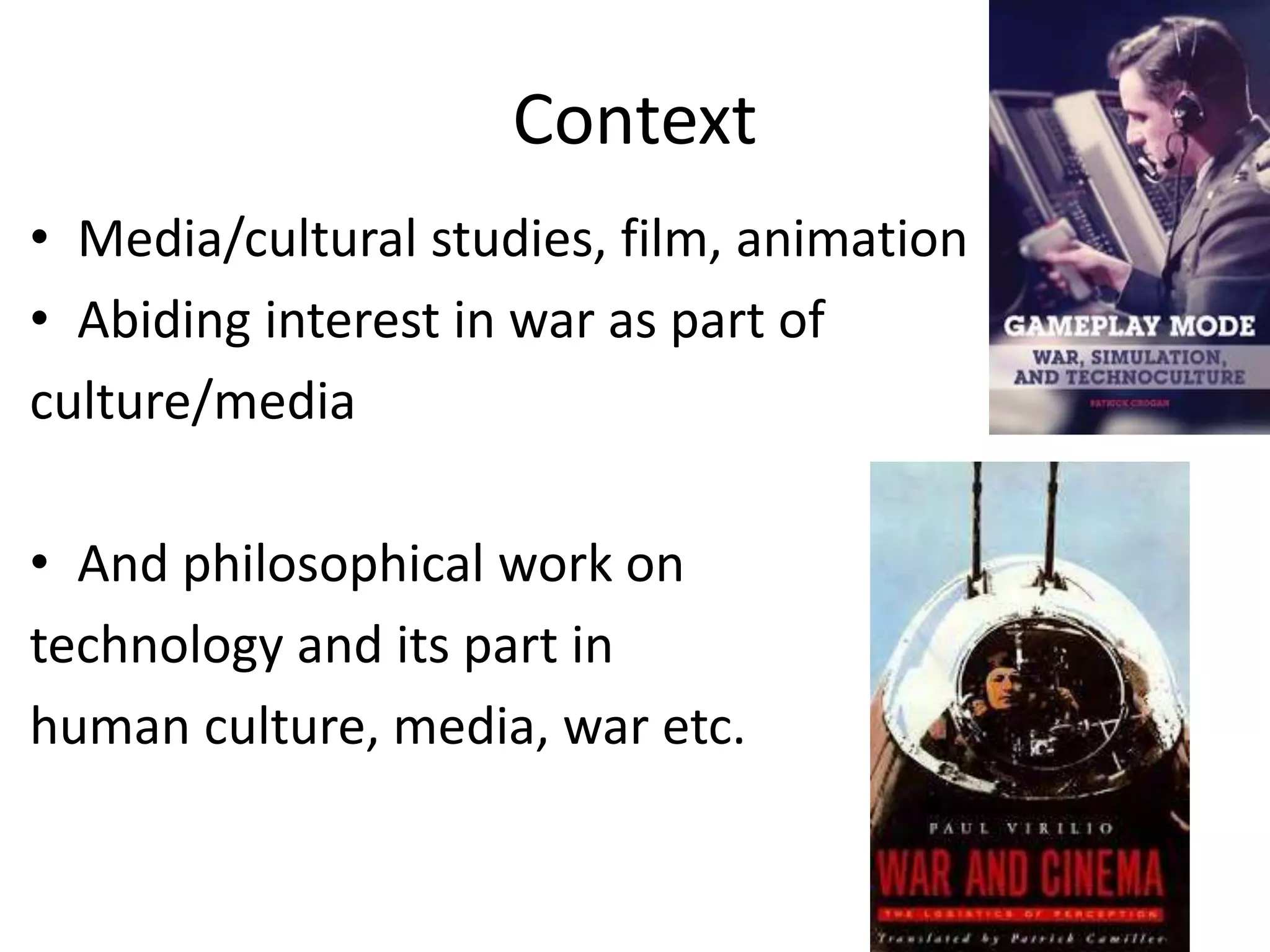
• Media/cultural studies, film, animation
• Abiding interest in war as part of
culture/media
• And philosophical work on
technology and its part in
human culture, media, war etc.
Aim
• PART 1 Situate development of AI/automated robotics
generally as human technological development – philosophy of
‘technicity’
• PART 2 Some comments on war/military technoscience (and
AI)
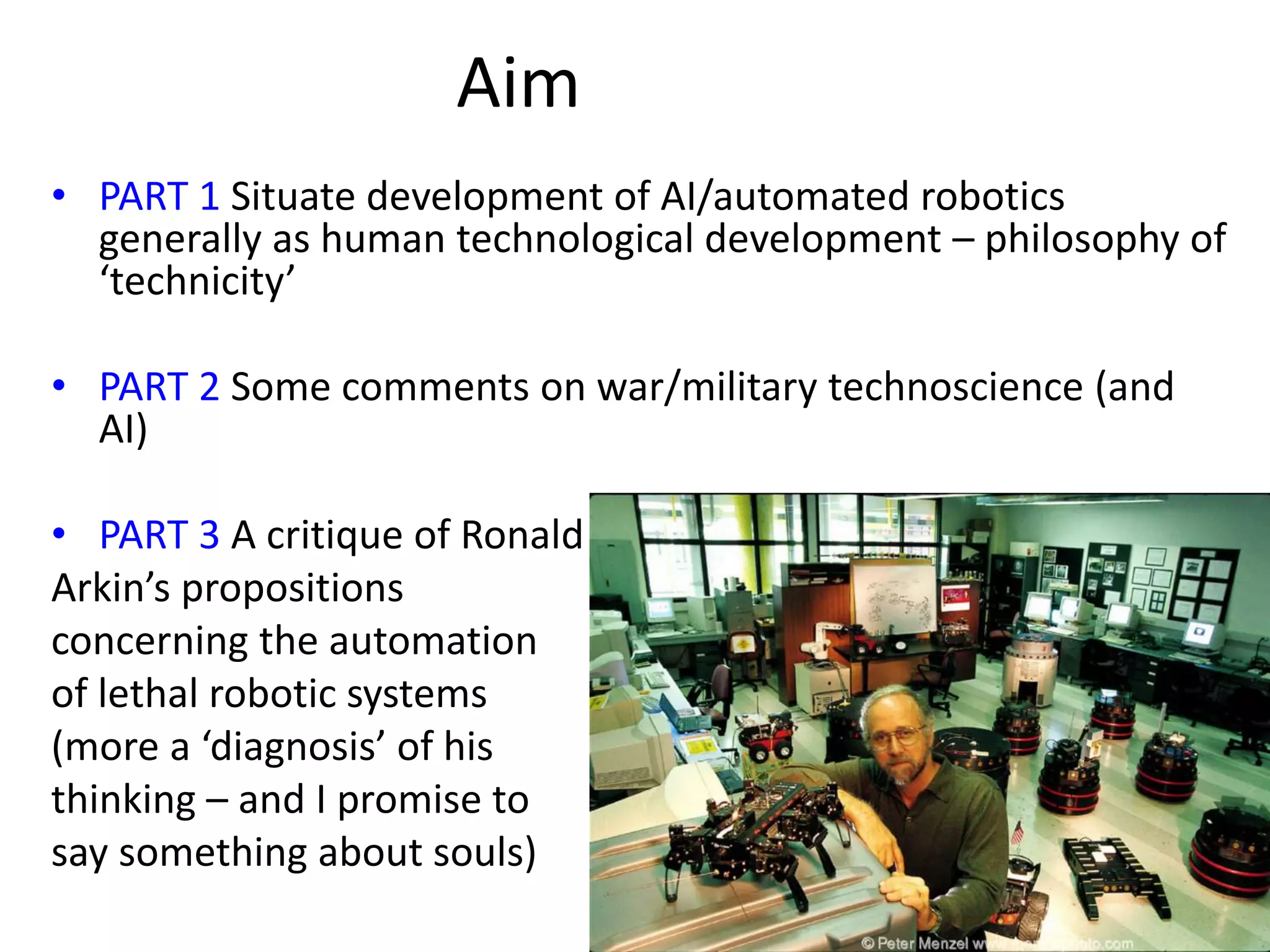
• PART 3 A critique of Ronald
Arkin’s propositions
concerning the automation
of lethal robotic systems
(more a ‘diagnosis’ of his
thinking – and I promise to
say something about souls)
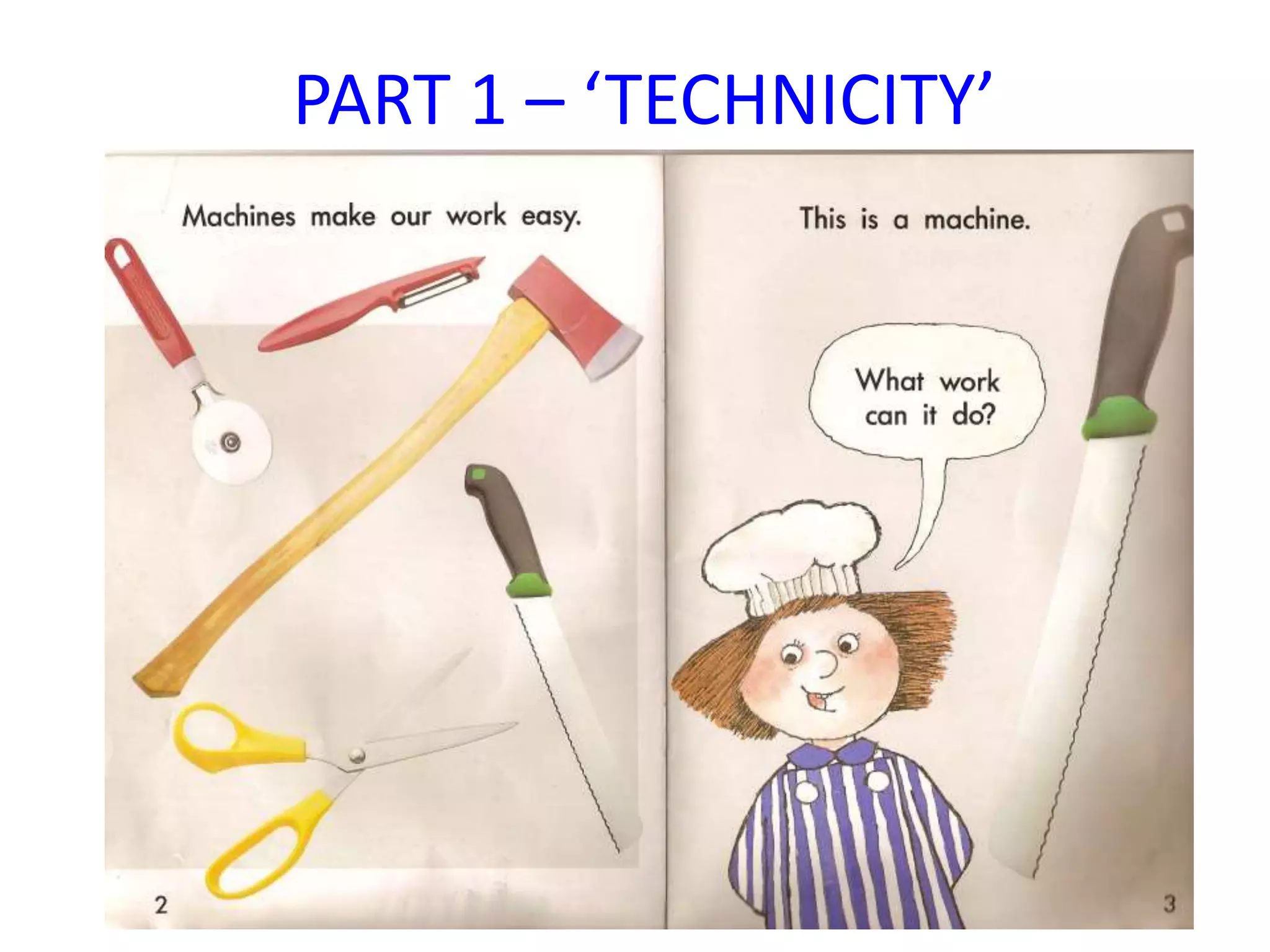
PART 1 – ‘TECHNICITY’
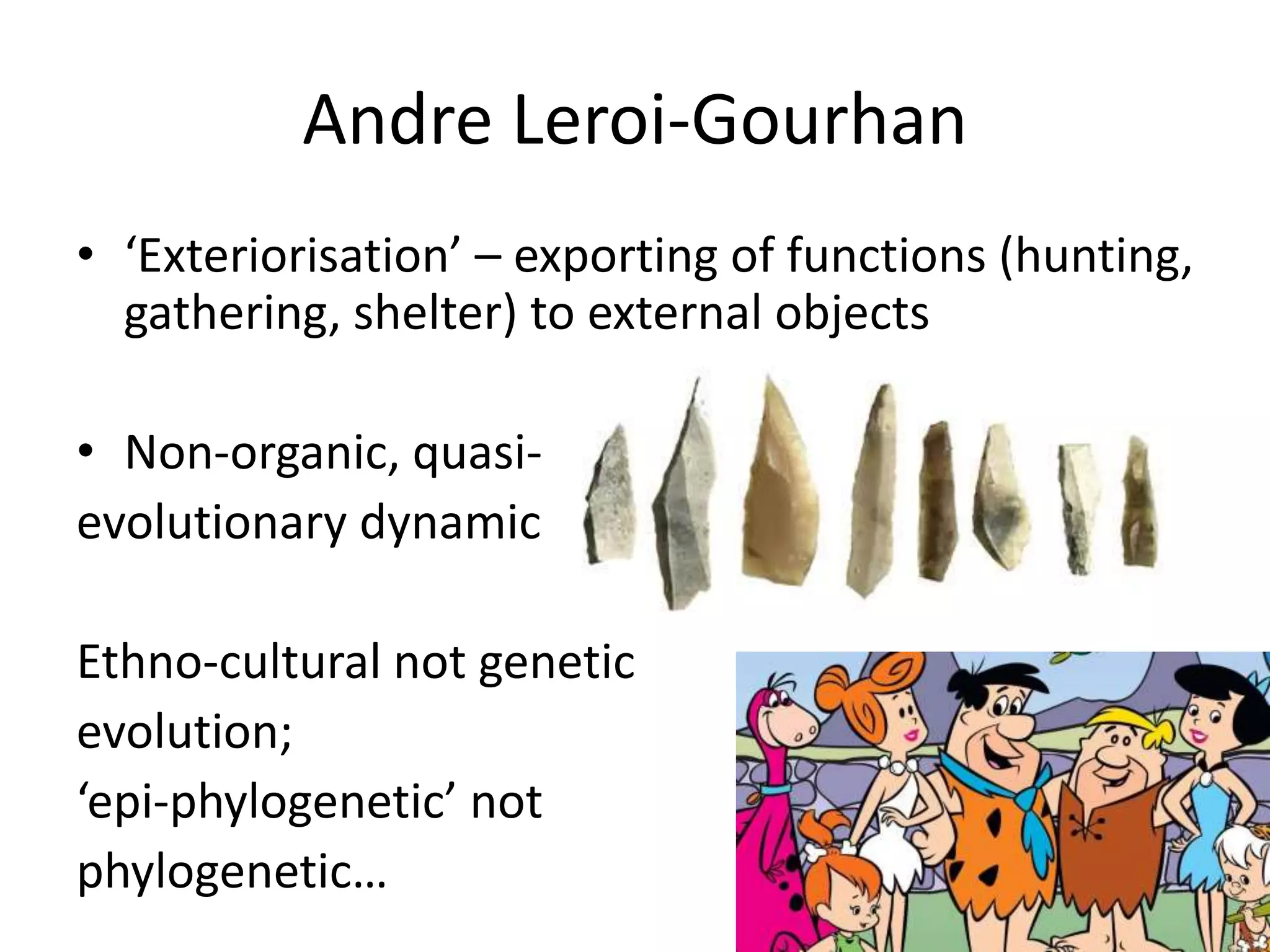
Andre Leroi-Gourhan
• ‘Exteriorisation’ – exporting of functions (hunting,
gathering, shelter) to external objects
• Non-organic, quasi-
evolutionary dynamic
Ethno-cultural not genetic
evolution;
‘epi-phylogenetic’ not
phylogenetic…
Stiegler
• The long dance of the ‘who’ and the ‘what’:
Both ‘lead’ and both ‘follow’ so much so it is
impossible to say once and for all who or what
came first
The human ‘being’ is a becoming.
Human being is a being-in-default of an
essential nature….
• Show clip from The Ister…. Of the ancient
Greek myth of the origin of humanity.
Technicity
= this condition of not having a stable, essential condition.
• We become in relation to technological dynamics that are
not simply our tools to make our life easier, our labour
more efficient. But nor are they independent of us
completely
• Organology: study of relations of the 2 kinds of “organs”:
the biological (brain, body, group) and the technical
(Ancient Greek organon – tool, instrument )
Eg. war
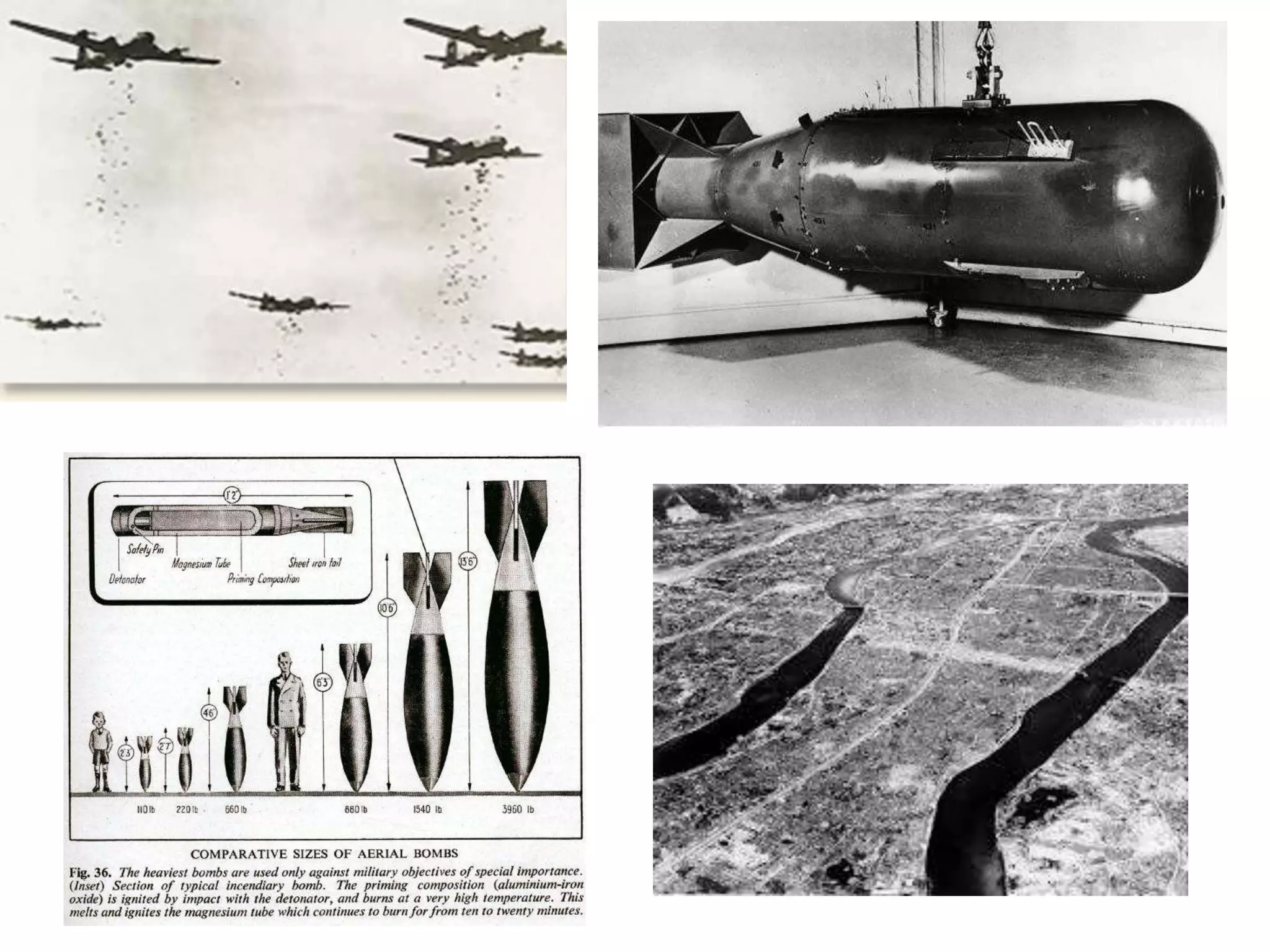
• (war and technological modernity go hand in
glove)
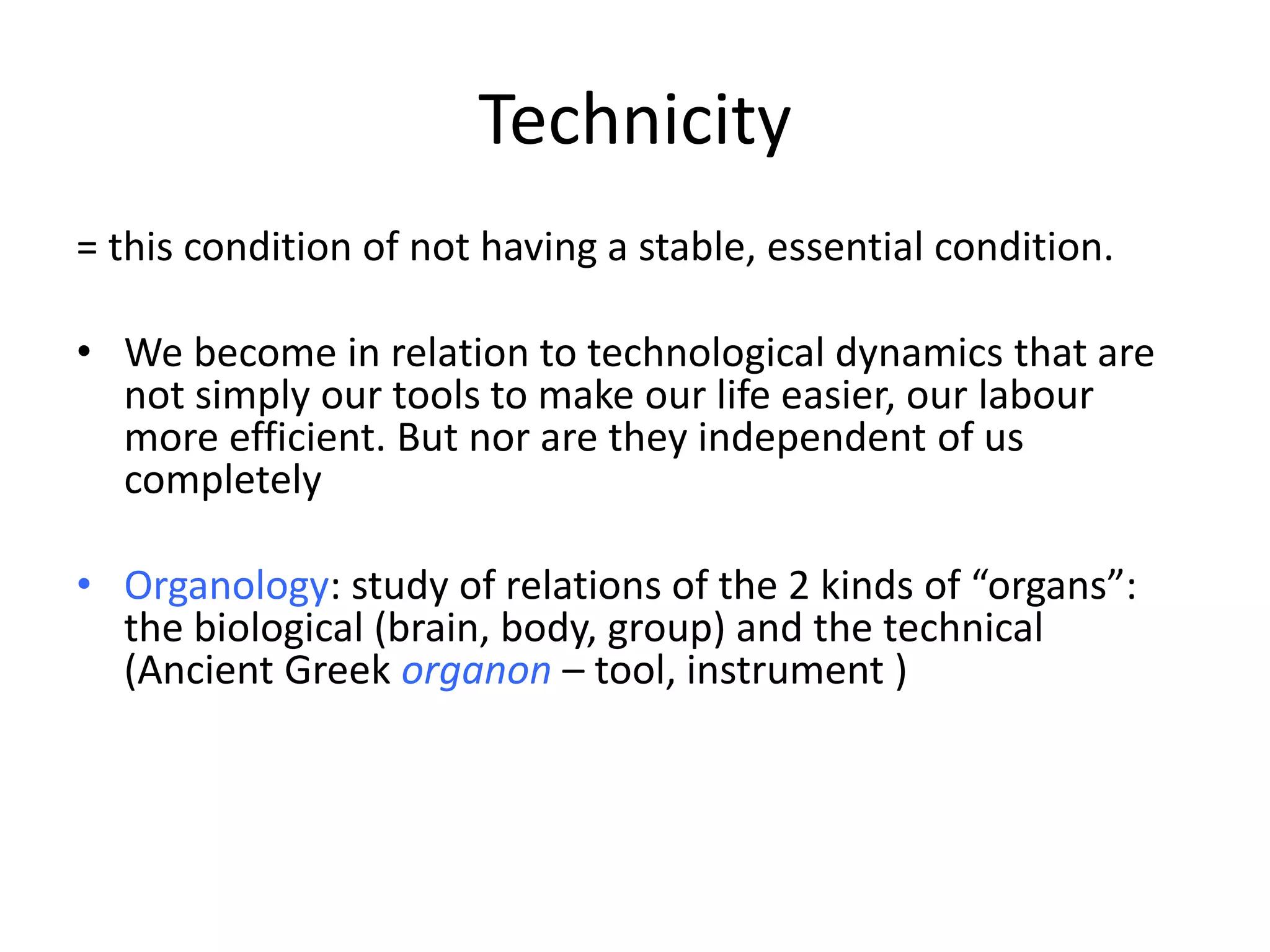
Mass production and arms
manufacture
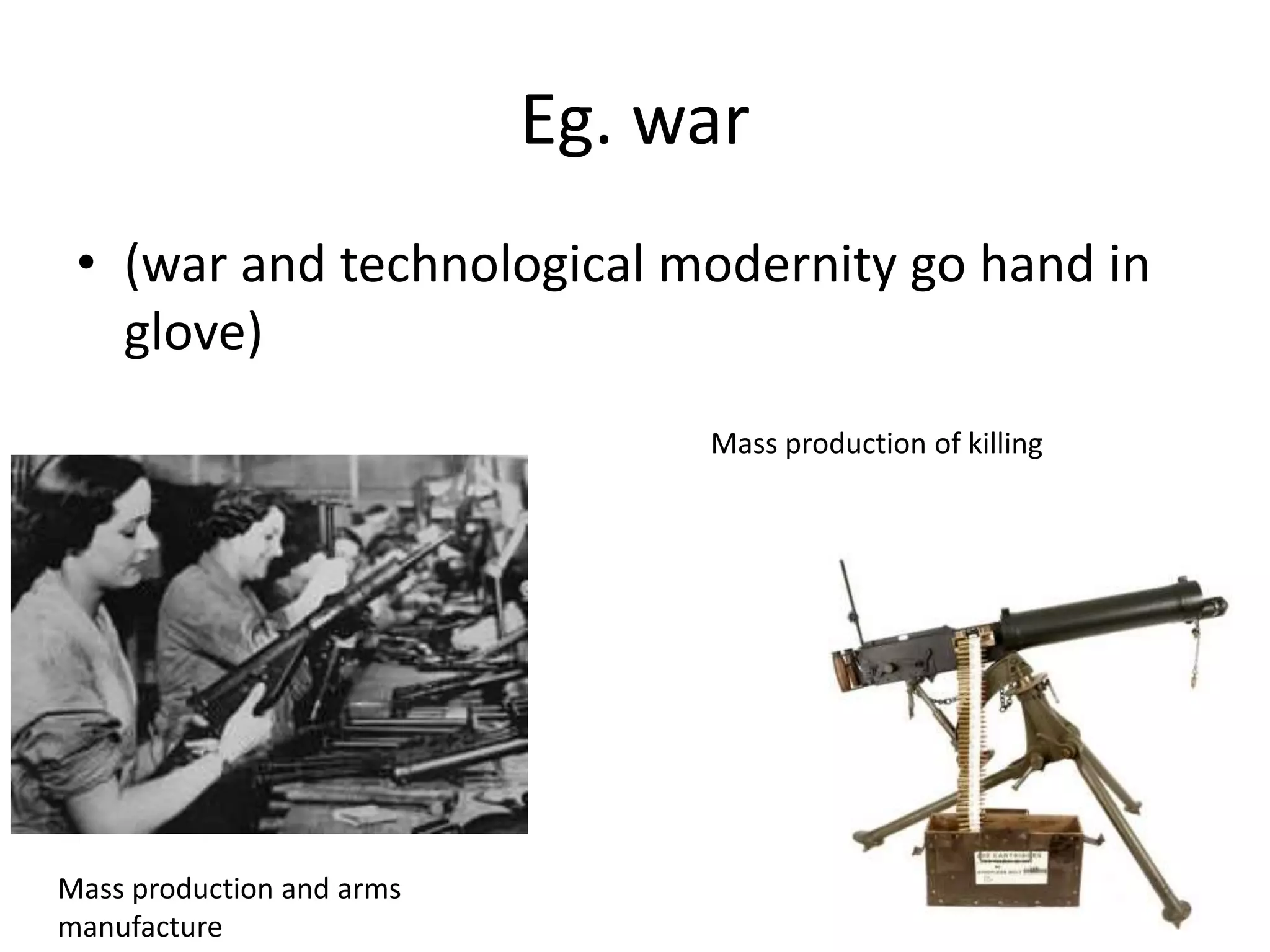
Mass production of killing
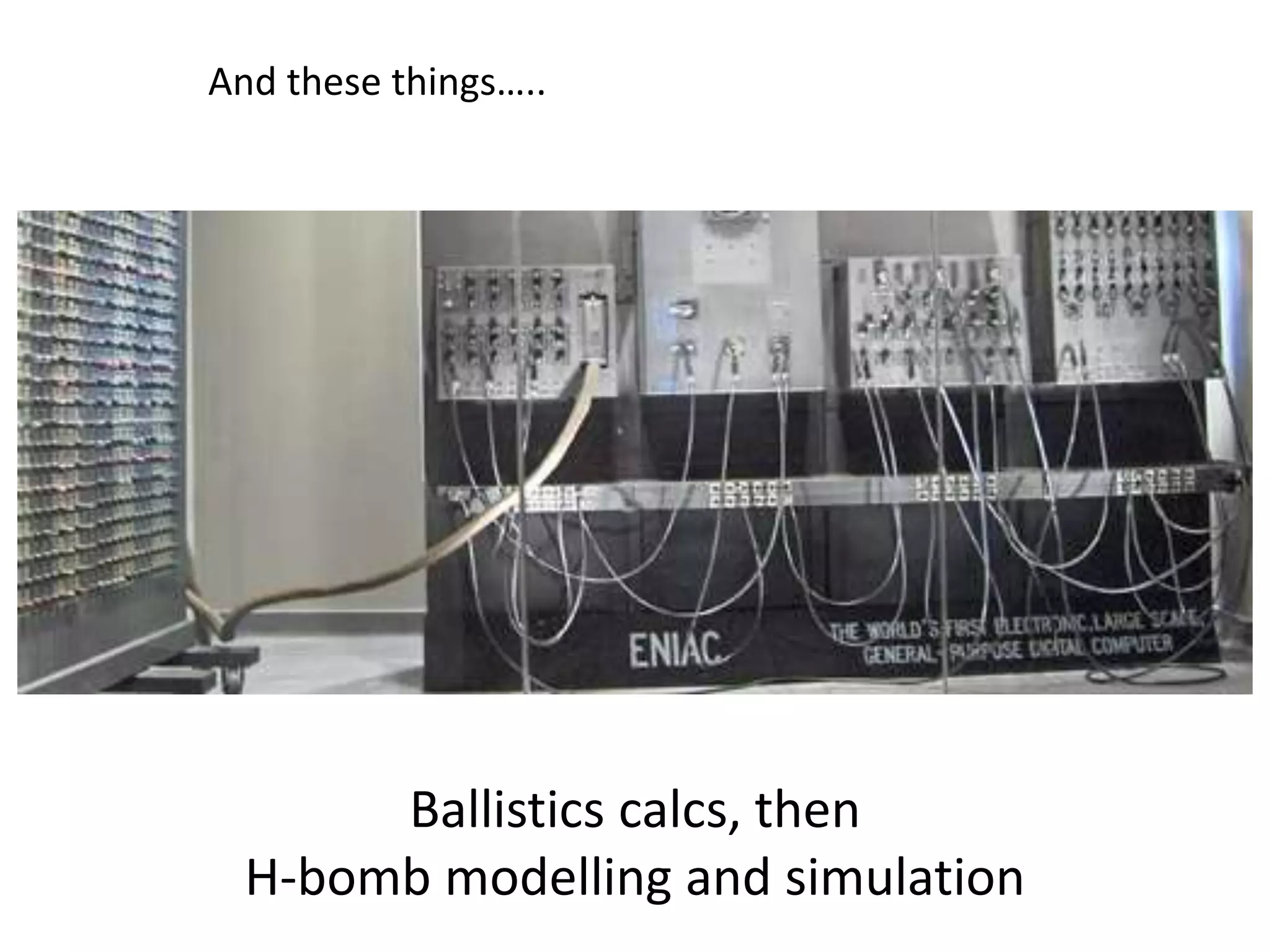
Ballistics calcs, then
H-bomb modelling and simulation
And these things…..
War is ‘fictional’
• Strife over ways of living (= ways of adopting
technically enabled possibilities)
• Who are we/what are we to become (or
remain? Or ‘go back to’?)
• ALL FICTIONS (which is not to say
unimportant: on the contrary! Pay strict
attention to your ‘stories’ and ‘histories’)
• And remember they are technically
implemented and conditioned/shaped
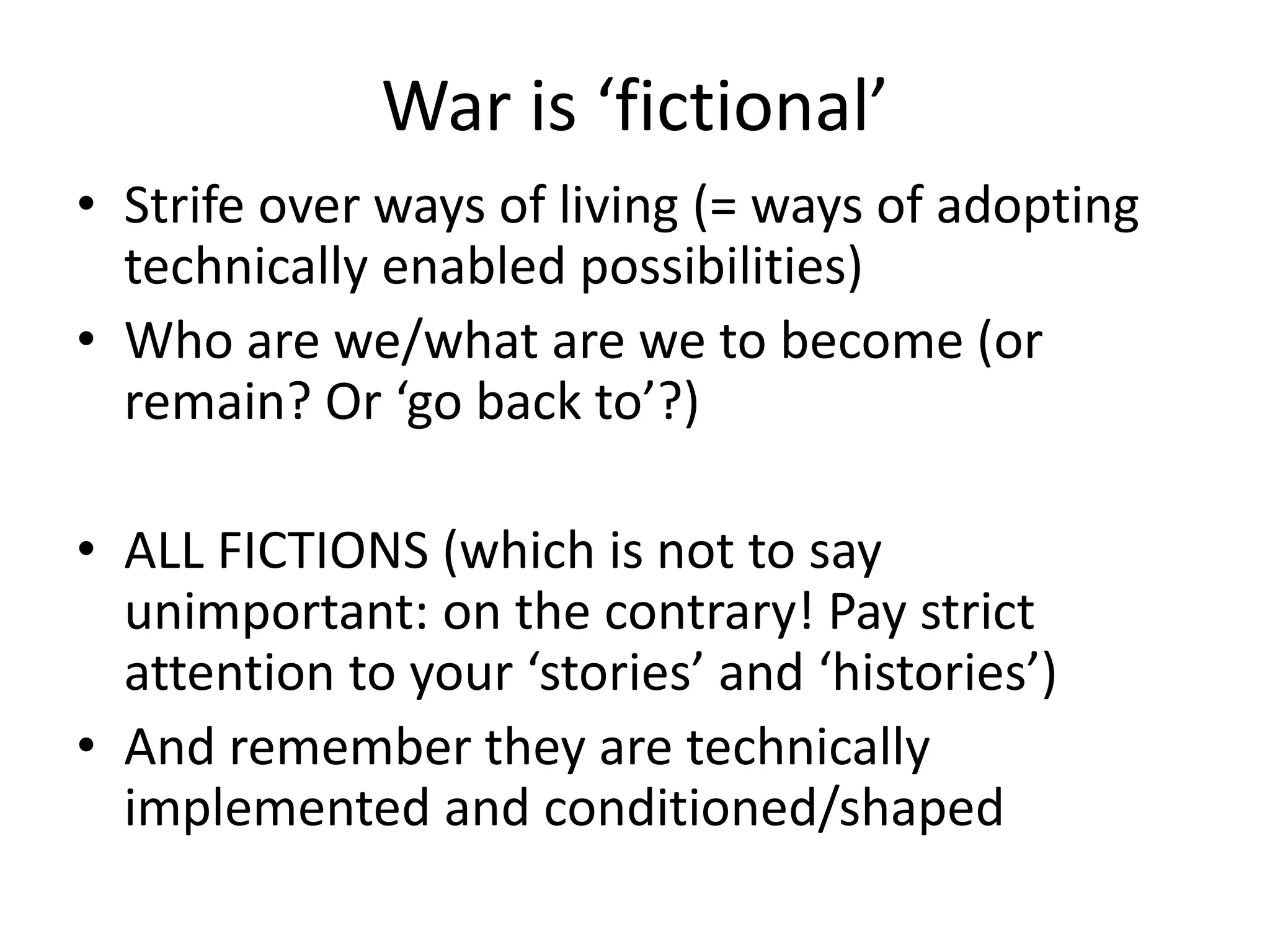
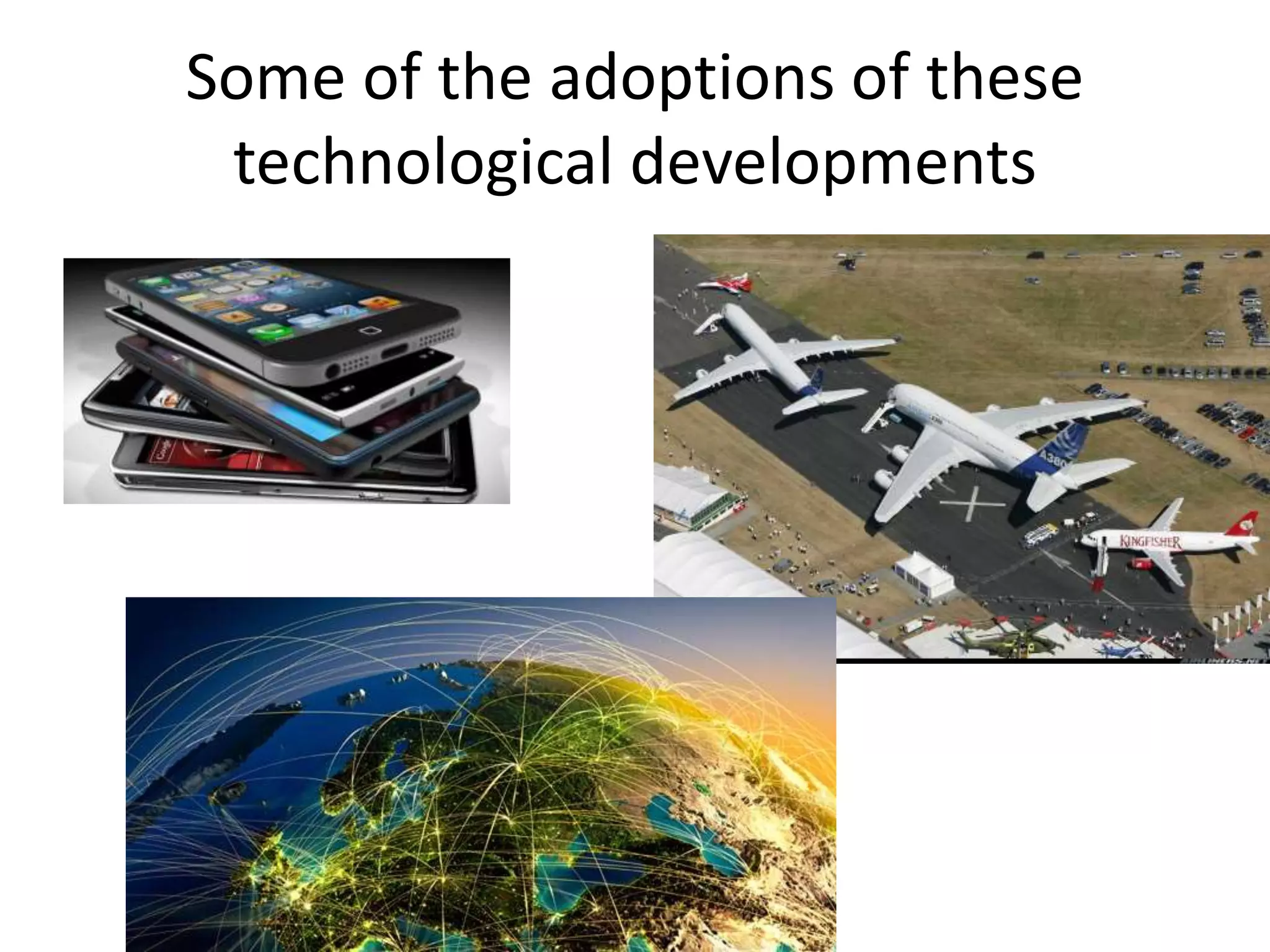
Some of the adoptions of these
technological developments
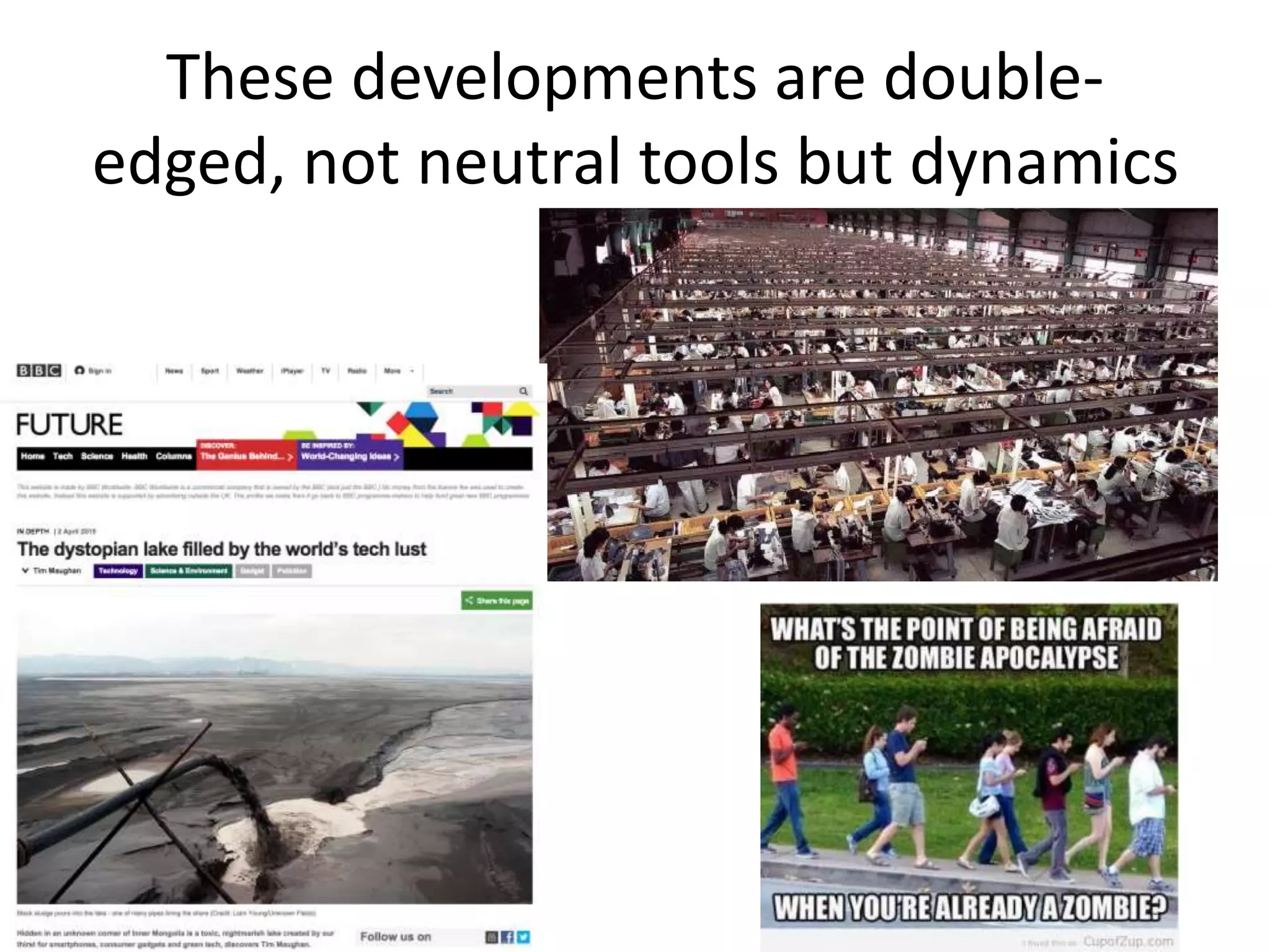
These developments are double-
edged, not neutral tools but dynamics
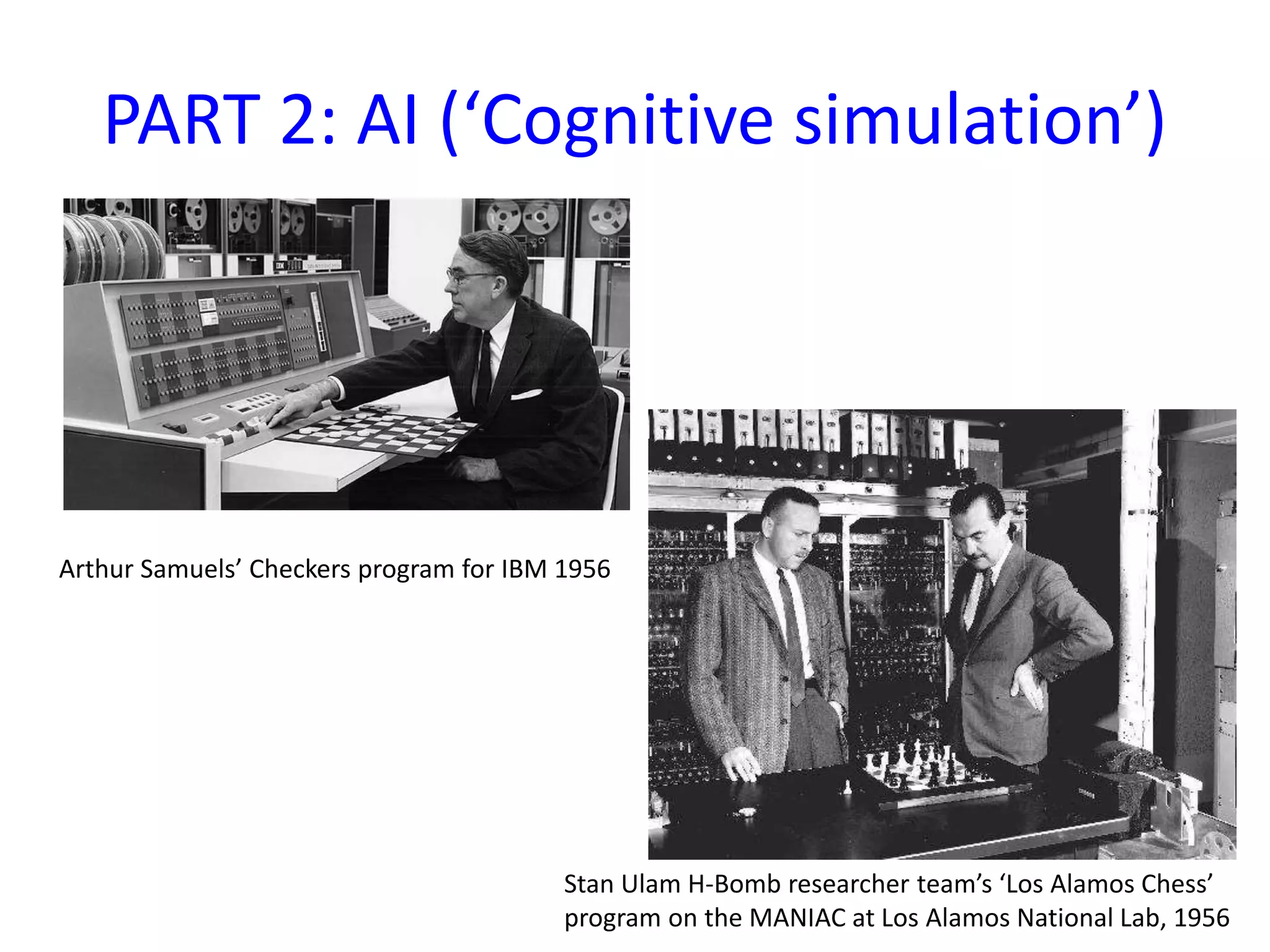
PART 2: AI (‘Cognitive simulation’)
Arthur Samuels’ Checkers program for IBM 1956
Stan Ulam H-Bomb researcher team’s ‘Los Alamos Chess’
program on the MANIAC at Los Alamos National Lab, 1956
AI ‘paradigms’
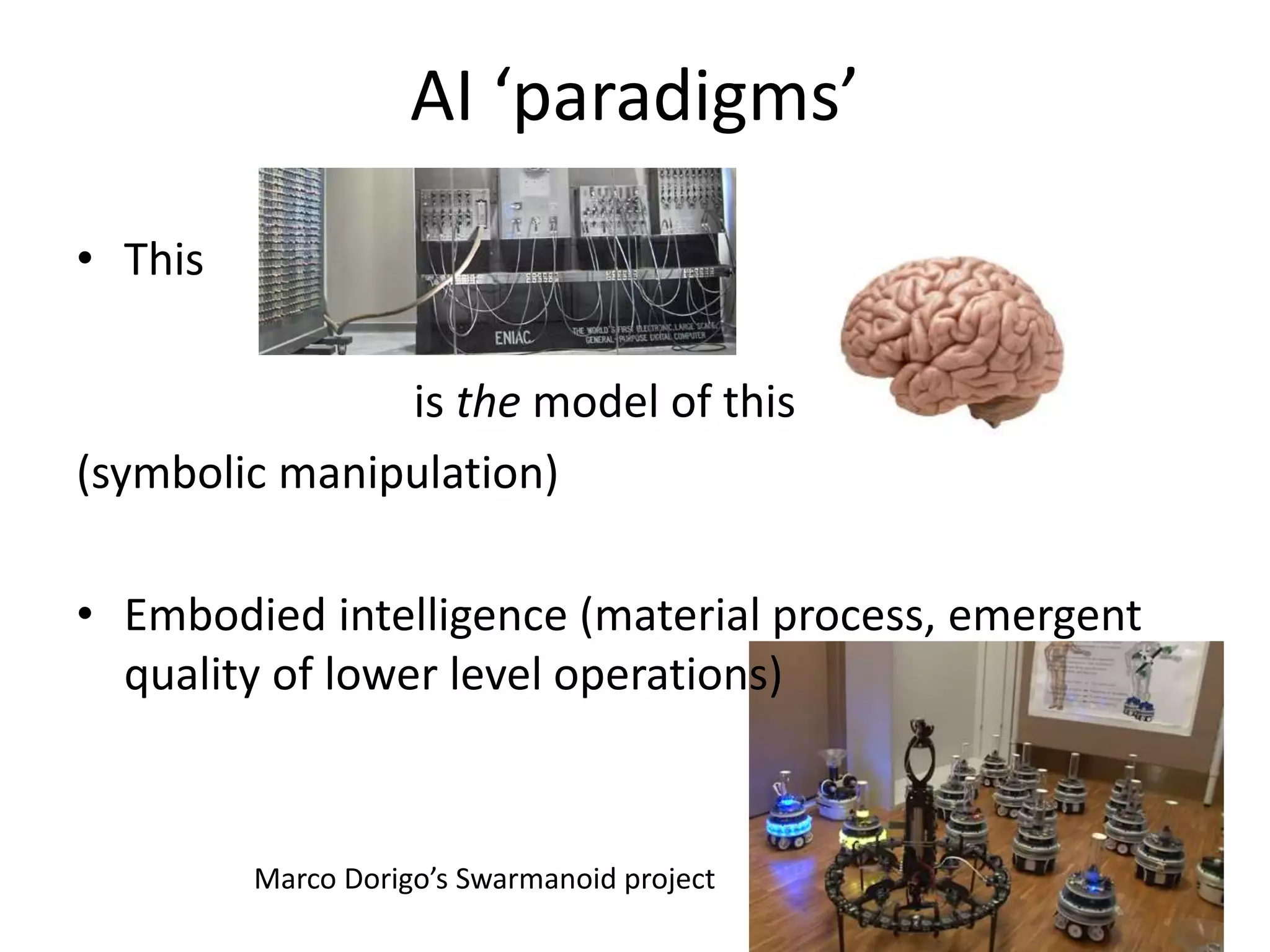
• This
is the model of this
(symbolic manipulation)
• Embodied intelligence (material process, emergent
quality of lower level operations)
Marco Dorigo’s Swarmanoid project
Technicity is missing
• Classic AI: yes of course the digital computer is
a model of thinking. But not the first, the only
or the ultimate one.
and
• Thinking has already been coloured/directed
technically and technologically in a long
history of different histories of cultural
beliefs/concepts/ways of living
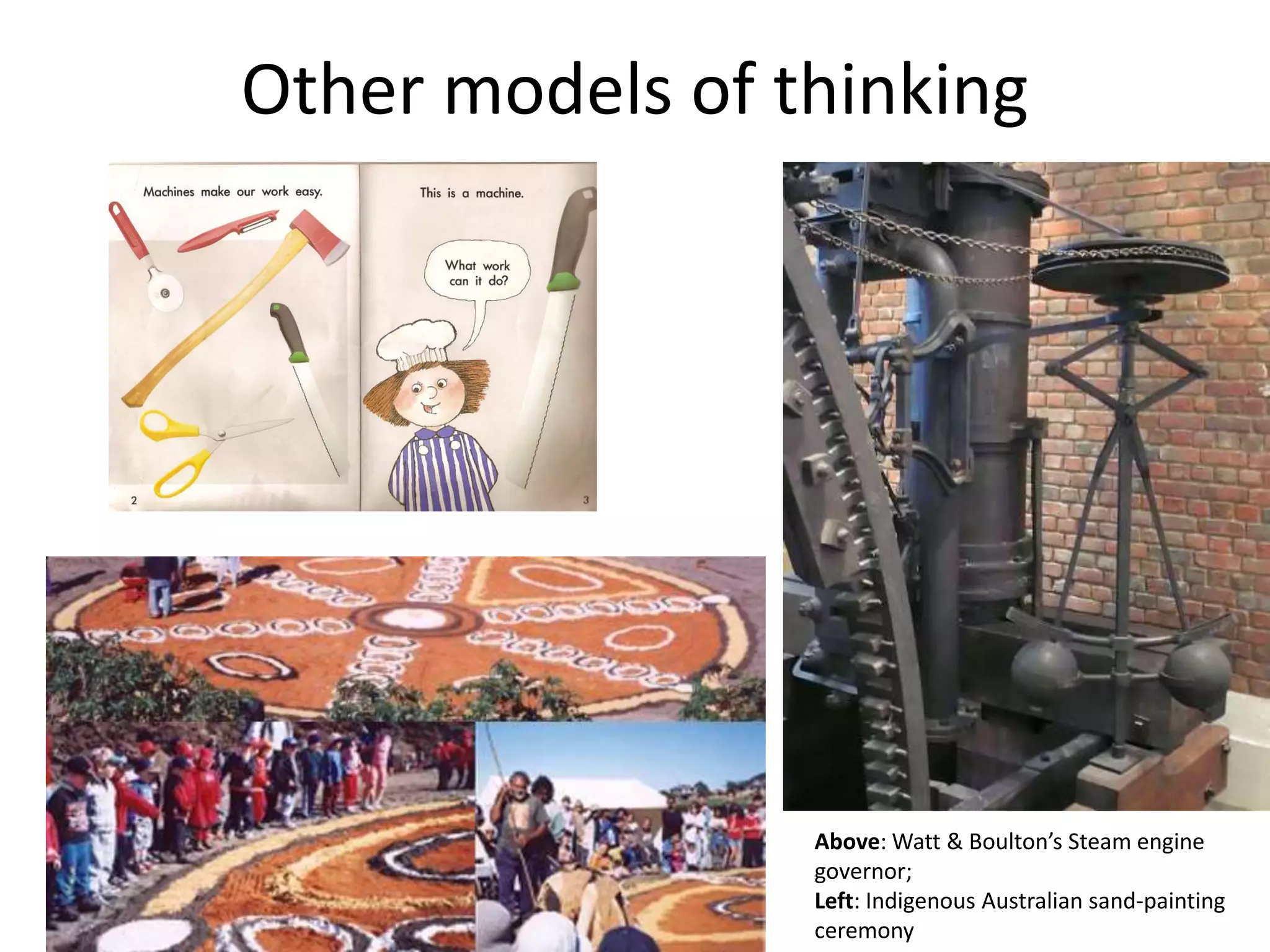
Other models of thinking
Above: Watt & Boulton’s Steam engine
governor;
Left: Indigenous Australian sand-painting
ceremony
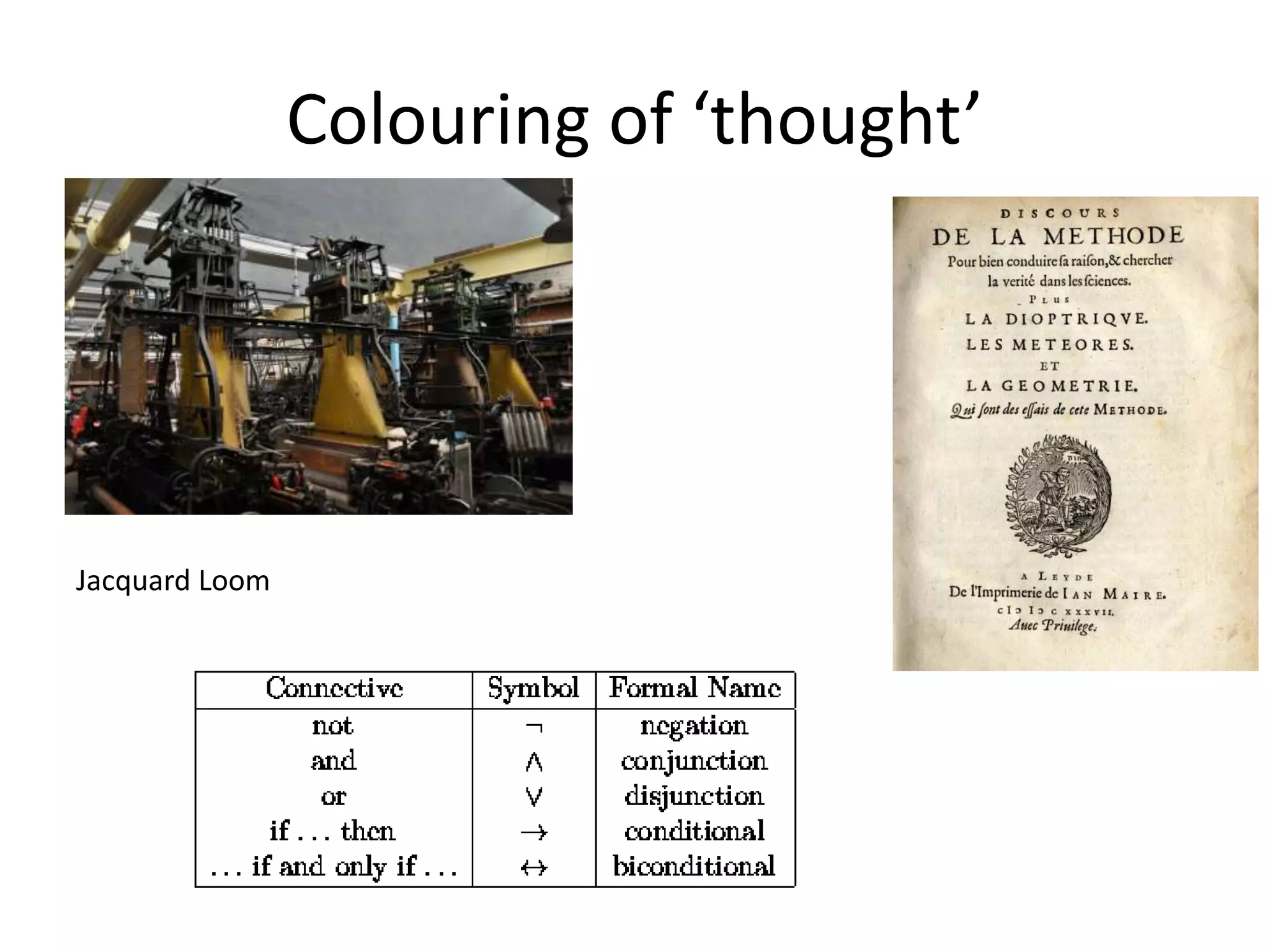
Colouring of ‘thought’
Jacquard Loom
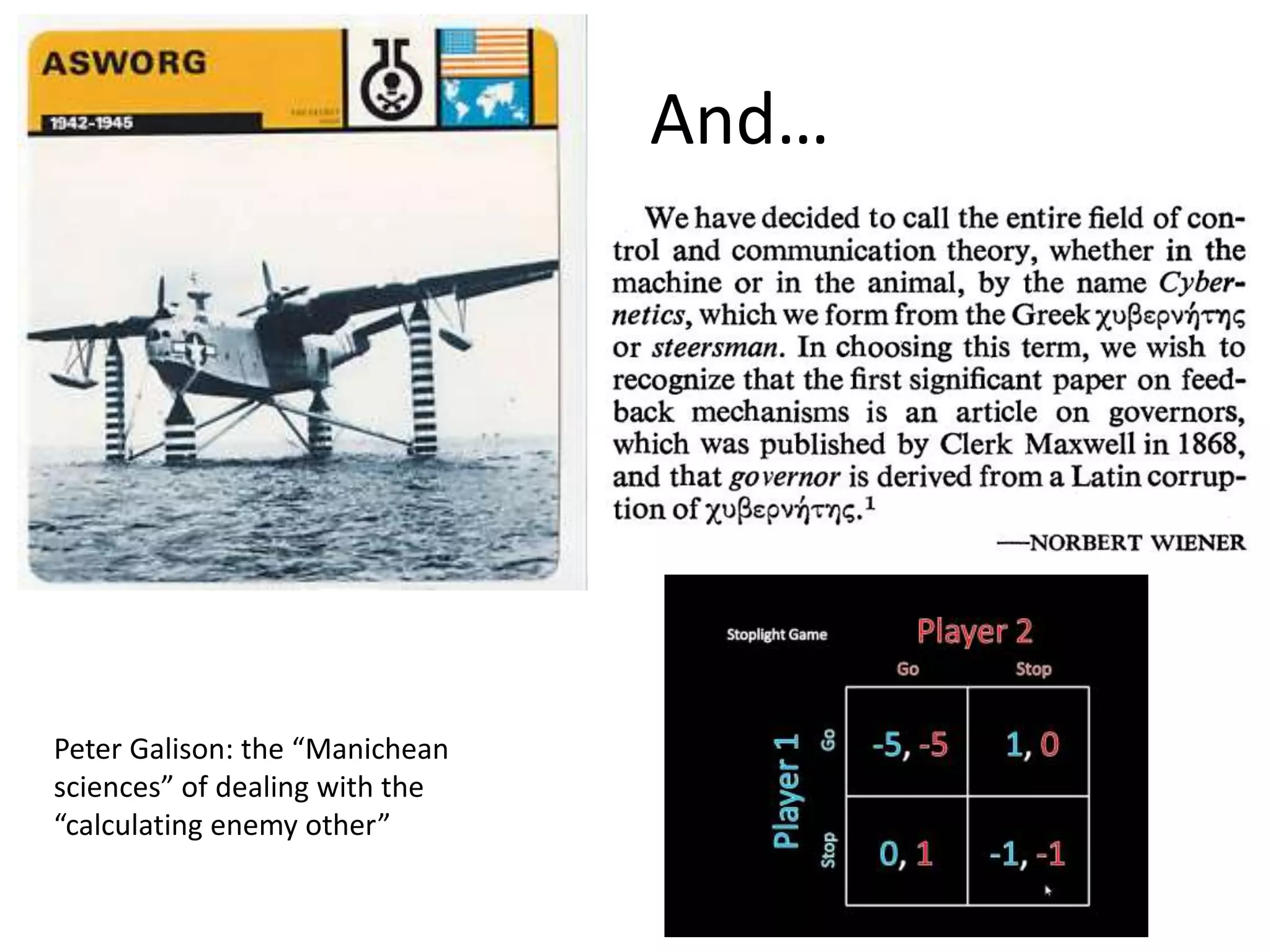
And…
Peter Galison: the “Manichean
sciences” of dealing with the
“calculating enemy other”
Technocultural Programme
• Leroi-Gourhan: culture amounts to a pro-
gramme for behaviour, ways to live, that is
technical and conceptual, exterior and interior
• Stiegler: this programme is a response to the
‘who are we?’ question of human being, the
being without an essential identity.
• It programs our thinking…..
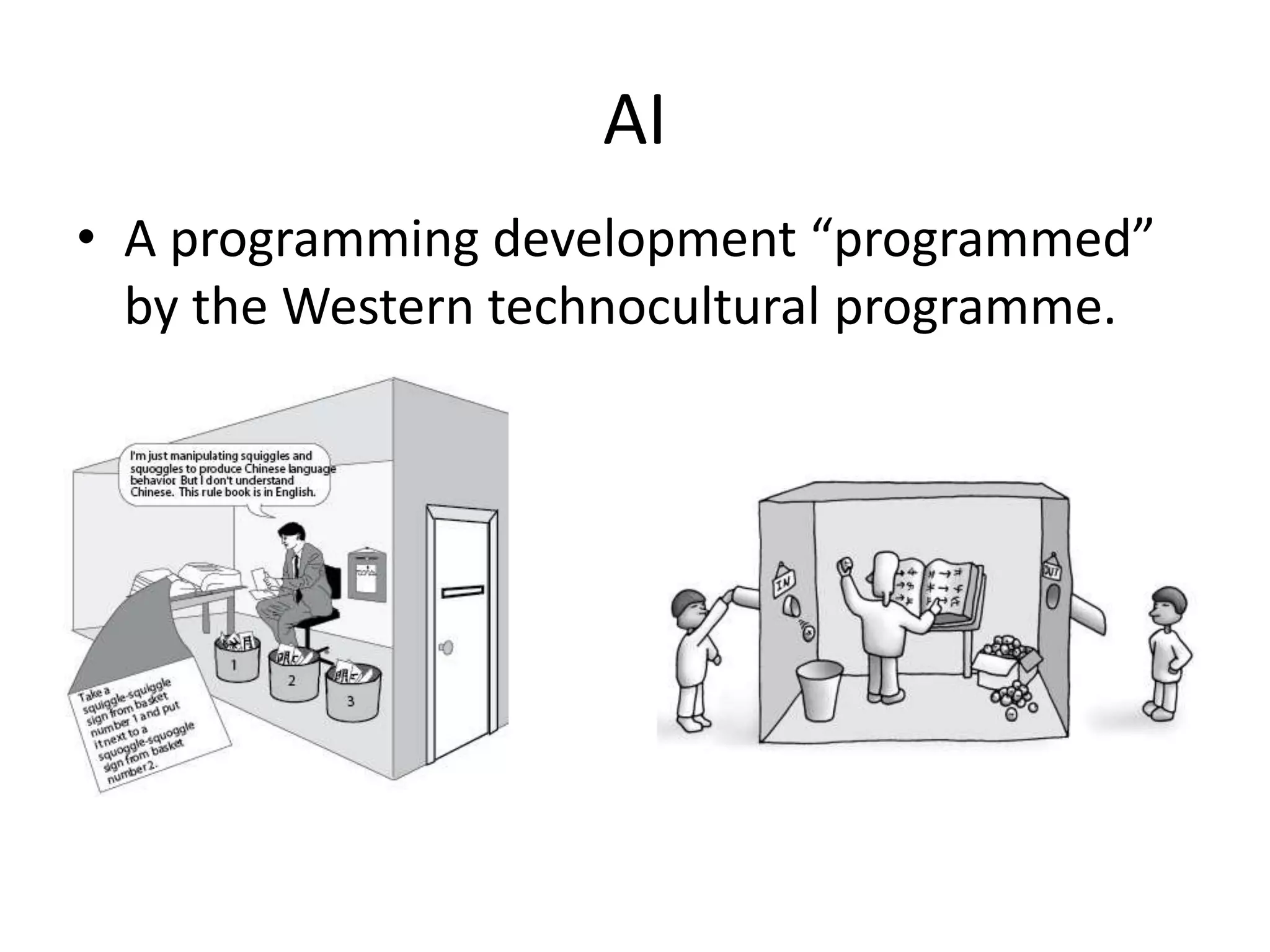
AI
• A programming development “programmed”
by the Western technocultural programme.
PART 3: ARKIN’S DEADLY AI
or, ‘artificial stupidity’
In the future….
Advances in computing speeds and capacity will change how
technology affects the OODA loop [Observe, Orient, Decide
and Act]. Today the role of technology is changing from
supporting to fully participating with humans in each step of
the process. In 2047 technology will be able to reduce the
time to complete the OODA loop to micro or nano- seconds.
Much like a chess master can outperform proficient chess
players, UAS will be able to react at these speeds and
therefore this loop moves toward becoming a “perceive and
act” vector. Increasingly humans will no longer be “in the
loop” but rather “on the loop” – monitoring the execution of
certain decisions. Simultaneously, advances in AI will enable
systems to make combat decisions and act within legal and
policy constraints without necessarily requiring human input
(41).
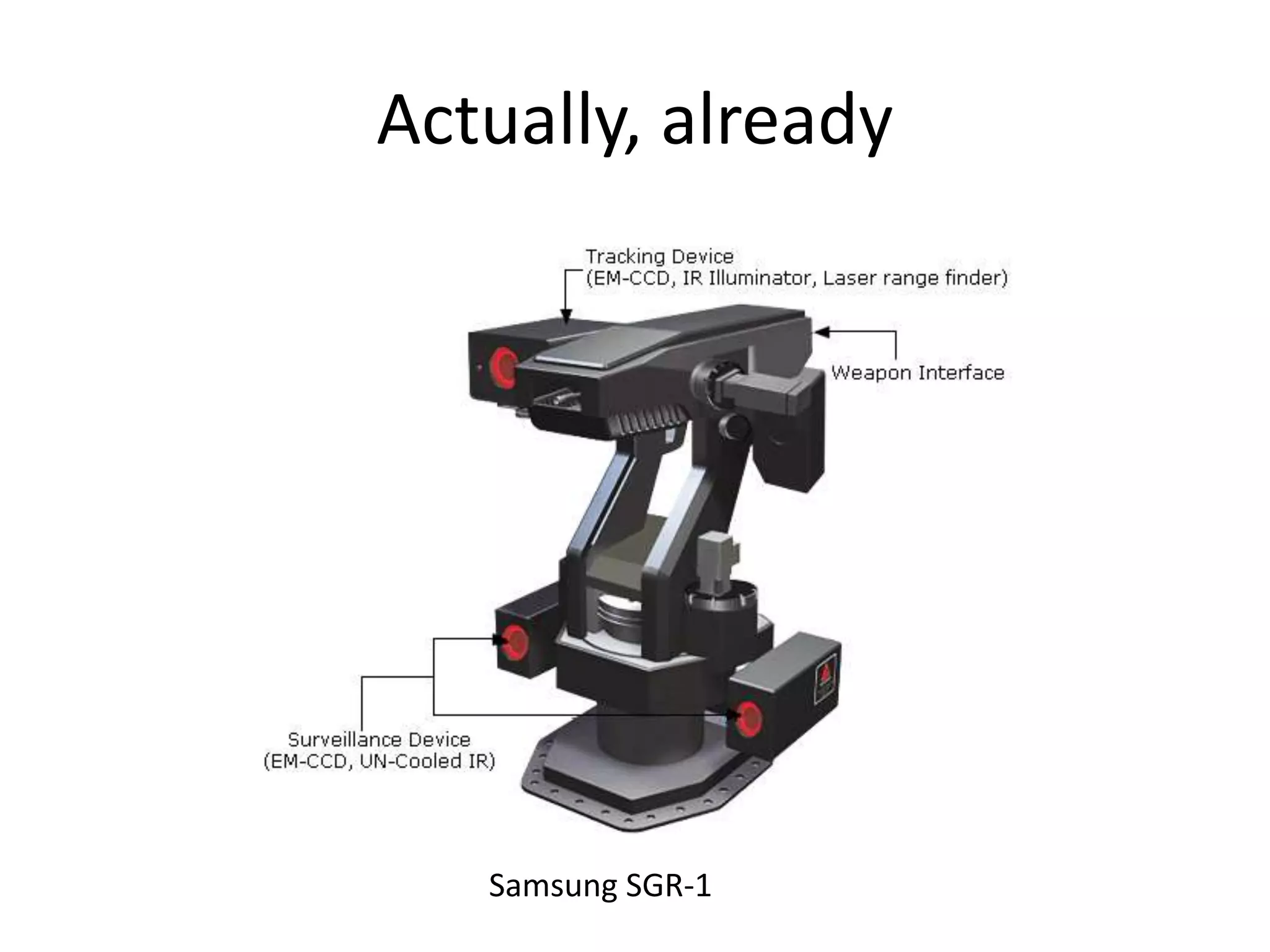
Actually, already
Samsung SGR-1
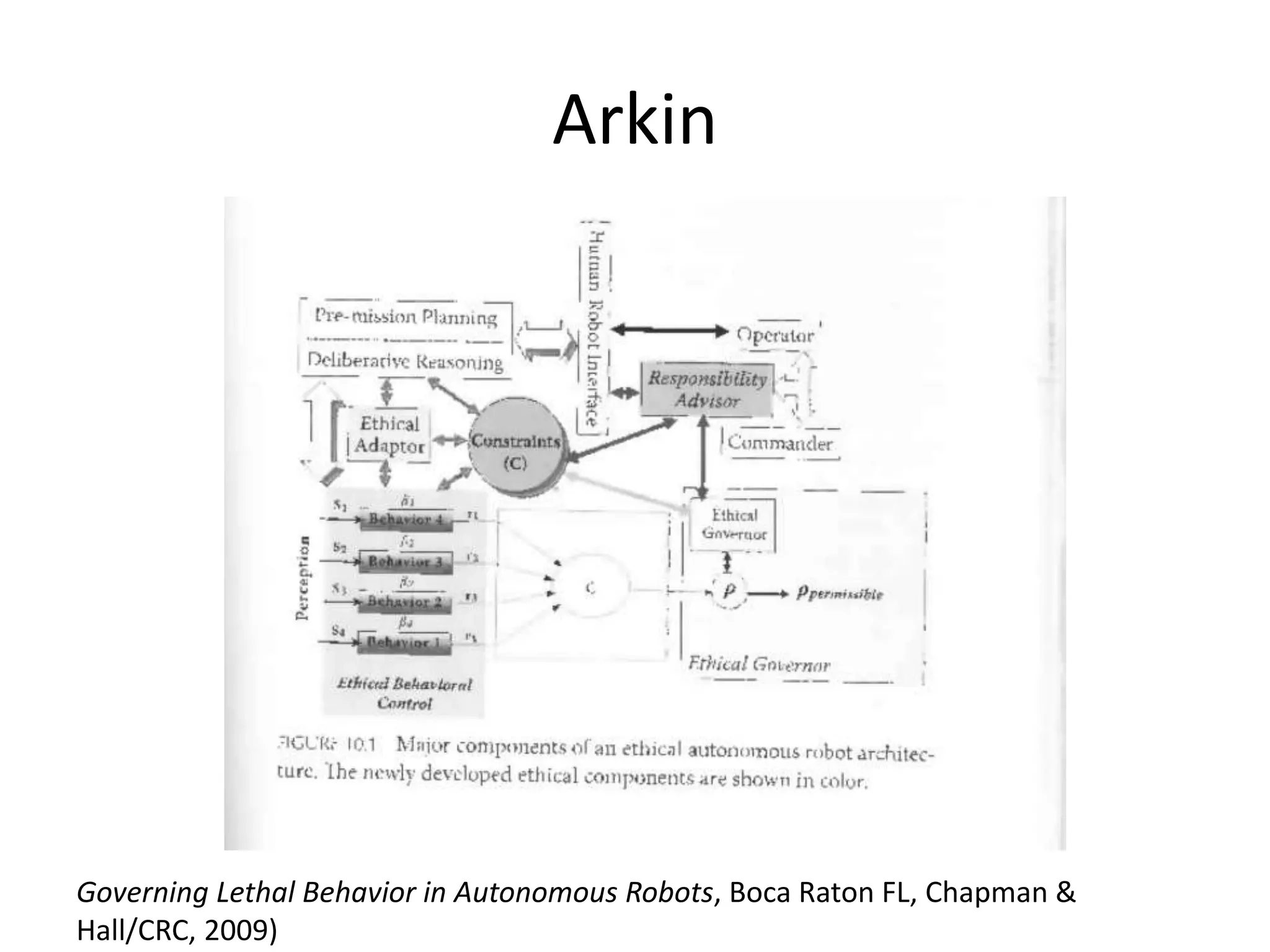
Arkin
Governing Lethal Behavior in Autonomous Robots, Boca Raton FL, Chapman &
Hall/CRC, 2009)
‘Ethical governor’
• ‘inspiration’ from Watt’s
mechanical governor that
was ‘intended to ensure that
the mechanism behaved
safely and within predefined
bounds of performance’
(128)
• A ‘bolt-on component
between the hybrid
architectural system
[robot/software/human
operator] and the actuators’
(127)
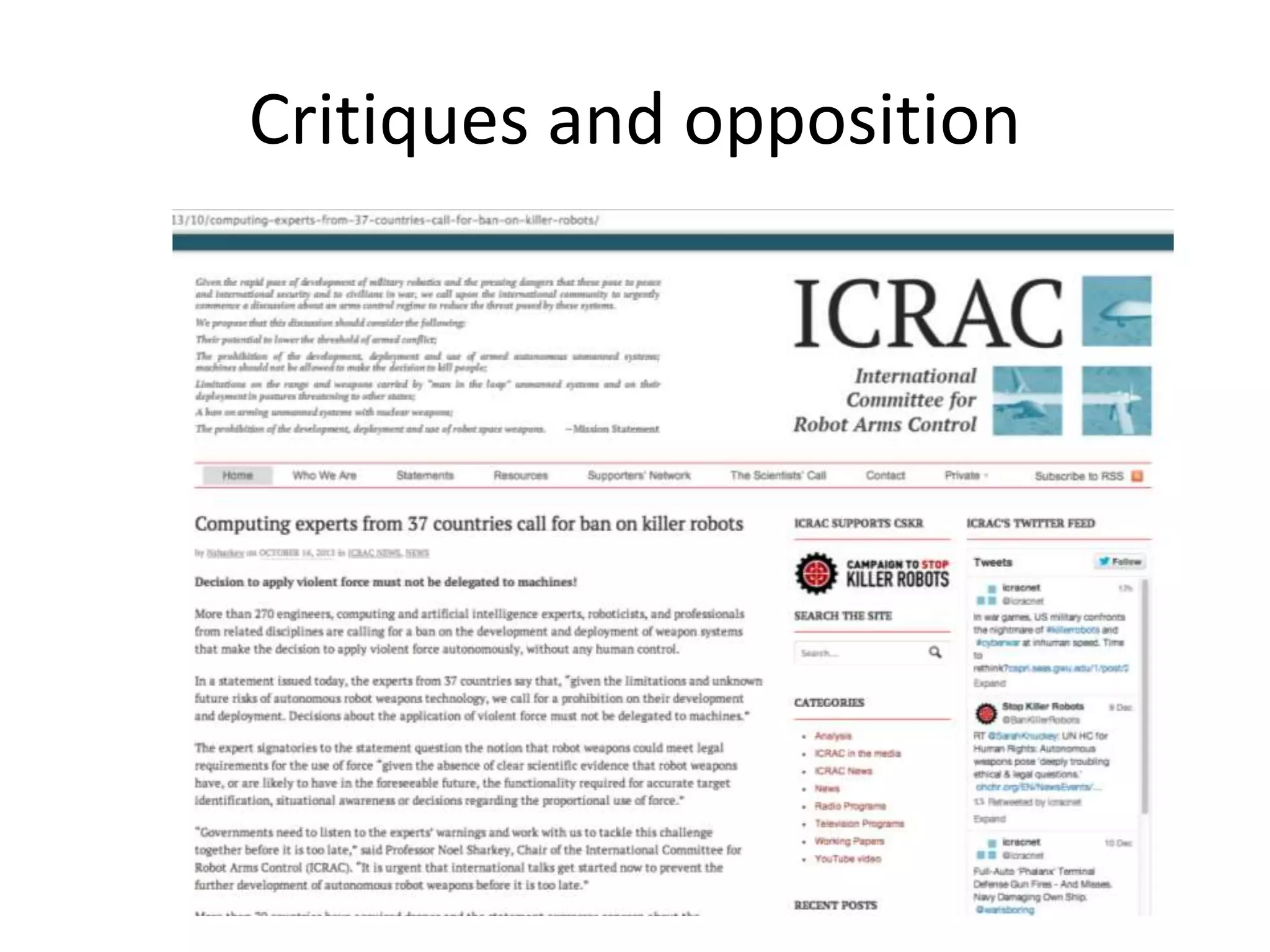
Critiques and opposition
Exteriorisation unbounded
• Delegation of functions/capacities that will
wreck the dynamic to and fro between:
‘human’ and technical extension/prosthesis
Thought/judgment/consideration/care/responsi
bility/self-reflection
And
Action, procedure, task, duty, system of
operations, Technocultural ‘programme’
Forgetting…
• Our fictional character
• Our provisional, contingent character
• That war is a failure to negotiate these fictions
peacefully
• Automating war’s prosecution is the worst
imaginable response to this failure
A better (if older) model of thought
• Not Calculation—decision, or ‘perceive and
act’ models
• But intermittent emergence of higher
‘intelligence’ out of the constant interactions
of the lower ‘souls’
• Aristotle’s De Anima – soul as animating
force/principle
3 souls of living beings
• Vegetative soul: capacity to nourish and
reproduce (eg. plants)
• Sensitive soul: capacity for sense perception
and movement/action in response (eg.
animals)
• Noetic soul (for Aristotle, only the human
posesses this): capacity for self-reflection,
thought
Stiegler: read Aristotle dynamically
• The capacities are overlapping and in dialogue
• The ‘noetic’ is a potential of the human, that
appears intermittently
• Always the potential of ‘regression’ to less
reflective, more ‘automatic’ modes of acting
And
• The human is always a human-technical
composition, so ‘our’ noetic, intelligent
potential is technically conditioned,
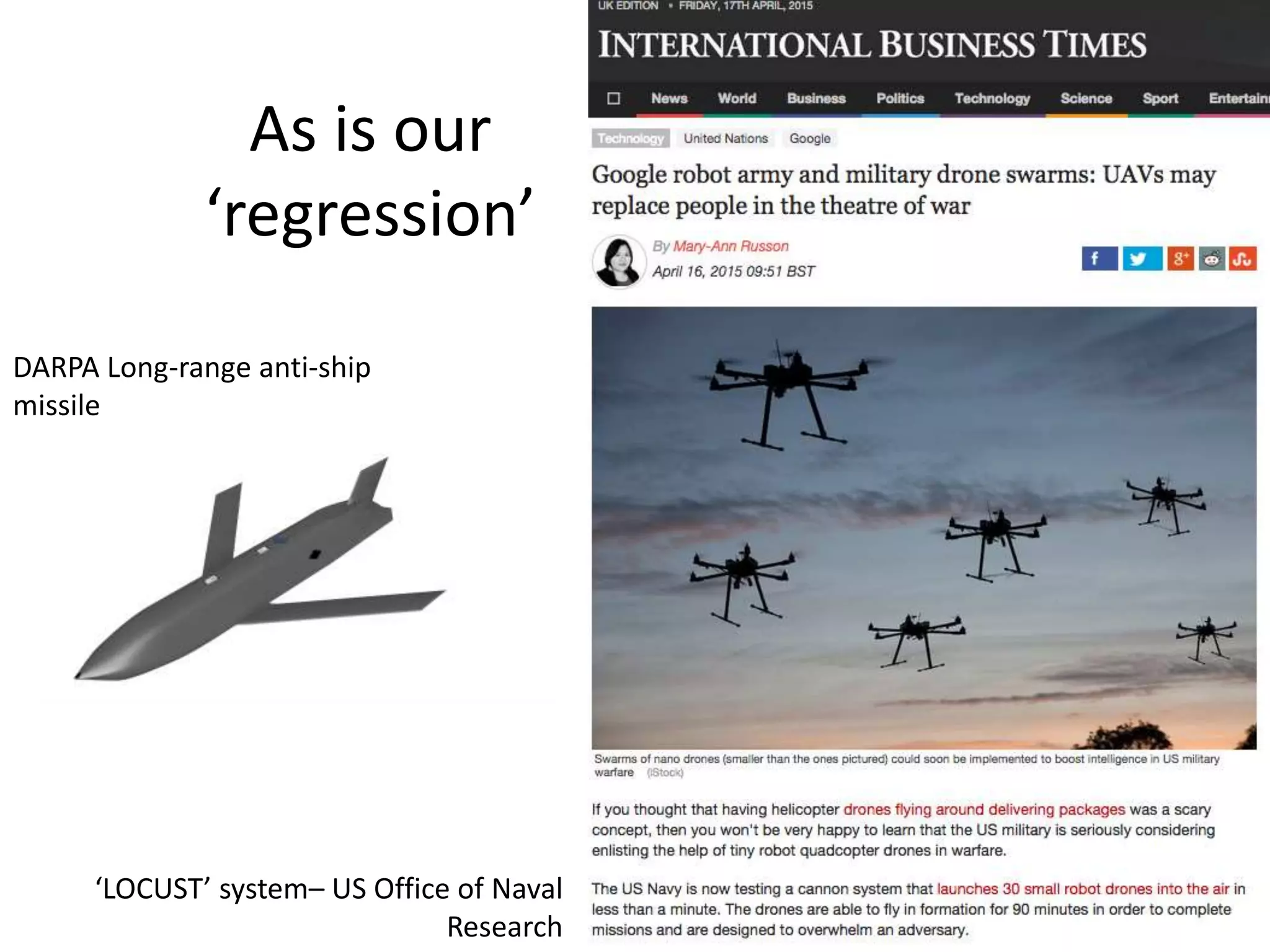
As is our
‘regression’
DARPA Long-range anti-ship
missile
‘LOCUST’ system– US Office of Naval
Research

Bath uni ai seminar april 2015 by Patrick Crogan

  • 1.
    Bath University AIResearch Seminar AI, Technicity and Souls: Military AI and Automation
  • 2.
    Context • Media/cultural studies,film, animation • Abiding interest in war as part of culture/media • And philosophical work on technology and its part in human culture, media, war etc.
  • 3.
    Aim • PART 1Situate development of AI/automated robotics generally as human technological development – philosophy of ‘technicity’ • PART 2 Some comments on war/military technoscience (and AI) • PART 3 A critique of Ronald Arkin’s propositions concerning the automation of lethal robotic systems (more a ‘diagnosis’ of his thinking – and I promise to say something about souls)
  • 4.
    PART 1 –‘TECHNICITY’
  • 6.
    Andre Leroi-Gourhan • ‘Exteriorisation’– exporting of functions (hunting, gathering, shelter) to external objects • Non-organic, quasi- evolutionary dynamic Ethno-cultural not genetic evolution; ‘epi-phylogenetic’ not phylogenetic…
  • 7.
    Stiegler • The longdance of the ‘who’ and the ‘what’: Both ‘lead’ and both ‘follow’ so much so it is impossible to say once and for all who or what came first The human ‘being’ is a becoming. Human being is a being-in-default of an essential nature….
  • 8.
    • Show clipfrom The Ister…. Of the ancient Greek myth of the origin of humanity.
  • 9.
    Technicity = this conditionof not having a stable, essential condition. • We become in relation to technological dynamics that are not simply our tools to make our life easier, our labour more efficient. But nor are they independent of us completely • Organology: study of relations of the 2 kinds of “organs”: the biological (brain, body, group) and the technical (Ancient Greek organon – tool, instrument )
  • 10.
    Eg. war • (warand technological modernity go hand in glove) Mass production and arms manufacture Mass production of killing
  • 12.
    Ballistics calcs, then H-bombmodelling and simulation And these things…..
  • 13.
    War is ‘fictional’ •Strife over ways of living (= ways of adopting technically enabled possibilities) • Who are we/what are we to become (or remain? Or ‘go back to’?) • ALL FICTIONS (which is not to say unimportant: on the contrary! Pay strict attention to your ‘stories’ and ‘histories’) • And remember they are technically implemented and conditioned/shaped
  • 14.
    Some of theadoptions of these technological developments
  • 15.
    These developments aredouble- edged, not neutral tools but dynamics
  • 16.
    PART 2: AI(‘Cognitive simulation’) Arthur Samuels’ Checkers program for IBM 1956 Stan Ulam H-Bomb researcher team’s ‘Los Alamos Chess’ program on the MANIAC at Los Alamos National Lab, 1956
  • 17.
    AI ‘paradigms’ • This isthe model of this (symbolic manipulation) • Embodied intelligence (material process, emergent quality of lower level operations) Marco Dorigo’s Swarmanoid project
  • 18.
    Technicity is missing •Classic AI: yes of course the digital computer is a model of thinking. But not the first, the only or the ultimate one. and • Thinking has already been coloured/directed technically and technologically in a long history of different histories of cultural beliefs/concepts/ways of living
  • 19.
    Other models ofthinking Above: Watt & Boulton’s Steam engine governor; Left: Indigenous Australian sand-painting ceremony
  • 20.
  • 21.
    And… Peter Galison: the“Manichean sciences” of dealing with the “calculating enemy other”
  • 22.
    Technocultural Programme • Leroi-Gourhan:culture amounts to a pro- gramme for behaviour, ways to live, that is technical and conceptual, exterior and interior • Stiegler: this programme is a response to the ‘who are we?’ question of human being, the being without an essential identity. • It programs our thinking…..
  • 23.
    AI • A programmingdevelopment “programmed” by the Western technocultural programme.
  • 24.
    PART 3: ARKIN’SDEADLY AI or, ‘artificial stupidity’
  • 25.
    In the future…. Advancesin computing speeds and capacity will change how technology affects the OODA loop [Observe, Orient, Decide and Act]. Today the role of technology is changing from supporting to fully participating with humans in each step of the process. In 2047 technology will be able to reduce the time to complete the OODA loop to micro or nano- seconds. Much like a chess master can outperform proficient chess players, UAS will be able to react at these speeds and therefore this loop moves toward becoming a “perceive and act” vector. Increasingly humans will no longer be “in the loop” but rather “on the loop” – monitoring the execution of certain decisions. Simultaneously, advances in AI will enable systems to make combat decisions and act within legal and policy constraints without necessarily requiring human input (41).
  • 26.
  • 27.
    Arkin Governing Lethal Behaviorin Autonomous Robots, Boca Raton FL, Chapman & Hall/CRC, 2009)
  • 28.
    ‘Ethical governor’ • ‘inspiration’from Watt’s mechanical governor that was ‘intended to ensure that the mechanism behaved safely and within predefined bounds of performance’ (128) • A ‘bolt-on component between the hybrid architectural system [robot/software/human operator] and the actuators’ (127)
  • 29.
  • 30.
    Exteriorisation unbounded • Delegationof functions/capacities that will wreck the dynamic to and fro between: ‘human’ and technical extension/prosthesis Thought/judgment/consideration/care/responsi bility/self-reflection And Action, procedure, task, duty, system of operations, Technocultural ‘programme’
  • 31.
    Forgetting… • Our fictionalcharacter • Our provisional, contingent character • That war is a failure to negotiate these fictions peacefully • Automating war’s prosecution is the worst imaginable response to this failure
  • 32.
    A better (ifolder) model of thought • Not Calculation—decision, or ‘perceive and act’ models • But intermittent emergence of higher ‘intelligence’ out of the constant interactions of the lower ‘souls’ • Aristotle’s De Anima – soul as animating force/principle
  • 33.
    3 souls ofliving beings • Vegetative soul: capacity to nourish and reproduce (eg. plants) • Sensitive soul: capacity for sense perception and movement/action in response (eg. animals) • Noetic soul (for Aristotle, only the human posesses this): capacity for self-reflection, thought
  • 34.
    Stiegler: read Aristotledynamically • The capacities are overlapping and in dialogue • The ‘noetic’ is a potential of the human, that appears intermittently • Always the potential of ‘regression’ to less reflective, more ‘automatic’ modes of acting And • The human is always a human-technical composition, so ‘our’ noetic, intelligent potential is technically conditioned,
  • 35.
    As is our ‘regression’ DARPALong-range anti-ship missile ‘LOCUST’ system– US Office of Naval Research