Food for thought..
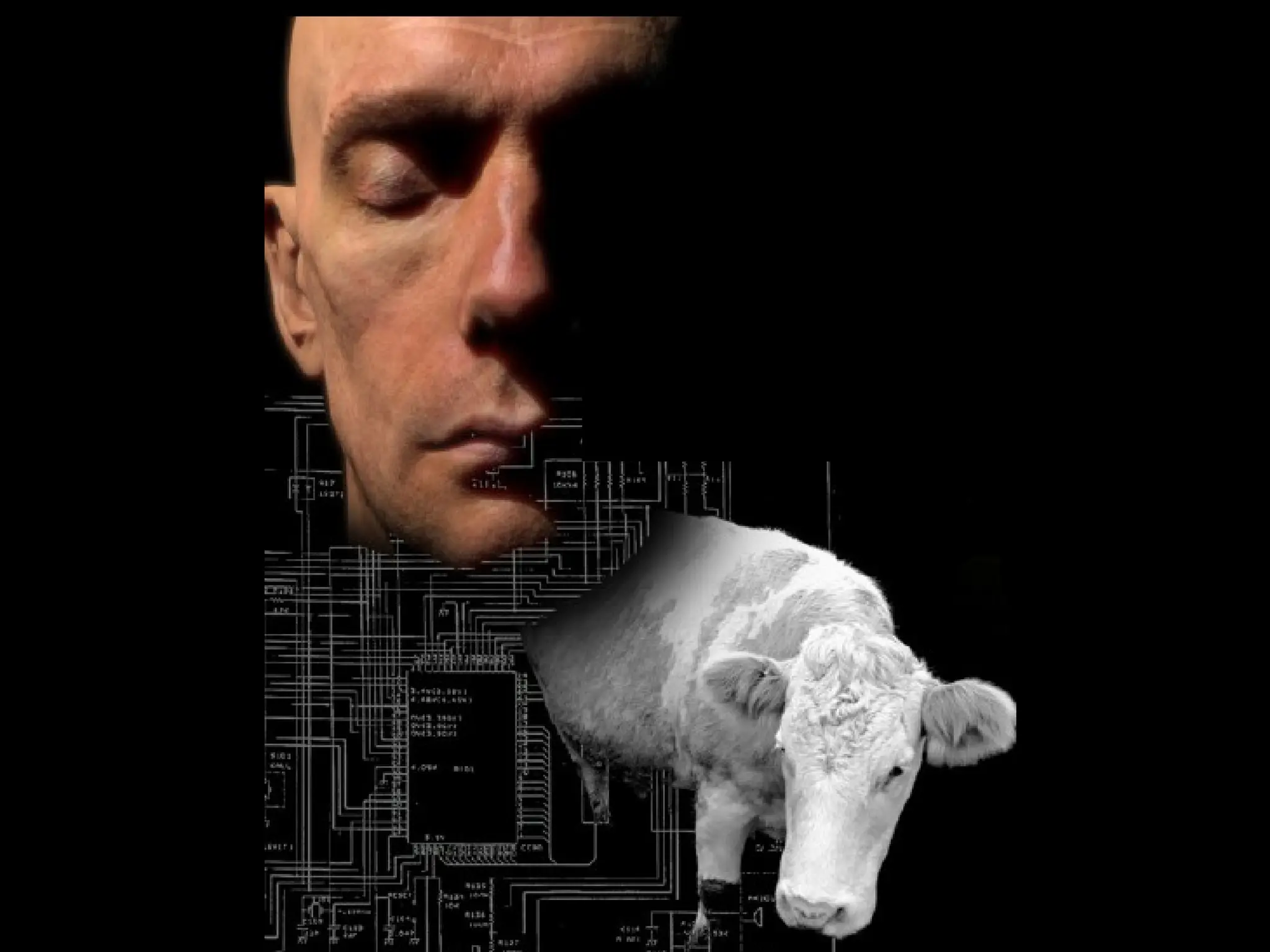
Front Cover: Which of the two beings depicted
on the front cover should be granted more
rights than the other?
The picture of the man is actually a computer
generated 3D model from the NVIDIA Corporation,
while the cow is indeed a photo of a real cow.
This is just to show how we can be fooled in what
gives us the impression of possessing intelligence.
(source: Picture and Comments[1])
NIKHIL HOODA
PRATEEK KHATRI
K.P. ASHWIN
HEMENDRA SRIVASTAVA
Philosophy of AI
Why Philosophy?
 Can a machine act intelligently? Can it solve any
problem that a person would solve by thinking?
 Can a machine have a mind, mental states and
consciousness in the same sense humans do? Can it
feel?
 Are human intelligence and machine intelligence the
same? Is the human brain essentially a computer?
These three questions reflect the divergent interests of AI
researchers, philosophers and cognitive scientists
respectively
Roots of AI in Philosophy
 AI occurred in philosophy as a new form of the
behaviourist theory.
 Behaviourism is the theory that tries to explain
human behaviour in terms of fixed rules that are
derived from observing human behaviour.
 To account for the changes in the brain behaviourists
proposed the presence of a black box. (black box
theory).
 Black Box theory eventually became AI with the
progress in processing speeds of computers.
What is intelligence : Turing Test
 Alan Turing, 50 years back, reduced the problem of
defining intelligence to a simple experiment.
 You ask the computer any question.
 If it is able to reply to it in the same manner a normal
human would, it is intelligent.
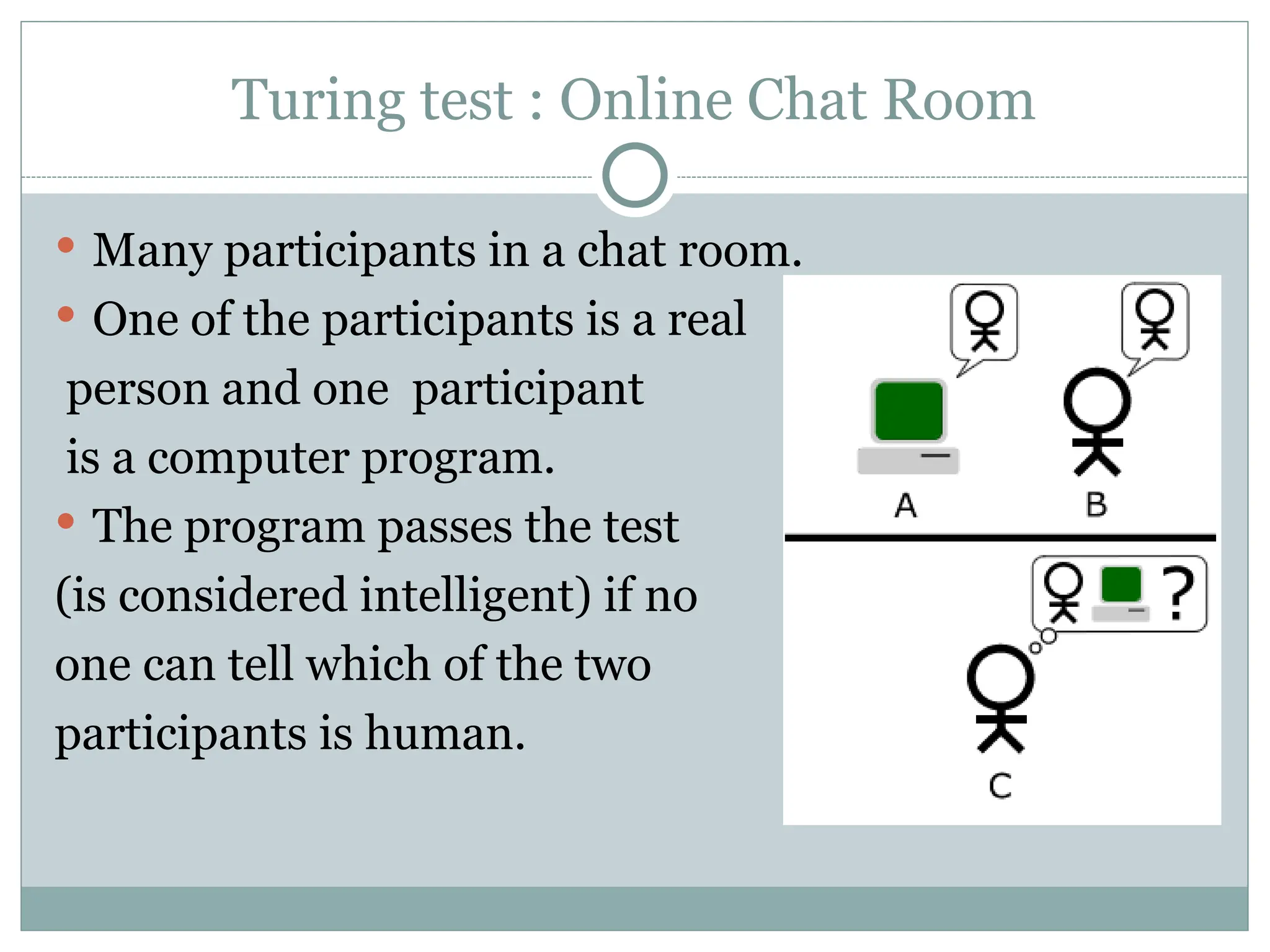
Turing test : Online Chat Room
 Many participants in a chat room.
 One of the participants is a real
person and one participant
is a computer program.
 The program passes the test
(is considered intelligent) if no
one can tell which of the two
participants is human.
Turing Test: Criticism
•Turing test does not directly test if the
computer behaves intelligently
•It only tests whether or not the
computer behaves like a human being.
•In general the two concepts are
different.
Russell and Norvig[2] : “aeronautical engineering texts do not
define the goal of their field as ‘making machines that fly so exactly
like pigeons that they can fool other pigeons.’ ”
Courtsey: Wikipedia
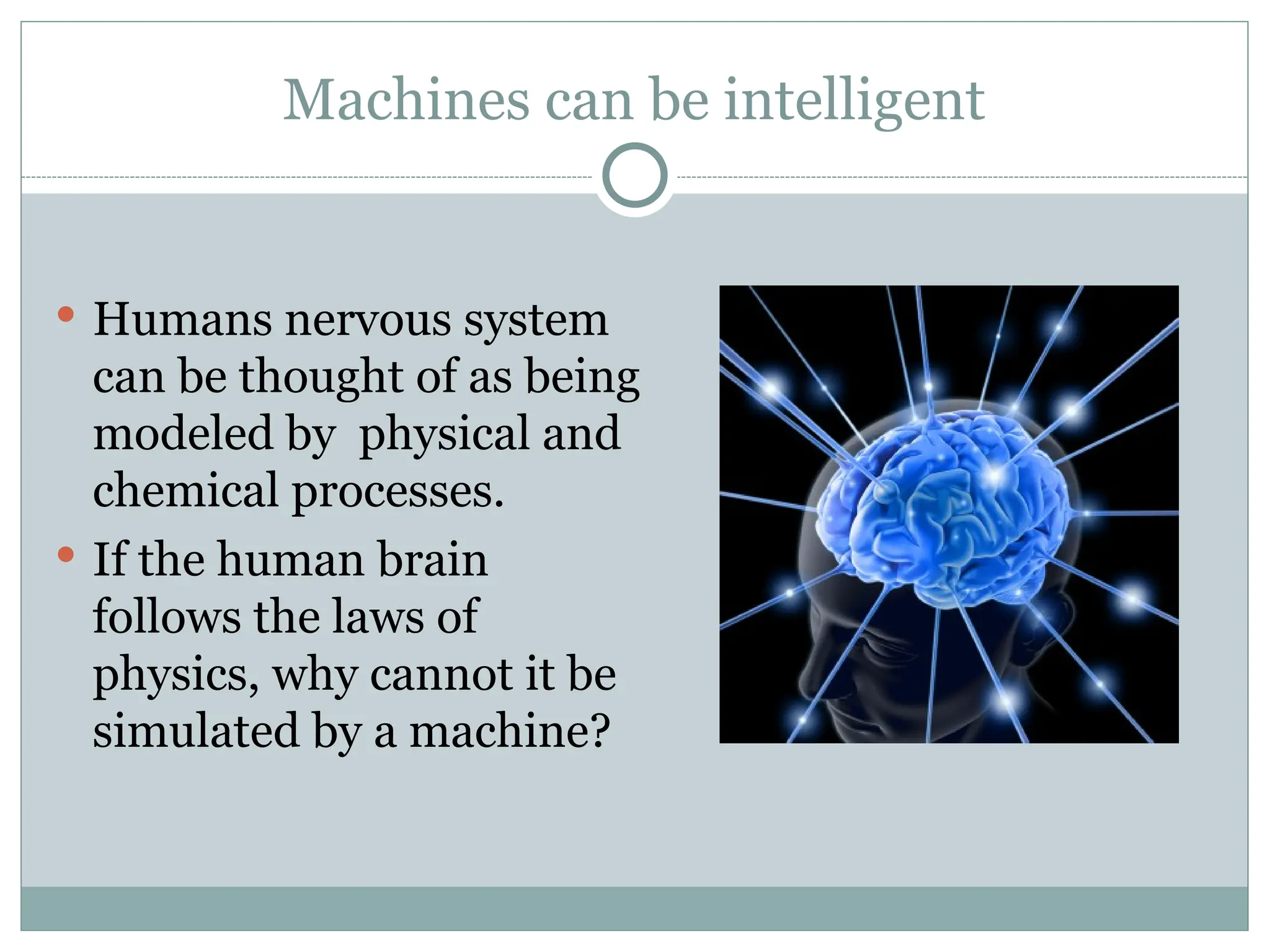
Machines can be intelligent
 Humans nervous system
can be thought of as being
modeled by physical and
chemical processes.
 If the human brain
follows the laws of
physics, why cannot it be
simulated by a machine?
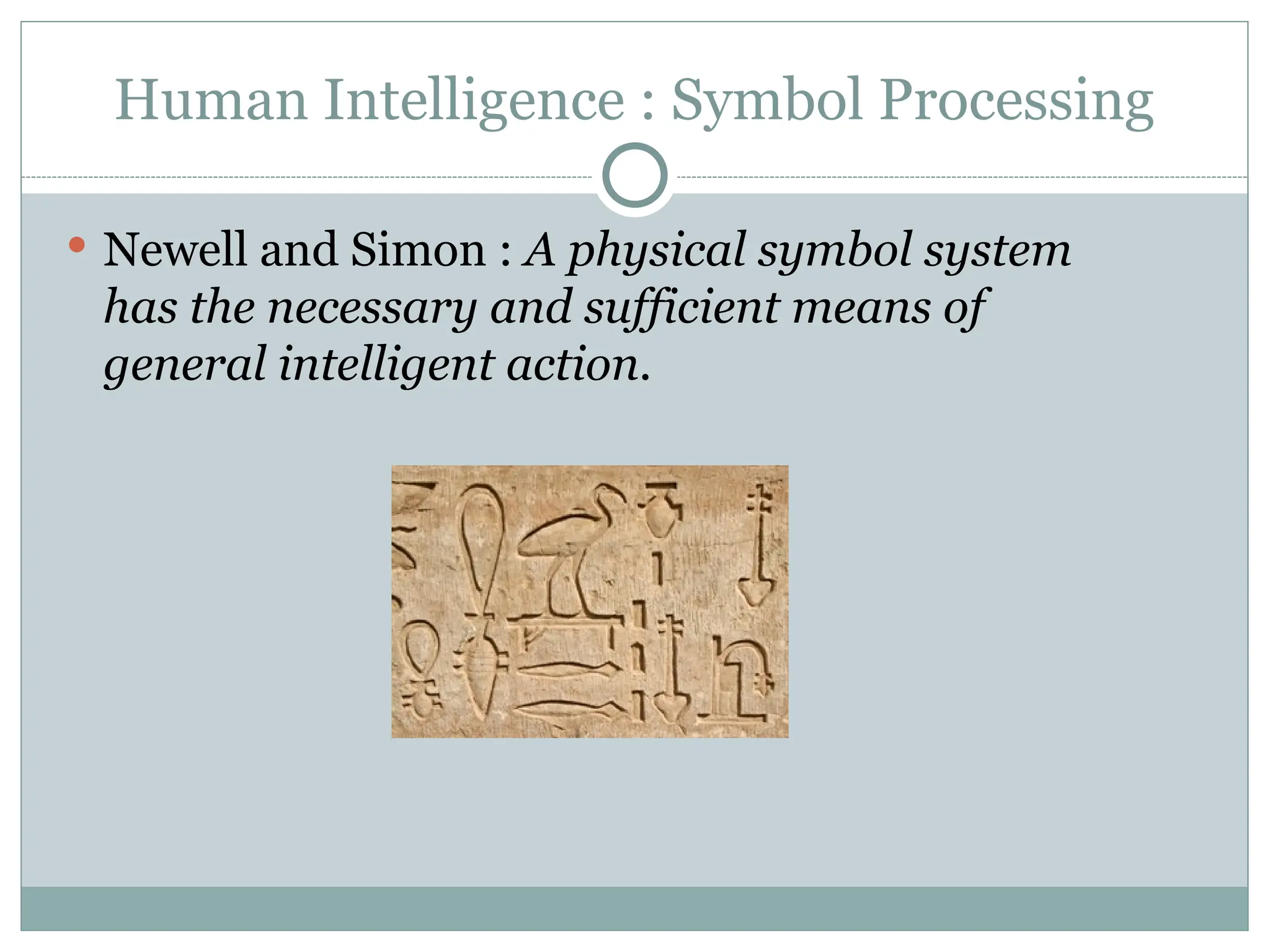
Human Intelligence : Symbol Processing
 Newell and Simon : A physical symbol system
has the necessary and sufficient means of
general intelligent action.
Symbol Processing : Criticism
 Gödel’s Theorem : For any sufficiently
powerful system its always possible to
construct sentences not provable by the
system .
 Seen by John Lucas[3] as proof that
machines can never achieve human
intelligence.
Symbol Processing : Criticism(Contd.)
 Penrose goes on to expand Lucas’ concept.
 Humans can see the truth of these Gödel’s
statements .
 Hence the human brain goes beyond
mathematical axioms and is not based on a
set of algorithms.
Symbol Processing : Criticism(Contd.)
 Quantum Mechanics is the difference!!!
 The philosopher David Chalmers half-
jokingly says: “consciousness is mysterious
and quantum mechanics is mysterious, so
maybe the two mysteries have a common
source."
Criticism of Criticism
 In the book Gödel, Escher, Bach: An Eternal Golden
Braid, Douglas Hofstadter explains that the "Gödel-
statements" always refer to the system itself ,similar to
statements that refer to themselves, such as "this
statement is false" or "I am lying“(also known as the
Epimenides paradox ).
 But, the Epimenides paradox applies to anything that
makes statements, whether they are machines or
humans, even Lucas himself.
 Consider:
 Lucas can't assert the truth of this statement.
Criticism of Criticism
 Russell and Norvig state that Gödel's argument only
applies to what can theoretically be proved, given an
infinite amount of memory and time.
 But real machines (including humans) have finite
resources and cannot prove many theorems.
 It is not necessary to prove everything in order to be
intelligent.
More Criticism
 Hubert Dreyfus argues that more than conscious
symbolic manipulation , human intelligence and
expertise depend primarily on unconscious instincts
and argued that these unconscious skills would never
be captured in formal rules.
Criticism of Criticism Again
 Turing : Just because we don't know the rules that
govern a complex behavior, this does not mean that
no such rules exist.
 Russell and Norvig : In recent years progress has
been made towards discovering the "rules" that
govern unconscious reasoning.
AI and Consciousness
 Morpheus : We have only bits and pieces of
information, but what we know for certain is that
some point in the early twenty-first century all of
mankind was united in celebration. We marveled at
our own magnificence as we gave birth to AI
 Neo : AI - you mean Artificial Intelligence?
 Morpheus : A singular consciousness that spawned
an entire race of machines.
The
Matrix
Some more Food for thought
 Can we achieve that Consciousness which Morpheus is
referring to?
 For this we first need to answer why do we need conscious
machines?
 According to Ricardo Sanz, there are three motivations to pursue
artificial consciousness (Sanz, 2005):
1) Implementing and designing machines resembling human beings
(cognitive robotics)
2) Understanding the nature of consciousness (cognitive science)
3) Implementing and designing more efficient control systems.
Machines resembling human beings
 What is the need of resemblance to human beings?
 Answer:- Our belief of being the most intelligent
creatures on Earth.
 Choice: Intelligent systems or conscious systems
 Does consciousness bring with it intelligence?
 Yes , it helps to achieve complex control in
autonomous machines. Intuition, self-awareness,
resilience all these are the result of our conscious
or sub-conscious mind and helps us make better
decisions.
Understanding the nature of consciousness
 By building conscious machines we are
trying to understand the cognitive science
behind it.
 This can be seen as the sub-goal of our long
term goal of understanding ourselves.
 It is impossible to build a conscious machine
without understanding what is
consciousness.
Designing efficient control systems
 A conscious system is better controlled than an
unconscious one which is working just on the basis
of some hardcoded rules and facts learnt on their
basis.
 Better control needs more than just experience.
Emotions, feelings, intuitions are some of the things.
 MIT cog-project: the robot is programmed to
remember his mother's face more than anybody
else's. Predictable. Same behavior always.
 Not the case with humans. The above feeling comes
through emotions.
Various viewpoints about consciousness in
machines
 Alexei V. Samsonovich: cognitive agent is one which
can learn any arbitrary schemas with the help of an
instructor.
 Owen Holland: robot should be able to create an
internal model of itself, outer model of environment
and the model of relationship between them.
 Some believe we don’t need conscious systems for
making intelligent machines.
 Some say consciousness is the by-product of our
complex structure, so don’t focus on consciousness.
Building a complex structure like us will automatically
lead to conscious agents.
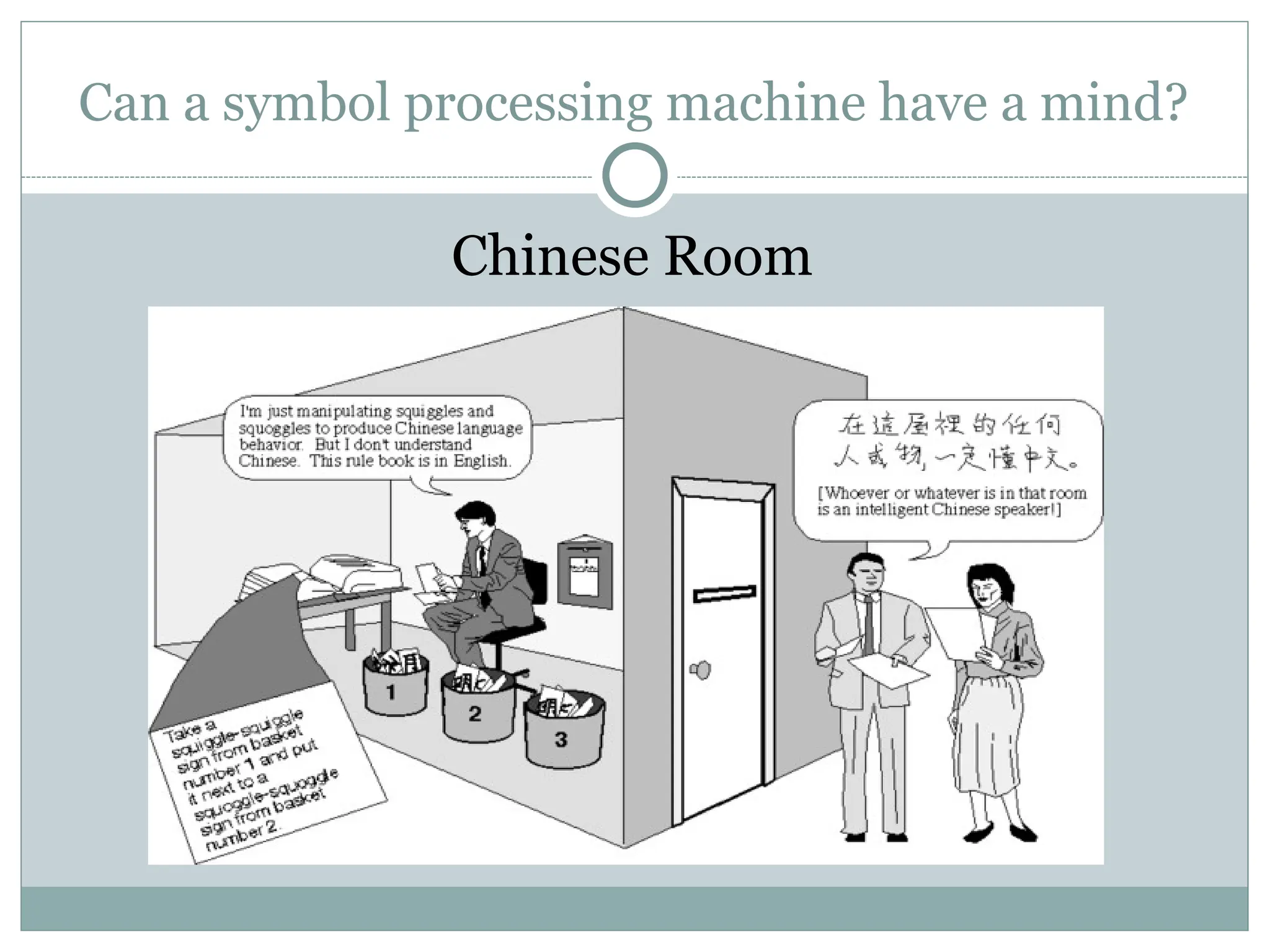
Can a symbol processing machine have a mind?
Chinese Room
Criticism: Chinese Room
 Searle’s argument: What computer does can
not be called thinking.
 It’s just a simulation and not intelligence in
the way we want it to have.
 The computer does not understand Chinese.
Criticism of criticism: Chinese Room
 Some argue that individual component of
that room don’t have consciousness but
room as a complete unit consisting of the
computer, the man, the program and the
cards understands Chinese.
Elements of Ethics in AI
Three aspects in ethics:
 Treat AI ethically
 Ethics in AI machines
 Using AI ethically
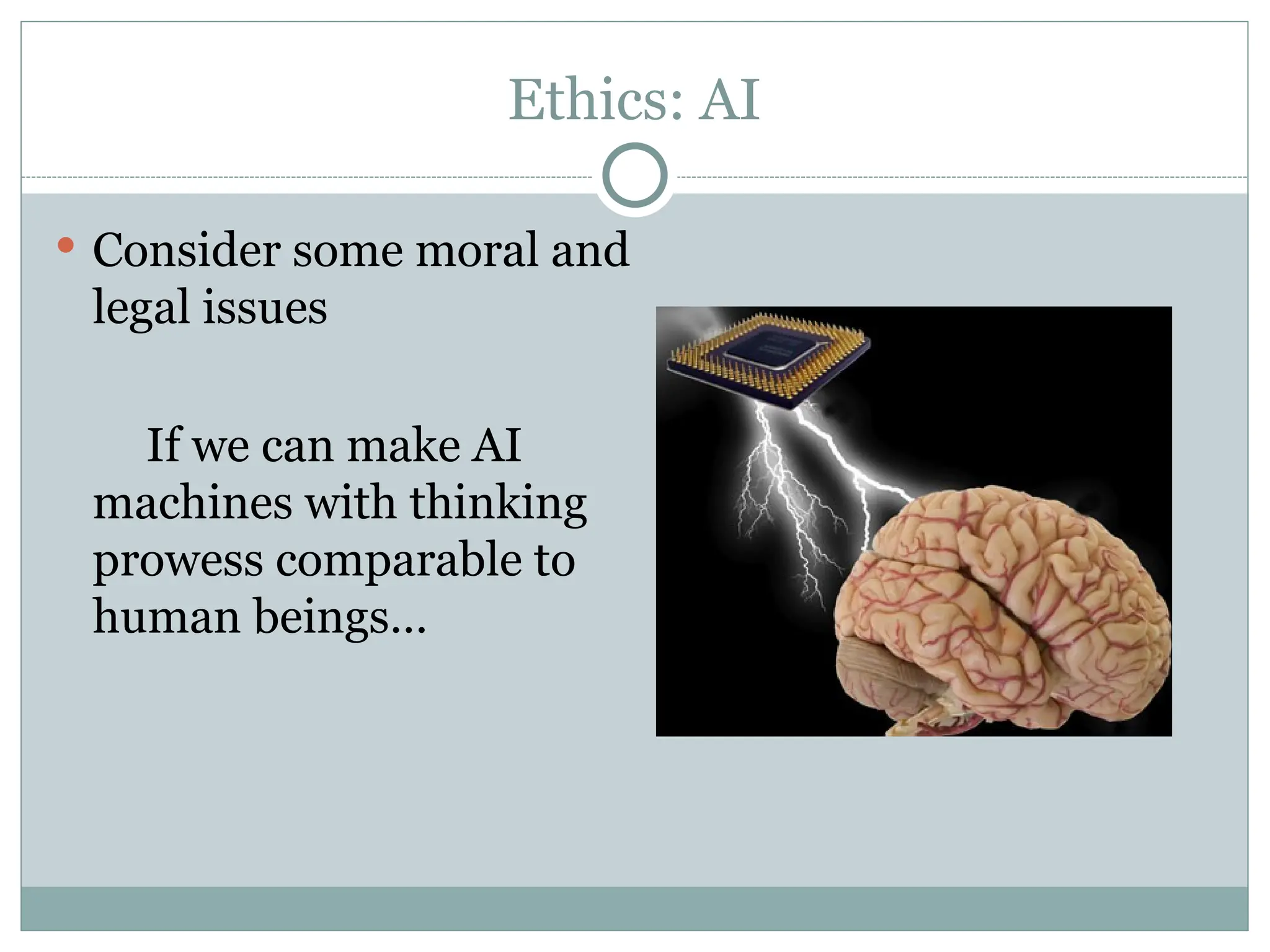
Ethics: AI
 Consider some moral and
legal issues
If we can make AI
machines with thinking
prowess comparable to
human beings…
Ethics : Sentience
 Sentience : The ability to feel pleasure or pain.
 Animal Rights : Sentience is the most important
feature that forces society to honor the rights of
animals.
 If a machine exhibits sentience, i.e., it is able to feel
pleasure and pain, then we must give it rights.
 Such a machine is expected to be made within 20
years.
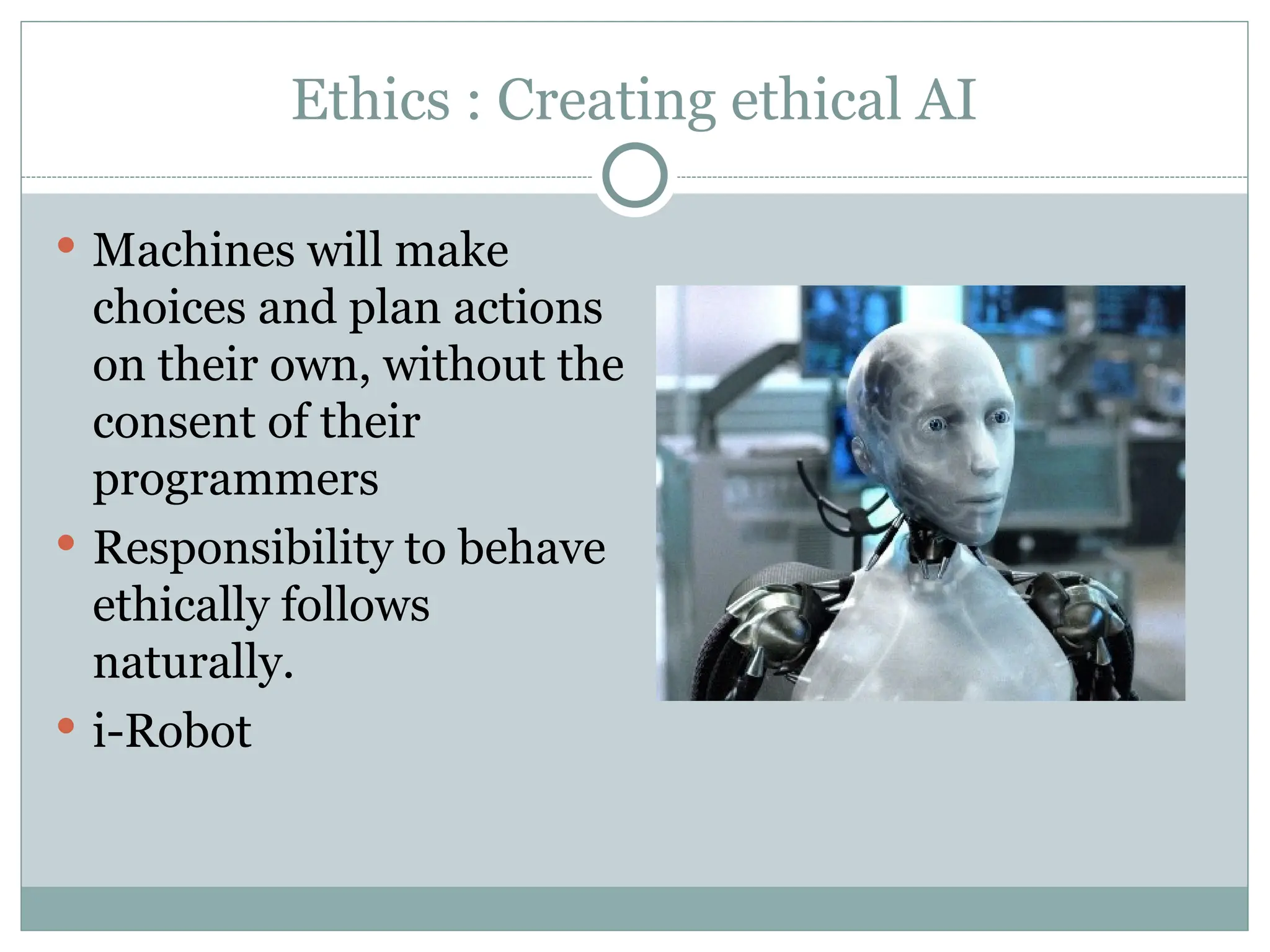
Ethics : Creating ethical AI
 Machines will make
choices and plan actions
on their own, without the
consent of their
programmers
 Responsibility to behave
ethically follows
naturally.
 i-Robot
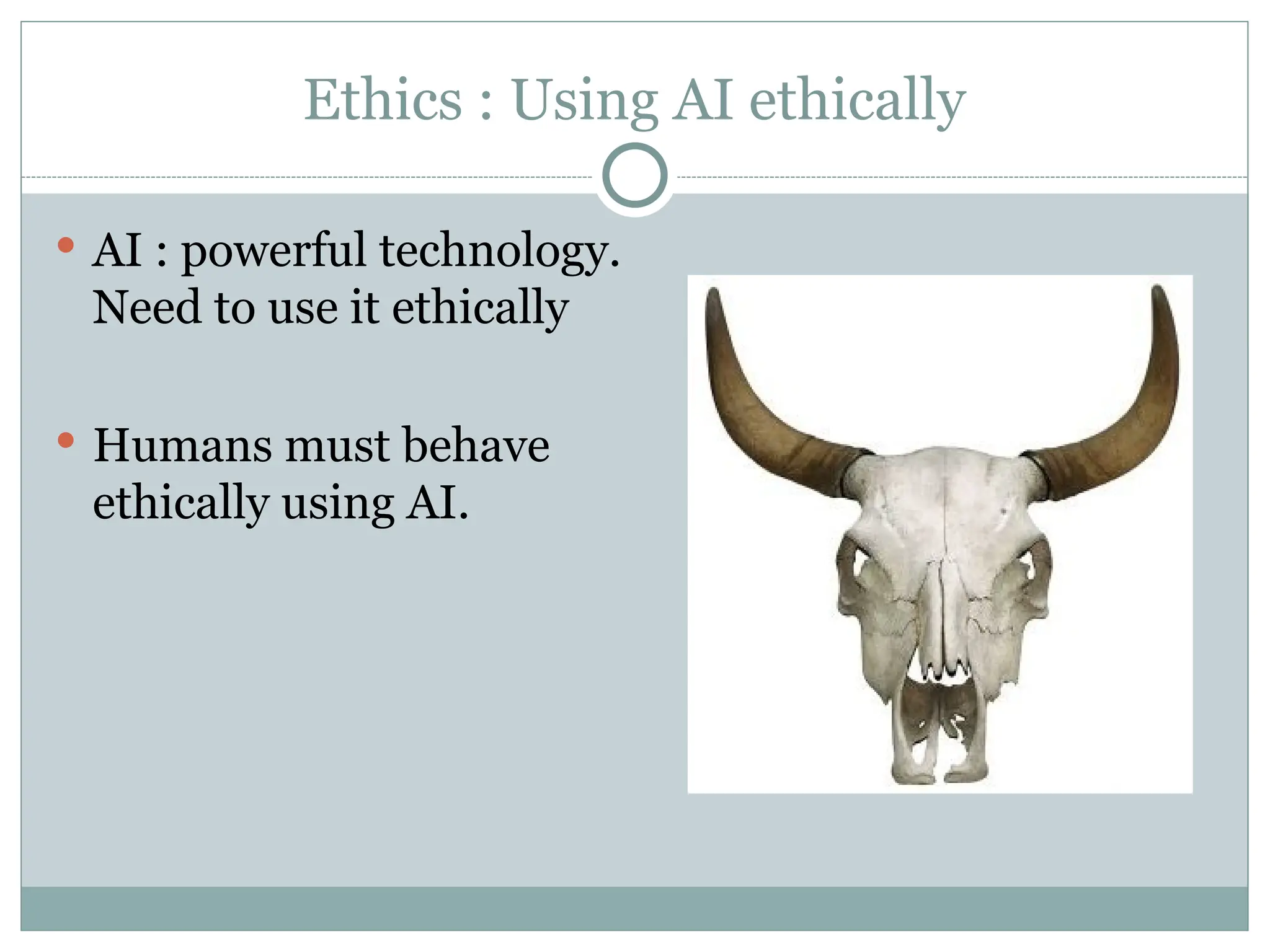
Ethics : Using AI ethically
 AI : powerful technology.
Need to use it ethically
 Humans must behave
ethically using AI.
Ethics : Opposition
 Lot of opposition to giving ethics to AI
 AI should not replace
 Doctors
 Judges
 Police officers,etc
 Wiezenbaum[4] : “Artificial intelligence, if used in
this way, represents a threat to human dignity”
Conclusion
"people might lose their sense of being unique. Weizenbaum (1976) ... points
out some of the potential threats that AI poses to society. One of Weizenbaum's
principal arguments is that AI research makes possible the idea that humans are
automata -- an idea that results in a loss of autonomy or even of humanity. We
note that the idea has been around much longer than AI, going back at least to
L'Homme Machine (La MMettrie, 1748). We also note that humanity has
survived other setbacks to our sense of uniqueness: De Revolutionibus Orbium
Coelestium (Copernicus, 1543) moved the Earth Away from the center of the
solar System and Descent of Man (Darwin, 1871) put Homo Sapiens at the same
level as other species. AI, if widely successful, may be at least as threatening to
the moral assumptions of 21st centure society as Darwin's theory of evolution was
to those of the 19th century."
References
 [1]Philosophy of Consciousness and Ethics in AI, Shawn
Kilmer, December 2007
 [2]Russell, Stuart J.; Norvig, Peter (2003), Artificial
Intelligence: A Modern Approach (2nd ed.), Upper
Saddle River, NJ: Prentice Hall, ISBN 0-13-790395-2
 [3]Lucas, J. R. (1961) Minds, machines and Gödel.
Philosophy 36: 112-117.
 [4]Why ethics is a hurdle for AI, Drew McDermott, North
American Conference on Computers and Philosophy
(NA-CAP) Bloomington, Indiana, July, 2008
 Artificial Intelligence and Consciousness, Antonio Chella,
Riccardo Manzotti, 2007
 http://en.wikipedia.org/wiki/Philosophy_of_AI

group4(Philosophy_of_AI), Ethics of artificial intelligence

  • 2.
    Food for thought.. FrontCover: Which of the two beings depicted on the front cover should be granted more rights than the other? The picture of the man is actually a computer generated 3D model from the NVIDIA Corporation, while the cow is indeed a photo of a real cow. This is just to show how we can be fooled in what gives us the impression of possessing intelligence. (source: Picture and Comments[1])
  • 3.
    NIKHIL HOODA PRATEEK KHATRI K.P.ASHWIN HEMENDRA SRIVASTAVA Philosophy of AI
  • 4.
    Why Philosophy?  Cana machine act intelligently? Can it solve any problem that a person would solve by thinking?  Can a machine have a mind, mental states and consciousness in the same sense humans do? Can it feel?  Are human intelligence and machine intelligence the same? Is the human brain essentially a computer? These three questions reflect the divergent interests of AI researchers, philosophers and cognitive scientists respectively
  • 5.
    Roots of AIin Philosophy  AI occurred in philosophy as a new form of the behaviourist theory.  Behaviourism is the theory that tries to explain human behaviour in terms of fixed rules that are derived from observing human behaviour.  To account for the changes in the brain behaviourists proposed the presence of a black box. (black box theory).  Black Box theory eventually became AI with the progress in processing speeds of computers.
  • 6.
    What is intelligence: Turing Test  Alan Turing, 50 years back, reduced the problem of defining intelligence to a simple experiment.  You ask the computer any question.  If it is able to reply to it in the same manner a normal human would, it is intelligent.
  • 7.
    Turing test :Online Chat Room  Many participants in a chat room.  One of the participants is a real person and one participant is a computer program.  The program passes the test (is considered intelligent) if no one can tell which of the two participants is human.
  • 8.
    Turing Test: Criticism •Turingtest does not directly test if the computer behaves intelligently •It only tests whether or not the computer behaves like a human being. •In general the two concepts are different. Russell and Norvig[2] : “aeronautical engineering texts do not define the goal of their field as ‘making machines that fly so exactly like pigeons that they can fool other pigeons.’ ” Courtsey: Wikipedia
  • 9.
    Machines can beintelligent  Humans nervous system can be thought of as being modeled by physical and chemical processes.  If the human brain follows the laws of physics, why cannot it be simulated by a machine?
  • 10.
    Human Intelligence :Symbol Processing  Newell and Simon : A physical symbol system has the necessary and sufficient means of general intelligent action.
  • 11.
    Symbol Processing :Criticism  Gödel’s Theorem : For any sufficiently powerful system its always possible to construct sentences not provable by the system .  Seen by John Lucas[3] as proof that machines can never achieve human intelligence.
  • 12.
    Symbol Processing :Criticism(Contd.)  Penrose goes on to expand Lucas’ concept.  Humans can see the truth of these Gödel’s statements .  Hence the human brain goes beyond mathematical axioms and is not based on a set of algorithms.
  • 13.
    Symbol Processing :Criticism(Contd.)  Quantum Mechanics is the difference!!!  The philosopher David Chalmers half- jokingly says: “consciousness is mysterious and quantum mechanics is mysterious, so maybe the two mysteries have a common source."
  • 14.
    Criticism of Criticism In the book Gödel, Escher, Bach: An Eternal Golden Braid, Douglas Hofstadter explains that the "Gödel- statements" always refer to the system itself ,similar to statements that refer to themselves, such as "this statement is false" or "I am lying“(also known as the Epimenides paradox ).  But, the Epimenides paradox applies to anything that makes statements, whether they are machines or humans, even Lucas himself.  Consider:  Lucas can't assert the truth of this statement.
  • 15.
    Criticism of Criticism Russell and Norvig state that Gödel's argument only applies to what can theoretically be proved, given an infinite amount of memory and time.  But real machines (including humans) have finite resources and cannot prove many theorems.  It is not necessary to prove everything in order to be intelligent.
  • 16.
    More Criticism  HubertDreyfus argues that more than conscious symbolic manipulation , human intelligence and expertise depend primarily on unconscious instincts and argued that these unconscious skills would never be captured in formal rules.
  • 17.
    Criticism of CriticismAgain  Turing : Just because we don't know the rules that govern a complex behavior, this does not mean that no such rules exist.  Russell and Norvig : In recent years progress has been made towards discovering the "rules" that govern unconscious reasoning.
  • 18.
    AI and Consciousness Morpheus : We have only bits and pieces of information, but what we know for certain is that some point in the early twenty-first century all of mankind was united in celebration. We marveled at our own magnificence as we gave birth to AI  Neo : AI - you mean Artificial Intelligence?  Morpheus : A singular consciousness that spawned an entire race of machines. The Matrix
  • 19.
    Some more Foodfor thought  Can we achieve that Consciousness which Morpheus is referring to?  For this we first need to answer why do we need conscious machines?  According to Ricardo Sanz, there are three motivations to pursue artificial consciousness (Sanz, 2005): 1) Implementing and designing machines resembling human beings (cognitive robotics) 2) Understanding the nature of consciousness (cognitive science) 3) Implementing and designing more efficient control systems.
  • 20.
    Machines resembling humanbeings  What is the need of resemblance to human beings?  Answer:- Our belief of being the most intelligent creatures on Earth.  Choice: Intelligent systems or conscious systems  Does consciousness bring with it intelligence?  Yes , it helps to achieve complex control in autonomous machines. Intuition, self-awareness, resilience all these are the result of our conscious or sub-conscious mind and helps us make better decisions.
  • 21.
    Understanding the natureof consciousness  By building conscious machines we are trying to understand the cognitive science behind it.  This can be seen as the sub-goal of our long term goal of understanding ourselves.  It is impossible to build a conscious machine without understanding what is consciousness.
  • 22.
    Designing efficient controlsystems  A conscious system is better controlled than an unconscious one which is working just on the basis of some hardcoded rules and facts learnt on their basis.  Better control needs more than just experience. Emotions, feelings, intuitions are some of the things.  MIT cog-project: the robot is programmed to remember his mother's face more than anybody else's. Predictable. Same behavior always.  Not the case with humans. The above feeling comes through emotions.
  • 23.
    Various viewpoints aboutconsciousness in machines  Alexei V. Samsonovich: cognitive agent is one which can learn any arbitrary schemas with the help of an instructor.  Owen Holland: robot should be able to create an internal model of itself, outer model of environment and the model of relationship between them.  Some believe we don’t need conscious systems for making intelligent machines.  Some say consciousness is the by-product of our complex structure, so don’t focus on consciousness. Building a complex structure like us will automatically lead to conscious agents.
  • 24.
    Can a symbolprocessing machine have a mind? Chinese Room
  • 25.
    Criticism: Chinese Room Searle’s argument: What computer does can not be called thinking.  It’s just a simulation and not intelligence in the way we want it to have.  The computer does not understand Chinese.
  • 26.
    Criticism of criticism:Chinese Room  Some argue that individual component of that room don’t have consciousness but room as a complete unit consisting of the computer, the man, the program and the cards understands Chinese.
  • 28.
    Elements of Ethicsin AI Three aspects in ethics:  Treat AI ethically  Ethics in AI machines  Using AI ethically
  • 29.
    Ethics: AI  Considersome moral and legal issues If we can make AI machines with thinking prowess comparable to human beings…
  • 30.
    Ethics : Sentience Sentience : The ability to feel pleasure or pain.  Animal Rights : Sentience is the most important feature that forces society to honor the rights of animals.  If a machine exhibits sentience, i.e., it is able to feel pleasure and pain, then we must give it rights.  Such a machine is expected to be made within 20 years.
  • 31.
    Ethics : Creatingethical AI  Machines will make choices and plan actions on their own, without the consent of their programmers  Responsibility to behave ethically follows naturally.  i-Robot
  • 32.
    Ethics : UsingAI ethically  AI : powerful technology. Need to use it ethically  Humans must behave ethically using AI.
  • 33.
    Ethics : Opposition Lot of opposition to giving ethics to AI  AI should not replace  Doctors  Judges  Police officers,etc  Wiezenbaum[4] : “Artificial intelligence, if used in this way, represents a threat to human dignity”
  • 34.
    Conclusion "people might losetheir sense of being unique. Weizenbaum (1976) ... points out some of the potential threats that AI poses to society. One of Weizenbaum's principal arguments is that AI research makes possible the idea that humans are automata -- an idea that results in a loss of autonomy or even of humanity. We note that the idea has been around much longer than AI, going back at least to L'Homme Machine (La MMettrie, 1748). We also note that humanity has survived other setbacks to our sense of uniqueness: De Revolutionibus Orbium Coelestium (Copernicus, 1543) moved the Earth Away from the center of the solar System and Descent of Man (Darwin, 1871) put Homo Sapiens at the same level as other species. AI, if widely successful, may be at least as threatening to the moral assumptions of 21st centure society as Darwin's theory of evolution was to those of the 19th century."
  • 35.
    References  [1]Philosophy ofConsciousness and Ethics in AI, Shawn Kilmer, December 2007  [2]Russell, Stuart J.; Norvig, Peter (2003), Artificial Intelligence: A Modern Approach (2nd ed.), Upper Saddle River, NJ: Prentice Hall, ISBN 0-13-790395-2  [3]Lucas, J. R. (1961) Minds, machines and Gödel. Philosophy 36: 112-117.  [4]Why ethics is a hurdle for AI, Drew McDermott, North American Conference on Computers and Philosophy (NA-CAP) Bloomington, Indiana, July, 2008  Artificial Intelligence and Consciousness, Antonio Chella, Riccardo Manzotti, 2007  http://en.wikipedia.org/wiki/Philosophy_of_AI