
What is
Transhumanism?
• ‘What a piece of work is a man! How noble in
reason, how infinite in faculty! In form and
moving how express and admirable! In action
how like an Angel! in apprehension how like a
god!’
• -Hamlet, Act II, Scene 2
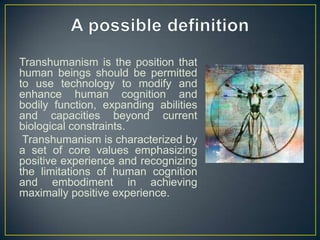
Transhumanism is the position that
human beings should be permitted
to use technology to modify and
enhance human cognition and
bodily function, expanding abilities
and capacities beyond current
biological constraints.
Transhumanism is characterized by
a set of core values emphasizing
positive experience and recognizing
the limitations of human cognition
and embodiment in achieving
maximally positive experience.
• Precursor sciences
•Plastic surgery
• Artificial Limbs
• Organ transplants
• Period of
investigation:
• The next 20-30 years
Number of plastic surgery procedures in the US:
14000000

12000000

10000000

8000000

6000000

4000000

2000000

0
1997

1999

2001

2003

2005

2007

2009

2011

2013

2015

Source: surgery.org

2017
•

Source : http://www.giftoflife.on.ca/en/stats.htm
Weak signals
• Bio-3D printing
• Brain wave study

Wild cards
• Bio-nano
technology
• Synthetic red blood
cells
• Brain transfer
3D Organ printing
“Tissue engineering technology
promises to solve the organ
transplantation crisis.
However, assembly of vascularized 3D
soft organs remains a big challenge.
Organ printing, which we define as
computer-aided, jet-based
3D tissue-engineering of living human
organs, offers a possible solution.”

Source :Vladimir Mironov, Thomas Boland. Thomas Trusk, Gabor Forgacs and Roger R. Markwald:
Organ printing: computer-aided jet-based 3D tissue engineering
Scenarios /
Variables

Freely
Transformable

Light Regulation

Dictatorial Regulation

Done by
multiple
organizations,
Tech
diverse and
Development fast-paced

Development is
tied to approval,
fewer but still
diverse
organizations,
fast-paced.

Concentrated, more
directionalized, possibly
focusing only on certain
aspects (Eg: Military
use, etc.)
Minimal development.

Significance in Regular, every
personal life day.

The possibility of
change, under
certain
circumstances
(Medical, etc.).

Limited to small
interested parties.

Conservative Attitude

Insignificant.

Social tension
Change on the
(inequalities,
most basic
Chance at lifestyle bureaucracy,
Social Effects levels.
improvement
corruption)

Social resistance
against technology

Development Strong
of countries
competition

International
Agreements

Armsrace

Anti-transhumanism
laws.

Significant
Age-averages Improvement

Slight
Improvement

Layered Improvement

Stagnation
Production based

Demand Based

3D Printing

Genetic diseases and epidemics, life
span extension

Bionics

Disabilities

Direct neural interfaces

Job specific demands

Nano-technology

Social media and always online society

Military technology

Adaptation to change
Oh, wonder!
How many goodly creatures are there here!
How beauteous mankind is! O brave new world,
That has such people in ’t!
-The Tempest, Act V, Scene 1
Transhumanism
Transhumanism

Transhumanism

  • 2.
  • 4.
    • ‘What apiece of work is a man! How noble in reason, how infinite in faculty! In form and moving how express and admirable! In action how like an Angel! in apprehension how like a god!’ • -Hamlet, Act II, Scene 2
  • 5.
    Transhumanism is theposition that human beings should be permitted to use technology to modify and enhance human cognition and bodily function, expanding abilities and capacities beyond current biological constraints. Transhumanism is characterized by a set of core values emphasizing positive experience and recognizing the limitations of human cognition and embodiment in achieving maximally positive experience.
  • 6.
    • Precursor sciences •Plasticsurgery • Artificial Limbs • Organ transplants • Period of investigation: • The next 20-30 years
  • 7.
    Number of plasticsurgery procedures in the US: 14000000 12000000 10000000 8000000 6000000 4000000 2000000 0 1997 1999 2001 2003 2005 2007 2009 2011 2013 2015 Source: surgery.org 2017
  • 8.
  • 9.
    Weak signals • Bio-3Dprinting • Brain wave study Wild cards • Bio-nano technology • Synthetic red blood cells • Brain transfer
  • 10.
    3D Organ printing “Tissueengineering technology promises to solve the organ transplantation crisis. However, assembly of vascularized 3D soft organs remains a big challenge. Organ printing, which we define as computer-aided, jet-based 3D tissue-engineering of living human organs, offers a possible solution.” Source :Vladimir Mironov, Thomas Boland. Thomas Trusk, Gabor Forgacs and Roger R. Markwald: Organ printing: computer-aided jet-based 3D tissue engineering
  • 13.
    Scenarios / Variables Freely Transformable Light Regulation DictatorialRegulation Done by multiple organizations, Tech diverse and Development fast-paced Development is tied to approval, fewer but still diverse organizations, fast-paced. Concentrated, more directionalized, possibly focusing only on certain aspects (Eg: Military use, etc.) Minimal development. Significance in Regular, every personal life day. The possibility of change, under certain circumstances (Medical, etc.). Limited to small interested parties. Conservative Attitude Insignificant. Social tension Change on the (inequalities, most basic Chance at lifestyle bureaucracy, Social Effects levels. improvement corruption) Social resistance against technology Development Strong of countries competition International Agreements Armsrace Anti-transhumanism laws. Significant Age-averages Improvement Slight Improvement Layered Improvement Stagnation
  • 15.
    Production based Demand Based 3DPrinting Genetic diseases and epidemics, life span extension Bionics Disabilities Direct neural interfaces Job specific demands Nano-technology Social media and always online society Military technology Adaptation to change
  • 16.
    Oh, wonder! How manygoodly creatures are there here! How beauteous mankind is! O brave new world, That has such people in ’t! -The Tempest, Act V, Scene 1