Physical Education 9 / Mr. Al-lyn L. Vocal 
BASKETBALL
I. DEFINITION: 
Basketball 
- a sport played by two teams of five players 
on a rectangular court 
- one of the world's most popular and widely 
viewed sports 
-a team can score a field goal by shooting 
the ball through the basket during regular 
play
II. OBJECTIVE OF THE GAME: 
to shoot a ball through a hoop 18 inches 
(46 cm) in diameter and 10 feet (3.0 m) high 
mounted to a backboard at each end
III. HISTORY: 
December 1891 
Canadian American Dr. James 
Naismith, a physical education 
professor and instructor at the 
International Young Men's Christian 
Association Training School (YMCA) 
(today, Springfield College) 
in Springfield, Massachusetts, USA), 
was trying to keep his gym class active 
on a rainy day
III. HISTORY: 
Basketball was originally played with 
a soccer ball 
The first balls made specifically for basketball 
were brown, and it was only in the late 1950s 
that Tony Hinkle, searching for a ball that 
would be more visible to players and 
spectators alike, introduced the orange ball 
that is now in common use
III. HISTORY 
Dribbling was not part of the original game 
except for the "bounce pass" to teammates 
Passing the ball was the primary means of 
ball movement 
Dribbling was eventually introduced but 
limited by the asymmetric shape of early 
balls
III. HISTORY: 
Influenced by the children’s game named 
Duck on a Rock 
The first official game was played in 
the YMCA gymnasium in Albany, New 
York on January 20, 1892 with nine players 
By 1897–1898 teams of five became 
standard
IV. EQUIPMENT: 
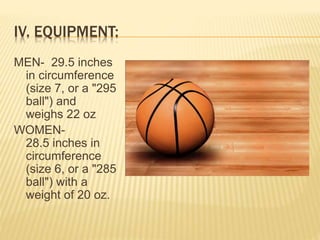
MEN- 29.5 inches 
in circumference 
(size 7, or a "295 
ball") and 
weighs 22 oz 
WOMEN- 
28.5 inches in 
circumference 
(size 6, or a "285 
ball") with a 
weight of 20 oz.
IV. EQUIPMENT:
IV. EQUIPMENT: 
A regulation basketball court in international 
games is 91.9 feet long and 49.2 feet wide. 
In the NBA the court is 94 feet by 50 feet. 
Most courts havewood flooring, usually 
constructed from maple planks running in 
the same direction as the longer court 
dimension.The name and logo of the home 
team is usually painted on or around the 
center circle.
IV. EQUIPMENT:
IV. EQUIPMENT: 
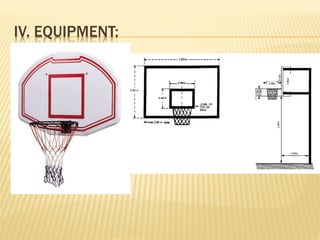
The basket is a steel rim 18 inches 
diameter with an attached net 
affixed to a backboard that 
measures 6 feet by 3.5 feet and one 
basket is at each end of the court. 
The white outlined box on the 
backboard is 18 inches high and 2 
feet wide.
IV. EQUIPMENT: 
At almost all levels of competition, the 
top of the rim is exactly 10 feet above 
the court and 4 feet inside the baseline. 
While variation is possible in the 
dimensions of the court and backboard, 
it is considered important for the basket 
to be of the correct height – a rim that is 
off by just a few inches can have an 
adverse effect on shooting
IV. EQUIPMENT:
V. OFFICIALS: 
- an official is a person who has the 
responsibility to enforce the rules and 
maintain the order of the game
A. REFEREE 
1. Crew chief – the lead official 
usually performs the jump ball 
2. Umpires – a.k.a. Referees 
same responsibilities with the 
lead official only that they are 
only assistants
WHISTLE
B. SCORER 
- The one who will record the points, violations 
and fouls gained by each team 
- Uses score sheet for documentary purposes 
and scoreboard for letting the teams know 
about their status in the game
SCORESHEET
SCOREBOARD
C. TIMEKEEPERS: 
-responsible for monitoring the time of the 
game
VI. BASIC SKILLS 
1. POSITIONING 
2. SHOOTING 
3. REBOUNDING 
4. PASSING 
5. DRIBBLING 
6. BLOCKING
VI. BASIC SKILLS: 
a. Positions 
- Although the rules do not specify any 
positions whatsoever, they have 
evolved as part of basketball 
-during the first five decades of 
basketball's evolution, one guard, two 
forwards, and two centers or two 
guards, two forwards, and one center 
were used
VI. BASIC SKILLS: 
a. Positioning 
-since the 1980s, more specific positions have evolved, 
namely: 
Point guard: usually the fastest player on the team, 
organizes the team's offense by controlling the ball and 
making sure that it gets to the right player at the right 
time. 
Shooting guard: creates a high volume of shots on 
offense, mainly long-ranged; and guards the opponent's 
best perimeter player on defense. 
Small forward: often primarily responsible for scoring 
points via cuts to the basket and dribble penetration; on 
defense seeks rebounds and steals, but sometimes plays 
more actively.
VI. BASIC SKILLS: 
a. Position 
Power forward: plays offensively often with 
their back to the basket; on defense, plays 
under the basket (in a zone defense) or 
against the opposing power forward (in man-to- 
man defense). 
Center: uses height and size to score (on 
offense), to protect the basket closely (on 
defense), or to rebound.
VI. BASIC SKILLS: 
b. Shooting 
-the act of attempting to score points by 
throwing the ball through the basket, 
methods varying with players and situations 
- a player faces the basket with both feet 
facing the basket 
-A player will rest the ball on the fingertips of 
the dominant hand (the shooting arm) slightly 
above the head, with the other hand 
supporting the side of the ball
VI. BASIC SKILLS: 
b. Shooting 
-the ball is usually shot by jumping (though 
not always) and extending the shooting arm 
-the shooting arm, fully extended with the 
wrist fully bent, is held stationary for a 
moment following the release of the ball, 
known as a follow-through 
- players may shoot directly into the basket 
or may use the backboard to redirect the ball 
into the basket
VI. BASIC SKILLS: 
3 Types of Shooting 
a. JUMPSHOT 
b. LAY-UP 
c. SLAM DUNK
A. JUMP SHOT
B. LAY-UP
C. SLAM DUNK
VI. BASIC SKILLS: 
c. Rebounding 
-the objective of rebounding is to 
successfully gain possession of the 
basketball after a missed field goal or free 
throw, as it rebounds from the hoop or 
backboard 
-this plays a major role in the game, as most 
possessions end when a team misses a shot
VI. BASIC SKILLS: 
2 Categories in Rebounding 
1. Offensive Rebounds 
2. Defensive Rebounds
A. OFFENSIVE REBOUNDS 
- in which the ball is recovered by the 
offensive side and does not change 
possession
B. DEFENSIVE REBOUND 
- in which the defending team gains 
possession of the loose ball
VI. BASIC SKILLS: 
d. PASSING 
- a method of moving the ball 
between players 
- most passes are accompanied by 
a step forward to increase power 
and are followed through with the 
hands to ensure accuracy
VI. BASIC SKILLS: 
6 TYPES OF PASS 
1. Chest Pass 
2. Bound Pass 
3. Overhead Pass 
4. Outlet Pass 
5. No-look Pass 
6. Behind-the-back Pass
V. NATURE OF THE GAME: 
A field goal scores two points for the shooting 
team if a player is touching or closer to the 
basket than the three-point line, and three 
points (known commonly as a 3 
pointer or three) if the player is behind the 
three-point line 
The team with the most points at the end of 
the game wins, but additional time (overtime) 
may be issued when the game ends with a 
draw
1. CHEST PASS 
- the ball is passed directly from the passer's 
chest to the receiver's chest. A proper chest 
pass involves an outward snap of the thumbs 
to add velocity and leaves the defence little 
time to react
2. BOUNCE PASS 
- the passer bounces the ball crisply about 
two-thirds of the way from his own chest to 
the receiver 
- the ball strikes the court and bounces up 
toward the receiver 
- the bounce pass takes longer to complete 
than the chest pass, but it is also harder for 
the opposing team to intercept (kicking the 
ball deliberately is a violation) 
- -players often use the bounce pass in 
crowded moments, or to pass around a
BOUNCE PASS
3. OVERHEAD PASS 
- used to pass the ball over a defender 
- the ball is released while over the passer's 
head
4. OUTLET PASS 
- occurs 
after a 
team gets 
a 
defensive 
rebound 
- next pass 
after 
reboundin 
g
5. NO LOOK PASS 
- a special way of 
doing this is 
passing the ball 
without looking at 
the receiving 
teammate
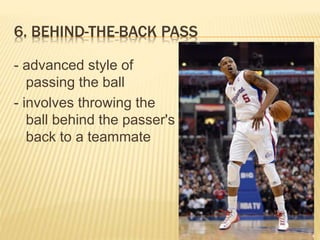
6. BEHIND-THE-BACK PASS 
- advanced style of 
passing the ball 
- involves throwing the 
ball behind the passer's 
back to a teammate
VI. BASIC SKILLS: 
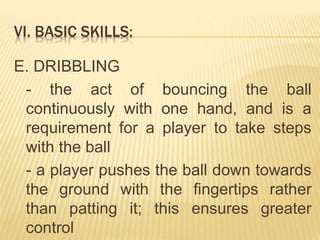
E. DRIBBLING 
- the act of bouncing the ball 
continuously with one hand, and is a 
requirement for a player to take steps 
with the ball 
- a player pushes the ball down towards 
the ground with the fingertips rather 
than patting it; this ensures greater 
control
DRIBBLING
VI. BASIC SKILLS 
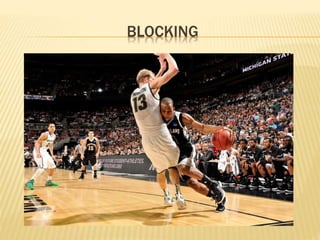
F. BLOCKING 
- performed when, after a shot is attempted, 
a defender succeeds in altering the shot by 
touching the ball
BLOCKING
Let’s have first 
QUIZ! 
Sir Al-lyn 

Basketball : History - Basic Skills

  • 1.
    Physical Education 9/ Mr. Al-lyn L. Vocal BASKETBALL
  • 2.
    I. DEFINITION: Basketball - a sport played by two teams of five players on a rectangular court - one of the world's most popular and widely viewed sports -a team can score a field goal by shooting the ball through the basket during regular play
  • 3.
    II. OBJECTIVE OFTHE GAME: to shoot a ball through a hoop 18 inches (46 cm) in diameter and 10 feet (3.0 m) high mounted to a backboard at each end
  • 4.
    III. HISTORY: December1891 Canadian American Dr. James Naismith, a physical education professor and instructor at the International Young Men's Christian Association Training School (YMCA) (today, Springfield College) in Springfield, Massachusetts, USA), was trying to keep his gym class active on a rainy day
  • 6.
    III. HISTORY: Basketballwas originally played with a soccer ball The first balls made specifically for basketball were brown, and it was only in the late 1950s that Tony Hinkle, searching for a ball that would be more visible to players and spectators alike, introduced the orange ball that is now in common use
  • 7.
    III. HISTORY Dribblingwas not part of the original game except for the "bounce pass" to teammates Passing the ball was the primary means of ball movement Dribbling was eventually introduced but limited by the asymmetric shape of early balls
  • 8.
    III. HISTORY: Influencedby the children’s game named Duck on a Rock The first official game was played in the YMCA gymnasium in Albany, New York on January 20, 1892 with nine players By 1897–1898 teams of five became standard
  • 9.
    IV. EQUIPMENT: MEN-29.5 inches in circumference (size 7, or a "295 ball") and weighs 22 oz WOMEN- 28.5 inches in circumference (size 6, or a "285 ball") with a weight of 20 oz.
  • 10.
  • 11.
    IV. EQUIPMENT: Aregulation basketball court in international games is 91.9 feet long and 49.2 feet wide. In the NBA the court is 94 feet by 50 feet. Most courts havewood flooring, usually constructed from maple planks running in the same direction as the longer court dimension.The name and logo of the home team is usually painted on or around the center circle.
  • 12.
  • 13.
    IV. EQUIPMENT: Thebasket is a steel rim 18 inches diameter with an attached net affixed to a backboard that measures 6 feet by 3.5 feet and one basket is at each end of the court. The white outlined box on the backboard is 18 inches high and 2 feet wide.
  • 14.
    IV. EQUIPMENT: Atalmost all levels of competition, the top of the rim is exactly 10 feet above the court and 4 feet inside the baseline. While variation is possible in the dimensions of the court and backboard, it is considered important for the basket to be of the correct height – a rim that is off by just a few inches can have an adverse effect on shooting
  • 15.
  • 16.
    V. OFFICIALS: -an official is a person who has the responsibility to enforce the rules and maintain the order of the game
  • 17.
    A. REFEREE 1.Crew chief – the lead official usually performs the jump ball 2. Umpires – a.k.a. Referees same responsibilities with the lead official only that they are only assistants
  • 18.
  • 19.
    B. SCORER -The one who will record the points, violations and fouls gained by each team - Uses score sheet for documentary purposes and scoreboard for letting the teams know about their status in the game
  • 20.
  • 21.
  • 22.
    C. TIMEKEEPERS: -responsiblefor monitoring the time of the game
  • 23.
    VI. BASIC SKILLS 1. POSITIONING 2. SHOOTING 3. REBOUNDING 4. PASSING 5. DRIBBLING 6. BLOCKING
  • 24.
    VI. BASIC SKILLS: a. Positions - Although the rules do not specify any positions whatsoever, they have evolved as part of basketball -during the first five decades of basketball's evolution, one guard, two forwards, and two centers or two guards, two forwards, and one center were used
  • 25.
    VI. BASIC SKILLS: a. Positioning -since the 1980s, more specific positions have evolved, namely: Point guard: usually the fastest player on the team, organizes the team's offense by controlling the ball and making sure that it gets to the right player at the right time. Shooting guard: creates a high volume of shots on offense, mainly long-ranged; and guards the opponent's best perimeter player on defense. Small forward: often primarily responsible for scoring points via cuts to the basket and dribble penetration; on defense seeks rebounds and steals, but sometimes plays more actively.
  • 26.
    VI. BASIC SKILLS: a. Position Power forward: plays offensively often with their back to the basket; on defense, plays under the basket (in a zone defense) or against the opposing power forward (in man-to- man defense). Center: uses height and size to score (on offense), to protect the basket closely (on defense), or to rebound.
  • 28.
    VI. BASIC SKILLS: b. Shooting -the act of attempting to score points by throwing the ball through the basket, methods varying with players and situations - a player faces the basket with both feet facing the basket -A player will rest the ball on the fingertips of the dominant hand (the shooting arm) slightly above the head, with the other hand supporting the side of the ball
  • 29.
    VI. BASIC SKILLS: b. Shooting -the ball is usually shot by jumping (though not always) and extending the shooting arm -the shooting arm, fully extended with the wrist fully bent, is held stationary for a moment following the release of the ball, known as a follow-through - players may shoot directly into the basket or may use the backboard to redirect the ball into the basket
  • 30.
    VI. BASIC SKILLS: 3 Types of Shooting a. JUMPSHOT b. LAY-UP c. SLAM DUNK
  • 31.
  • 32.
  • 33.
  • 34.
    VI. BASIC SKILLS: c. Rebounding -the objective of rebounding is to successfully gain possession of the basketball after a missed field goal or free throw, as it rebounds from the hoop or backboard -this plays a major role in the game, as most possessions end when a team misses a shot
  • 35.
    VI. BASIC SKILLS: 2 Categories in Rebounding 1. Offensive Rebounds 2. Defensive Rebounds
  • 36.
    A. OFFENSIVE REBOUNDS - in which the ball is recovered by the offensive side and does not change possession
  • 37.
    B. DEFENSIVE REBOUND - in which the defending team gains possession of the loose ball
  • 38.
    VI. BASIC SKILLS: d. PASSING - a method of moving the ball between players - most passes are accompanied by a step forward to increase power and are followed through with the hands to ensure accuracy
  • 39.
    VI. BASIC SKILLS: 6 TYPES OF PASS 1. Chest Pass 2. Bound Pass 3. Overhead Pass 4. Outlet Pass 5. No-look Pass 6. Behind-the-back Pass
  • 40.
    V. NATURE OFTHE GAME: A field goal scores two points for the shooting team if a player is touching or closer to the basket than the three-point line, and three points (known commonly as a 3 pointer or three) if the player is behind the three-point line The team with the most points at the end of the game wins, but additional time (overtime) may be issued when the game ends with a draw
  • 41.
    1. CHEST PASS - the ball is passed directly from the passer's chest to the receiver's chest. A proper chest pass involves an outward snap of the thumbs to add velocity and leaves the defence little time to react
  • 42.
    2. BOUNCE PASS - the passer bounces the ball crisply about two-thirds of the way from his own chest to the receiver - the ball strikes the court and bounces up toward the receiver - the bounce pass takes longer to complete than the chest pass, but it is also harder for the opposing team to intercept (kicking the ball deliberately is a violation) - -players often use the bounce pass in crowded moments, or to pass around a
  • 43.
  • 44.
    3. OVERHEAD PASS - used to pass the ball over a defender - the ball is released while over the passer's head
  • 45.
    4. OUTLET PASS - occurs after a team gets a defensive rebound - next pass after reboundin g
  • 46.
    5. NO LOOKPASS - a special way of doing this is passing the ball without looking at the receiving teammate
  • 47.
    6. BEHIND-THE-BACK PASS - advanced style of passing the ball - involves throwing the ball behind the passer's back to a teammate
  • 48.
    VI. BASIC SKILLS: E. DRIBBLING - the act of bouncing the ball continuously with one hand, and is a requirement for a player to take steps with the ball - a player pushes the ball down towards the ground with the fingertips rather than patting it; this ensures greater control
  • 49.
  • 50.
    VI. BASIC SKILLS F. BLOCKING - performed when, after a shot is attempted, a defender succeeds in altering the shot by touching the ball
  • 51.
  • 52.
    Let’s have first QUIZ! Sir Al-lyn 