Normal,
Overweight
and Obese
Mr. AL-LYN L. VOCAL
Physical Education 10
La Salle University Integrated School
Why Is a Healthy Weight Important?
 Reaching and maintaining a healthy weight is important
for overall health and can help you prevent and control
many diseases and conditions.
 If you are overweight or obese, you are at higher risk of
developing serious health problems, including heart
disease, high blood pressure, type 2 diabetes,
gallstones, breathing problems, and certain cancers.
That is why maintaining a healthy weight is so
important.
Normal
Why Is a Healthy Weight Important?
It helps you lower
your risk for
developing these
problems, helps you
feel good about
yourself, and gives
you more energy to
enjoy life.
Normal
What Factors Contribute To a
Healthy Weight?
Many factors can contribute to a
person’s weight. These factors
include environment, family history
and genetics, metabolism (the way
your body changes food and oxygen
into energy), and behavior or habits.
Normal
Energy Balance
Energy balance is important for
maintaining a healthy weight.
The amount of energy or calories you get
from food and drinks (energy IN) is balanced
with the energy your body uses for things like
breathing, digesting, and being physically
active (energy OUT):
The same amount of energy IN and energy
OUT over time = weight stays the same
(energy balance)
Normal
Energy Balance
More energy IN than OUT over time =
weight gain
More energy OUT than IN over time =
weight loss
To maintain a healthy weight, your
energy IN and OUT don’t have to
balance exactly every day. It’s the
balance over time that helps you
maintain a healthy weight.
Normal
Energy Balance
You can reach and maintain a healthy
weight if you:
Follow a healthy diet, and if you are
overweight or obese, reduce your daily
intake by 500 calories for weight loss
Are physically active
Limit the time you spend being
physically inactive
Normal
http://www.nhlbi.nih.gov/health/educational/lose_wt/
Normal
Normal
The Benefits of an Active Lifestyle
Living an active life is important to
staying healthy. According to
the Harvard School of Public Health,
staying active helps to reduce your
risk of:
heart disease
stroke
diabetes
cancer
Normal
The Benefits of an Active Lifestyle
You don’t have to be a distance
runner to improve your health. The
most important thing is that you’re
staying active. It helps just to:
give your heart a workout
stay strong
try to maintain a healthy weight
Normal
Tips for Maintaining an Active
Lifestyle
The trick to staying active
is to find something you
enjoy doing.
For some, that means
having a friend to exercise
with.
It doesn’t matter whether
you’re going to the gym or
walking around the block.
Normal
Tips for Maintaining an Active
Lifestyle
Others prefer to
dance along to an
aerobics DVD in
private or go for a
quiet bike ride.
It can be hard to find
your workout style.
It can help to mix it up
every once in a while.
Normal
Tip 1: Take It Slow
 Haven’t been active in several
years?
 Start out slow. Always talk to
your doctor before starting an
exercise program.
 There may be precautions
you should take.
 In general, you’ll want to start
out with sessions of only five
or 10 minutes.
 You can gradually increase
the length of your sessions
over time.
Normal
Tip 2: Get Your 30
 Your goal for physical activity should be 30 minutes
each day. According to the Harvard School of Public
Health, three 10-minute sessions are just as good as
one longer session. For example, you could do:
 10 minutes of dancing before work
 a 10-minute walk around the parking lot at lunch
 a 10-minute walk around the neighborhood as soon as
you get home
 Of course, more exercise is better. However, take
precautions to avoid injuries such as muscle strain. It’s
better to work out a little less one day if it will help you
do it again the next.
Normal
Tip 3: Pump Some Iron
 You don’t just need
aerobic exercise.
Resistance training or
weight lifting is also
important. This type of
exercise helps
strengthen your bones
and improve your
balance and
coordination. This
reduces your risk for
osteoporosis. It also
helps prevent injuries or
falls.
Normal
Tip 4: Mix It Up
Many gyms and community centers
offer free classes with a monthly
membership. Take advantage of
those opportunities. You may get to
experience some of the newest and
hottest fitness trends. You never
know what you might fall in love
with next.
Normal
Tip 5: Mind Your Money
You can get a great workout at home
for just pennies. Fitness DVDs are a
great way to exercise.. Many local
libraries also lend out exercise DVDs.
Checking out different DVDs can be a
great way to find new types of
exercise you like.
Normal
Tip 5: Mind Your Money
Another option is
to tune in to a
fitness show
broadcast on TV.
Exercise shows
are also available
on the Internet.
Normal
Tip 5: Mind Your Money
Other home-friendly workouts that require little
or no special equipment include:
walking or jogging
jumping rope
dancing
squats
weight training with found objects (bags of
beans, a heavy book, a water bottle)
jumping jacks
push-ups
Normal
Tip 6: Stretch
Stretching after a workout should always
be part of your routine. Stretching
improves flexibility and range of motion. It
may also cut your risk of injury or muscle
cramps. Finally, stretching improves
circulation throughout the body.
Normal
http://www.healthline.com/health/womens-health-active-lifestyle#3
https://www.youtube.com/watch?v=Pw7HC_Ppb
iA
Why lose weight?
If you’re extremely obese, losing weight
can mean “less heart disease,
less diabetes and less cancer,” said
Robert Eckel, M.D., past president of the
American Heart Association. “Metabolic
improvements start to occur when people
with extreme obesity lose about 10
percent of their body weight.”
Obesity
Why lose weight?
Losing weight can reduce your risk
of heart disease and stroke; risk
factors like high blood
pressure, plasma glucose and sleep
apnea.
It can also help lower your total
cholesterol, triglycerides and raise
“good” cholesterol — HDL.
Obesity
Understanding Extreme Obesity
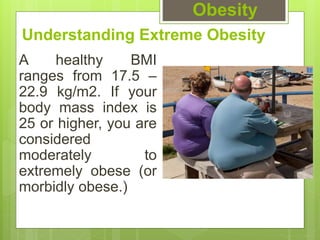
A healthy BMI
ranges from 17.5 –
22.9 kg/m2. If your
body mass index is
25 or higher, you are
considered
moderately to
extremely obese (or
morbidly obese.)
Obesity
How to Get Healthier
If you’re extremely obese, taking action to lose weight and
improve your health may seem overwhelming. You may
have had trouble losing weight or maintaining your weight
loss, been diagnosed with medical problems and endured
the social stigma of obesity.
Obesity
How to Get Healthier
“The key to getting started is to find a
compassionate doctor with expertise in treating
extreme obesity,” said Dr. Eckel, who is also
professor of medicine and Charles A. Boettcher
II Chair in Atherosclerosis at the University of
Colorado Anschutz Medical Campus in Aurora,
Colo. “Bonding with your physician is the
best way to get past first base and on the
path to better health.”
Obesity
How to Get Healthier
 If you’re extremely obese, Dr. Eckel recommends that
you become more active, but not to start a vigorous
workout program without getting physician advice and
not until you’ve lost about 10 percent of your body
weight.
 “You can continue the level of physical activity that
you’re already doing, but check with your physician
before increasing it,” Dr. Eckel said. “Some people
with extreme obesity may have health issues like
arthritis or heart disease that could limit or even be
worsened by exercise.”
Obesity
Treatment Options
 Talk to your doctor about the health benefits and the
risks of treatment options for extreme obesity:
 Change your diet. You may be referred to a dietician
who can help you with a plan to lose one to two
pounds per week. To lose weight, you have to reduce
the number of calories you consume. Start by
tracking everything you eat.
“You have to become a good record-keeper,” Dr.
Eckel said. “Reduce calories by 500 calories per day
to lose about a one pound a week, or cut 1,000
calories a day to lose about two pounds a week.”
Obesity
Treatment Options
 Consider adding physical
activity after reaching a minimum of 10
percent weight-loss goal.
Medication. Some people can benefit
from medication to help with weight loss
for extreme obesity. Keep in mind that
medication can be expensive and have
side effects.
Obesity
Treatment Options
 Surgery. If changing your diet, getting more physical
activity and taking medication haven’t helped you lose
enough weight, bariatric or “metabolic” surgery may be
an option. The American Heart Association
recommends surgery for those who are healthy
enough for the procedure and have been unsuccessful
with lifestyle changes and medication. Risks can
include infections and potentially dangerous blood
clots soon after the operation, and concerns about
getting the right amount of vitamins and minerals long-
term.
Obesity
Get The Social Or Medical Support You
Need
 Although some people can modify their lifestyle
and lose weight on their own, many need extra
help. A social support system can help
encourage your progress and keep you on track.
Decide what support best fits your needs —
either a weight-loss support group or one-on-
one therapy.
 Some people with extreme obesity suffer from
depression. Talk to your doctor about the best
treatment, as some anti-depressant medications
can cause weight gain.
Obesity
Food Calorie Content
http://whatscookingamerica.net/NutritionalChart.
htm

Normal, Overweight and Obese

  • 1.
    Normal, Overweight and Obese Mr. AL-LYNL. VOCAL Physical Education 10 La Salle University Integrated School
  • 2.
    Why Is aHealthy Weight Important?  Reaching and maintaining a healthy weight is important for overall health and can help you prevent and control many diseases and conditions.  If you are overweight or obese, you are at higher risk of developing serious health problems, including heart disease, high blood pressure, type 2 diabetes, gallstones, breathing problems, and certain cancers. That is why maintaining a healthy weight is so important. Normal
  • 3.
    Why Is aHealthy Weight Important? It helps you lower your risk for developing these problems, helps you feel good about yourself, and gives you more energy to enjoy life. Normal
  • 4.
    What Factors ContributeTo a Healthy Weight? Many factors can contribute to a person’s weight. These factors include environment, family history and genetics, metabolism (the way your body changes food and oxygen into energy), and behavior or habits. Normal
  • 5.
    Energy Balance Energy balanceis important for maintaining a healthy weight. The amount of energy or calories you get from food and drinks (energy IN) is balanced with the energy your body uses for things like breathing, digesting, and being physically active (energy OUT): The same amount of energy IN and energy OUT over time = weight stays the same (energy balance) Normal
  • 6.
    Energy Balance More energyIN than OUT over time = weight gain More energy OUT than IN over time = weight loss To maintain a healthy weight, your energy IN and OUT don’t have to balance exactly every day. It’s the balance over time that helps you maintain a healthy weight. Normal
  • 7.
    Energy Balance You canreach and maintain a healthy weight if you: Follow a healthy diet, and if you are overweight or obese, reduce your daily intake by 500 calories for weight loss Are physically active Limit the time you spend being physically inactive Normal http://www.nhlbi.nih.gov/health/educational/lose_wt/
  • 8.
  • 9.
  • 10.
    The Benefits ofan Active Lifestyle Living an active life is important to staying healthy. According to the Harvard School of Public Health, staying active helps to reduce your risk of: heart disease stroke diabetes cancer Normal
  • 11.
    The Benefits ofan Active Lifestyle You don’t have to be a distance runner to improve your health. The most important thing is that you’re staying active. It helps just to: give your heart a workout stay strong try to maintain a healthy weight Normal
  • 12.
    Tips for Maintainingan Active Lifestyle The trick to staying active is to find something you enjoy doing. For some, that means having a friend to exercise with. It doesn’t matter whether you’re going to the gym or walking around the block. Normal
  • 13.
    Tips for Maintainingan Active Lifestyle Others prefer to dance along to an aerobics DVD in private or go for a quiet bike ride. It can be hard to find your workout style. It can help to mix it up every once in a while. Normal
  • 14.
    Tip 1: TakeIt Slow  Haven’t been active in several years?  Start out slow. Always talk to your doctor before starting an exercise program.  There may be precautions you should take.  In general, you’ll want to start out with sessions of only five or 10 minutes.  You can gradually increase the length of your sessions over time. Normal
  • 15.
    Tip 2: GetYour 30  Your goal for physical activity should be 30 minutes each day. According to the Harvard School of Public Health, three 10-minute sessions are just as good as one longer session. For example, you could do:  10 minutes of dancing before work  a 10-minute walk around the parking lot at lunch  a 10-minute walk around the neighborhood as soon as you get home  Of course, more exercise is better. However, take precautions to avoid injuries such as muscle strain. It’s better to work out a little less one day if it will help you do it again the next. Normal
  • 16.
    Tip 3: PumpSome Iron  You don’t just need aerobic exercise. Resistance training or weight lifting is also important. This type of exercise helps strengthen your bones and improve your balance and coordination. This reduces your risk for osteoporosis. It also helps prevent injuries or falls. Normal
  • 17.
    Tip 4: MixIt Up Many gyms and community centers offer free classes with a monthly membership. Take advantage of those opportunities. You may get to experience some of the newest and hottest fitness trends. You never know what you might fall in love with next. Normal
  • 18.
    Tip 5: MindYour Money You can get a great workout at home for just pennies. Fitness DVDs are a great way to exercise.. Many local libraries also lend out exercise DVDs. Checking out different DVDs can be a great way to find new types of exercise you like. Normal
  • 19.
    Tip 5: MindYour Money Another option is to tune in to a fitness show broadcast on TV. Exercise shows are also available on the Internet. Normal
  • 20.
    Tip 5: MindYour Money Other home-friendly workouts that require little or no special equipment include: walking or jogging jumping rope dancing squats weight training with found objects (bags of beans, a heavy book, a water bottle) jumping jacks push-ups Normal
  • 21.
    Tip 6: Stretch Stretchingafter a workout should always be part of your routine. Stretching improves flexibility and range of motion. It may also cut your risk of injury or muscle cramps. Finally, stretching improves circulation throughout the body. Normal http://www.healthline.com/health/womens-health-active-lifestyle#3
  • 22.
  • 23.
    Why lose weight? Ifyou’re extremely obese, losing weight can mean “less heart disease, less diabetes and less cancer,” said Robert Eckel, M.D., past president of the American Heart Association. “Metabolic improvements start to occur when people with extreme obesity lose about 10 percent of their body weight.” Obesity
  • 24.
    Why lose weight? Losingweight can reduce your risk of heart disease and stroke; risk factors like high blood pressure, plasma glucose and sleep apnea. It can also help lower your total cholesterol, triglycerides and raise “good” cholesterol — HDL. Obesity
  • 25.
    Understanding Extreme Obesity Ahealthy BMI ranges from 17.5 – 22.9 kg/m2. If your body mass index is 25 or higher, you are considered moderately to extremely obese (or morbidly obese.) Obesity
  • 26.
    How to GetHealthier If you’re extremely obese, taking action to lose weight and improve your health may seem overwhelming. You may have had trouble losing weight or maintaining your weight loss, been diagnosed with medical problems and endured the social stigma of obesity. Obesity
  • 27.
    How to GetHealthier “The key to getting started is to find a compassionate doctor with expertise in treating extreme obesity,” said Dr. Eckel, who is also professor of medicine and Charles A. Boettcher II Chair in Atherosclerosis at the University of Colorado Anschutz Medical Campus in Aurora, Colo. “Bonding with your physician is the best way to get past first base and on the path to better health.” Obesity
  • 28.
    How to GetHealthier  If you’re extremely obese, Dr. Eckel recommends that you become more active, but not to start a vigorous workout program without getting physician advice and not until you’ve lost about 10 percent of your body weight.  “You can continue the level of physical activity that you’re already doing, but check with your physician before increasing it,” Dr. Eckel said. “Some people with extreme obesity may have health issues like arthritis or heart disease that could limit or even be worsened by exercise.” Obesity
  • 29.
    Treatment Options  Talkto your doctor about the health benefits and the risks of treatment options for extreme obesity:  Change your diet. You may be referred to a dietician who can help you with a plan to lose one to two pounds per week. To lose weight, you have to reduce the number of calories you consume. Start by tracking everything you eat. “You have to become a good record-keeper,” Dr. Eckel said. “Reduce calories by 500 calories per day to lose about a one pound a week, or cut 1,000 calories a day to lose about two pounds a week.” Obesity
  • 30.
    Treatment Options  Consideradding physical activity after reaching a minimum of 10 percent weight-loss goal. Medication. Some people can benefit from medication to help with weight loss for extreme obesity. Keep in mind that medication can be expensive and have side effects. Obesity
  • 31.
    Treatment Options  Surgery.If changing your diet, getting more physical activity and taking medication haven’t helped you lose enough weight, bariatric or “metabolic” surgery may be an option. The American Heart Association recommends surgery for those who are healthy enough for the procedure and have been unsuccessful with lifestyle changes and medication. Risks can include infections and potentially dangerous blood clots soon after the operation, and concerns about getting the right amount of vitamins and minerals long- term. Obesity
  • 32.
    Get The SocialOr Medical Support You Need  Although some people can modify their lifestyle and lose weight on their own, many need extra help. A social support system can help encourage your progress and keep you on track. Decide what support best fits your needs — either a weight-loss support group or one-on- one therapy.  Some people with extreme obesity suffer from depression. Talk to your doctor about the best treatment, as some anti-depressant medications can cause weight gain. Obesity
  • 33.