Physical education
project
2012- 2013


Delhi public school,
Navi Mumbai
PROJECT COORDINATOR- MR.
YASHWANT MOKASHI
ACKNOWLEDGEMENT
I would like to express my special
thanks of gratitude to my teacher
yashwant sir as well as our principal
who gave me the golden opportunity to
do this wonderful project. Which also
helped me in doing a lot of Research
and I came to know about so many new
things
I am really thankful to them.
Secondly I would also like to thank my
parents and friends who helped me a
lot in finishing this project within
the limited time.
HISTORY AND
         ORIGIN
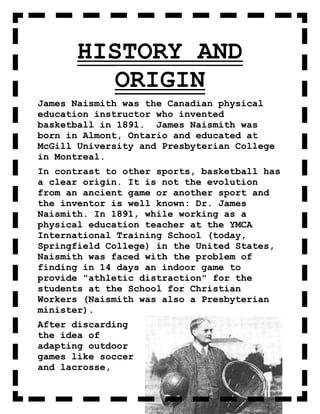
James Naismith was the Canadian physical
education instructor who invented
basketball in 1891. James Naismith was
born in Almont, Ontario and educated at
McGill University and Presbyterian College
in Montreal.
In contrast to other sports, basketball has
a clear origin. It is not the evolution
from an ancient game or another sport and
the inventor is well known: Dr. James
Naismith. In 1891, while working as a
physical education teacher at the YMCA
International Training School (today,
Springfield College) in the United States,
Naismith was faced with the problem of
finding in 14 days an indoor game to
provide "athletic distraction" for the
students at the School for Christian
Workers (Naismith was also a Presbyterian
minister).
After discarding
the idea of
adapting outdoor
games like soccer
and lacrosse,
Naismith recalled the concept of a game of
his school days known as duck-on-a-rock
that involved accuracy attempting to knock
a "duck" off the top of a large rock by
tossing another rock at it.
Of course it was not exactly as we know it
today. The first game was played with a
soccer ball and two peach baskets nailed
10-feet high used as goals, on a court just
half the size of a present-day court. The
baskets retained their bottoms so balls
scored into the basket had to be poked out
with a long dowel each time and dribbling
(bouncing of the ball up and down while
moving) was not part of the original game.
The sport was an instant success and thanks
to the initial impulse received by the YMCA
movement, basketball's popularity quickly
grew nationwide and was introduced in many
nations. He had the honor to witness
basketball become an Olympic sport at
the 1936 Games held in Berlin.
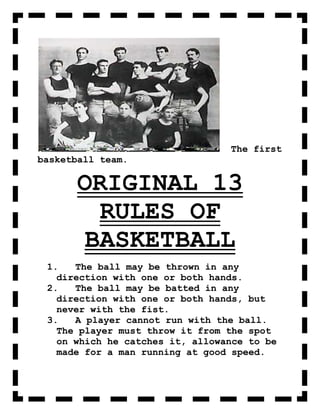
The first
basketball team.

      ORIGINAL 13
        RULES OF
       BASKETBALL
 1.   The ball may be thrown in any
   direction with one or both hands.
 2.   The ball may be batted in any
   direction with one or both hands, but
   never with the fist.
 3.   A player cannot run with the ball.
   The player must throw it from the spot
   on which he catches it, allowance to be
   made for a man running at good speed.
4.   The ball must be held in or between
  the hands. The arms or body must not be
  used for holding it.
5.   No shouldering, holding, pushing,
  striking or tripping in any way of an
  opponent. The first infringement of
  this rule by any person shall count as
  a foul; the second shall disqualify him
  until the next goal is made or, if
  there was evident intent to injure the
  person, for the whole of the game. No
  substitution shall be allowed.
6.   A foul is striking at the ball with
  the fist, violations of Rules 3 and 4
  and such as described in Rule 5.
7.   If either side make three
  consecutive fouls it shall count as a
  goal for the opponents (consecutive
  means without the opponents in the
  meantime making a foul).
8.   Goal shall be made when the ball is
  thrown or batted from the ground into
  the basket and stays there, providing
  those defending the goal do not touch
  or disturb the goal. If the ball rests
  on the edge and the opponents move the
  basket, it shall count as a goal.
9.   When the ball goes out of bounds, it
  shall be thrown into the field and
  played by the first person touching it.
  In case of dispute the umpire shall
throw it straight into the field. The
  thrower-in is allowed five seconds. If
  he holds it longer, it shall go to the
  opponent. If any side persists in
  delaying the game, the umpire shall
  call a foul on them.
10. The umpire shall be judge of the men
  and shall note the fouls and notify the
  referee when three consecutive fouls
  have been made. He shall have the power
  to disqualify men according to Rule 5.
11. The referee shall be the judge of
  the ball and decide when it is in play
  in bounds, to which side it belongs,
  and shall keep the time. He shall
  decide when a goal has been made and
  keep account of the goals with any
  other duties that are usually performed
  by a referee.
12. The time shall be two 15-minute
  halves with five minutes' rest between.
13. The side making the most goals in
  that time shall be declared the
  winners.


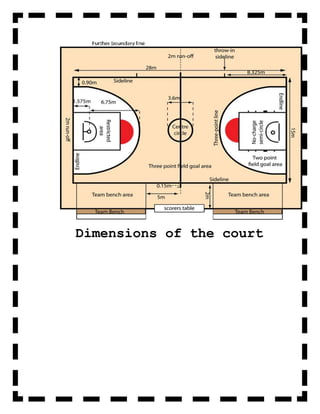
  DIMENSIONS AND
   REQUIREMENTS
Dimensions of the court
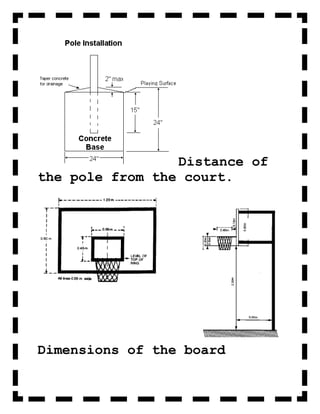
Distance of
the pole from the court.


Dimensions of the board
FUNDAMENTAL
         SKILLS
The sport of basketball requires five basic
skills. While some players might be more
experienced with some skills than others,
it is best to have at least some ability in
all five areas. Basketball is a fast-paced
game that requires the knowledge and
instinct to perform quickly and properly.
Be sure to practice all five skills.

Dribbling
Dribbling is an important skill for all
basketball players. This skill will allow
you to move up and down the court, maneuver
past defenders and execute plays. Proper
dribbling requires ball-handling skills and
knowledge of how to spread your fingers for
ball control. Different types of dribbles
are:-

   High Dribble
   Low Dribble
   Speed Dribble
   Change-Of-Pace Dribble
   Crossover 'Switch'.
Shooting
In order to score points in basketball, you
need to shoot the ball into the hoop. This
requires the ability to properly hold and
throw the ball into the air toward the
basket while avoiding defenders. A proper
shot requires precise aiming, arm extension
and lift from the legs. Different types of
shots are :-
   Jump Shot
   Layup
   Hook Shot
   Dunk
   Free Throw
Running
Running is a big part of basketball. In a
full-court game, you will find yourself
running back and forth as the game quickly
transitions between offense and defense.
When you have the ball, running will help
you to avoid defenders and get to the
basket quicker. On defense, you often will
find yourself needing to run after the
opponent, especially during fast breaks.


Passing
Passing is another skill that when mastered
can help you become a complete basketball
player. Basketball is a team sport that
involves finding a teammate who is open for
a shot. The ability to pass the ball to
this player can make the difference between
scoring and not scoring. Types of passes :-
   Chest passes
   2. Bounce Pass
   3. Overhead Pass
   4. Outlet Pass
   5. No-Look Pass
   6. behind the Back Pass
Jumping
Jumping is another skill that can define
how good a basketball player is. Jumping is
involved in offense during the jump ball in
the beginning, while taking shots and
sometimes while trying to catch a pass. On
defensive you will need the ability to jump
when trying to block a shot or a pass.
Being able to out jump your opponent for a
rebound also is important.
RULES AND
      REGULATIONS
Measurements and time limits discussed in
this section often vary among tournaments
and organizations; international and NBA
rules are used in this section.
The object of the game is to outscore one's
opponents by throwing the ball through the
opponents' basket from above while
preventing the opponents from doing so on
their own. An attempt to score in this way
is called a shot. A successful shot is
worth two points, or three points if it is
taken from beyond the three-point arc which
is 6.25 meters (20 ft 6 in) from the basket
in international games and 23 feet 9 inches
(7.24 m) in NBA games
Playing regulations
Games are played in four quarters of
10 College games use two 20-minute
halves, while United States high school
varsity games use 8 minute quarters. 15
minutes are allowed for a half-time break
under FIBA, NBA, and NCAA rulesand 10
minutes in United States high schools.
Overtime periods are five minutes in
length except for high school which is four
minutes in length. Teams exchange baskets
for the second half. The time allowed is
actual playing time; the clock is stopped
while the play is not active. Five players
from each team may be on the court at one
time. Substitutions are unlimited but can
only be done when play is stopped. Teams
also have a coach, who oversees the
development and strategies of the team, and
other team personnel such as assistant
coaches, managers, statisticians, doctors
and trainers.
For both men's and women's teams, a
standard uniform consists of a pair of
shorts and a jersey with a clearly visible
number, unique within the team, printed on
both the front and back. Players wear high-
top sneakers that provide extra ankle
support. Typically, team names, players'
names and, outside of North America,
sponsors are printed on the uniforms.
A limited number of time-outs, clock
stoppages requested by a coach are
allowed.They generally last no longer than
one minute unless, for televised games, a
commercial break is needed.
The game is controlled by
the officials consisting of the referee
(referred to as crew chief in the NBA), one
or two umpires (referred to as referees in
the NBA) and the table officials. For
college, the NBA, and many high schools,
there are a total of three referees on the
court. The table officials are responsible
for keeping track of each teams scoring,
timekeeping, individual and team fouls,
player substitutions, team possession
arrow, and the shot clock.


    COMMON SPORTS
       INJURIES
Basketball is one of the most popular
sports in the United States and throughout
the world. Basketball injuries can be
separated into two general categories:
overuse injuries and traumatic injuries.
Overuse injuries
Injuries caused by stressing an
area over and over until it is
damaged and begins to hurt are
described as overuse injuries.
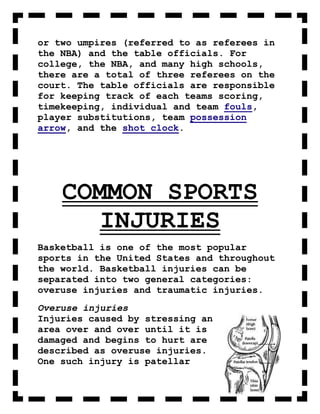
One such injury is patellar
tendinitis, or "jumper's knee," which is
characterized by pain in the tendon just
below the kneecap.
Achilles tendinitis is another common
overuse injury in basketball players. This
injury of the tendon connecting the muscles
in the back of the calf to the heel bone
causes pain in the back of the leg just
above the heel.
Traumatic injuries
Traumatic injuries are those caused by a
sudden forceful injury. Some of the more
common traumatic injuries in basketball are
jammed fingers. The severity of a jammed
finger can range from a minor injury of the
ligaments, which connect bones, to a broken
finger. Splinting may be needed to allow
the injured finger to heal.
Another type of traumatic injury is a
               muscle pull or tear. Ankle
               sprains
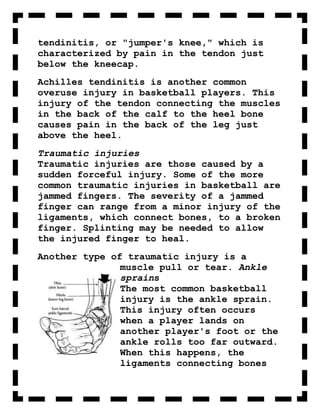
               The most common basketball
               injury is the ankle sprain.
               This injury often occurs
               when a player lands on
               another player's foot or the
               ankle rolls too far outward.
               When this happens, the
               ligaments connecting bones
and supporting the ankle are stretched and
tornKnee injuries
Knee injuries are some of the most serious
basketball injuries. One type of knee
injury is a sprain. A knee sprain is a
small tear in the ligaments or joint
capsule that is not severe enough to cause
your knee to give way.
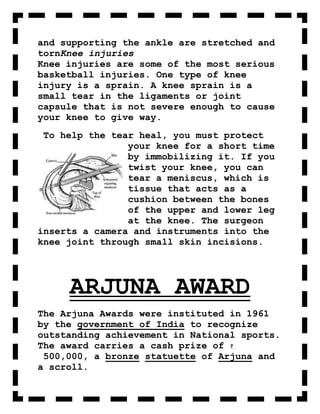
 To help the tear heal, you must protect
                your knee for a short time
                by immobilizing it. If you
                twist your knee, you can
                tear a meniscus, which is
                tissue that acts as a
                cushion between the bones
                of the upper and lower leg
                at the knee. The surgeon
inserts a camera and instruments into the
knee joint through small skin incisions.


     ARJUNA AWARD
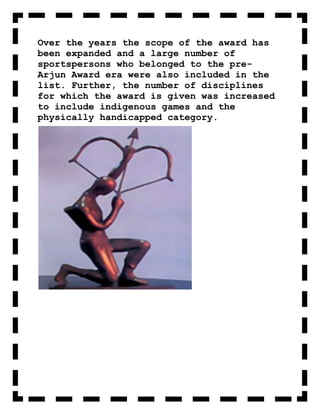
The Arjuna Awards were instituted in 1961
by the government of India to recognize
outstanding achievement in National sports.
The award carries a cash prize of
 500,000, a bronze statuette of Arjuna and
a scroll.
Over the years the scope of the award has
been expanded and a large number of
sportspersons who belonged to the pre-
Arjun Award era were also included in the
list. Further, the number of disciplines
for which the award is given was increased
to include indigenous games and the
physically handicapped category.
ARJUNA AWARD
      WINNERS FOR
       BASKETBALL
   Khushi ram
Khushi Ram is a former basketball player
from India who represented India at many
international competitions. He was
awarded Arjuna award in 1967. He was born
in Rajasthan state in 1936.Khushi ram has a
reputation of being amongst the best
players of Asia .He was the first captain
of Indian Basketball team. After retiring
in 1976, he took over as coach of shri ram
rayons team in Kota.

   Surendra Kumar Kataria
Surendra Kumar Kataria is a
former basketball player from India who
represented India at many international
competitions. He was awarded Arjuna
award in 1973. He was born
inRajasthan state and represented Indian
Railways in national tournaments. It should
also be mentioned here that he was a sharp-
shooter in the true sense of the word, and
Indian basketball has not seen such a
shooter in all its history.


   Hanuman Singh
Hanuman Singh is a noted former basketball
player from India. He played for India
in Asian Games, Commonwealth Games and
at 1980 Olympics.[1] He was awarded Arjuna
Award in 1975. Born in 1950 in Nagaur
district of Rajasthan state.He sudied
at Military School,Ajmer . He
represented Indian railways in national
tournaments .He is now employed with SAIL.


   Radhey Shyam Bijarnia
Radhey Shyam Bijarnia was
an Indian basketball player who
represented India at the 1980 Summer
Olympics and the 1982 Asian Games in Delhi.
He was a recipient of the Arjuna Award for
his achievements. He died in 2005 at the
age of 54 at his native village Sri
Madhopur in Rajasthan.
BASKETBALL!

BASKETBALL!

  • 1.
    Physical education project 2012- 2013 Delhipublic school, Navi Mumbai PROJECT COORDINATOR- MR. YASHWANT MOKASHI
  • 2.
    ACKNOWLEDGEMENT I would liketo express my special thanks of gratitude to my teacher yashwant sir as well as our principal who gave me the golden opportunity to do this wonderful project. Which also helped me in doing a lot of Research and I came to know about so many new things I am really thankful to them. Secondly I would also like to thank my parents and friends who helped me a lot in finishing this project within the limited time.
  • 3.
    HISTORY AND ORIGIN James Naismith was the Canadian physical education instructor who invented basketball in 1891. James Naismith was born in Almont, Ontario and educated at McGill University and Presbyterian College in Montreal. In contrast to other sports, basketball has a clear origin. It is not the evolution from an ancient game or another sport and the inventor is well known: Dr. James Naismith. In 1891, while working as a physical education teacher at the YMCA International Training School (today, Springfield College) in the United States, Naismith was faced with the problem of finding in 14 days an indoor game to provide "athletic distraction" for the students at the School for Christian Workers (Naismith was also a Presbyterian minister). After discarding the idea of adapting outdoor games like soccer and lacrosse,
  • 4.
    Naismith recalled theconcept of a game of his school days known as duck-on-a-rock that involved accuracy attempting to knock a "duck" off the top of a large rock by tossing another rock at it. Of course it was not exactly as we know it today. The first game was played with a soccer ball and two peach baskets nailed 10-feet high used as goals, on a court just half the size of a present-day court. The baskets retained their bottoms so balls scored into the basket had to be poked out with a long dowel each time and dribbling (bouncing of the ball up and down while moving) was not part of the original game. The sport was an instant success and thanks to the initial impulse received by the YMCA movement, basketball's popularity quickly grew nationwide and was introduced in many nations. He had the honor to witness basketball become an Olympic sport at the 1936 Games held in Berlin.
  • 5.
    The first basketball team. ORIGINAL 13 RULES OF BASKETBALL 1. The ball may be thrown in any direction with one or both hands. 2. The ball may be batted in any direction with one or both hands, but never with the fist. 3. A player cannot run with the ball. The player must throw it from the spot on which he catches it, allowance to be made for a man running at good speed.
  • 6.
    4. The ball must be held in or between the hands. The arms or body must not be used for holding it. 5. No shouldering, holding, pushing, striking or tripping in any way of an opponent. The first infringement of this rule by any person shall count as a foul; the second shall disqualify him until the next goal is made or, if there was evident intent to injure the person, for the whole of the game. No substitution shall be allowed. 6. A foul is striking at the ball with the fist, violations of Rules 3 and 4 and such as described in Rule 5. 7. If either side make three consecutive fouls it shall count as a goal for the opponents (consecutive means without the opponents in the meantime making a foul). 8. Goal shall be made when the ball is thrown or batted from the ground into the basket and stays there, providing those defending the goal do not touch or disturb the goal. If the ball rests on the edge and the opponents move the basket, it shall count as a goal. 9. When the ball goes out of bounds, it shall be thrown into the field and played by the first person touching it. In case of dispute the umpire shall
  • 7.
    throw it straightinto the field. The thrower-in is allowed five seconds. If he holds it longer, it shall go to the opponent. If any side persists in delaying the game, the umpire shall call a foul on them. 10. The umpire shall be judge of the men and shall note the fouls and notify the referee when three consecutive fouls have been made. He shall have the power to disqualify men according to Rule 5. 11. The referee shall be the judge of the ball and decide when it is in play in bounds, to which side it belongs, and shall keep the time. He shall decide when a goal has been made and keep account of the goals with any other duties that are usually performed by a referee. 12. The time shall be two 15-minute halves with five minutes' rest between. 13. The side making the most goals in that time shall be declared the winners. DIMENSIONS AND REQUIREMENTS
  • 8.
  • 9.
    Distance of the polefrom the court. Dimensions of the board
  • 10.
    FUNDAMENTAL SKILLS The sport of basketball requires five basic skills. While some players might be more experienced with some skills than others, it is best to have at least some ability in all five areas. Basketball is a fast-paced game that requires the knowledge and instinct to perform quickly and properly. Be sure to practice all five skills. Dribbling Dribbling is an important skill for all basketball players. This skill will allow you to move up and down the court, maneuver past defenders and execute plays. Proper dribbling requires ball-handling skills and knowledge of how to spread your fingers for ball control. Different types of dribbles are:- High Dribble Low Dribble Speed Dribble Change-Of-Pace Dribble Crossover 'Switch'.
  • 11.
    Shooting In order toscore points in basketball, you need to shoot the ball into the hoop. This requires the ability to properly hold and throw the ball into the air toward the basket while avoiding defenders. A proper shot requires precise aiming, arm extension and lift from the legs. Different types of shots are :- Jump Shot Layup Hook Shot Dunk Free Throw Running Running is a big part of basketball. In a full-court game, you will find yourself running back and forth as the game quickly transitions between offense and defense. When you have the ball, running will help you to avoid defenders and get to the basket quicker. On defense, you often will find yourself needing to run after the opponent, especially during fast breaks. Passing
  • 12.
    Passing is anotherskill that when mastered can help you become a complete basketball player. Basketball is a team sport that involves finding a teammate who is open for a shot. The ability to pass the ball to this player can make the difference between scoring and not scoring. Types of passes :- Chest passes 2. Bounce Pass 3. Overhead Pass 4. Outlet Pass 5. No-Look Pass 6. behind the Back Pass Jumping Jumping is another skill that can define how good a basketball player is. Jumping is involved in offense during the jump ball in the beginning, while taking shots and sometimes while trying to catch a pass. On defensive you will need the ability to jump when trying to block a shot or a pass. Being able to out jump your opponent for a rebound also is important.
  • 13.
    RULES AND REGULATIONS Measurements and time limits discussed in this section often vary among tournaments and organizations; international and NBA rules are used in this section. The object of the game is to outscore one's opponents by throwing the ball through the opponents' basket from above while preventing the opponents from doing so on their own. An attempt to score in this way is called a shot. A successful shot is worth two points, or three points if it is taken from beyond the three-point arc which is 6.25 meters (20 ft 6 in) from the basket in international games and 23 feet 9 inches (7.24 m) in NBA games Playing regulations Games are played in four quarters of 10 College games use two 20-minute halves, while United States high school varsity games use 8 minute quarters. 15 minutes are allowed for a half-time break under FIBA, NBA, and NCAA rulesand 10 minutes in United States high schools. Overtime periods are five minutes in
  • 14.
    length except forhigh school which is four minutes in length. Teams exchange baskets for the second half. The time allowed is actual playing time; the clock is stopped while the play is not active. Five players from each team may be on the court at one time. Substitutions are unlimited but can only be done when play is stopped. Teams also have a coach, who oversees the development and strategies of the team, and other team personnel such as assistant coaches, managers, statisticians, doctors and trainers. For both men's and women's teams, a standard uniform consists of a pair of shorts and a jersey with a clearly visible number, unique within the team, printed on both the front and back. Players wear high- top sneakers that provide extra ankle support. Typically, team names, players' names and, outside of North America, sponsors are printed on the uniforms. A limited number of time-outs, clock stoppages requested by a coach are allowed.They generally last no longer than one minute unless, for televised games, a commercial break is needed. The game is controlled by the officials consisting of the referee (referred to as crew chief in the NBA), one
  • 15.
    or two umpires(referred to as referees in the NBA) and the table officials. For college, the NBA, and many high schools, there are a total of three referees on the court. The table officials are responsible for keeping track of each teams scoring, timekeeping, individual and team fouls, player substitutions, team possession arrow, and the shot clock. COMMON SPORTS INJURIES Basketball is one of the most popular sports in the United States and throughout the world. Basketball injuries can be separated into two general categories: overuse injuries and traumatic injuries. Overuse injuries Injuries caused by stressing an area over and over until it is damaged and begins to hurt are described as overuse injuries. One such injury is patellar
  • 16.
    tendinitis, or "jumper'sknee," which is characterized by pain in the tendon just below the kneecap. Achilles tendinitis is another common overuse injury in basketball players. This injury of the tendon connecting the muscles in the back of the calf to the heel bone causes pain in the back of the leg just above the heel. Traumatic injuries Traumatic injuries are those caused by a sudden forceful injury. Some of the more common traumatic injuries in basketball are jammed fingers. The severity of a jammed finger can range from a minor injury of the ligaments, which connect bones, to a broken finger. Splinting may be needed to allow the injured finger to heal. Another type of traumatic injury is a muscle pull or tear. Ankle sprains The most common basketball injury is the ankle sprain. This injury often occurs when a player lands on another player's foot or the ankle rolls too far outward. When this happens, the ligaments connecting bones
  • 17.
    and supporting theankle are stretched and tornKnee injuries Knee injuries are some of the most serious basketball injuries. One type of knee injury is a sprain. A knee sprain is a small tear in the ligaments or joint capsule that is not severe enough to cause your knee to give way. To help the tear heal, you must protect your knee for a short time by immobilizing it. If you twist your knee, you can tear a meniscus, which is tissue that acts as a cushion between the bones of the upper and lower leg at the knee. The surgeon inserts a camera and instruments into the knee joint through small skin incisions. ARJUNA AWARD The Arjuna Awards were instituted in 1961 by the government of India to recognize outstanding achievement in National sports. The award carries a cash prize of 500,000, a bronze statuette of Arjuna and a scroll.
  • 18.
    Over the yearsthe scope of the award has been expanded and a large number of sportspersons who belonged to the pre- Arjun Award era were also included in the list. Further, the number of disciplines for which the award is given was increased to include indigenous games and the physically handicapped category.
  • 19.
    ARJUNA AWARD WINNERS FOR BASKETBALL Khushi ram Khushi Ram is a former basketball player from India who represented India at many international competitions. He was awarded Arjuna award in 1967. He was born in Rajasthan state in 1936.Khushi ram has a reputation of being amongst the best players of Asia .He was the first captain of Indian Basketball team. After retiring in 1976, he took over as coach of shri ram rayons team in Kota. Surendra Kumar Kataria Surendra Kumar Kataria is a former basketball player from India who represented India at many international competitions. He was awarded Arjuna award in 1973. He was born inRajasthan state and represented Indian Railways in national tournaments. It should also be mentioned here that he was a sharp- shooter in the true sense of the word, and
  • 20.
    Indian basketball hasnot seen such a shooter in all its history. Hanuman Singh Hanuman Singh is a noted former basketball player from India. He played for India in Asian Games, Commonwealth Games and at 1980 Olympics.[1] He was awarded Arjuna Award in 1975. Born in 1950 in Nagaur district of Rajasthan state.He sudied at Military School,Ajmer . He represented Indian railways in national tournaments .He is now employed with SAIL. Radhey Shyam Bijarnia Radhey Shyam Bijarnia was an Indian basketball player who represented India at the 1980 Summer Olympics and the 1982 Asian Games in Delhi. He was a recipient of the Arjuna Award for his achievements. He died in 2005 at the age of 54 at his native village Sri Madhopur in Rajasthan.