© 2006 The McGraw-Hill Companies, Inc. All rights reserved.McGraw-Hill
Part V
The Romantic
Period
(1820-1900)
Edited by:
Al-lyn Vocal
La Salle University
Presentation developed by:
Robert Elliott
Tennessee State University
An Appreciation
© 2006 The McGraw-Hill Companies, Inc. All rights reserved.McGraw-Hill
Time-Line
Monroe Doctrine—1823
Hugo: Hunchback of Notre Dame—1831
Dickens: Oliver Twist—1837
Dumas: The Three Musketeers—1844
Poe: The Raven—1845
Darwin: Origin of Species—1859
American Civil War—1861-1865
Twain: Huckleberry Finn—1884
Bell invents telephone—1876
An Appreciation
© 2006 The McGraw-Hill Companies, Inc. All rights reserved.McGraw-Hill
Romanticism (1820-1900)
Stressed emotion, imagination, and individualism
Emotional subjectivity basis of arts
Favorite artistic topics:
– Fantasy and the supernatural
Period of the Industrial Revolution
– Resulted in social and economic changes
– Middle Ages/concept of chivalry & romance
– Nature: as mirror of the human heart
- Architecture revived Gothic elements
An Appreciation
© 2006 The McGraw-Hill Companies, Inc. All rights reserved.McGraw-Hill
Chapter 1: Romanticism in Music
Many important Romantic composers
– Franz Schubert
– Robert Schumann
– Frederic Chopin
– Franz Liszt
An Appreciation
© 2006 The McGraw-Hill Companies, Inc. All rights reserved.McGraw-Hill
– Much individual alteration and adjustment
Continued use of Classical period forms
Greater range of tone color, dynamics, and pitch than in
Classical period
Expanded harmony—complex chords
An Appreciation
© 2006 The McGraw-Hill Companies, Inc. All rights reserved.McGraw-Hill
Characteristics of Romantic Music
Individuality of Style
Composers wanted uniquely identifiable music
– Worked to find their own voice
In Romantic music, it is far easier to identify
individual composers through listening
An Appreciation
© 2006 The McGraw-Hill Companies, Inc. All rights reserved.McGraw-Hill
Expressive Aims and Subjects
Dark topics draw composers
All approaches were explored:
– Flamboyance, intimacy, unpredictability, melancholy, rapture,
longing, …
Romantic love still the focus of songs and operas
– Lovers frequently depicted as unhappy and facing overwhelming obstacles
An Appreciation
© 2006 The McGraw-Hill Companies, Inc. All rights reserved.McGraw-Hill
Nationalism and Exoticism
Nationalism: music with a national identity
Exoticism: intentionally implies a foreign culture
– Makes use of melodies, rhythms, and instruments
associated with distant lands
– Uses folk songs, dances, legends, and history of a land
– Frequently employed in operas with foreign settings
An Appreciation
© 2006 The McGraw-Hill Companies, Inc. All rights reserved.McGraw-Hill
Program Music
Association with a story, poem, idea, or scene
– Understanding the music is enhanced through reading
the program or viewing the associated work
– Though common in the Romantic, concept had been employed for centuries previously
- E.g., La Primavera (from the Four Seasons) by Vivaldi
– Many Romantic composers were also authors
– Made possible a “union of the arts”
- Poets wanted their poetry to be musical
- Musicians wanted their music to be poetic
An Appreciation
© 2006 The McGraw-Hill Companies, Inc. All rights reserved.McGraw-Hill
Expressive Tone Color
Composers tried to create unique sounds
– Blending of existing instruments
– Addition of new instruments
– Never before had timbre been so important
Enlarged orchestra allowed more instrument colors
– Classical 20-60 members vs. Romantic ~100
Advances in instrument design allowed more color
- Berlioz: Treatise on Modern Instrumentation and Orchestration (1844)
– Valved brass instruments could now play melodies
– Piano design improved and range was extended
– Orchestration came to be regarded as an art form
An Appreciation
© 2006 The McGraw-Hill Companies, Inc. All rights reserved.McGraw-Hill
Colorful Harmony
Chords built with notes not in traditional keys
– Chromatic harmony
Harmonic instability a consciously used device
– Wide use of keys
– Frequent and rapid modulation
An Appreciation
© 2006 The McGraw-Hill Companies, Inc. All rights reserved.McGraw-Hill
Expanded Range of Dynamics,
Pitch & Tempo
Dynamics ff, pp expanded to ffff and pppp
Extremely high and low pitches were added
Changes in mood frequently underlined by (sometimes
subtle) shifts in tempo
– Rubato: slight holding back or pressing forward of tempo
An Appreciation
© 2006 The McGraw-Hill Companies, Inc. All rights reserved.McGraw-Hill
Forms: Miniature and Monumental
Some composers went on for hours
Others music lasted only a few minutes
– Written for a single instrument
– Required hundreds of performers
Composers wrote symphonies, sonatas, string quartets,
concertos, operas, and many other Classically traditional
works
An Appreciation
© 2006 The McGraw-Hill Companies, Inc. All rights reserved.McGraw-Hill
Romantic Composers and
Their Public
Demise of the patronage system
– Composers regarded themselves as “free spirits”
– Decline in aristocratic fortune—Napoleonic wars
New urban classes/new musical topics
Public was entranced by virtuosity
Music conservatories founded in Europe and U.S.
An Appreciation
© 2006 The McGraw-Hill Companies, Inc. All rights reserved.McGraw-Hill
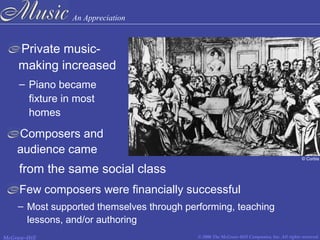
Private music-
making increased
Composers and
audience came
Few composers were financially successful
– Piano became
fixture in most
homes
from the same social class
– Most supported themselves through performing, teaching
lessons, and/or authoring
© Corbis
An Appreciation
© 2006 The McGraw-Hill Companies, Inc. All rights reserved.McGraw-Hill
The Art Song
Composition for solo voice and piano
– Accompaniment integral part of the song
– Composers interpret poem’s, mood, atmosphere and imagery into music
- Mood often set at beginning with piano introduction and summed
up at end with piano postlude
Linked to vast amount of poetry in this period
An Appreciation
© 2006 The McGraw-Hill Companies, Inc. All rights reserved.McGraw-Hill
Strophic and Through-Composed Form
Strophic form repeats music for each verse
Through-composed—new music for each verse
Sometimes modified strophic form used
The Song Cycle
Group of songs unified in some manner
– Storyline or musical idea may link the songs
An Appreciation
© 2006 The McGraw-Hill Companies, Inc. All rights reserved.McGraw-Hill
Franz Schubert
Born in Vienna (1797-1828)
Early Romantic composer
Prodigious output
– When 18 years old wrote 143 songs
- Included 2 symphonies, an opera, and a mass
Not financially successful
– His symphonies were not performed until after his death
– At 19 years of age, wrote 179 works
An Appreciation
© 2006 The McGraw-Hill Companies, Inc. All rights reserved.McGraw-Hill
Schubert’s Music
Wrote over 600 songs
– Also symphonies, string quartets, other chamber music, sonatas, masses, operas,
& piano works
- The Unfinished Symphony: only 2 movements, not 4
An Appreciation
© 2006 The McGraw-Hill Companies, Inc. All rights reserved.McGraw-Hill
Listening
Erlkonig (The Erlking; 1815)
Franz Schubert
Vocal Music Guide: p. 224
Brief Set, CD 3:12
Based upon narrative ballad with supernatural topic by Goethe
Listen for: Through-composed form
Piano portrays galloping horse
Different characters have their notes pitched at
different levels to emphasize dialog
Dramatic ending
An Appreciation
© 2006 The McGraw-Hill Companies, Inc. All rights reserved.McGraw-Hill
Robert Schumann
German, early to mid-Romantic (1810-1856)
– Problem with hand ended his ambition
Wanted to be piano virtuoso
Temperamentally unsuited for some of the musical
positions he attempted
Married his piano teacher’s daughter
Committed to asylum where he died
- Treatments and gadget made problem worse
An Appreciation
© 2006 The McGraw-Hill Companies, Inc. All rights reserved.McGraw-Hill
Robert Schumann’s Music
Wrote piano pieces, art songs, and later symphonies
– Piano pieces and art songs frequently in cycles
Known for his gift for melody
An Appreciation
© 2006 The McGraw-Hill Companies, Inc. All rights reserved.McGraw-Hill
Listening
From Carnaval (1834), a cycle of program
music by Robert Schumann
Estrella, for his first fiancée
Ternary form, note syncopation in B section
Listening Guide p. 229 Brief Set, CD 3:18
Reconnaissance (Reunion)
Ternary form, note B section shift from homophonic
to polyphonic texture
Listening Guide p. 229 Brief Set, CD 3:20
An Appreciation
© 2006 The McGraw-Hill Companies, Inc. All rights reserved.McGraw-Hill
Frederic Chopin
Polish born musician (1810-1849)
Early to mid-Romantic composer
Wrote almost exclusively for piano
Came to Paris at age 21
– Europe’s Romantic Period artistic capital
– Made extensive use of piano pedals
Composed mostly for chamber concert
– Avoided concert halls
Affair with Aurore Dudevant (a.k.a. George Sand)
An Appreciation
© 2006 The McGraw-Hill Companies, Inc. All rights reserved.McGraw-Hill
Chopin’s Music
Developed personal style at early age
– Not program music, but evokes an image
– Unique harmonic style influenced others
Most of his pieces are elegant miniatures
An Appreciation
© 2006 The McGraw-Hill Companies, Inc. All rights reserved.McGraw-Hill
Listening
Nocturne in E Flat Major, op. 9, no. 2
Frederic Chopin (1830-31)
Listening Outline: p. 234
Brief Set, CD 3:26
Nocturne (night piece)—slow, lyrical, intimate piece for piano
Listen for: Expressive, emotional presentation with
subtle shifts in tempo and dynamics
Note pedal notation on printed music (p. 235)
An Appreciation
© 2006 The McGraw-Hill Companies, Inc. All rights reserved.McGraw-Hill
Listening
Etude in C Minor, Op. 10, no. 12
(Revolutionary; 1831?)
Frederic Chopin
Listening Outline: p. 236
Brief Set, CD 3:29
Etude—study piece focusing upon a specific performance
technique
Listen for: Speed & endurance required of left hand
Not just a study, but interesting music
An Appreciation
© 2006 The McGraw-Hill Companies, Inc. All rights reserved.McGraw-Hill
Listening
Polonaise in A Flat Major, Op. 10, no. 12 (1842)
Frederic Chopin
Listening Guide: p. 237
Basic Set, CD 5:13
Polonaise—originated as stately processional dance for Polish
nobility
Listen for: Triple meter
Ternary—A B A’ with coda
An Appreciation
© 2006 The McGraw-Hill Companies, Inc. All rights reserved.McGraw-Hill
Franz Liszt
Hungarian born composer (1811-1886)
Touring concert pianist until age 36
– Virtuoso pianist
– Incredible performer and showman—”pop star”
– Retired from touring & took court position
- More time to compose
– Later wrote music foreshadowing 20th Century
An Appreciation
© 2006 The McGraw-Hill Companies, Inc. All rights reserved.McGraw-Hill
Liszt’s Music
Extremely controversial
Created symphonic poem (tone poem)
Broke away from strict Classical forms
– Some call it “Bombastic” and “vulgar”
– Others say that it is the ideal music
An Appreciation
© 2006 The McGraw-Hill Companies, Inc. All rights reserved.McGraw-Hill
Listening
Transcendental etude no. 10 in F Minor (1851)
Franz Liszt
Listening Guide: p. 240
Basic set, CD 5:18
Listen for: Shifting tempo
Extreme emotionalism
High degree of difficulty for performer
(virtuoso piece)
Ternary form with a coda
An Appreciation
© 2006 The McGraw-Hill Companies, Inc. All rights reserved.McGraw-Hill
Program Music
Instrumental music associated with a story,
poem, idea, or scene
– Non-program music is called absolute music
Usually performed with written explanation of
the piece—a program
An Appreciation
© 2006 The McGraw-Hill Companies, Inc. All rights reserved.McGraw-Hill
In Romantic Period, program music usually for piano
or orchestra
– Program symphony—multi-movement/orchestral
Common types:
– Concert overture—modeled on opera overture
– Symphonic poem (or tone poem)—1 movement, orchestral, flexible form
– Incidental music—for use before or during a play
An Appreciation
© 2006 The McGraw-Hill Companies, Inc. All rights reserved.McGraw-Hill
Nationalism in 19th Century Music
National identity grew during the Romantic
– Citizens, not mercenaries now fought wars
– Bonds of language, history, and culture formed
- Led to unifications creating Germany and Italy
An Appreciation
© 2006 The McGraw-Hill Companies, Inc. All rights reserved.McGraw-Hill
Composers deliberately gave their works distinctive
national identity
– Use of folksongs and folkdances
– Created original melodies with folk flavor
– Wrote operas and program music inspired by native history,
legends, and landscapes
Strongest impact in countries dominated by music of
Germany, Austria, Italy and France
An Appreciation
© 2006 The McGraw-Hill Companies, Inc. All rights reserved.McGraw-Hill
Listening
The Moldau (1874)
Part of the cycle Ma Vlast (My Country)
Bedrich Smetana
Symphonic poem depicting the main river that flows thorough
the Bohemian (Czech) countryside
Program notes: p. 253
Listening Outline: p. 254
Brief Set, CD 3:34
Listen for: Program material and how composer
related it to the music

5. romantic period

  • 1.
    © 2006 TheMcGraw-Hill Companies, Inc. All rights reserved.McGraw-Hill Part V The Romantic Period (1820-1900) Edited by: Al-lyn Vocal La Salle University Presentation developed by: Robert Elliott Tennessee State University
  • 2.
    An Appreciation © 2006The McGraw-Hill Companies, Inc. All rights reserved.McGraw-Hill Time-Line Monroe Doctrine—1823 Hugo: Hunchback of Notre Dame—1831 Dickens: Oliver Twist—1837 Dumas: The Three Musketeers—1844 Poe: The Raven—1845 Darwin: Origin of Species—1859 American Civil War—1861-1865 Twain: Huckleberry Finn—1884 Bell invents telephone—1876
  • 3.
    An Appreciation © 2006The McGraw-Hill Companies, Inc. All rights reserved.McGraw-Hill Romanticism (1820-1900) Stressed emotion, imagination, and individualism Emotional subjectivity basis of arts Favorite artistic topics: – Fantasy and the supernatural Period of the Industrial Revolution – Resulted in social and economic changes – Middle Ages/concept of chivalry & romance – Nature: as mirror of the human heart - Architecture revived Gothic elements
  • 4.
    An Appreciation © 2006The McGraw-Hill Companies, Inc. All rights reserved.McGraw-Hill Chapter 1: Romanticism in Music Many important Romantic composers – Franz Schubert – Robert Schumann – Frederic Chopin – Franz Liszt
  • 5.
    An Appreciation © 2006The McGraw-Hill Companies, Inc. All rights reserved.McGraw-Hill – Much individual alteration and adjustment Continued use of Classical period forms Greater range of tone color, dynamics, and pitch than in Classical period Expanded harmony—complex chords
  • 6.
    An Appreciation © 2006The McGraw-Hill Companies, Inc. All rights reserved.McGraw-Hill Characteristics of Romantic Music Individuality of Style Composers wanted uniquely identifiable music – Worked to find their own voice In Romantic music, it is far easier to identify individual composers through listening
  • 7.
    An Appreciation © 2006The McGraw-Hill Companies, Inc. All rights reserved.McGraw-Hill Expressive Aims and Subjects Dark topics draw composers All approaches were explored: – Flamboyance, intimacy, unpredictability, melancholy, rapture, longing, … Romantic love still the focus of songs and operas – Lovers frequently depicted as unhappy and facing overwhelming obstacles
  • 8.
    An Appreciation © 2006The McGraw-Hill Companies, Inc. All rights reserved.McGraw-Hill Nationalism and Exoticism Nationalism: music with a national identity Exoticism: intentionally implies a foreign culture – Makes use of melodies, rhythms, and instruments associated with distant lands – Uses folk songs, dances, legends, and history of a land – Frequently employed in operas with foreign settings
  • 9.
    An Appreciation © 2006The McGraw-Hill Companies, Inc. All rights reserved.McGraw-Hill Program Music Association with a story, poem, idea, or scene – Understanding the music is enhanced through reading the program or viewing the associated work – Though common in the Romantic, concept had been employed for centuries previously - E.g., La Primavera (from the Four Seasons) by Vivaldi – Many Romantic composers were also authors – Made possible a “union of the arts” - Poets wanted their poetry to be musical - Musicians wanted their music to be poetic
  • 10.
    An Appreciation © 2006The McGraw-Hill Companies, Inc. All rights reserved.McGraw-Hill Expressive Tone Color Composers tried to create unique sounds – Blending of existing instruments – Addition of new instruments – Never before had timbre been so important Enlarged orchestra allowed more instrument colors – Classical 20-60 members vs. Romantic ~100 Advances in instrument design allowed more color - Berlioz: Treatise on Modern Instrumentation and Orchestration (1844) – Valved brass instruments could now play melodies – Piano design improved and range was extended – Orchestration came to be regarded as an art form
  • 11.
    An Appreciation © 2006The McGraw-Hill Companies, Inc. All rights reserved.McGraw-Hill Colorful Harmony Chords built with notes not in traditional keys – Chromatic harmony Harmonic instability a consciously used device – Wide use of keys – Frequent and rapid modulation
  • 12.
    An Appreciation © 2006The McGraw-Hill Companies, Inc. All rights reserved.McGraw-Hill Expanded Range of Dynamics, Pitch & Tempo Dynamics ff, pp expanded to ffff and pppp Extremely high and low pitches were added Changes in mood frequently underlined by (sometimes subtle) shifts in tempo – Rubato: slight holding back or pressing forward of tempo
  • 13.
    An Appreciation © 2006The McGraw-Hill Companies, Inc. All rights reserved.McGraw-Hill Forms: Miniature and Monumental Some composers went on for hours Others music lasted only a few minutes – Written for a single instrument – Required hundreds of performers Composers wrote symphonies, sonatas, string quartets, concertos, operas, and many other Classically traditional works
  • 14.
    An Appreciation © 2006The McGraw-Hill Companies, Inc. All rights reserved.McGraw-Hill Romantic Composers and Their Public Demise of the patronage system – Composers regarded themselves as “free spirits” – Decline in aristocratic fortune—Napoleonic wars New urban classes/new musical topics Public was entranced by virtuosity Music conservatories founded in Europe and U.S.
  • 15.
    An Appreciation © 2006The McGraw-Hill Companies, Inc. All rights reserved.McGraw-Hill Private music- making increased Composers and audience came Few composers were financially successful – Piano became fixture in most homes from the same social class – Most supported themselves through performing, teaching lessons, and/or authoring © Corbis
  • 16.
    An Appreciation © 2006The McGraw-Hill Companies, Inc. All rights reserved.McGraw-Hill The Art Song Composition for solo voice and piano – Accompaniment integral part of the song – Composers interpret poem’s, mood, atmosphere and imagery into music - Mood often set at beginning with piano introduction and summed up at end with piano postlude Linked to vast amount of poetry in this period
  • 17.
    An Appreciation © 2006The McGraw-Hill Companies, Inc. All rights reserved.McGraw-Hill Strophic and Through-Composed Form Strophic form repeats music for each verse Through-composed—new music for each verse Sometimes modified strophic form used The Song Cycle Group of songs unified in some manner – Storyline or musical idea may link the songs
  • 18.
    An Appreciation © 2006The McGraw-Hill Companies, Inc. All rights reserved.McGraw-Hill Franz Schubert Born in Vienna (1797-1828) Early Romantic composer Prodigious output – When 18 years old wrote 143 songs - Included 2 symphonies, an opera, and a mass Not financially successful – His symphonies were not performed until after his death – At 19 years of age, wrote 179 works
  • 19.
    An Appreciation © 2006The McGraw-Hill Companies, Inc. All rights reserved.McGraw-Hill Schubert’s Music Wrote over 600 songs – Also symphonies, string quartets, other chamber music, sonatas, masses, operas, & piano works - The Unfinished Symphony: only 2 movements, not 4
  • 20.
    An Appreciation © 2006The McGraw-Hill Companies, Inc. All rights reserved.McGraw-Hill Listening Erlkonig (The Erlking; 1815) Franz Schubert Vocal Music Guide: p. 224 Brief Set, CD 3:12 Based upon narrative ballad with supernatural topic by Goethe Listen for: Through-composed form Piano portrays galloping horse Different characters have their notes pitched at different levels to emphasize dialog Dramatic ending
  • 21.
    An Appreciation © 2006The McGraw-Hill Companies, Inc. All rights reserved.McGraw-Hill Robert Schumann German, early to mid-Romantic (1810-1856) – Problem with hand ended his ambition Wanted to be piano virtuoso Temperamentally unsuited for some of the musical positions he attempted Married his piano teacher’s daughter Committed to asylum where he died - Treatments and gadget made problem worse
  • 22.
    An Appreciation © 2006The McGraw-Hill Companies, Inc. All rights reserved.McGraw-Hill Robert Schumann’s Music Wrote piano pieces, art songs, and later symphonies – Piano pieces and art songs frequently in cycles Known for his gift for melody
  • 23.
    An Appreciation © 2006The McGraw-Hill Companies, Inc. All rights reserved.McGraw-Hill Listening From Carnaval (1834), a cycle of program music by Robert Schumann Estrella, for his first fiancée Ternary form, note syncopation in B section Listening Guide p. 229 Brief Set, CD 3:18 Reconnaissance (Reunion) Ternary form, note B section shift from homophonic to polyphonic texture Listening Guide p. 229 Brief Set, CD 3:20
  • 24.
    An Appreciation © 2006The McGraw-Hill Companies, Inc. All rights reserved.McGraw-Hill Frederic Chopin Polish born musician (1810-1849) Early to mid-Romantic composer Wrote almost exclusively for piano Came to Paris at age 21 – Europe’s Romantic Period artistic capital – Made extensive use of piano pedals Composed mostly for chamber concert – Avoided concert halls Affair with Aurore Dudevant (a.k.a. George Sand)
  • 25.
    An Appreciation © 2006The McGraw-Hill Companies, Inc. All rights reserved.McGraw-Hill Chopin’s Music Developed personal style at early age – Not program music, but evokes an image – Unique harmonic style influenced others Most of his pieces are elegant miniatures
  • 26.
    An Appreciation © 2006The McGraw-Hill Companies, Inc. All rights reserved.McGraw-Hill Listening Nocturne in E Flat Major, op. 9, no. 2 Frederic Chopin (1830-31) Listening Outline: p. 234 Brief Set, CD 3:26 Nocturne (night piece)—slow, lyrical, intimate piece for piano Listen for: Expressive, emotional presentation with subtle shifts in tempo and dynamics Note pedal notation on printed music (p. 235)
  • 27.
    An Appreciation © 2006The McGraw-Hill Companies, Inc. All rights reserved.McGraw-Hill Listening Etude in C Minor, Op. 10, no. 12 (Revolutionary; 1831?) Frederic Chopin Listening Outline: p. 236 Brief Set, CD 3:29 Etude—study piece focusing upon a specific performance technique Listen for: Speed & endurance required of left hand Not just a study, but interesting music
  • 28.
    An Appreciation © 2006The McGraw-Hill Companies, Inc. All rights reserved.McGraw-Hill Listening Polonaise in A Flat Major, Op. 10, no. 12 (1842) Frederic Chopin Listening Guide: p. 237 Basic Set, CD 5:13 Polonaise—originated as stately processional dance for Polish nobility Listen for: Triple meter Ternary—A B A’ with coda
  • 29.
    An Appreciation © 2006The McGraw-Hill Companies, Inc. All rights reserved.McGraw-Hill Franz Liszt Hungarian born composer (1811-1886) Touring concert pianist until age 36 – Virtuoso pianist – Incredible performer and showman—”pop star” – Retired from touring & took court position - More time to compose – Later wrote music foreshadowing 20th Century
  • 30.
    An Appreciation © 2006The McGraw-Hill Companies, Inc. All rights reserved.McGraw-Hill Liszt’s Music Extremely controversial Created symphonic poem (tone poem) Broke away from strict Classical forms – Some call it “Bombastic” and “vulgar” – Others say that it is the ideal music
  • 31.
    An Appreciation © 2006The McGraw-Hill Companies, Inc. All rights reserved.McGraw-Hill Listening Transcendental etude no. 10 in F Minor (1851) Franz Liszt Listening Guide: p. 240 Basic set, CD 5:18 Listen for: Shifting tempo Extreme emotionalism High degree of difficulty for performer (virtuoso piece) Ternary form with a coda
  • 32.
    An Appreciation © 2006The McGraw-Hill Companies, Inc. All rights reserved.McGraw-Hill Program Music Instrumental music associated with a story, poem, idea, or scene – Non-program music is called absolute music Usually performed with written explanation of the piece—a program
  • 33.
    An Appreciation © 2006The McGraw-Hill Companies, Inc. All rights reserved.McGraw-Hill In Romantic Period, program music usually for piano or orchestra – Program symphony—multi-movement/orchestral Common types: – Concert overture—modeled on opera overture – Symphonic poem (or tone poem)—1 movement, orchestral, flexible form – Incidental music—for use before or during a play
  • 34.
    An Appreciation © 2006The McGraw-Hill Companies, Inc. All rights reserved.McGraw-Hill Nationalism in 19th Century Music National identity grew during the Romantic – Citizens, not mercenaries now fought wars – Bonds of language, history, and culture formed - Led to unifications creating Germany and Italy
  • 35.
    An Appreciation © 2006The McGraw-Hill Companies, Inc. All rights reserved.McGraw-Hill Composers deliberately gave their works distinctive national identity – Use of folksongs and folkdances – Created original melodies with folk flavor – Wrote operas and program music inspired by native history, legends, and landscapes Strongest impact in countries dominated by music of Germany, Austria, Italy and France
  • 36.
    An Appreciation © 2006The McGraw-Hill Companies, Inc. All rights reserved.McGraw-Hill Listening The Moldau (1874) Part of the cycle Ma Vlast (My Country) Bedrich Smetana Symphonic poem depicting the main river that flows thorough the Bohemian (Czech) countryside Program notes: p. 253 Listening Outline: p. 254 Brief Set, CD 3:34 Listen for: Program material and how composer related it to the music