DYNAMIC AND STATIC RETINOSCOPY
PRESENTER –SOURAV THAKUR
MODERATOR –PRIYANKA MAM
Contents-
• DYNAMIC RETINOSCOPY
• USE OF DYNAMIC RETINOSCOPY
• TYPES OF DYNAMIC RETINOSCOPY
• STATIC RETINOSCOPY
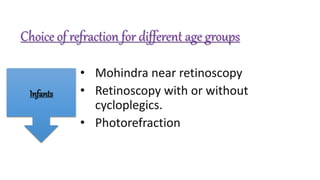
Choice of refraction for different age groups
• Mohindra near retinoscopy
• Retinoscopy with or without
cycloplegics.
• Photorefraction
Infants
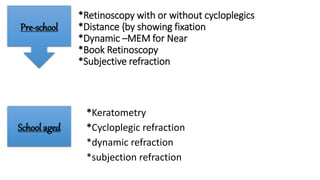
*Retinoscopy with or without cycloplegics
*Distance {by showing fixation
*Dynamic –MEM for Near
*Book Retinoscopy
*Subjective refraction
*Keratometry
*Cycloplegic refraction
*dynamic refraction
*subjection refraction
Pre-school
School aged
Dynamic retinoscopy
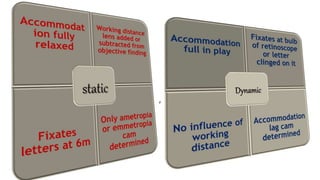
refractive state is determined while subject fixates an object at some
closer distance ,usually at or near the plane of retinoscope itself .
..History of dynamic retinoscopy-
.when patient asked to fixate near object .
.A .J. CROSS is credited with introducing the basic theory and
method of dynamic retinoscopy .
NOTT,SHEARD ,SKEFFINGTON-elaborated on the theory and
procedure .
.
Use of dynamic retinoscopy -
1 it is primarily use to confirmed suspected causes of vergence or
accommodative disfunction also used to determine a patient is over or
under corrected .
2 to check for accommodative disorders
3 to help decide amblyopic therapy.
4. It revels the stability or degree of fluctuation of accommodative system
.
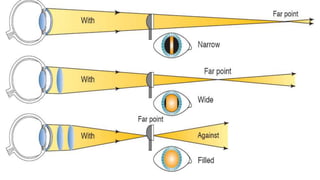
WITH MOVEMENT –eye conjugate to a point either behind the eye or behind the
retinoscope .
AGAINST MOVEMENT – eye conjugate to a point between the eye {patient }and
retinoscope .
NEUTRALITY –eye conjugate with retinoscope .
Accommodative response =stimuli
in front of target {lead of accommodative }
behind the target { lag of accommodation }
Lag of accommodation at near refer to an accommodative
response less than accommodative demand .
Lead of accommodation refer to accommodative response that
exceeds the accommodative demand .
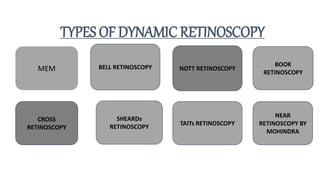
TYPES OF DYNAMIC RETINOSCOPY
MEM BELL RETINOSCOPY NOTT RETINOSCOPY
CROSS
RETINOSCOPY
SHEARDs
RETINOSCOPY
TAITs RETINOSCOPY
BOOK
RETINOSCOPY
NEAR
RETINOSCOPY BY
MOHINDRA
‘
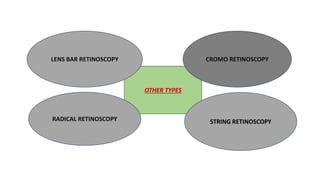
OTHER TYPES
CROMO RETINOSCOPY
STRING RETINOSCOPY
LENS BAR RETINOSCOPY
RADICAL RETINOSCOPY
MEM –{ Monocular Estimate Method
}
Founder dr .harold Haynes
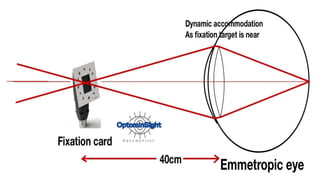
clinician neutralize the reflex of eye while patient accommodate
to fixate a target at near usually 40cm .
Procedure -
1..MEM should attached to retinoscope with beam of retinoscope
passing through hole in center of it .
2..Test performed normal room illumination {40cm }
3..The patient should wear habitual glasses
4..Performed under binocular correction .
5..Keep desired testing distance consistent
6..Remain as close to patient line of sight as possible when neutralizing
7..Observe the reflex
8..Estimate the dioptric value required to neutralize the observed
motion .
Interpretation –
WITH MOVEMENT :LAG OF ACC. ………ADD PLUS
AGAINST MOTION :LEAD OF ACC ……….ADD MINUS
Lag of acc. Is amount of plus lens that neutralized the reflex .
No working distance compensation is done .
No power added or subtracted to neutralized power.
.
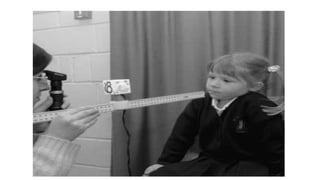
Nott retinoscopy –
developed by{ I.S Nott on 1920 }
Main purpose identical to MEM method
Distance 40cm
Procedure =
1.Wear his compensating distance lenses .
2.Distance to read the letters .
3.Perform retinoscopy by moving farther from plane of regard until
motion is neutralized .
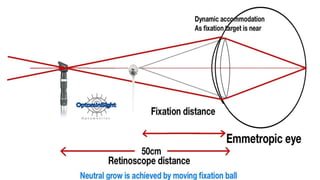
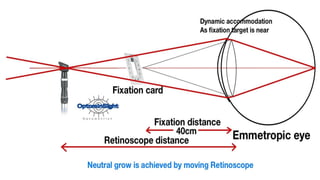
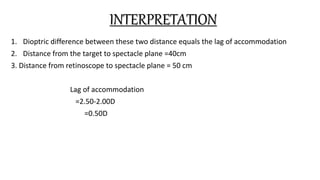
1. Dioptric difference between these two distance equals the lag of accommodation
2. Distance from the target to spectacle plane =40cm
3. Distance from retinoscope to spectacle plane = 50 cm
Lag of accommodation
=2.50-2.00D
=0.50D
INTERPRETATION
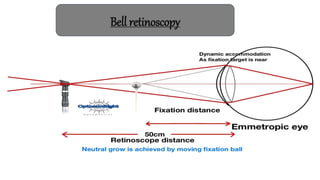
Bell retinoscopy
Sheard method
Charles sheard {1920}
• Introduced the concept of “lag of
accommodation “.
• Add plus lens power until neutrality occurred .
Tait method
{1953}
• Working distance 33cm .
• Fogging with considerable amount of plus lens power
and then approaches neutral by reducing the plus lens
power .
• Found average approx. +1.50D more than sheard system
, thus total lag of accommodation +2.25D.
• Close to +2.50D i.e. negative relative accommodation. .
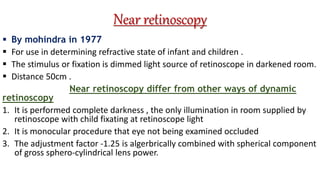
Near retinoscopy
 By mohindra in 1977
 For use in determining refractive state of infant and children .
 The stimulus or fixation is dimmed light source of retinoscope in darkened room.
 Distance 50cm .
Near retinoscopy differ from other ways of dynamic
retinoscopy
1. It is performed complete darkness , the only illumination in room supplied by
retinoscope with child fixating at retinoscope light
2. It is monocular procedure that eye not being examined occluded
3. The adjustment factor -1.25 is algerbrically combined with spherical component
of gross sphero-cylindrical lens power.
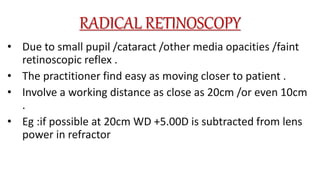
RADICAL RETINOSCOPY
• Due to small pupil /cataract /other media opacities /faint
retinoscopic reflex .
• The practitioner find easy as moving closer to patient .
• Involve a working distance as close as 20cm /or even 10cm
.
• Eg :if possible at 20cm WD +5.00D is subtracted from lens
power in refractor
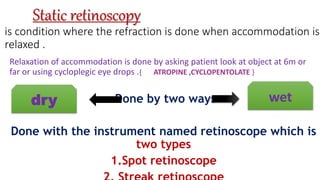
Static retinoscopy
is condition where the refraction is done when accommodation is
relaxed .
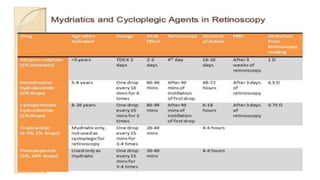
Relaxation of accommodation is done by asking patient look at object at 6m or
far or using cycloplegic eye drops .{ ATROPINE ,CYCLOPENTOLATE }
Done by two ways
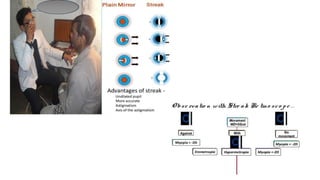
Done with the instrument named retinoscope which is
two types
1.Spot retinoscope
dry wet
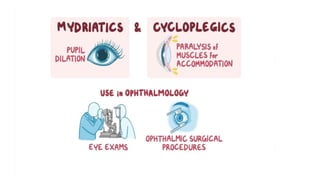
CYCLOPLEGIA-
1.It is the paralysis of ciliary muscle of the eye ,resulting is
the loss of visual accommodation .
2.Accommodation is the ability of lens to change its
refraction power to view the near object clearly .
3.It is brought about by the contraction of ciliary muscle .
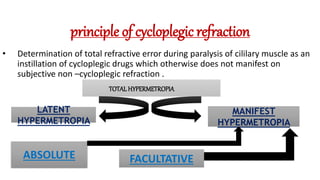
principle of cycloplegic refraction
• Determination of total refractive error during paralysis of cililary muscle as an
instillation of cycloplegic drugs which otherwise does not manifest on
subjective non –cycloplegic refraction .
TOTAL HYPERMETROPIA
LATENT
HYPERMETROPIA
MANIFEST
HYPERMETROPIA
ABSOLUTE FACULTATIVE
Pmt {post mydriatic test }
Assessment of the finding of cyclo-refraction by
subjective means after the effect of cycloplegia is
eliminated .
In case of cycloplegia this test is usually done after
3-5 days and 1 month later on in case of atropine .
*NOTE –IF PATIENT IS HYPERMETROPIC ,GIVE
THE MOST PLUS [+] POWER POSSIBLE
WITHOUT REDUCING VISUAL ACUITY .
,
BASICS DYNAMIC AND STATIC RETINOSCOPY...

BASICS DYNAMIC AND STATIC RETINOSCOPY...

  • 1.
    DYNAMIC AND STATICRETINOSCOPY PRESENTER –SOURAV THAKUR MODERATOR –PRIYANKA MAM
  • 2.
    Contents- • DYNAMIC RETINOSCOPY •USE OF DYNAMIC RETINOSCOPY • TYPES OF DYNAMIC RETINOSCOPY • STATIC RETINOSCOPY
  • 3.
    Choice of refractionfor different age groups • Mohindra near retinoscopy • Retinoscopy with or without cycloplegics. • Photorefraction Infants
  • 4.
    *Retinoscopy with orwithout cycloplegics *Distance {by showing fixation *Dynamic –MEM for Near *Book Retinoscopy *Subjective refraction *Keratometry *Cycloplegic refraction *dynamic refraction *subjection refraction Pre-school School aged
  • 5.
    Dynamic retinoscopy refractive stateis determined while subject fixates an object at some closer distance ,usually at or near the plane of retinoscope itself . ..History of dynamic retinoscopy- .when patient asked to fixate near object . .A .J. CROSS is credited with introducing the basic theory and method of dynamic retinoscopy . NOTT,SHEARD ,SKEFFINGTON-elaborated on the theory and procedure . .
  • 7.
    Use of dynamicretinoscopy - 1 it is primarily use to confirmed suspected causes of vergence or accommodative disfunction also used to determine a patient is over or under corrected . 2 to check for accommodative disorders 3 to help decide amblyopic therapy. 4. It revels the stability or degree of fluctuation of accommodative system . WITH MOVEMENT –eye conjugate to a point either behind the eye or behind the retinoscope . AGAINST MOVEMENT – eye conjugate to a point between the eye {patient }and retinoscope . NEUTRALITY –eye conjugate with retinoscope .
  • 8.
    Accommodative response =stimuli infront of target {lead of accommodative } behind the target { lag of accommodation } Lag of accommodation at near refer to an accommodative response less than accommodative demand . Lead of accommodation refer to accommodative response that exceeds the accommodative demand .
  • 9.
    TYPES OF DYNAMICRETINOSCOPY MEM BELL RETINOSCOPY NOTT RETINOSCOPY CROSS RETINOSCOPY SHEARDs RETINOSCOPY TAITs RETINOSCOPY BOOK RETINOSCOPY NEAR RETINOSCOPY BY MOHINDRA
  • 10.
    ‘ OTHER TYPES CROMO RETINOSCOPY STRINGRETINOSCOPY LENS BAR RETINOSCOPY RADICAL RETINOSCOPY
  • 11.
    MEM –{ MonocularEstimate Method } Founder dr .harold Haynes clinician neutralize the reflex of eye while patient accommodate to fixate a target at near usually 40cm .
  • 13.
    Procedure - 1..MEM shouldattached to retinoscope with beam of retinoscope passing through hole in center of it . 2..Test performed normal room illumination {40cm } 3..The patient should wear habitual glasses 4..Performed under binocular correction . 5..Keep desired testing distance consistent 6..Remain as close to patient line of sight as possible when neutralizing 7..Observe the reflex 8..Estimate the dioptric value required to neutralize the observed motion .
  • 14.
    Interpretation – WITH MOVEMENT:LAG OF ACC. ………ADD PLUS AGAINST MOTION :LEAD OF ACC ……….ADD MINUS Lag of acc. Is amount of plus lens that neutralized the reflex . No working distance compensation is done . No power added or subtracted to neutralized power. .
  • 15.
    Nott retinoscopy – developedby{ I.S Nott on 1920 } Main purpose identical to MEM method Distance 40cm Procedure = 1.Wear his compensating distance lenses . 2.Distance to read the letters . 3.Perform retinoscopy by moving farther from plane of regard until motion is neutralized .
  • 18.
    1. Dioptric differencebetween these two distance equals the lag of accommodation 2. Distance from the target to spectacle plane =40cm 3. Distance from retinoscope to spectacle plane = 50 cm Lag of accommodation =2.50-2.00D =0.50D INTERPRETATION
  • 19.
  • 20.
    Sheard method Charles sheard{1920} • Introduced the concept of “lag of accommodation “. • Add plus lens power until neutrality occurred .
  • 21.
    Tait method {1953} • Workingdistance 33cm . • Fogging with considerable amount of plus lens power and then approaches neutral by reducing the plus lens power . • Found average approx. +1.50D more than sheard system , thus total lag of accommodation +2.25D. • Close to +2.50D i.e. negative relative accommodation. .
  • 22.
    Near retinoscopy  Bymohindra in 1977  For use in determining refractive state of infant and children .  The stimulus or fixation is dimmed light source of retinoscope in darkened room.  Distance 50cm . Near retinoscopy differ from other ways of dynamic retinoscopy 1. It is performed complete darkness , the only illumination in room supplied by retinoscope with child fixating at retinoscope light 2. It is monocular procedure that eye not being examined occluded 3. The adjustment factor -1.25 is algerbrically combined with spherical component of gross sphero-cylindrical lens power.
  • 23.
    RADICAL RETINOSCOPY • Dueto small pupil /cataract /other media opacities /faint retinoscopic reflex . • The practitioner find easy as moving closer to patient . • Involve a working distance as close as 20cm /or even 10cm . • Eg :if possible at 20cm WD +5.00D is subtracted from lens power in refractor
  • 24.
    Static retinoscopy is conditionwhere the refraction is done when accommodation is relaxed . Relaxation of accommodation is done by asking patient look at object at 6m or far or using cycloplegic eye drops .{ ATROPINE ,CYCLOPENTOLATE } Done by two ways Done with the instrument named retinoscope which is two types 1.Spot retinoscope dry wet
  • 27.
    CYCLOPLEGIA- 1.It is theparalysis of ciliary muscle of the eye ,resulting is the loss of visual accommodation . 2.Accommodation is the ability of lens to change its refraction power to view the near object clearly . 3.It is brought about by the contraction of ciliary muscle .
  • 29.
    principle of cycloplegicrefraction • Determination of total refractive error during paralysis of cililary muscle as an instillation of cycloplegic drugs which otherwise does not manifest on subjective non –cycloplegic refraction . TOTAL HYPERMETROPIA LATENT HYPERMETROPIA MANIFEST HYPERMETROPIA ABSOLUTE FACULTATIVE
  • 31.
    Pmt {post mydriatictest } Assessment of the finding of cyclo-refraction by subjective means after the effect of cycloplegia is eliminated . In case of cycloplegia this test is usually done after 3-5 days and 1 month later on in case of atropine . *NOTE –IF PATIENT IS HYPERMETROPIC ,GIVE THE MOST PLUS [+] POWER POSSIBLE WITHOUT REDUCING VISUAL ACUITY .
  • 32.