resultant force
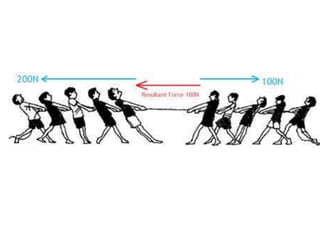
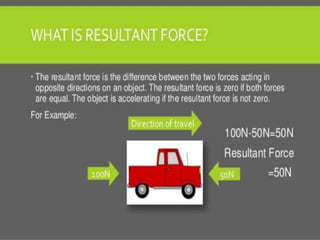
• A resultant force is the single force and
associated torque obtained by combining a
system of forces and torques acting on a rigid
body. The defining feature of a resultant force,
or resultant force-torque, is that it has the
same effect on the rigid body as the original
system of forces.
PRINCIPLE OF SUPERPOSITION OF
FORCES
• This principle states that the combined effect of force
system acting on a particle or a rigid body is the sum of
effects of individual forces.
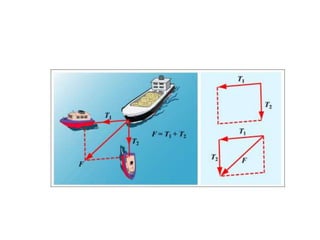
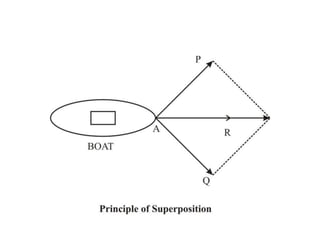
• Consider two forces P and Q acting at A on a boat as
shown in Fig.3.1. Let R be the resultant of these two
forces P and Q. According to Newton’s second law of
motion, the boat will move in the direction of resultant
force R with acceleration proportional to R. The same
motion can be obtained when P and Q are applied
simultaneously.
rigid body
• In physics, a rigid body is an idealization of a
solid body in which deformation is neglected.
In other words, the distance between any two
given points of a rigid body remains constant
in time regardless of external forces exerted
on it
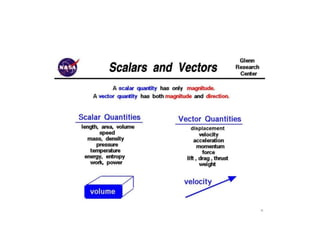
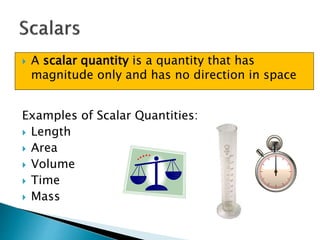
 A scalar quantity is a quantity that has
magnitude only and has no direction in space
Examples of Scalar Quantities:
 Length
 Area
 Volume
 Time
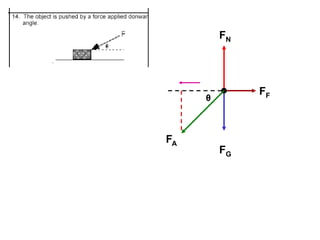
 Mass
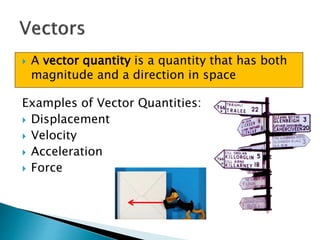
 A vector quantity is a quantity that has both
magnitude and a direction in space
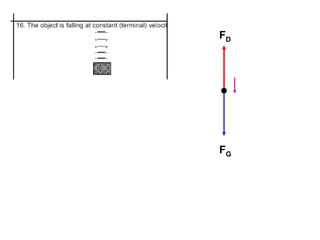
Examples of Vector Quantities:
 Displacement
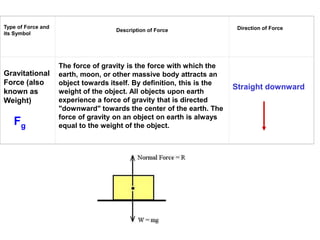
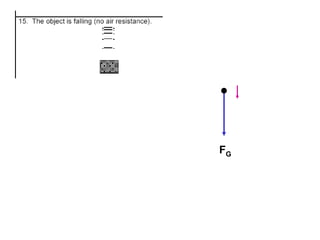
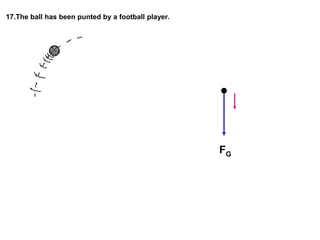
 Velocity
 Acceleration
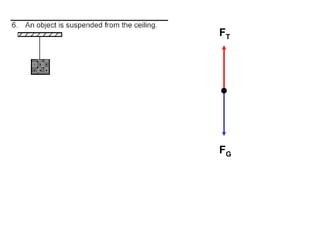
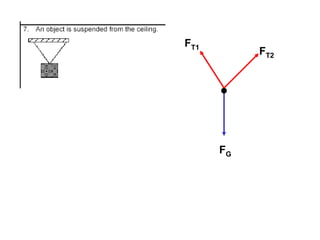
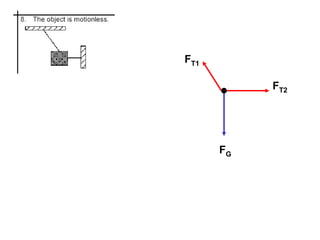
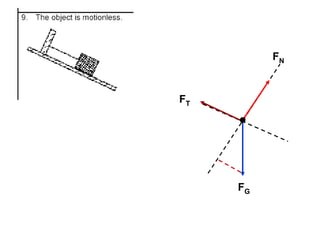
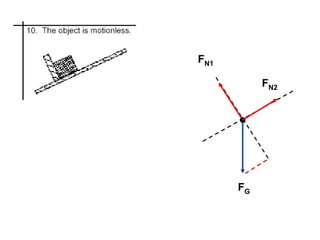
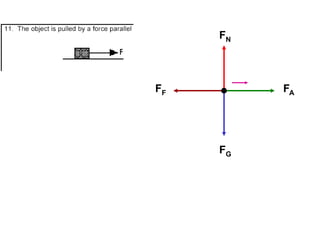
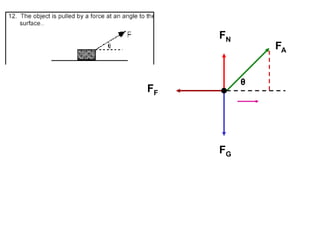
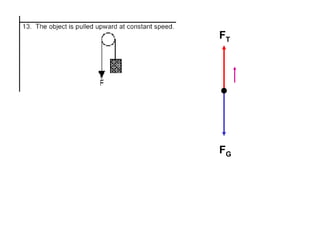
 Force
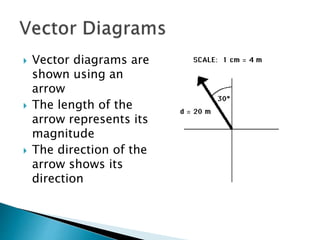
 Vector diagrams are
shown using an
arrow
 The length of the
arrow represents its
magnitude
 The direction of the
arrow shows its
direction
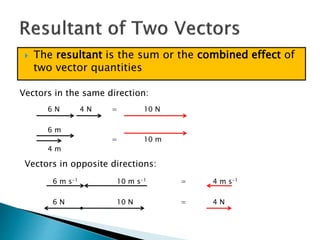
Vectors in opposite directions:
6 m s-1 10 m s-1 = 4 m s-1
6 N 10 N = 4 N
Vectors in the same direction:
6 N 4 N = 10 N
6 m
= 10 m
4 m
 The resultant is the sum or the combined effect of
two vector quantities
 What is a scalar quantity?
 Give 2 examples
 What is a vector quantity?
 Give 2 examples
 How are vectors represented?
 What is the resultant of 2 vector quantities?
 What is the triangle law?
 What is the parallelogram law?
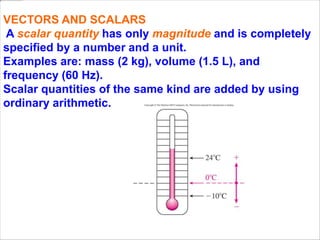
VECTORS AND SCALARS
A scalar quantity has only magnitude and is completely
specified by a number and a unit.
Examples are: mass (2 kg), volume (1.5 L), and
frequency (60 Hz).
Scalar quantities of the same kind are added by using
ordinary arithmetic.
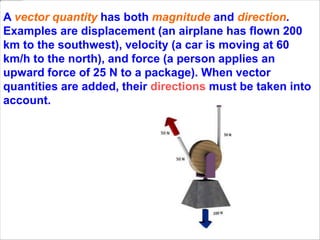
A vector quantity has both magnitude and direction.
Examples are displacement (an airplane has flown 200
km to the southwest), velocity (a car is moving at 60
km/h to the north), and force (a person applies an
upward force of 25 N to a package). When vector
quantities are added, their directions must be taken into
account.
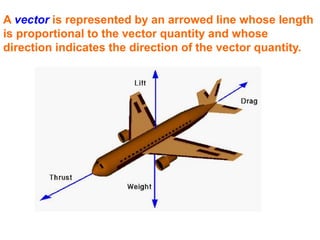
A vector is represented by an arrowed line whose length
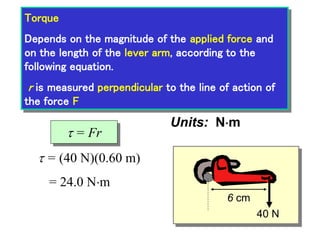
is proportional to the vector quantity and whose
direction indicates the direction of the vector quantity.
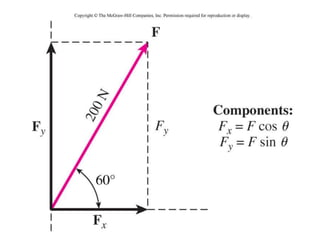
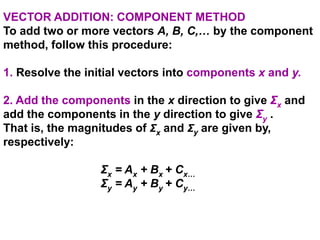
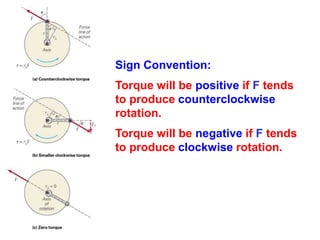
VECTOR ADDITION: COMPONENT METHOD
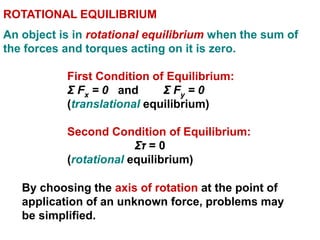
To add two or more vectors A, B, C,… by the component
method, follow this procedure:
1. Resolve the initial vectors into components x and y.
2. Add the components in the x direction to give Σx and
add the components in the y direction to give Σy .
That is, the magnitudes of Σx and Σy are given by,
respectively:
Σx = Ax + Bx + Cx…
Σy = Ay + By + Cy…
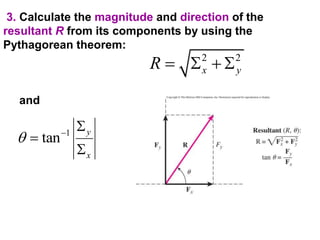
3. Calculate the magnitude and direction of the
resultant R from its components by using the
Pythagorean theorem:
and
2 2
x yR    
1
tan
y
x
 



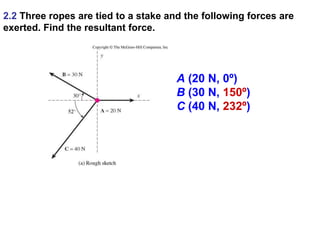
2.2 Three ropes are tied to a stake and the following forces are
exerted. Find the resultant force.
A (20 N, 0º)
B (30 N, 150º)
C (40 N, 232º)
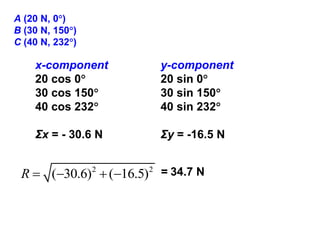
A (20 N, 0)
B (30 N, 150)
C (40 N, 232)
x-component
20 cos 0
30 cos 150
40 cos 232
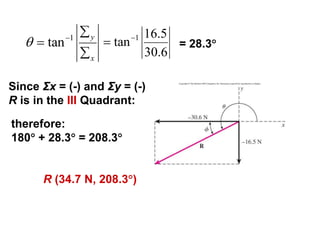
Σx = - 30.6 N
= 34.7 N2 2
( 30.6) ( 16.5)R    
y-component
20 sin 0
30 sin 150
40 sin 232
Σy = -16.5 N
= 28.3
Since Σx = (-) and Σy = (-)
R is in the III Quadrant:
1
tan
y
x
 



1 16.5
tan
30.6


therefore:
180 + 28.3 = 208.3
R (34.7 N, 208.3)
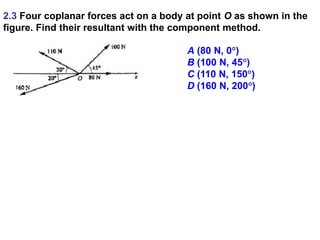
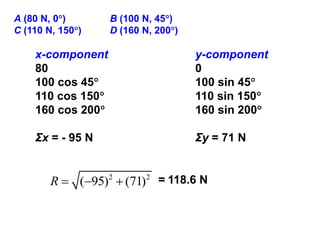
2.3 Four coplanar forces act on a body at point O as shown in the
figure. Find their resultant with the component method.
A (80 N, 0)
B (100 N, 45)
C (110 N, 150)
D (160 N, 200)
A (80 N, 0) B (100 N, 45)
C (110 N, 150) D (160 N, 200)
x-component y-component
80 0
100 cos 45 100 sin 45
110 cos 150 110 sin 150
160 cos 200 160 sin 200
Σx = - 95 N Σy = 71 N
= 118.6 N2 2
( 95) (71)R   
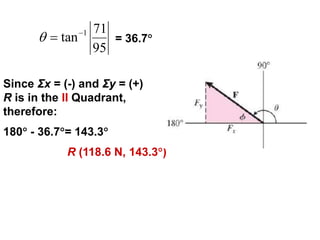
= 36.7
Since Σx = (-) and Σy = (+)
R is in the II Quadrant,
therefore:
180 - 36.7= 143.3
R (118.6 N, 143.3)
1 71
tan
95
 

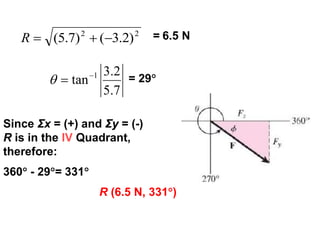
22
)2.3()7.5( R = 6.5 N
= 29
Since Σx = (+) and Σy = (-)
R is in the IV Quadrant,
therefore:
360 - 29= 331
R (6.5 N, 331)
1 3.2
tan
5.7
 

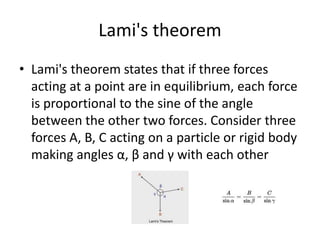
Lami's theorem
• Lami's theorem states that if three forces
acting at a point are in equilibrium, each force
is proportional to the sine of the angle
between the other two forces. Consider three
forces A, B, C acting on a particle or rigid body
making angles α, β and γ with each other
Type of Force and
its Symbol
Description of Force Direction of Force
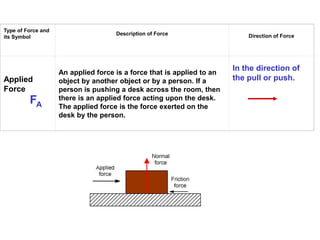
Applied
Force
An applied force is a force that is applied to an
object by another object or by a person. If a
person is pushing a desk across the room, then
there is an applied force acting upon the desk.
The applied force is the force exerted on the
desk by the person.
FA
In the direction of
the pull or push.
Type of Force and
its Symbol
Description of Force Direction of Force
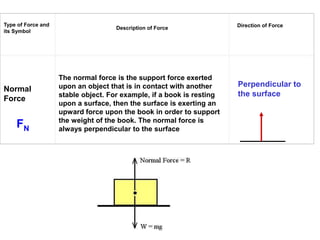
Normal
Force
The normal force is the support force exerted
upon an object that is in contact with another
stable object. For example, if a book is resting
upon a surface, then the surface is exerting an
upward force upon the book in order to support
the weight of the book. The normal force is
always perpendicular to the surface
Perpendicular to
the surface
FN
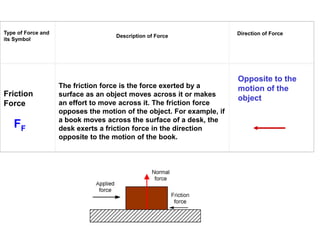
Type of Force and
its Symbol
Description of Force Direction of Force
Friction
Force
The friction force is the force exerted by a
surface as an object moves across it or makes
an effort to move across it. The friction force
opposes the motion of the object. For example, if
a book moves across the surface of a desk, the
desk exerts a friction force in the direction
opposite to the motion of the book.
Opposite to the
motion of the
object
FF
Type of Force and
its Symbol
Description of Force Direction of Force
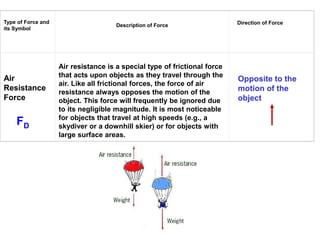
Air
Resistance
Force
Air resistance is a special type of frictional force
that acts upon objects as they travel through the
air. Like all frictional forces, the force of air
resistance always opposes the motion of the
object. This force will frequently be ignored due
to its negligible magnitude. It is most noticeable
for objects that travel at high speeds (e.g., a
skydiver or a downhill skier) or for objects with
large surface areas.
Opposite to the
motion of the
object
FD
Type of Force and
its Symbol
Description of Force Direction of Force
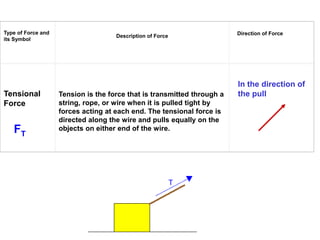
Tensional
Force
Tension is the force that is transmitted through a
string, rope, or wire when it is pulled tight by
forces acting at each end. The tensional force is
directed along the wire and pulls equally on the
objects on either end of the wire.
In the direction of
the pull
FT
Type of Force and
its Symbol
Description of Force Direction of Force
Gravitational
Force (also
known as
Weight)
The force of gravity is the force with which the
earth, moon, or other massive body attracts an
object towards itself. By definition, this is the
weight of the object. All objects upon earth
experience a force of gravity that is directed
"downward" towards the center of the earth. The
force of gravity on an object on earth is always
equal to the weight of the object.
Straight downward
Fg
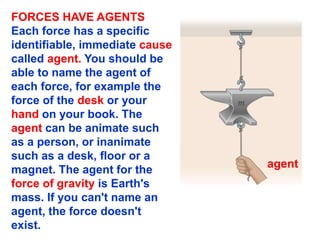
FORCES HAVE AGENTS
Each force has a specific
identifiable, immediate cause
called agent. You should be
able to name the agent of
each force, for example the
force of the desk or your
hand on your book. The
agent can be animate such
as a person, or inanimate
such as a desk, floor or a
magnet. The agent for the
force of gravity is Earth's
mass. If you can't name an
agent, the force doesn't
exist.
agent
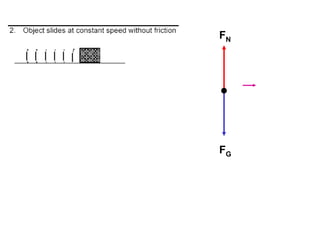
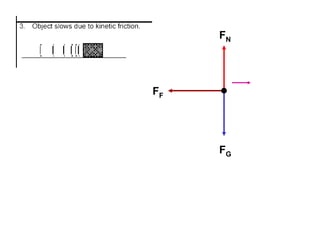
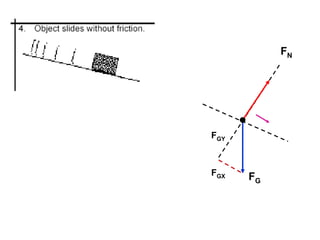
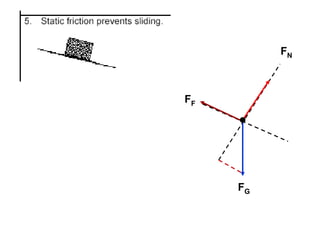
Directions:
- Choose a coordinate system defining the positive
direction of motion.
- Replace the object by a dot and locate it in the center
of the coordinate system.
- Draw arrows to represent the forces acting on the
system.
A free-body-diagram (FBD) is a vector
diagram that shows all the forces that
act on an object whose motion is being
studied.
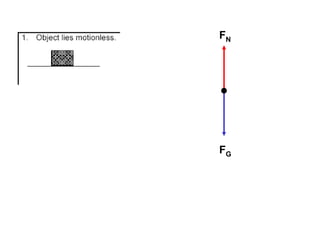
FN
FG
FN
FG
FN
FG
FF
FG
FN
FGX
FGY
FG
FN
FF
FT
FG
FT2
FG
FT1
FT2
FG
FT1
FG
FN
FT
FG
FN1
FN2
FN
FG
FF FA
FN
FG
FF
FA
θ
FT
FG
FN
FG
FF
FA
θ
FG
FD
FG
FG
17.The ball has been punted by a football player.
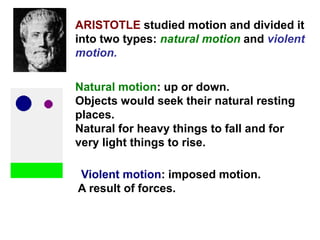
ARISTOTLE studied motion and divided it
into two types: natural motion and violent
motion.
Natural motion: up or down.
Objects would seek their natural resting
places.
Natural for heavy things to fall and for
very light things to rise.
Violent motion: imposed motion.
A result of forces.
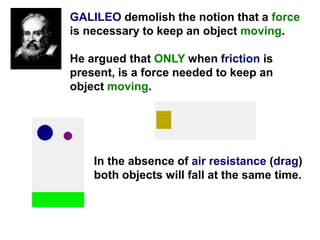
GALILEO demolish the notion that a force
is necessary to keep an object moving.
He argued that ONLY when friction is
present, is a force needed to keep an
object moving.
In the absence of air resistance (drag)
both objects will fall at the same time.
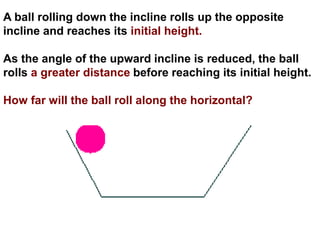
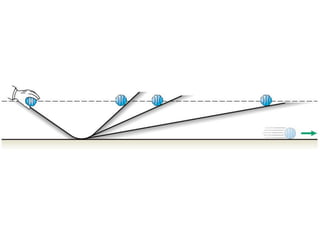
A ball rolling down the incline rolls up the opposite
incline and reaches its initial height.
As the angle of the upward incline is reduced, the ball
rolls a greater distance before reaching its initial height.
How far will the ball roll along the horizontal?
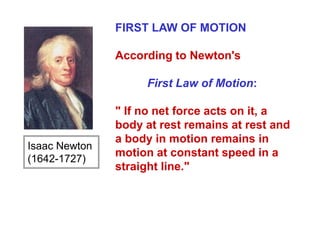
FIRST LAW OF MOTION
According to Newton's
First Law of Motion:
" If no net force acts on it, a
body at rest remains at rest and
a body in motion remains in
motion at constant speed in a
straight line."
Isaac Newton
(1642-1727)
NEWTON'S FIRST LAW OF MOTION
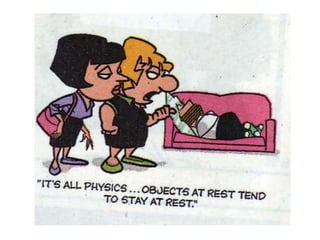
"An object at rest tends to stay at rest and an object
in motion tends to stay in motion with the same speed
and in the same direction unless acted upon by an
unbalanced force."
There are two parts to this statement:
- one which predicts the behavior ofstationary
objects and
- the other which predicts the behavior of moving
objects.
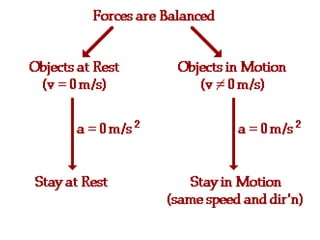
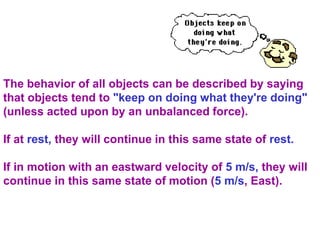
The behavior of all objects can be described by saying
that objects tend to "keep on doing what they're doing"
(unless acted upon by an unbalanced force).
If at rest, they will continue in this same state of rest.
If in motion with an eastward velocity of 5 m/s, they will
continue in this same state of motion (5 m/s, East).
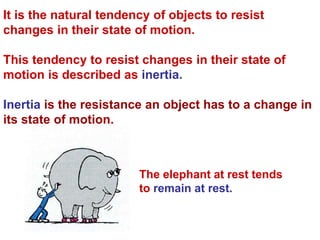
It is the natural tendency of objects to resist
changes in their state of motion.
This tendency to resist changes in their state of
motion is described as inertia.
Inertia is the resistance an object has to a change in
its state of motion.
The elephant at rest tends
to remain at rest.
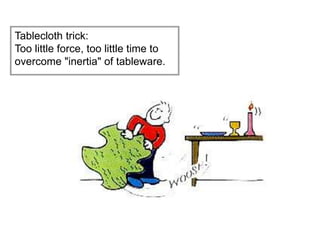
Tablecloth trick:
Too little force, too little time to
overcome "inertia" of tableware.
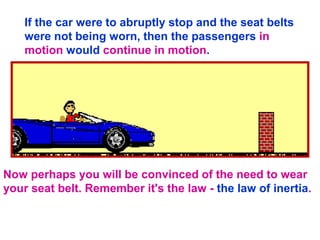
If the car were to abruptly stop and the seat belts
were not being worn, then the passengers in
motion would continue in motion.
Now perhaps you will be convinced of the need to wear
your seat belt. Remember it's the law - the law of inertia.
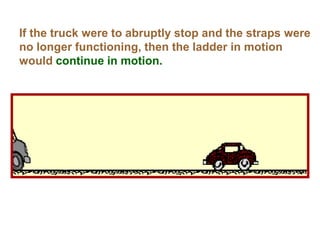
If the truck were to abruptly stop and the straps were
no longer functioning, then the ladder in motion
would continue in motion.
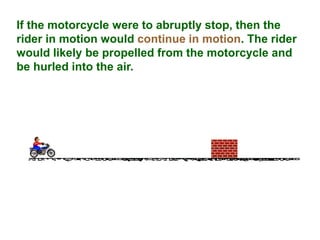
If the motorcycle were to abruptly stop, then the
rider in motion would continue in motion. The rider
would likely be propelled from the motorcycle and
be hurled into the air.
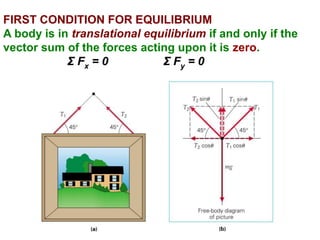
FIRST CONDITION FOR EQUILIBRIUM
A body is in translational equilibrium if and only if the
vector sum of the forces acting upon it is zero.
Σ Fx = 0 Σ Fy = 0
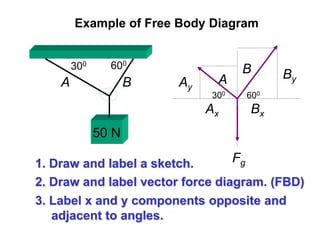
Example of Free Body Diagram
300 600
50 N
A AB
B
Fg
300 600
Bx
By
Ax
Ay
1. Draw and label a sketch.
2. Draw and label vector force diagram. (FBD)
3. Label x and y components opposite and
adjacent to angles.
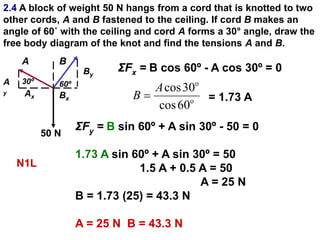
2.4 A block of weight 50 N hangs from a cord that is knotted to two
other cords, A and B fastened to the ceiling. If cord B makes an
angle of 60˚ with the ceiling and cord A forms a 30° angle, draw the
free body diagram of the knot and find the tensions A and B.
A B
50 N
ΣFx = B cos 60º - A cos 30º = 0
cos30
cos60
A
B 
o
o = 1.73 A
ΣFy = B sin 60º + A sin 30º - 50 = 0
1.73 A sin 60º + A sin 30º = 50
1.5 A + 0.5 A = 50
A = 25 N
B = 1.73 (25) = 43.3 N
A = 25 N B = 43.3 N
60º30º
Ax
A
y
By
Bx
N1L
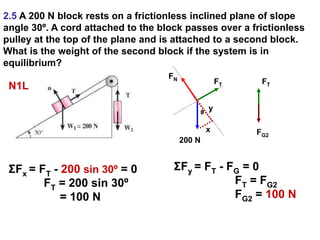
2.5 A 200 N block rests on a frictionless inclined plane of slope
angle 30º. A cord attached to the block passes over a frictionless
pulley at the top of the plane and is attached to a second block.
What is the weight of the second block if the system is in
equilibrium?
FN
200 N
FG2
FT FT
x
yθ
ΣFx = FT - 200 sin 30º = 0
FT = 200 sin 30º
= 100 N
ΣFy = FT - FG = 0
FT = FG2
FG2 = 100 N
N1L
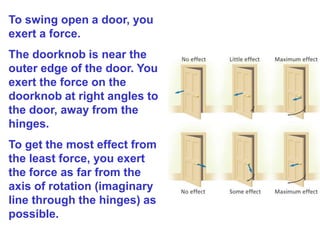
To swing open a door, you
exert a force.
The doorknob is near the
outer edge of the door. You
exert the force on the
doorknob at right angles to
the door, away from the
hinges.
To get the most effect from
the least force, you exert
the force as far from the
axis of rotation (imaginary
line through the hinges) as
possible.
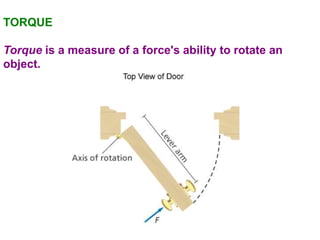
TORQUE
Torque is a measure of a force's ability to rotate an
object.
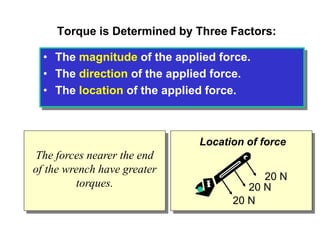
Torque is Determined by Three Factors:
• The magnitude of the applied force.
• The direction of the applied force.
• The location of the applied force.
20 N
Magnitude of force
40 N
The 40-N force
produces twice the
torque as does the
20-N force.
Each of the 20-N
forces has a different
torque due to the
direction of force. 20 N
Direction of Force
20 N


20 N20 N
Location of force
The forces nearer the end
of the wrench have greater
torques.
20 N
20 N
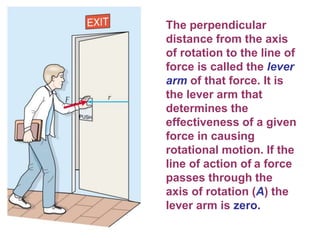
The perpendicular
distance from the axis
of rotation to the line of
force is called the lever
arm of that force. It is
the lever arm that
determines the
effectiveness of a given
force in causing
rotational motion. If the
line of action of a force
passes through the
axis of rotation (A) the
lever arm is zero.
Units for Torque
Torque
Depends on the magnitude of the applied force and
on the length of the lever arm, according to the
following equation.
r is measured perpendicular to the line of action of
the force F
t = Fr
Units: Nm
6 cm
40 N
t = (40 N)(0.60 m)
= 24.0 Nm
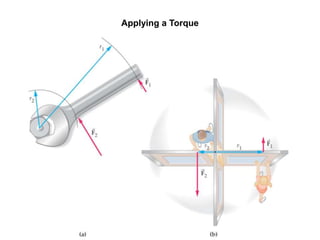
Applying a Torque
Sign Convention:
Torque will be positive if F tends
to produce counterclockwise
rotation.
Torque will be negative if F tends
to produce clockwise rotation.
ROTATIONAL EQUILIBRIUM
An object is in rotational equilibrium when the sum of
the forces and torques acting on it is zero.
First Condition of Equilibrium:
Σ Fx = 0 and Σ Fy = 0
(translational equilibrium)
Second Condition of Equilibrium:
Στ = 0
(rotational equilibrium)
By choosing the axis of rotation at the point of
application of an unknown force, problems may
be simplified.
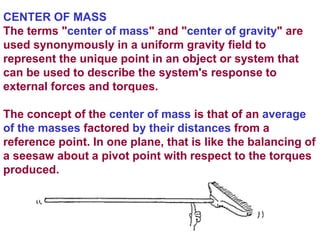
CENTER OF MASS
The terms "center of mass" and "center of gravity" are
used synonymously in a uniform gravity field to
represent the unique point in an object or system that
can be used to describe the system's response to
external forces and torques.
The concept of the center of mass is that of an average
of the masses factored by their distances from a
reference point. In one plane, that is like the balancing of
a seesaw about a pivot point with respect to the torques
produced.
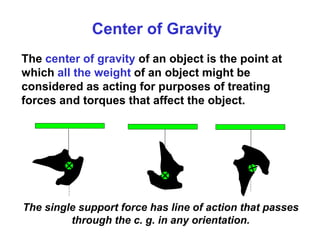
Center of Gravity
The center of gravity of an object is the point at
which all the weight of an object might be
considered as acting for purposes of treating
forces and torques that affect the object.
The single support force has line of action that passes
through the c. g. in any orientation.
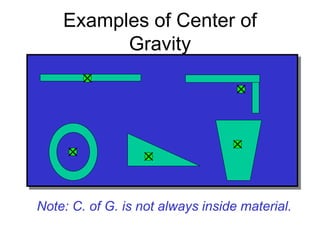
Examples of Center of
Gravity
Note: C. of G. is not always inside material.
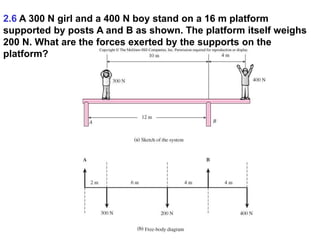
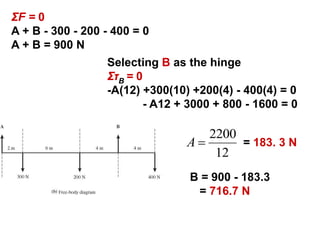
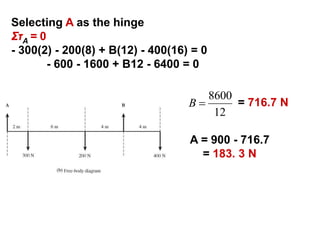
2.6 A 300 N girl and a 400 N boy stand on a 16 m platform
supported by posts A and B as shown. The platform itself weighs
200 N. What are the forces exerted by the supports on the
platform?
2200
12
A  = 183. 3 N
B = 900 - 183.3
= 716.7 N
ΣF = 0
A + B - 300 - 200 - 400 = 0
A + B = 900 N
Selecting B as the hinge
ΣτB = 0
-A(12) +300(10) +200(4) - 400(4) = 0
- A12 + 3000 + 800 - 1600 = 0
= 716.7 N
A = 900 - 716.7
= 183. 3 N
Selecting A as the hinge
ΣτA = 0
- 300(2) - 200(8) + B(12) - 400(16) = 0
- 600 - 1600 + B12 - 6400 = 0
8600
12
B 
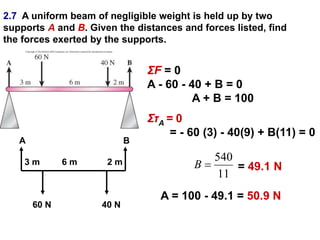
2.7 A uniform beam of negligible weight is held up by two
supports A and B. Given the distances and forces listed, find
the forces exerted by the supports.
ΣF = 0
A - 60 - 40 + B = 0
A + B = 100
ΣτA = 0
= - 60 (3) - 40(9) + B(11) = 0
A B
60 N 40 N
3 m 6 m 2 m 540
11
B  = 49.1 N
A = 100 - 49.1 = 50.9 N

basics

  • 1.
    resultant force • Aresultant force is the single force and associated torque obtained by combining a system of forces and torques acting on a rigid body. The defining feature of a resultant force, or resultant force-torque, is that it has the same effect on the rigid body as the original system of forces.
  • 5.
    PRINCIPLE OF SUPERPOSITIONOF FORCES • This principle states that the combined effect of force system acting on a particle or a rigid body is the sum of effects of individual forces. • Consider two forces P and Q acting at A on a boat as shown in Fig.3.1. Let R be the resultant of these two forces P and Q. According to Newton’s second law of motion, the boat will move in the direction of resultant force R with acceleration proportional to R. The same motion can be obtained when P and Q are applied simultaneously.
  • 8.
    rigid body • Inphysics, a rigid body is an idealization of a solid body in which deformation is neglected. In other words, the distance between any two given points of a rigid body remains constant in time regardless of external forces exerted on it
  • 15.
     A scalarquantity is a quantity that has magnitude only and has no direction in space Examples of Scalar Quantities:  Length  Area  Volume  Time  Mass
  • 16.
     A vectorquantity is a quantity that has both magnitude and a direction in space Examples of Vector Quantities:  Displacement  Velocity  Acceleration  Force
  • 17.
     Vector diagramsare shown using an arrow  The length of the arrow represents its magnitude  The direction of the arrow shows its direction
  • 18.
    Vectors in oppositedirections: 6 m s-1 10 m s-1 = 4 m s-1 6 N 10 N = 4 N Vectors in the same direction: 6 N 4 N = 10 N 6 m = 10 m 4 m  The resultant is the sum or the combined effect of two vector quantities
  • 19.
     What isa scalar quantity?  Give 2 examples  What is a vector quantity?  Give 2 examples  How are vectors represented?  What is the resultant of 2 vector quantities?  What is the triangle law?  What is the parallelogram law?
  • 20.
    VECTORS AND SCALARS Ascalar quantity has only magnitude and is completely specified by a number and a unit. Examples are: mass (2 kg), volume (1.5 L), and frequency (60 Hz). Scalar quantities of the same kind are added by using ordinary arithmetic.
  • 21.
    A vector quantityhas both magnitude and direction. Examples are displacement (an airplane has flown 200 km to the southwest), velocity (a car is moving at 60 km/h to the north), and force (a person applies an upward force of 25 N to a package). When vector quantities are added, their directions must be taken into account.
  • 22.
    A vector isrepresented by an arrowed line whose length is proportional to the vector quantity and whose direction indicates the direction of the vector quantity.
  • 24.
    VECTOR ADDITION: COMPONENTMETHOD To add two or more vectors A, B, C,… by the component method, follow this procedure: 1. Resolve the initial vectors into components x and y. 2. Add the components in the x direction to give Σx and add the components in the y direction to give Σy . That is, the magnitudes of Σx and Σy are given by, respectively: Σx = Ax + Bx + Cx… Σy = Ay + By + Cy…
  • 25.
    3. Calculate themagnitude and direction of the resultant R from its components by using the Pythagorean theorem: and 2 2 x yR     1 tan y x     
  • 26.
    2.2 Three ropesare tied to a stake and the following forces are exerted. Find the resultant force. A (20 N, 0º) B (30 N, 150º) C (40 N, 232º)
  • 27.
    A (20 N,0) B (30 N, 150) C (40 N, 232) x-component 20 cos 0 30 cos 150 40 cos 232 Σx = - 30.6 N = 34.7 N2 2 ( 30.6) ( 16.5)R     y-component 20 sin 0 30 sin 150 40 sin 232 Σy = -16.5 N
  • 28.
    = 28.3 Since Σx= (-) and Σy = (-) R is in the III Quadrant: 1 tan y x      1 16.5 tan 30.6   therefore: 180 + 28.3 = 208.3 R (34.7 N, 208.3)
  • 29.
    2.3 Four coplanarforces act on a body at point O as shown in the figure. Find their resultant with the component method. A (80 N, 0) B (100 N, 45) C (110 N, 150) D (160 N, 200)
  • 30.
    A (80 N,0) B (100 N, 45) C (110 N, 150) D (160 N, 200) x-component y-component 80 0 100 cos 45 100 sin 45 110 cos 150 110 sin 150 160 cos 200 160 sin 200 Σx = - 95 N Σy = 71 N = 118.6 N2 2 ( 95) (71)R   
  • 31.
    = 36.7 Since Σx= (-) and Σy = (+) R is in the II Quadrant, therefore: 180 - 36.7= 143.3 R (118.6 N, 143.3) 1 71 tan 95   
  • 32.
    22 )2.3()7.5( R =6.5 N = 29 Since Σx = (+) and Σy = (-) R is in the IV Quadrant, therefore: 360 - 29= 331 R (6.5 N, 331) 1 3.2 tan 5.7   
  • 33.
    Lami's theorem • Lami'stheorem states that if three forces acting at a point are in equilibrium, each force is proportional to the sine of the angle between the other two forces. Consider three forces A, B, C acting on a particle or rigid body making angles α, β and γ with each other
  • 34.
    Type of Forceand its Symbol Description of Force Direction of Force Applied Force An applied force is a force that is applied to an object by another object or by a person. If a person is pushing a desk across the room, then there is an applied force acting upon the desk. The applied force is the force exerted on the desk by the person. FA In the direction of the pull or push.
  • 35.
    Type of Forceand its Symbol Description of Force Direction of Force Normal Force The normal force is the support force exerted upon an object that is in contact with another stable object. For example, if a book is resting upon a surface, then the surface is exerting an upward force upon the book in order to support the weight of the book. The normal force is always perpendicular to the surface Perpendicular to the surface FN
  • 36.
    Type of Forceand its Symbol Description of Force Direction of Force Friction Force The friction force is the force exerted by a surface as an object moves across it or makes an effort to move across it. The friction force opposes the motion of the object. For example, if a book moves across the surface of a desk, the desk exerts a friction force in the direction opposite to the motion of the book. Opposite to the motion of the object FF
  • 37.
    Type of Forceand its Symbol Description of Force Direction of Force Air Resistance Force Air resistance is a special type of frictional force that acts upon objects as they travel through the air. Like all frictional forces, the force of air resistance always opposes the motion of the object. This force will frequently be ignored due to its negligible magnitude. It is most noticeable for objects that travel at high speeds (e.g., a skydiver or a downhill skier) or for objects with large surface areas. Opposite to the motion of the object FD
  • 38.
    Type of Forceand its Symbol Description of Force Direction of Force Tensional Force Tension is the force that is transmitted through a string, rope, or wire when it is pulled tight by forces acting at each end. The tensional force is directed along the wire and pulls equally on the objects on either end of the wire. In the direction of the pull FT
  • 39.
    Type of Forceand its Symbol Description of Force Direction of Force Gravitational Force (also known as Weight) The force of gravity is the force with which the earth, moon, or other massive body attracts an object towards itself. By definition, this is the weight of the object. All objects upon earth experience a force of gravity that is directed "downward" towards the center of the earth. The force of gravity on an object on earth is always equal to the weight of the object. Straight downward Fg
  • 40.
    FORCES HAVE AGENTS Eachforce has a specific identifiable, immediate cause called agent. You should be able to name the agent of each force, for example the force of the desk or your hand on your book. The agent can be animate such as a person, or inanimate such as a desk, floor or a magnet. The agent for the force of gravity is Earth's mass. If you can't name an agent, the force doesn't exist. agent
  • 41.
    Directions: - Choose acoordinate system defining the positive direction of motion. - Replace the object by a dot and locate it in the center of the coordinate system. - Draw arrows to represent the forces acting on the system. A free-body-diagram (FBD) is a vector diagram that shows all the forces that act on an object whose motion is being studied.
  • 42.
  • 43.
  • 44.
  • 45.
  • 46.
  • 47.
  • 48.
  • 49.
  • 50.
  • 51.
  • 52.
  • 53.
  • 54.
  • 55.
  • 56.
  • 57.
  • 58.
    FG 17.The ball hasbeen punted by a football player.
  • 59.
    ARISTOTLE studied motionand divided it into two types: natural motion and violent motion. Natural motion: up or down. Objects would seek their natural resting places. Natural for heavy things to fall and for very light things to rise. Violent motion: imposed motion. A result of forces.
  • 60.
    GALILEO demolish thenotion that a force is necessary to keep an object moving. He argued that ONLY when friction is present, is a force needed to keep an object moving. In the absence of air resistance (drag) both objects will fall at the same time.
  • 61.
    A ball rollingdown the incline rolls up the opposite incline and reaches its initial height. As the angle of the upward incline is reduced, the ball rolls a greater distance before reaching its initial height. How far will the ball roll along the horizontal?
  • 63.
    FIRST LAW OFMOTION According to Newton's First Law of Motion: " If no net force acts on it, a body at rest remains at rest and a body in motion remains in motion at constant speed in a straight line." Isaac Newton (1642-1727)
  • 64.
    NEWTON'S FIRST LAWOF MOTION "An object at rest tends to stay at rest and an object in motion tends to stay in motion with the same speed and in the same direction unless acted upon by an unbalanced force." There are two parts to this statement: - one which predicts the behavior ofstationary objects and - the other which predicts the behavior of moving objects.
  • 66.
    The behavior ofall objects can be described by saying that objects tend to "keep on doing what they're doing" (unless acted upon by an unbalanced force). If at rest, they will continue in this same state of rest. If in motion with an eastward velocity of 5 m/s, they will continue in this same state of motion (5 m/s, East).
  • 67.
    It is thenatural tendency of objects to resist changes in their state of motion. This tendency to resist changes in their state of motion is described as inertia. Inertia is the resistance an object has to a change in its state of motion. The elephant at rest tends to remain at rest.
  • 69.
    Tablecloth trick: Too littleforce, too little time to overcome "inertia" of tableware.
  • 70.
    If the carwere to abruptly stop and the seat belts were not being worn, then the passengers in motion would continue in motion. Now perhaps you will be convinced of the need to wear your seat belt. Remember it's the law - the law of inertia.
  • 71.
    If the truckwere to abruptly stop and the straps were no longer functioning, then the ladder in motion would continue in motion.
  • 72.
    If the motorcyclewere to abruptly stop, then the rider in motion would continue in motion. The rider would likely be propelled from the motorcycle and be hurled into the air.
  • 76.
    FIRST CONDITION FOREQUILIBRIUM A body is in translational equilibrium if and only if the vector sum of the forces acting upon it is zero. Σ Fx = 0 Σ Fy = 0
  • 77.
    Example of FreeBody Diagram 300 600 50 N A AB B Fg 300 600 Bx By Ax Ay 1. Draw and label a sketch. 2. Draw and label vector force diagram. (FBD) 3. Label x and y components opposite and adjacent to angles.
  • 78.
    2.4 A blockof weight 50 N hangs from a cord that is knotted to two other cords, A and B fastened to the ceiling. If cord B makes an angle of 60˚ with the ceiling and cord A forms a 30° angle, draw the free body diagram of the knot and find the tensions A and B. A B 50 N ΣFx = B cos 60º - A cos 30º = 0 cos30 cos60 A B  o o = 1.73 A ΣFy = B sin 60º + A sin 30º - 50 = 0 1.73 A sin 60º + A sin 30º = 50 1.5 A + 0.5 A = 50 A = 25 N B = 1.73 (25) = 43.3 N A = 25 N B = 43.3 N 60º30º Ax A y By Bx N1L
  • 79.
    2.5 A 200N block rests on a frictionless inclined plane of slope angle 30º. A cord attached to the block passes over a frictionless pulley at the top of the plane and is attached to a second block. What is the weight of the second block if the system is in equilibrium? FN 200 N FG2 FT FT x yθ ΣFx = FT - 200 sin 30º = 0 FT = 200 sin 30º = 100 N ΣFy = FT - FG = 0 FT = FG2 FG2 = 100 N N1L
  • 80.
    To swing opena door, you exert a force. The doorknob is near the outer edge of the door. You exert the force on the doorknob at right angles to the door, away from the hinges. To get the most effect from the least force, you exert the force as far from the axis of rotation (imaginary line through the hinges) as possible.
  • 81.
    TORQUE Torque is ameasure of a force's ability to rotate an object.
  • 82.
    Torque is Determinedby Three Factors: • The magnitude of the applied force. • The direction of the applied force. • The location of the applied force. 20 N Magnitude of force 40 N The 40-N force produces twice the torque as does the 20-N force. Each of the 20-N forces has a different torque due to the direction of force. 20 N Direction of Force 20 N   20 N20 N Location of force The forces nearer the end of the wrench have greater torques. 20 N 20 N
  • 83.
    The perpendicular distance fromthe axis of rotation to the line of force is called the lever arm of that force. It is the lever arm that determines the effectiveness of a given force in causing rotational motion. If the line of action of a force passes through the axis of rotation (A) the lever arm is zero.
  • 84.
    Units for Torque Torque Dependson the magnitude of the applied force and on the length of the lever arm, according to the following equation. r is measured perpendicular to the line of action of the force F t = Fr Units: Nm 6 cm 40 N t = (40 N)(0.60 m) = 24.0 Nm
  • 85.
  • 86.
    Sign Convention: Torque willbe positive if F tends to produce counterclockwise rotation. Torque will be negative if F tends to produce clockwise rotation.
  • 87.
    ROTATIONAL EQUILIBRIUM An objectis in rotational equilibrium when the sum of the forces and torques acting on it is zero. First Condition of Equilibrium: Σ Fx = 0 and Σ Fy = 0 (translational equilibrium) Second Condition of Equilibrium: Στ = 0 (rotational equilibrium) By choosing the axis of rotation at the point of application of an unknown force, problems may be simplified.
  • 88.
    CENTER OF MASS Theterms "center of mass" and "center of gravity" are used synonymously in a uniform gravity field to represent the unique point in an object or system that can be used to describe the system's response to external forces and torques. The concept of the center of mass is that of an average of the masses factored by their distances from a reference point. In one plane, that is like the balancing of a seesaw about a pivot point with respect to the torques produced.
  • 89.
    Center of Gravity Thecenter of gravity of an object is the point at which all the weight of an object might be considered as acting for purposes of treating forces and torques that affect the object. The single support force has line of action that passes through the c. g. in any orientation.
  • 90.
    Examples of Centerof Gravity Note: C. of G. is not always inside material.
  • 91.
    2.6 A 300N girl and a 400 N boy stand on a 16 m platform supported by posts A and B as shown. The platform itself weighs 200 N. What are the forces exerted by the supports on the platform?
  • 92.
    2200 12 A  =183. 3 N B = 900 - 183.3 = 716.7 N ΣF = 0 A + B - 300 - 200 - 400 = 0 A + B = 900 N Selecting B as the hinge ΣτB = 0 -A(12) +300(10) +200(4) - 400(4) = 0 - A12 + 3000 + 800 - 1600 = 0
  • 93.
    = 716.7 N A= 900 - 716.7 = 183. 3 N Selecting A as the hinge ΣτA = 0 - 300(2) - 200(8) + B(12) - 400(16) = 0 - 600 - 1600 + B12 - 6400 = 0 8600 12 B 
  • 94.
    2.7 A uniformbeam of negligible weight is held up by two supports A and B. Given the distances and forces listed, find the forces exerted by the supports. ΣF = 0 A - 60 - 40 + B = 0 A + B = 100 ΣτA = 0 = - 60 (3) - 40(9) + B(11) = 0 A B 60 N 40 N 3 m 6 m 2 m 540 11 B  = 49.1 N A = 100 - 49.1 = 50.9 N