BASIC COMPUTER
ORGANIZATION
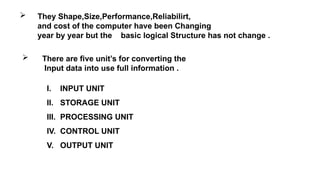
 They Shape,Size,Performance,Reliabilirt,
and cost of the computer have been Changing
year by year but the basic logical Structure has not change .
 There are five unit’s for converting the
Input data into use full information .
I. INPUT UNIT
II. STORAGE UNIT
III. PROCESSING UNIT
IV. CONTROL UNIT
V. OUTPUT UNIT
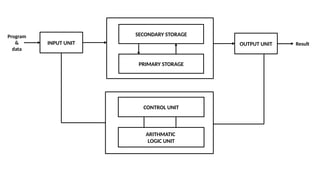
SECONDARY STORAGE
PRIMARY STORAGE
CONTROL UNIT
ARITHMATIC
LOGIC UNIT
INPUT UNIT OUTPUT UNIT
Program
&
data
Result
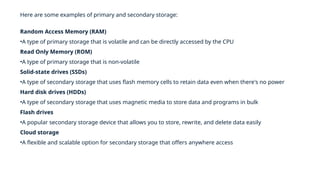
Here are some examples of primary and secondary storage:
Random Access Memory (RAM)
•A type of primary storage that is volatile and can be directly accessed by the CPU
Read Only Memory (ROM)
•A type of primary storage that is non-volatile
Solid-state drives (SSDs)
•A type of secondary storage that uses flash memory cells to retain data even when there's no power
Hard disk drives (HDDs)
•A type of secondary storage that uses magnetic media to store data and programs in bulk
Flash drives
•A popular secondary storage device that allows you to store, rewrite, and delete data easily
Cloud storage
•A flexible and scalable option for secondary storage that offers anywhere access
INPUT UNIT
 The data instruction are enter a computer through
In input unit use of the input device .
 It accept the instruction and data from outside world
 It convert the instruction and data to binary code
 It supplied the converted instruction and data
to computer system for there processing
STORAGE UNIT
 The data and instruction are enter into a computer
System throw input unit
 it store inside the computer before actual
Processing start
 the storage unit of a computer is two type
1. Primary Storage
2. Secondary storage
PRIMARY STORAGE
 It also know as main memory
 It store information file
 the computer is on
 It is volatile
 It has limited storage capacity
 It is a temporary storage device
 It is very expensive
Secondary Storage
 It is also know as actual memory
 It’s store’s the data permanently
When power is off the data are not erased
 It is non volatile
 It store’s data permanently
 It is a cheaper then primary storage
 Magnetic disk it used for secondary storage
ARITHMETIC LOGIC UNIT
 It is a place when actual execution of
Instruction and data takes place during processing operation
 The calculation are perform and all comparison are take’s place in alu
 The data and instruction are stores primary storage
 It mostly perform arithmetic operation like Add, Subtract, Multiplication, And the logical operation like
greaterthen,lessthen, equal to etc .
Control Unit
 The control unit act as a central nervous system
 It manages and coordinate the entire the computer system
CENTRAL PROCESSING UNIT (CPU)
 IT is the combination of control unit and arithmatic logic unit
 It is the brain of computer
 All the major calculation and comperison are take’s place inside CPU
 It is responsible for activatin and controling the operation of other unit
Output Unit
 The computer word’s with binary code and produced the result in binary form
 There for before suppling the result it convert then to human acceptable from

basiccomputerorganization-160726065251.pptx

  • 1.
  • 2.
     They Shape,Size,Performance,Reliabilirt, andcost of the computer have been Changing year by year but the basic logical Structure has not change .  There are five unit’s for converting the Input data into use full information . I. INPUT UNIT II. STORAGE UNIT III. PROCESSING UNIT IV. CONTROL UNIT V. OUTPUT UNIT
  • 3.
    SECONDARY STORAGE PRIMARY STORAGE CONTROLUNIT ARITHMATIC LOGIC UNIT INPUT UNIT OUTPUT UNIT Program & data Result
  • 5.
    Here are someexamples of primary and secondary storage: Random Access Memory (RAM) •A type of primary storage that is volatile and can be directly accessed by the CPU Read Only Memory (ROM) •A type of primary storage that is non-volatile Solid-state drives (SSDs) •A type of secondary storage that uses flash memory cells to retain data even when there's no power Hard disk drives (HDDs) •A type of secondary storage that uses magnetic media to store data and programs in bulk Flash drives •A popular secondary storage device that allows you to store, rewrite, and delete data easily Cloud storage •A flexible and scalable option for secondary storage that offers anywhere access
  • 6.
    INPUT UNIT  Thedata instruction are enter a computer through In input unit use of the input device .  It accept the instruction and data from outside world  It convert the instruction and data to binary code  It supplied the converted instruction and data to computer system for there processing
  • 7.
    STORAGE UNIT  Thedata and instruction are enter into a computer System throw input unit  it store inside the computer before actual Processing start  the storage unit of a computer is two type 1. Primary Storage 2. Secondary storage
  • 8.
    PRIMARY STORAGE  Italso know as main memory  It store information file  the computer is on  It is volatile  It has limited storage capacity  It is a temporary storage device  It is very expensive
  • 9.
    Secondary Storage  Itis also know as actual memory  It’s store’s the data permanently When power is off the data are not erased  It is non volatile  It store’s data permanently  It is a cheaper then primary storage  Magnetic disk it used for secondary storage
  • 10.
    ARITHMETIC LOGIC UNIT It is a place when actual execution of Instruction and data takes place during processing operation  The calculation are perform and all comparison are take’s place in alu  The data and instruction are stores primary storage  It mostly perform arithmetic operation like Add, Subtract, Multiplication, And the logical operation like greaterthen,lessthen, equal to etc .
  • 11.
    Control Unit  Thecontrol unit act as a central nervous system  It manages and coordinate the entire the computer system
  • 12.
    CENTRAL PROCESSING UNIT(CPU)  IT is the combination of control unit and arithmatic logic unit  It is the brain of computer  All the major calculation and comperison are take’s place inside CPU  It is responsible for activatin and controling the operation of other unit
  • 13.
    Output Unit  Thecomputer word’s with binary code and produced the result in binary form  There for before suppling the result it convert then to human acceptable from