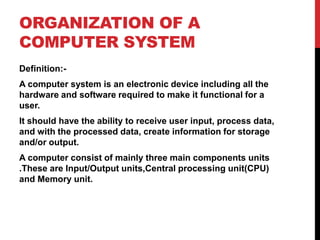
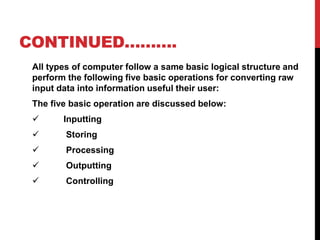
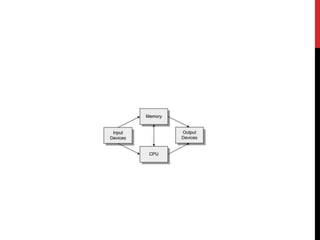
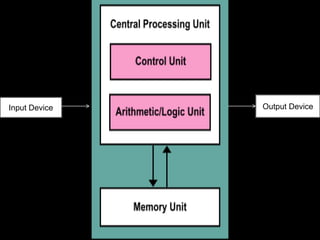
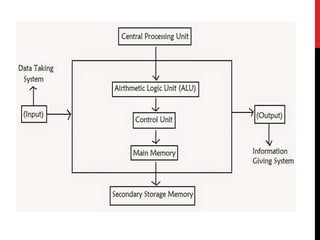
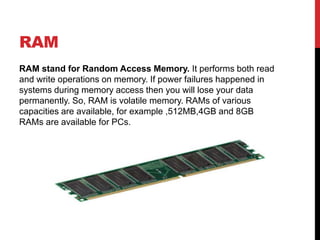
This document provides an overview of the basic components and operations of a computer system. It discusses how a computer system is composed of input, output, processing, memory, and controlling units. The central processing unit (CPU) acts as the brain and contains the arithmetic logic unit (ALU) and control unit to process data. Memory, including primary memory like RAM and ROM, is used to store programs and data both temporarily for processing and more permanently. Input and output devices allow the user to interface with the computer system by entering and receiving data. The five basic operations of a computer system are inputting, storing, processing, outputting, and controlling data.