Review of Family Planning
Programme
Dr. Kiran Ambwani, DC (Family Planning)
10/10/24 1
NRHM Review Meeting, Bhopal
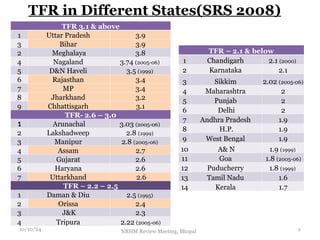
TFR in Different States(SRS 2008)
TFR 3.1 & above
1 Uttar Pradesh 3.9
3 Bihar 3.9
2 Meghalaya 3.8
4 Nagaland 3.74 (2005-06)
5 D&N Haveli 3.5 (1999)
6 Rajasthan 3.4
7 MP 3.4
8 Jharkhand 3.2
9 Chhattisgarh 3.1
TFR- 2.6 – 3.0
1 Arunachal 3.03 (2005-06)
2 Lakshadweep 2.8 (1999)
3 Manipur 2.8 (2005-06)
4 Assam 2.7
5 Gujarat 2.6
6 Haryana 2.6
7 Uttarkhand 2.6
TFR – 2.2 – 2.5
1 Daman & Diu 2.5 (1995)
2 Orissa 2.4
3 J&K 2.3
4 Tripura 2.22 (2005-06)
TFR – 2.1 & below
1 Chandigarh 2.1 (2000)
2 Karnataka 2.1
3 Sikkim 2.02 (2005-06)
4 Maharashtra 2
5 Punjab 2
6 Delhi 2
7 Andhra Pradesh 1.9
8 H.P. 1.9
9 West Bengal 1.9
10 A& N 1.9 (1999)
11 Goa 1.8 (2005-06)
12 Puducherry 1.8 (1999)
13 Tamil Nadu 1.6
14 Kerala 1.7
10/10/24 2
NRHM Review Meeting, Bhopal
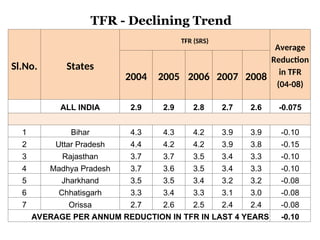
Sl.No. States
TFR (SRS)
Average
Reduction
in TFR
(04-08)
2004 2005 2006 2007 2008
ALL INDIA 2.9 2.9 2.8 2.7 2.6 -0.075
1 Bihar 4.3 4.3 4.2 3.9 3.9 -0.10
2 Uttar Pradesh 4.4 4.2 4.2 3.9 3.8 -0.15
3 Rajasthan 3.7 3.7 3.5 3.4 3.3 -0.10
4 Madhya Pradesh 3.7 3.6 3.5 3.4 3.3 -0.10
5 Jharkhand 3.5 3.5 3.4 3.2 3.2 -0.08
6 Chhatisgarh 3.3 3.4 3.3 3.1 3.0 -0.08
7 Orissa 2.7 2.6 2.5 2.4 2.4 -0.08
AVERAGE PER ANNUM REDUCTION IN TFR IN LAST 4 YEARS -0.10
TFR - Declining Trend
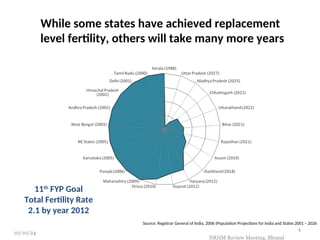
While some states have achieved replacement
level fertility, others will take many more years
Source: Registrar General of India, 2006 (Population Projections for India and States 2001 – 2026
11th
FYP Goal
Total Fertility Rate
2.1 by year 2012
10/10/24
4
NRHM Review Meeting, Bhopal
Source:DLHS-3 (2007-08)
Spacing
methods
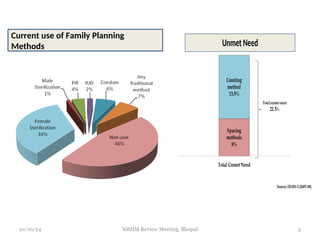
8%
Limiting
method
13.5%
Total Unmet Need
Totalunmetneed
21.5%
Unmet Need
Current use of Family Planning
Methods
10/10/24 5
NRHM Review Meeting, Bhopal
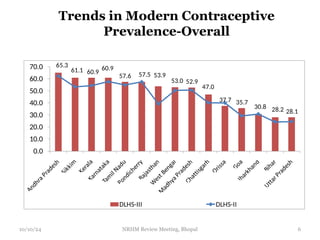
Trends in Modern Contraceptive
Prevalence-Overall
6
65.3
61.1 60.9
60.9
57.6 57.5 53.9
53.0 52.9
47.0
37.7 35.7
30.8 28.2 28.1
0.0
10.0
20.0
30.0
40.0
50.0
60.0
70.0
DLHS-III DLHS-II
10/10/24 NRHM Review Meeting, Bhopal
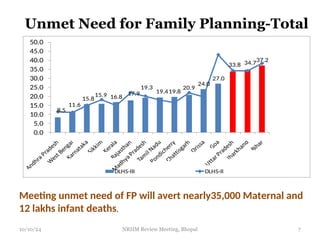
Unmet Need for Family Planning-Total
7
8.5
11.6
15.8
15.9 16.8
17.9
19.3
19.419.8
20.9
24.0
27.0
33.8 34.737.2
0.0
5.0
10.0
15.0
20.0
25.0
30.0
35.0
40.0
45.0
50.0
DLHS-III DLHS-II
Meeting unmet need of FP will avert nearly35,000 Maternal and
12 lakhs infant deaths.
10/10/24 NRHM Review Meeting, Bhopal
Source: DLHS – 3, 2007-08
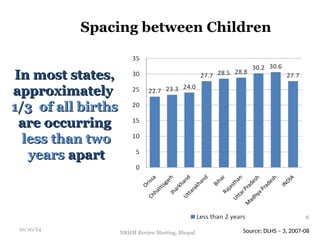
In most states,
In most states,
approximately
approximately
1/3 of all births
1/3 of all births
are occurring
are occurring
less than two
less than two
years
years apart
apart
Spacing between Children
10/10/24
8
NRHM Review Meeting, Bhopal
Source: DLHS-3 (2007-08), IIPS Mumbai
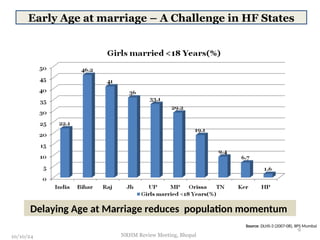
Delaying Age at Marriage reduces population momentum
Early Age at marriage – A Challenge in HF States
10/10/24
9
NRHM Review Meeting, Bhopal
Source: DLHS-III
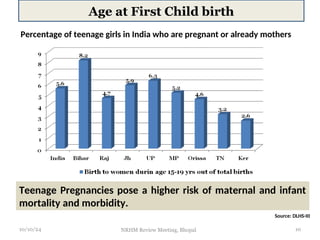
Percentage of teenage girls in India who are pregnant or already mothers
Teenage Pregnancies pose a higher risk of maternal and infant
mortality and morbidity.
Age at First Child birth
10/10/24 10
NRHM Review Meeting, Bhopal
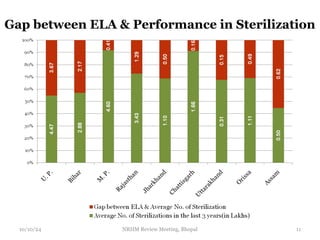
Gap between ELA & Performance in Sterilization
10/10/24 11
NRHM Review Meeting, Bhopal
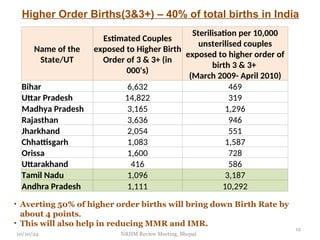
Name of the
State/UT
Estimated Couples
exposed to Higher Birth
Order of 3 & 3+ (in
000's)
Sterilisation per 10,000
unsterilised couples
exposed to higher order of
birth 3 & 3+
(March 2009- April 2010)
Bihar 6,632 469
Uttar Pradesh 14,822 319
Madhya Pradesh 3,165 1,296
Rajasthan 3,636 946
Jharkhand 2,054 551
Chhattisgarh 1,083 1,587
Orissa 1,600 728
Uttarakhand 416 586
Tamil Nadu 1,096 3,187
Andhra Pradesh 1,111 10,292
• Averting 50% of higher order births will bring down Birth Rate by
about 4 points.
• This will also help in reducing MMR and IMR.
Higher Order Births(3&3+) – 40% of total births in India
10/10/24
12
NRHM Review Meeting, Bhopal
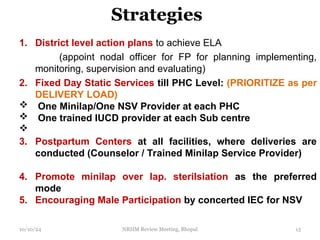
Strategies
1. District level action plans to achieve ELA
(appoint nodal officer for FP for planning implementing,
monitoring, supervision and evaluating)
2. Fixed Day Static Services till PHC Level: (PRIORITIZE as per
DELIVERY LOAD)
 One Minilap/One NSV Provider at each PHC
 One trained IUCD provider at each Sub centre

3. Postpartum Centers at all facilities, where deliveries are
conducted (Counselor / Trained Minilap Service Provider)
4. Promote minilap over lap. sterilsiation as the preferred
mode
5. Encouraging Male Participation by concerted IEC for NSV
10/10/24 NRHM Review Meeting, Bhopal 13
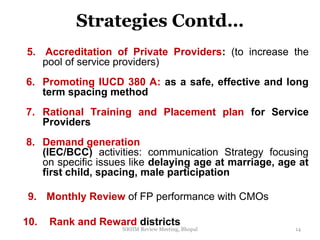
Strategies Contd…
5. Accreditation of Private Providers: (to increase the
pool of service providers)
6. Promoting IUCD 380 A: as a safe, effective and long
term spacing method
7. Rational Training and Placement plan for Service
Providers
8. Demand generation
(IEC/BCC) activities: communication Strategy focusing
on specific issues like delaying age at marriage, age at
first child, spacing, male participation
9. Monthly Review of FP performance with CMOs
10. Rank and Reward districts
NRHM Review Meeting, Bhopal 14
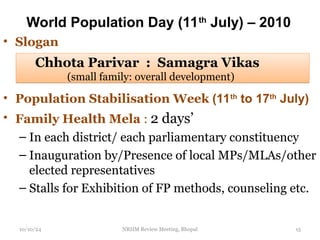
World Population Day (11th
July) – 2010
• Slogan
• Population Stabilisation Week (11th
to 17th
July)
• Family Health Mela : 2 days’
– In each district/ each parliamentary constituency
– Inauguration by/Presence of local MPs/MLAs/other
elected representatives
– Stalls for Exhibition of FP methods, counseling etc.
10/10/24 NRHM Review Meeting, Bhopal 15
Chhota Parivar : Samagra Vikas
(small family: overall development)
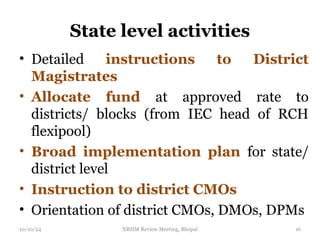
State level activities
• Detailed instructions to District
Magistrates
• Allocate fund at approved rate to
districts/ blocks (from IEC head of RCH
flexipool)
• Broad implementation plan for state/
district level
• Instruction to district CMOs
• Orientation of district CMOs, DMOs, DPMs
10/10/24 NRHM Review Meeting, Bhopal 16
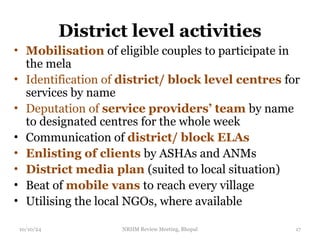
District level activities
• Mobilisation of eligible couples to participate in
the mela
• Identification of district/ block level centres for
services by name
• Deputation of service providers’ team by name
to designated centres for the whole week
• Communication of district/ block ELAs
• Enlisting of clients by ASHAs and ANMs
• District media plan (suited to local situation)
• Beat of mobile vans to reach every village
• Utilising the local NGOs, where available
10/10/24 NRHM Review Meeting, Bhopal 17
Thank you
10/10/24 NRHM Review Meeting, Bhopal 18

family-planning-programme for nursing students.ppt

  • 1.
    Review of FamilyPlanning Programme Dr. Kiran Ambwani, DC (Family Planning) 10/10/24 1 NRHM Review Meeting, Bhopal
  • 2.
    TFR in DifferentStates(SRS 2008) TFR 3.1 & above 1 Uttar Pradesh 3.9 3 Bihar 3.9 2 Meghalaya 3.8 4 Nagaland 3.74 (2005-06) 5 D&N Haveli 3.5 (1999) 6 Rajasthan 3.4 7 MP 3.4 8 Jharkhand 3.2 9 Chhattisgarh 3.1 TFR- 2.6 – 3.0 1 Arunachal 3.03 (2005-06) 2 Lakshadweep 2.8 (1999) 3 Manipur 2.8 (2005-06) 4 Assam 2.7 5 Gujarat 2.6 6 Haryana 2.6 7 Uttarkhand 2.6 TFR – 2.2 – 2.5 1 Daman & Diu 2.5 (1995) 2 Orissa 2.4 3 J&K 2.3 4 Tripura 2.22 (2005-06) TFR – 2.1 & below 1 Chandigarh 2.1 (2000) 2 Karnataka 2.1 3 Sikkim 2.02 (2005-06) 4 Maharashtra 2 5 Punjab 2 6 Delhi 2 7 Andhra Pradesh 1.9 8 H.P. 1.9 9 West Bengal 1.9 10 A& N 1.9 (1999) 11 Goa 1.8 (2005-06) 12 Puducherry 1.8 (1999) 13 Tamil Nadu 1.6 14 Kerala 1.7 10/10/24 2 NRHM Review Meeting, Bhopal
  • 3.
    Sl.No. States TFR (SRS) Average Reduction inTFR (04-08) 2004 2005 2006 2007 2008 ALL INDIA 2.9 2.9 2.8 2.7 2.6 -0.075 1 Bihar 4.3 4.3 4.2 3.9 3.9 -0.10 2 Uttar Pradesh 4.4 4.2 4.2 3.9 3.8 -0.15 3 Rajasthan 3.7 3.7 3.5 3.4 3.3 -0.10 4 Madhya Pradesh 3.7 3.6 3.5 3.4 3.3 -0.10 5 Jharkhand 3.5 3.5 3.4 3.2 3.2 -0.08 6 Chhatisgarh 3.3 3.4 3.3 3.1 3.0 -0.08 7 Orissa 2.7 2.6 2.5 2.4 2.4 -0.08 AVERAGE PER ANNUM REDUCTION IN TFR IN LAST 4 YEARS -0.10 TFR - Declining Trend
  • 4.
    While some stateshave achieved replacement level fertility, others will take many more years Source: Registrar General of India, 2006 (Population Projections for India and States 2001 – 2026 11th FYP Goal Total Fertility Rate 2.1 by year 2012 10/10/24 4 NRHM Review Meeting, Bhopal
  • 5.
    Source:DLHS-3 (2007-08) Spacing methods 8% Limiting method 13.5% Total UnmetNeed Totalunmetneed 21.5% Unmet Need Current use of Family Planning Methods 10/10/24 5 NRHM Review Meeting, Bhopal
  • 6.
    Trends in ModernContraceptive Prevalence-Overall 6 65.3 61.1 60.9 60.9 57.6 57.5 53.9 53.0 52.9 47.0 37.7 35.7 30.8 28.2 28.1 0.0 10.0 20.0 30.0 40.0 50.0 60.0 70.0 DLHS-III DLHS-II 10/10/24 NRHM Review Meeting, Bhopal
  • 7.
    Unmet Need forFamily Planning-Total 7 8.5 11.6 15.8 15.9 16.8 17.9 19.3 19.419.8 20.9 24.0 27.0 33.8 34.737.2 0.0 5.0 10.0 15.0 20.0 25.0 30.0 35.0 40.0 45.0 50.0 DLHS-III DLHS-II Meeting unmet need of FP will avert nearly35,000 Maternal and 12 lakhs infant deaths. 10/10/24 NRHM Review Meeting, Bhopal
  • 8.
    Source: DLHS –3, 2007-08 In most states, In most states, approximately approximately 1/3 of all births 1/3 of all births are occurring are occurring less than two less than two years years apart apart Spacing between Children 10/10/24 8 NRHM Review Meeting, Bhopal
  • 9.
    Source: DLHS-3 (2007-08),IIPS Mumbai Delaying Age at Marriage reduces population momentum Early Age at marriage – A Challenge in HF States 10/10/24 9 NRHM Review Meeting, Bhopal
  • 10.
    Source: DLHS-III Percentage ofteenage girls in India who are pregnant or already mothers Teenage Pregnancies pose a higher risk of maternal and infant mortality and morbidity. Age at First Child birth 10/10/24 10 NRHM Review Meeting, Bhopal
  • 11.
    Gap between ELA& Performance in Sterilization 10/10/24 11 NRHM Review Meeting, Bhopal
  • 12.
    Name of the State/UT EstimatedCouples exposed to Higher Birth Order of 3 & 3+ (in 000's) Sterilisation per 10,000 unsterilised couples exposed to higher order of birth 3 & 3+ (March 2009- April 2010) Bihar 6,632 469 Uttar Pradesh 14,822 319 Madhya Pradesh 3,165 1,296 Rajasthan 3,636 946 Jharkhand 2,054 551 Chhattisgarh 1,083 1,587 Orissa 1,600 728 Uttarakhand 416 586 Tamil Nadu 1,096 3,187 Andhra Pradesh 1,111 10,292 • Averting 50% of higher order births will bring down Birth Rate by about 4 points. • This will also help in reducing MMR and IMR. Higher Order Births(3&3+) – 40% of total births in India 10/10/24 12 NRHM Review Meeting, Bhopal
  • 13.
    Strategies 1. District levelaction plans to achieve ELA (appoint nodal officer for FP for planning implementing, monitoring, supervision and evaluating) 2. Fixed Day Static Services till PHC Level: (PRIORITIZE as per DELIVERY LOAD)  One Minilap/One NSV Provider at each PHC  One trained IUCD provider at each Sub centre  3. Postpartum Centers at all facilities, where deliveries are conducted (Counselor / Trained Minilap Service Provider) 4. Promote minilap over lap. sterilsiation as the preferred mode 5. Encouraging Male Participation by concerted IEC for NSV 10/10/24 NRHM Review Meeting, Bhopal 13
  • 14.
    Strategies Contd… 5. Accreditationof Private Providers: (to increase the pool of service providers) 6. Promoting IUCD 380 A: as a safe, effective and long term spacing method 7. Rational Training and Placement plan for Service Providers 8. Demand generation (IEC/BCC) activities: communication Strategy focusing on specific issues like delaying age at marriage, age at first child, spacing, male participation 9. Monthly Review of FP performance with CMOs 10. Rank and Reward districts NRHM Review Meeting, Bhopal 14
  • 15.
    World Population Day(11th July) – 2010 • Slogan • Population Stabilisation Week (11th to 17th July) • Family Health Mela : 2 days’ – In each district/ each parliamentary constituency – Inauguration by/Presence of local MPs/MLAs/other elected representatives – Stalls for Exhibition of FP methods, counseling etc. 10/10/24 NRHM Review Meeting, Bhopal 15 Chhota Parivar : Samagra Vikas (small family: overall development)
  • 16.
    State level activities •Detailed instructions to District Magistrates • Allocate fund at approved rate to districts/ blocks (from IEC head of RCH flexipool) • Broad implementation plan for state/ district level • Instruction to district CMOs • Orientation of district CMOs, DMOs, DPMs 10/10/24 NRHM Review Meeting, Bhopal 16
  • 17.
    District level activities •Mobilisation of eligible couples to participate in the mela • Identification of district/ block level centres for services by name • Deputation of service providers’ team by name to designated centres for the whole week • Communication of district/ block ELAs • Enlisting of clients by ASHAs and ANMs • District media plan (suited to local situation) • Beat of mobile vans to reach every village • Utilising the local NGOs, where available 10/10/24 NRHM Review Meeting, Bhopal 17
  • 18.
    Thank you 10/10/24 NRHMReview Meeting, Bhopal 18

Editor's Notes

  • #4 As stated in India’s National Population Policy, the goal is to achieve a TFR of 2.1 (replacement fertility) by 2010. While several states (those highlighted in blue), have achieved this goal it will take other states many more years. In some cases, like Uttar Pradesh and Madhya Pradesh, achieving replacement level fertility could take at least another 15 years.
  • #5 This slide shows the proportion of married women according to their use or nonuse of family planning. As this slide shows, 46 percent of married women are not using any method of contraception, 47 percent are using modern methods, and 7 percent are using traditional methods. Nearly half of all married women are not using any form of contraception. They are a key audience for family planning information and outreach. Among modern method users, female sterilization is the most widely used method, accounting for 72 percent of all modern method users. This emphasis on a single contraceptive method implies a gap in service delivery, both in counseling and availability of a wide range of methods, especially methods used to space births.
  • #6 Increase in CPR has been marginal in most of the states barring Rajasthan Increase in spacing use has been witnessed in only six out of the 15 states. States such as UP, Jharkhand, MP, Bihar, Chattisgarh, Karnataka, TN, Kerala and Pondicherry have depicted decline in spacing method use
  • #8 Due to lack of appropriate use of spacing methods or not using any method of FP