Motors | Automation | Energy | Coatings
Basic Electric Motor
Maintenance
Maintenance
Ed Robinson
Ed Robinson
Regional Service Manger
erobinson@weg.net
erobinson@weg.net
Motors | Automation | Energy | Coatings
Eli Lilly Study
Eli Lilly Study
Primary causes of failure:
• Misalignment of sheaves and couplings
Misalignment of sheaves and couplings
• Over/under lubrication of bearings
Over/under lubrication of bearings
• Improper tension in belted systems
Improper tension in belted systems
• Temperature: Readings taken on the drive-end bell housing
Temperature: Readings taken on the drive-end bell housing
within 1 in. of the drive shaft closely approximate the
within 1 in. of the drive shaft closely approximate the internal
internal
winding and bearing temperatures
Motors | Automation | Energy | Coatings
Basic Maintenance
Basic Maintenance
1.
1. Bearing & Lubrication
Bearing & Lubrication
Maintenance
Maintenance
2.
2. Coupling Maintenance
Coupling Maintenance
3.
3. Electrical Inspection
Electrical Inspection
Motors | Automation | Energy | Coatings
Bearing Failures
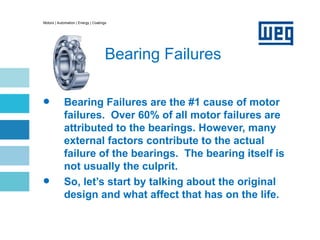
• Bearing Failures are the #1 cause of motor
failures. Over 60% of all motor failures are
attributed to the bearings. However, many
external factors contribute to the actual
failure of the bearings. The bearing itself is
not usually the culprit.
• So, let’s start by talking about the original
design and what affect that has on the life.
Motors | Automation | Energy | Coatings
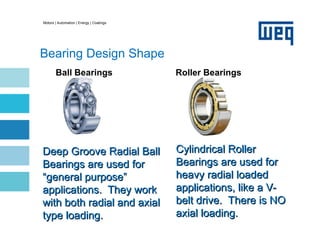
Bearing Design Shape
Deep Groove Radial Ball
Bearings are used for
“general purpose”
“general purpose”
applications. They work
with both radial and axial
type loading.
type loading.
Ball Bearings Roller Bearings
Cylindrical Roller
Cylindrical Roller
Bearings are used for
heavy radial loaded
heavy radial loaded
applications, like a V-
belt drive. There is NO
axial loading.
axial loading.
Motors | Automation | Energy | Coatings
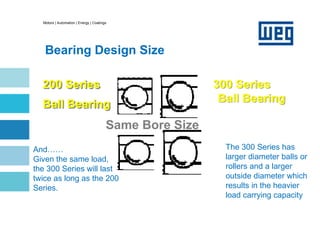
Bearing Design Size
200 Series
Ball Bearing
300 Series
Ball Bearing
Same Bore Size
And……
Given the same load,
the 300 Series will last
twice as long as the 200
Series.
The 300 Series has
larger diameter balls or
rollers and a larger
outside diameter which
results in the heavier
load carrying capacity
Motors | Automation | Energy | Coatings
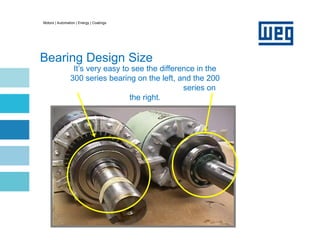
Bearing Design Size
It’s very easy to see the difference in the
300 series bearing on the left, and the 200
series on
the right.
Motors | Automation | Energy | Coatings
Bearing Design
Factors in the life of a bearing
Load and Speed. Those are the two determining factors in
designing a bearing for a particular application and the life
expected from that bearing in that application.
The size of the bearing will help determine how much load, and
for how long the bearing can handle that load. The size and type
of the rolling element also plays an important part in the load
rating.
Since you can’t change the design characteristics or the size of
the bearings in your motors, it is a good idea to include these
things in your analysis for selecting a new motor, in the
beginning.
Motors | Automation | Energy | Coatings
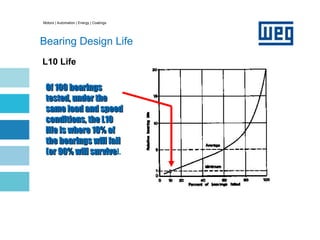
Bearing Design Life
L10 Life
Of 100 bearings
Of 100 bearings
tested, under the
tested, under the
same load and speed
same load and speed
conditions, the L10
conditions, the L10
life is where 10% of
the bearings will fail
(or 90% will survive
(or 90% will survive).
Motors | Automation | Energy | Coatings
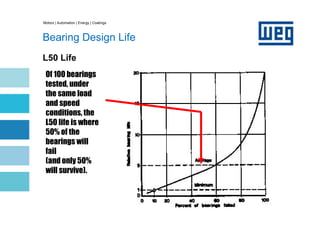
Bearing Design Life
L50 Life
Of 100 bearings
tested, under
the same load
and speed
conditions, the
L50 life is where
50% of the
bearings will
fail
(and only 50%
will survive).
Motors | Automation | Energy | Coatings
Bearing Design Life
L10 Life
L50 allows them to downsize the
bearing and save money. But who
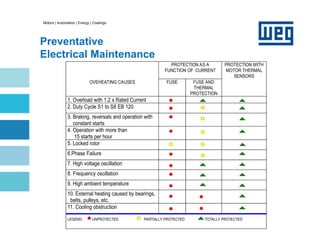
really pays?
Some Manufacturers use L10 life in
engineering their motors.
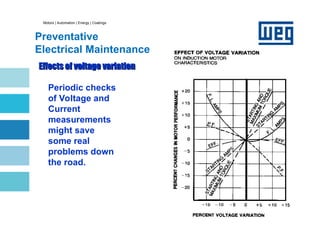
And some use L50 life in
engineering their motors.
Motors | Automation | Energy | Coatings
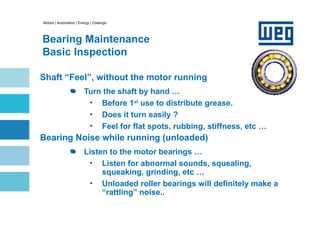
Bearing Maintenance
Basic Inspection
Shaft “Feel”, without the motor running
Turn the shaft by hand …
• Before 1st
use to distribute grease.
• Does it turn easily ?
• Feel for flat spots, rubbing, stiffness, etc …
Bearing Noise while running (unloaded)
Listen to the motor bearings …
• Listen for abnormal sounds, squealing,
squeaking, grinding, etc …
• Unloaded roller bearings will definitely make a
“rattling” noise..
Motors | Automation | Energy | Coatings
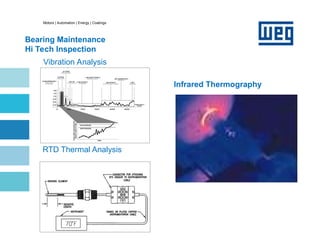
Bearing Maintenance
Hi Tech Inspection
Vibration Analysis
RTD Thermal Analysis
Infrared Thermography
Motors | Automation | Energy | Coatings
Bearing Failure Factors
Leading causes of bearing failure
Lack of lubrication
Too much lubrication
Incompatibility of greases
Contamination of lubrication
Internal Winding Temperatures
Motors | Automation | Energy | Coatings
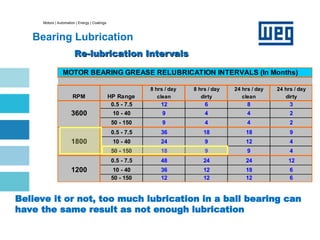
Bearing Lubrication
Re-lubrication Intervals
MOTOR BEARING GREASE RELUBRICATION INTERVALS (In Months)
8 hrs / day 8 hrs / day 24 hrs / day 24 hrs / day
RPM HP Range clean dirty clean dirty
0.5 - 7.5 12 6 8 3
3600 10 - 40 9 4 4 2
50 - 150 9 4 4 2
0.5 - 7.5 36 18 18 9
1800 10 - 40 24 9 12 4
50 - 150 18 9 9 4
0.5 - 7.5 48 24 24 12
1200 10 - 40 36 12 18 6
50 - 150 12 12 12 6
Believe it or not, too much lubrication in a ball bearing can
have the same result as not enough lubrication
Motors | Automation | Energy | Coatings
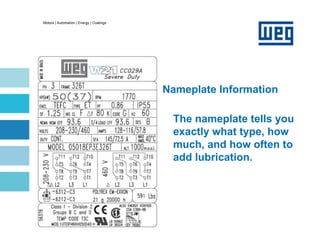
Nameplate Information
The nameplate tells you
exactly what type, how
much, and how often to
add lubrication.
Motors | Automation | Energy | Coatings
Bearing Lubrication Grease
Did you know you can’t mix just any grease with any other grease?
It’s true - doing so can cause catastrophic damage to equipment.
And it’s true even if the grease types are the same. Why is this?
Grease consists of two parts - the actual lubricant (normally oil) and a
carrier, or base. Each has it’s own function. It’s the carriers that are
not compatible. Always know the base of the grease you are adding
and the base of the grease you are adding to. Once you know those
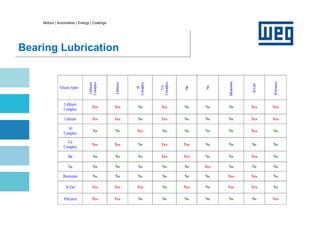
things, you can use the chart on the next page to determine if you
can add one grease to the other.
The grease compatibility chart will help ----
Motors | Automation | Energy | Coatings
Bearing Lubrication
Grease types
Lithium
Complex
Lithium
Al
Complex
Ca
Complex
Ba
Na
Bentonite
Si
Gel
Polyurea
Lithium
Complex
Yes Yes No Yes No No No Yes Yes
Lithium Yes Yes No Yes No No No Yes Yes
Al
Complex
No No Yes No No No No Yes No
Ca
Complex
Yes Yes No Yes Yes No No No No
Ba No No No Yes Yes No No Yes No
Na No No No No No Yes No No No
Bentonite No No No No No No Yes Yes No
Si Gel Yes Yes Yes No Yes No Yes Yes No
Polyurea Yes Yes No No No No No No Yes
Motors | Automation | Energy | Coatings
Bearing Lubrication
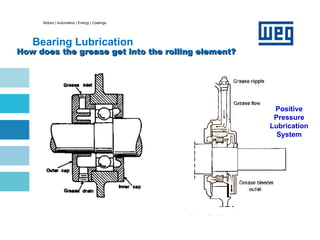
How does the grease get into the rolling element?
Positive
Pressure
Lubrication
System
Motors | Automation | Energy | Coatings
Basic Maintenance
1. Bearing & Lubrication Maintenance
2. Coupling Maintenance
3. Electrical Inspection
Motors | Automation | Energy | Coatings
Belt Drives
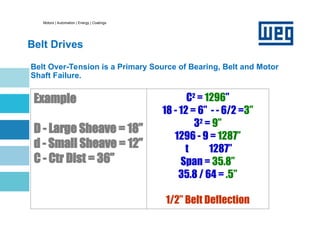
Belt Over-Tension is a Primary Source of Bearing, Belt and Motor
Shaft Failure.
Example
D - Large Sheave = 18”
d - Small Sheave = 12”
C - Ctr Dist = 36”
C2
= 1296”
18 - 12 = 6” - - 6/2 =3”
32
= 9”
1296 - 9 = 1287”
t 1287”
Span = 35.8”
35.8 / 64 = .5”
1/2” Belt Deflection
Motors | Automation | Energy | Coatings
Belt Drives
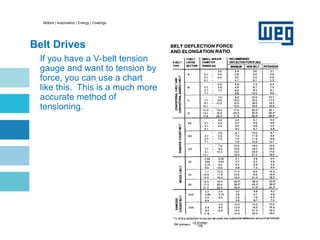
If you have a V-belt tension
gauge and want to tension by
force, you can use a chart
like this. This is a much more
accurate method of
tensioning.
Motors | Automation | Energy | Coatings
Belt Drives
Life Expectancy
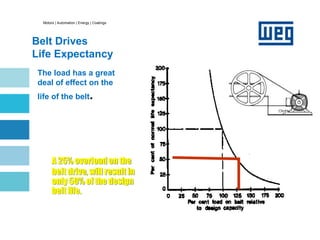
The load has a great
deal of effect on the
life of the belt.
A 25% overload on the
belt drive, will result in
only 50% of the design
belt life.
Motors | Automation | Energy | Coatings
Belt Drives
Life Expectancy
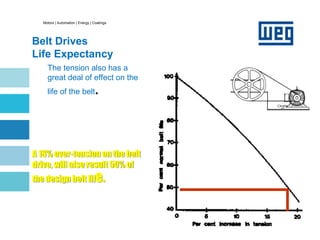
The tension also has a
great deal of effect on the
life of the belt.
A 18% over-tension on the belt
drive, will also result 50% of
the design belt life.
Motors | Automation | Energy | Coatings
Belt Drives
Life Expectancy
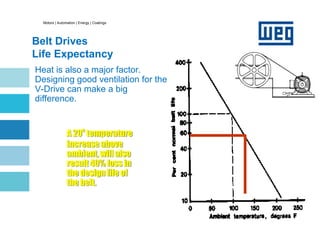
Heat is also a major factor.
Designing good ventilation for the
V-Drive can make a big
difference.
A 20o
temperature
increase above
ambient, will also
result 40% loss in
the design life of
the belt.
Motors | Automation | Energy | Coatings
Belt Drives
Installation
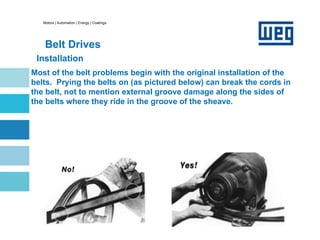
Most of the belt problems begin with the original installation of the
belts. Prying the belts on (as pictured below) can break the cords in
the belt, not to mention external groove damage along the sides of
the belts where they ride in the groove of the sheave.
Motors | Automation | Energy | Coatings
Belt Drives
Alignment
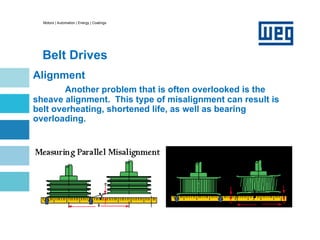
Another problem that is often overlooked is the
sheave alignment. This type of misalignment can result is
belt overheating, shortened life, as well as bearing
overloading.
Motors | Automation | Energy | Coatings
Belt Drives
Maintenance
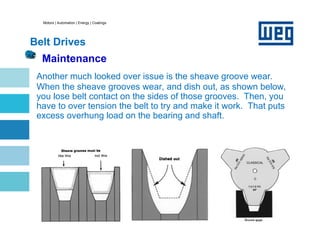
Another much looked over issue is the sheave groove wear.
When the sheave grooves wear, and dish out, as shown below,
you lose belt contact on the sides of those grooves. Then, you
have to over tension the belt to try and make it work. That puts
excess overhung load on the bearing and shaft.
Motors | Automation | Energy | Coatings
Belt Drives
Maintenance
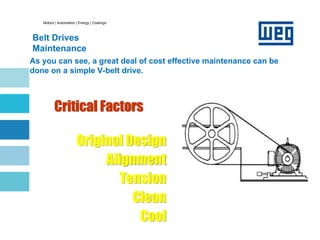
As you can see, a great deal of cost effective maintenance can be
done on a simple V-belt drive.
Critical Factors
Original Design
Alignment
Tension
Clean
Cool
Motors | Automation | Energy | Coatings
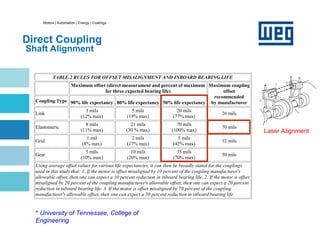
Direct Coupling
Shaft Alignment
TABLE.2 RULES FOR OFFSET MISALIGNMENT AND INBOARD BEARING LIFE
Maximum offset (direct measurament and percent of maximum
for three expected bearing life)
Coupling Type 90% life expectancy 80% life expectancy 50% life expectancy
Maximum coupling
offset
recommended
by manufacturer
Link
3 mils
(12% max)
5 mils
(19% max)
20 mils
(77% max)
26 mils
Elastomeric
8 mils
(11% max)
21 mils
(30 % max)
70 mils
(100% max)
70 mils
Grid
1 mil
(8% max)
2 mils
(17% max)
5 mils
(42% max)
12 mils
Gear
5 mils
(10% max)
10 mils
(20% max)
35 mils
(70% max)
50 mils
Using average offset values for various life expectancies, it can then be broadly stated for the couplings
used in this study that: 1. If the motor is offset misaligned by 10 percent of the coupling manufacturer's
allowable offset, then one can expect a 10 percent reduction in inboard bearing life. 2. If the motor is offset
misaligned by 20 percent of the coupling manufacturer's allowable offset, then one can expect a 20 percent
reduction in inboard bearing life. 3. If the motor is offset misaligned by 70 percent of the coupling
manufacturer's allowable offset, then one can expect a 50 percent reduction in inboard bearing life.
* University of Tennessee, College of
Engineering
Laser Alignment
Motors | Automation | Energy | Coatings
Basic Maintenance
1. Bearing & Lubrication Maintenance
2. Coupling Maintenance
3. Electrical Inspection
Motors | Automation | Energy | Coatings
Electrical Inspection
There are a lot of items included in this area, but it
starts with good wiring practices, including good clean
connections, and good grounding procedures. Many
electrical failures involving motors happen during the
initial connections. If your electrician doesn’t
understand the wiring diagram, get some outside help.
Don’t use the trial and error method. Most electrical
failures that happen because of miss-connection, will
do so quickly. This is an expensive mistake.
Motors | Automation | Energy | Coatings
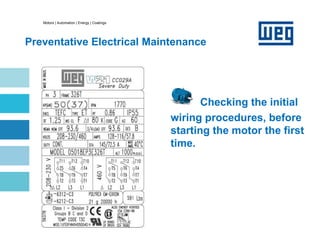
Preventative Electrical Maintenance
Checking the initial
wiring procedures, before
starting the motor the first
time.
Motors | Automation | Energy | Coatings
Motor Protection
Protecting the motor from
overloads
overloads
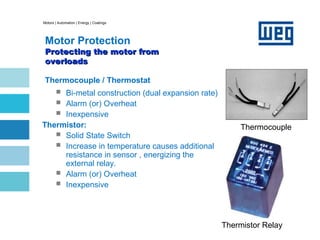
Thermocouple / Thermostat
 Bi-metal construction (dual expansion rate)
 Alarm (or) Overheat
 Inexpensive
Thermistor:
 Solid State Switch
 Increase in temperature causes additional
resistance in sensor , energizing the
external relay.
 Alarm (or) Overheat
 Inexpensive
Thermocouple
Thermistor Relay
Motors | Automation | Energy | Coatings
Motor Protection
Protecting the motor from overloads
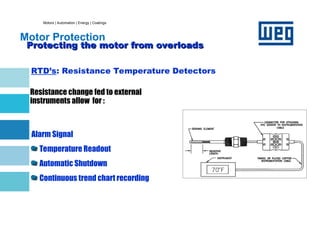
RTD’s: Resistance Temperature Detectors
Resistance change fed to external
instruments allow for :
Alarm Signal
Temperature Readout
Automatic Shutdown
Continuous trend chart recording
Motors | Automation | Energy | Coatings
Motor Protection
Protecting the motor from overloads
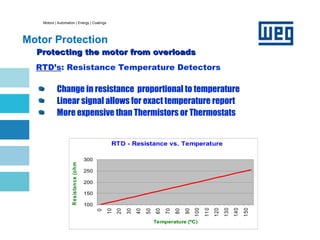
RTD’s: Resistance Temperature Detectors
Change in resistance proportional to temperature
Linear signal allows for exact temperature report
More expensive than Thermistors or Thermostats
RTD - Resistance vs. Temperature
100
150
200
250
300
0
10
20
30
40
50
60
70
80
90
100
11
0
120
130
140
150
Temperature (ºC)
R
esistance
(ohms)
Motors | Automation | Energy | Coatings
Preventative
Electrical Maintenance
PROTECTION AS A
FUNCTION OF CURRENT
PROTECTION WITH
MOTOR THERMAL
SENSORS
OVEHEATING CAUSES FUSE FUSE AND
THERMAL
PROTECTION
1. Overload with 1.2 x Rated Current
2. Duty Cycle S1 to S8 EB 120
3. Braking, reversals and operation with
constant starts
4. Operation with more than
15 starts per hour
5. Locked rotor
6.Phase Failure
7. High voltage oscillation
8. Frequency oscillation
9. High ambient temperature
10. External heating caused by bearings,
belts, pulleys, etc.
11. Cooling obstruction
LEGEND: UNPROTECTED PARTIALLY PROTECTED TOTALLY PROTECTED
Motors | Automation | Energy | Coatings
Preventative
Electrical Maintenance
Effects of voltage variation
Periodic checks
of Voltage and
Current
measurements
might save
some real
problems down
the road.
Motors | Automation | Energy | Coatings
Preventative
Electrical Maintenance
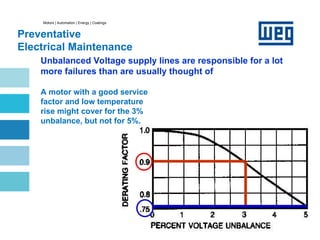
Unbalanced Voltage supply lines are responsible for a lot
more failures than are usually thought of
A motor with a good service
factor and low temperature
rise might cover for the 3%
unbalance, but not for 5%.
Motors | Automation | Energy | Coatings
Application vs. Design Issues
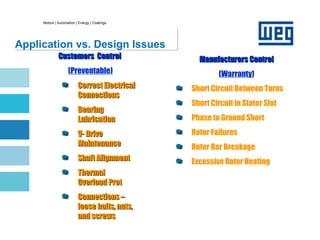
Customers Control
Customers Control
(Preventable)
Correct Electrical
Correct Electrical
Connections
Connections
Bearing
Bearing
Lubrication
Lubrication
V- Drive
V- Drive
Maintenance
Maintenance
Shaft Alignment
Shaft Alignment
Thermal
Thermal
Overload Prot
Overload Prot
Connections –
Connections –
loose bolts, nuts,
loose bolts, nuts,
and screws
and screws
Manufacturers Control
(Warranty)
Short Circuit Between Turns
Short Circuit in Stator Slot
Phase to Ground Short
Rotor Failures
Rotor Bar Breakage
Excessive Rotor Heating
Motors | Automation | Energy | Coatings
Preventative Maintenance
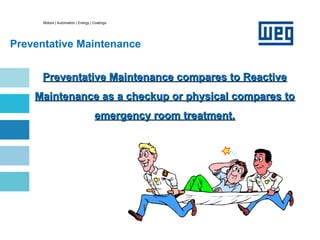
Preventative Maintenance compares to Reactive
Maintenance as a checkup or physical compares to
emergency room treatment.
Motors | Automation | Energy | Coatings
Equipment Life/Cost Curve
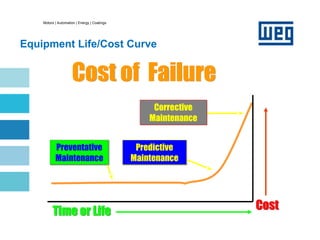
Cost of Failure
Corrective
Maintenance
Predictive
Maintenance
Preventative
Maintenance
Cost
Time or Life
Motors | Automation | Energy | Coatings
Predictive Maintenance
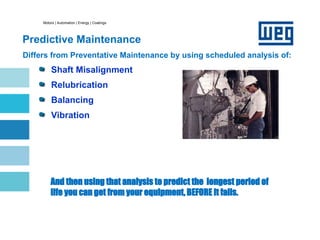
Differs from Preventative Maintenance by using scheduled analysis of:
Shaft Misalignment
Relubrication
Balancing
Vibration
And then using that analysis to predict the longest period of
life you can get from your equipment, BEFORE it fails.
Motors | Automation | Energy | Coatings
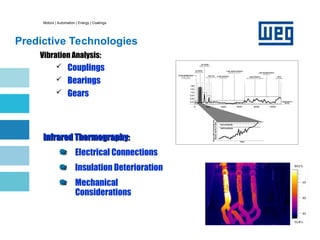
Predictive Technologies
Vibration Analysis:
 Couplings
 Bearings
 Gears
Infrared Thermography:
Electrical Connections
Insulation Deterioration
Mechanical
Considerations
Motors | Automation | Energy | Coatings
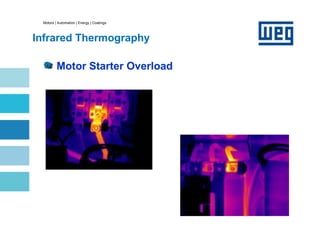
Infrared Thermography
Motor Starter Overload
Motors | Automation | Energy | Coatings
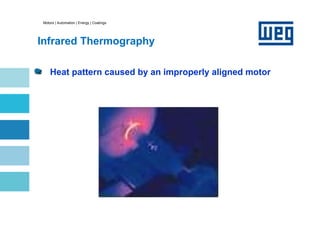
Infrared Thermography
Heat pattern caused by an improperly aligned motor
Motors | Automation | Energy | Coatings
Conclusions
You can get more for your maintenance dollars with
Preventive and Predictive maintenance routines. The old days
of “Don’t fix it if it ain’t broke” are going by the way.
Downtime and lost production is simply too expensive to let it
run ‘til it quits. Identifying the critical applications, and
starting a routine to log the failures, their causes and repairs
is the first step.
Motors | Automation | Energy | Coatings
Conclusions
Also, identifying the right motor in the first place is a great place
to start. Some of the most important features to look for are:
Motor Insulation and Temperature Rise
Service Factor
Bearing Sizes and Load Capacities
Construction Materials
Efficiency ( Not only does the efficiency of the motor save
you operating costs, but it helps to ensure the quality of materials
the motor is built with )

basic of machine, motor maintenance..ppt

  • 1.
    Motors | Automation| Energy | Coatings Basic Electric Motor Basic Electric Motor Maintenance Maintenance Ed Robinson Ed Robinson Regional Service Manger Regional Service Manger erobinson@weg.net erobinson@weg.net
  • 2.
    Motors | Automation| Energy | Coatings Eli Lilly Study Eli Lilly Study Primary causes of failure: Primary causes of failure: • Misalignment of sheaves and couplings Misalignment of sheaves and couplings • Over/under lubrication of bearings Over/under lubrication of bearings • Improper tension in belted systems Improper tension in belted systems • Temperature: Readings taken on the drive-end bell housing Temperature: Readings taken on the drive-end bell housing within 1 in. of the drive shaft closely approximate the within 1 in. of the drive shaft closely approximate the internal internal winding and bearing temperatures winding and bearing temperatures
  • 3.
    Motors | Automation| Energy | Coatings Basic Maintenance Basic Maintenance 1. 1. Bearing & Lubrication Bearing & Lubrication Maintenance Maintenance 2. 2. Coupling Maintenance Coupling Maintenance 3. 3. Electrical Inspection Electrical Inspection
  • 4.
    Motors | Automation| Energy | Coatings Bearing Failures • Bearing Failures are the #1 cause of motor failures. Over 60% of all motor failures are attributed to the bearings. However, many external factors contribute to the actual failure of the bearings. The bearing itself is not usually the culprit. • So, let’s start by talking about the original design and what affect that has on the life.
  • 5.
    Motors | Automation| Energy | Coatings Bearing Design Shape Deep Groove Radial Ball Deep Groove Radial Ball Bearings are used for Bearings are used for “general purpose” “general purpose” applications. They work applications. They work with both radial and axial with both radial and axial type loading. type loading. Ball Bearings Roller Bearings Cylindrical Roller Cylindrical Roller Bearings are used for Bearings are used for heavy radial loaded heavy radial loaded applications, like a V- applications, like a V- belt drive. There is NO belt drive. There is NO axial loading. axial loading.
  • 6.
    Motors | Automation| Energy | Coatings Bearing Design Size 200 Series Ball Bearing 300 Series Ball Bearing Same Bore Size And…… Given the same load, the 300 Series will last twice as long as the 200 Series. The 300 Series has larger diameter balls or rollers and a larger outside diameter which results in the heavier load carrying capacity
  • 7.
    Motors | Automation| Energy | Coatings Bearing Design Size It’s very easy to see the difference in the 300 series bearing on the left, and the 200 series on the right.
  • 8.
    Motors | Automation| Energy | Coatings Bearing Design Factors in the life of a bearing Factors in the life of a bearing Load and Speed. Those are the two determining factors in designing a bearing for a particular application and the life expected from that bearing in that application. The size of the bearing will help determine how much load, and for how long the bearing can handle that load. The size and type of the rolling element also plays an important part in the load rating. Since you can’t change the design characteristics or the size of the bearings in your motors, it is a good idea to include these things in your analysis for selecting a new motor, in the beginning.
  • 9.
    Motors | Automation| Energy | Coatings Bearing Design Life L10 Life Of 100 bearings Of 100 bearings tested, under the tested, under the same load and speed same load and speed conditions, the L10 conditions, the L10 life is where 10% of life is where 10% of the bearings will fail the bearings will fail (or 90% will survive (or 90% will survive).
  • 10.
    Motors | Automation| Energy | Coatings Bearing Design Life L50 Life Of 100 bearings tested, under the same load and speed conditions, the L50 life is where 50% of the bearings will fail (and only 50% will survive).
  • 11.
    Motors | Automation| Energy | Coatings Bearing Design Life L10 Life L50 allows them to downsize the bearing and save money. But who really pays? Some Manufacturers use L10 life in engineering their motors. And some use L50 life in engineering their motors.
  • 12.
    Motors | Automation| Energy | Coatings Bearing Maintenance Basic Inspection Shaft “Feel”, without the motor running Turn the shaft by hand … • Before 1st use to distribute grease. • Does it turn easily ? • Feel for flat spots, rubbing, stiffness, etc … Bearing Noise while running (unloaded) Listen to the motor bearings … • Listen for abnormal sounds, squealing, squeaking, grinding, etc … • Unloaded roller bearings will definitely make a “rattling” noise..
  • 13.
    Motors | Automation| Energy | Coatings Bearing Maintenance Hi Tech Inspection Vibration Analysis RTD Thermal Analysis Infrared Thermography
  • 14.
    Motors | Automation| Energy | Coatings Bearing Failure Factors Leading causes of bearing failure Lack of lubrication Too much lubrication Incompatibility of greases Contamination of lubrication Internal Winding Temperatures
  • 15.
    Motors | Automation| Energy | Coatings Bearing Lubrication Re-lubrication Intervals Re-lubrication Intervals MOTOR BEARING GREASE RELUBRICATION INTERVALS (In Months) 8 hrs / day 8 hrs / day 24 hrs / day 24 hrs / day RPM HP Range clean dirty clean dirty 0.5 - 7.5 12 6 8 3 3600 10 - 40 9 4 4 2 50 - 150 9 4 4 2 0.5 - 7.5 36 18 18 9 1800 10 - 40 24 9 12 4 50 - 150 18 9 9 4 0.5 - 7.5 48 24 24 12 1200 10 - 40 36 12 18 6 50 - 150 12 12 12 6 Believe it or not, too much lubrication in a ball bearing can have the same result as not enough lubrication
  • 16.
    Motors | Automation| Energy | Coatings Nameplate Information The nameplate tells you exactly what type, how much, and how often to add lubrication.
  • 17.
    Motors | Automation| Energy | Coatings Bearing Lubrication Grease Did you know you can’t mix just any grease with any other grease? It’s true - doing so can cause catastrophic damage to equipment. And it’s true even if the grease types are the same. Why is this? Grease consists of two parts - the actual lubricant (normally oil) and a carrier, or base. Each has it’s own function. It’s the carriers that are not compatible. Always know the base of the grease you are adding and the base of the grease you are adding to. Once you know those things, you can use the chart on the next page to determine if you can add one grease to the other. The grease compatibility chart will help ----
  • 18.
    Motors | Automation| Energy | Coatings Bearing Lubrication Grease types Lithium Complex Lithium Al Complex Ca Complex Ba Na Bentonite Si Gel Polyurea Lithium Complex Yes Yes No Yes No No No Yes Yes Lithium Yes Yes No Yes No No No Yes Yes Al Complex No No Yes No No No No Yes No Ca Complex Yes Yes No Yes Yes No No No No Ba No No No Yes Yes No No Yes No Na No No No No No Yes No No No Bentonite No No No No No No Yes Yes No Si Gel Yes Yes Yes No Yes No Yes Yes No Polyurea Yes Yes No No No No No No Yes
  • 19.
    Motors | Automation| Energy | Coatings Bearing Lubrication How does the grease get into the rolling element? How does the grease get into the rolling element? Positive Pressure Lubrication System
  • 20.
    Motors | Automation| Energy | Coatings Basic Maintenance 1. Bearing & Lubrication Maintenance 2. Coupling Maintenance 3. Electrical Inspection
  • 21.
    Motors | Automation| Energy | Coatings Belt Drives Belt Over-Tension is a Primary Source of Bearing, Belt and Motor Shaft Failure. Example D - Large Sheave = 18” d - Small Sheave = 12” C - Ctr Dist = 36” C2 = 1296” 18 - 12 = 6” - - 6/2 =3” 32 = 9” 1296 - 9 = 1287” t 1287” Span = 35.8” 35.8 / 64 = .5” 1/2” Belt Deflection
  • 22.
    Motors | Automation| Energy | Coatings Belt Drives If you have a V-belt tension gauge and want to tension by force, you can use a chart like this. This is a much more accurate method of tensioning.
  • 23.
    Motors | Automation| Energy | Coatings Belt Drives Life Expectancy The load has a great deal of effect on the life of the belt. A 25% overload on the belt drive, will result in only 50% of the design belt life.
  • 24.
    Motors | Automation| Energy | Coatings Belt Drives Life Expectancy The tension also has a great deal of effect on the life of the belt. A 18% over-tension on the belt drive, will also result 50% of the design belt life.
  • 25.
    Motors | Automation| Energy | Coatings Belt Drives Life Expectancy Heat is also a major factor. Designing good ventilation for the V-Drive can make a big difference. A 20o temperature increase above ambient, will also result 40% loss in the design life of the belt.
  • 26.
    Motors | Automation| Energy | Coatings Belt Drives Installation Most of the belt problems begin with the original installation of the belts. Prying the belts on (as pictured below) can break the cords in the belt, not to mention external groove damage along the sides of the belts where they ride in the groove of the sheave.
  • 27.
    Motors | Automation| Energy | Coatings Belt Drives Alignment Another problem that is often overlooked is the sheave alignment. This type of misalignment can result is belt overheating, shortened life, as well as bearing overloading.
  • 28.
    Motors | Automation| Energy | Coatings Belt Drives Maintenance Another much looked over issue is the sheave groove wear. When the sheave grooves wear, and dish out, as shown below, you lose belt contact on the sides of those grooves. Then, you have to over tension the belt to try and make it work. That puts excess overhung load on the bearing and shaft.
  • 29.
    Motors | Automation| Energy | Coatings Belt Drives Maintenance As you can see, a great deal of cost effective maintenance can be done on a simple V-belt drive. Critical Factors Original Design Alignment Tension Clean Cool
  • 30.
    Motors | Automation| Energy | Coatings Direct Coupling Shaft Alignment TABLE.2 RULES FOR OFFSET MISALIGNMENT AND INBOARD BEARING LIFE Maximum offset (direct measurament and percent of maximum for three expected bearing life) Coupling Type 90% life expectancy 80% life expectancy 50% life expectancy Maximum coupling offset recommended by manufacturer Link 3 mils (12% max) 5 mils (19% max) 20 mils (77% max) 26 mils Elastomeric 8 mils (11% max) 21 mils (30 % max) 70 mils (100% max) 70 mils Grid 1 mil (8% max) 2 mils (17% max) 5 mils (42% max) 12 mils Gear 5 mils (10% max) 10 mils (20% max) 35 mils (70% max) 50 mils Using average offset values for various life expectancies, it can then be broadly stated for the couplings used in this study that: 1. If the motor is offset misaligned by 10 percent of the coupling manufacturer's allowable offset, then one can expect a 10 percent reduction in inboard bearing life. 2. If the motor is offset misaligned by 20 percent of the coupling manufacturer's allowable offset, then one can expect a 20 percent reduction in inboard bearing life. 3. If the motor is offset misaligned by 70 percent of the coupling manufacturer's allowable offset, then one can expect a 50 percent reduction in inboard bearing life. * University of Tennessee, College of Engineering Laser Alignment
  • 31.
    Motors | Automation| Energy | Coatings Basic Maintenance 1. Bearing & Lubrication Maintenance 2. Coupling Maintenance 3. Electrical Inspection
  • 32.
    Motors | Automation| Energy | Coatings Electrical Inspection There are a lot of items included in this area, but it starts with good wiring practices, including good clean connections, and good grounding procedures. Many electrical failures involving motors happen during the initial connections. If your electrician doesn’t understand the wiring diagram, get some outside help. Don’t use the trial and error method. Most electrical failures that happen because of miss-connection, will do so quickly. This is an expensive mistake.
  • 33.
    Motors | Automation| Energy | Coatings Preventative Electrical Maintenance Checking the initial wiring procedures, before starting the motor the first time.
  • 34.
    Motors | Automation| Energy | Coatings Motor Protection Protecting the motor from Protecting the motor from overloads overloads Thermocouple / Thermostat  Bi-metal construction (dual expansion rate)  Alarm (or) Overheat  Inexpensive Thermistor:  Solid State Switch  Increase in temperature causes additional resistance in sensor , energizing the external relay.  Alarm (or) Overheat  Inexpensive Thermocouple Thermistor Relay
  • 35.
    Motors | Automation| Energy | Coatings Motor Protection Protecting the motor from overloads Protecting the motor from overloads RTD’s: Resistance Temperature Detectors Resistance change fed to external instruments allow for : Alarm Signal Temperature Readout Automatic Shutdown Continuous trend chart recording
  • 36.
    Motors | Automation| Energy | Coatings Motor Protection Protecting the motor from overloads Protecting the motor from overloads RTD’s: Resistance Temperature Detectors Change in resistance proportional to temperature Linear signal allows for exact temperature report More expensive than Thermistors or Thermostats RTD - Resistance vs. Temperature 100 150 200 250 300 0 10 20 30 40 50 60 70 80 90 100 11 0 120 130 140 150 Temperature (ºC) R esistance (ohms)
  • 37.
    Motors | Automation| Energy | Coatings Preventative Electrical Maintenance PROTECTION AS A FUNCTION OF CURRENT PROTECTION WITH MOTOR THERMAL SENSORS OVEHEATING CAUSES FUSE FUSE AND THERMAL PROTECTION 1. Overload with 1.2 x Rated Current 2. Duty Cycle S1 to S8 EB 120 3. Braking, reversals and operation with constant starts 4. Operation with more than 15 starts per hour 5. Locked rotor 6.Phase Failure 7. High voltage oscillation 8. Frequency oscillation 9. High ambient temperature 10. External heating caused by bearings, belts, pulleys, etc. 11. Cooling obstruction LEGEND: UNPROTECTED PARTIALLY PROTECTED TOTALLY PROTECTED
  • 38.
    Motors | Automation| Energy | Coatings Preventative Electrical Maintenance Effects of voltage variation Effects of voltage variation Periodic checks of Voltage and Current measurements might save some real problems down the road.
  • 39.
    Motors | Automation| Energy | Coatings Preventative Electrical Maintenance Unbalanced Voltage supply lines are responsible for a lot more failures than are usually thought of A motor with a good service factor and low temperature rise might cover for the 3% unbalance, but not for 5%.
  • 40.
    Motors | Automation| Energy | Coatings Application vs. Design Issues Customers Control Customers Control (Preventable) Correct Electrical Correct Electrical Connections Connections Bearing Bearing Lubrication Lubrication V- Drive V- Drive Maintenance Maintenance Shaft Alignment Shaft Alignment Thermal Thermal Overload Prot Overload Prot Connections – Connections – loose bolts, nuts, loose bolts, nuts, and screws and screws Manufacturers Control Manufacturers Control (Warranty) Short Circuit Between Turns Short Circuit in Stator Slot Phase to Ground Short Rotor Failures Rotor Bar Breakage Excessive Rotor Heating
  • 41.
    Motors | Automation| Energy | Coatings Preventative Maintenance Preventative Maintenance compares to Reactive Preventative Maintenance compares to Reactive Maintenance as a checkup or physical compares to Maintenance as a checkup or physical compares to emergency room treatment. emergency room treatment.
  • 42.
    Motors | Automation| Energy | Coatings Equipment Life/Cost Curve Cost of Failure Corrective Maintenance Predictive Maintenance Preventative Maintenance Cost Time or Life
  • 43.
    Motors | Automation| Energy | Coatings Predictive Maintenance Differs from Preventative Maintenance by using scheduled analysis of: Shaft Misalignment Relubrication Balancing Vibration And then using that analysis to predict the longest period of life you can get from your equipment, BEFORE it fails.
  • 44.
    Motors | Automation| Energy | Coatings Predictive Technologies Vibration Analysis:  Couplings  Bearings  Gears Infrared Thermography: Infrared Thermography: Electrical Connections Insulation Deterioration Mechanical Considerations
  • 45.
    Motors | Automation| Energy | Coatings Infrared Thermography Motor Starter Overload
  • 46.
    Motors | Automation| Energy | Coatings Infrared Thermography Heat pattern caused by an improperly aligned motor
  • 47.
    Motors | Automation| Energy | Coatings Conclusions You can get more for your maintenance dollars with Preventive and Predictive maintenance routines. The old days of “Don’t fix it if it ain’t broke” are going by the way. Downtime and lost production is simply too expensive to let it run ‘til it quits. Identifying the critical applications, and starting a routine to log the failures, their causes and repairs is the first step.
  • 48.
    Motors | Automation| Energy | Coatings Conclusions Also, identifying the right motor in the first place is a great place to start. Some of the most important features to look for are: Motor Insulation and Temperature Rise Service Factor Bearing Sizes and Load Capacities Construction Materials Efficiency ( Not only does the efficiency of the motor save you operating costs, but it helps to ensure the quality of materials the motor is built with )