Basic of News Writing
CHELDY S. ELUMBA-PABLEO,MPA;LlB
What is News Writing?
News writing gives the reader information that will
have an impact on them in some way.
It usually flows from most important to least important.
“What is news? It is information only.” –Walter
Cronkite, former CBS News anchor
CHELDY S. ELUMBA-PABLEO,MPA;LlB
HEADLINE EXAMPLE
Headline
CHELDY S. ELUMBA-PABLEO,MPA;LlB
HOW TO WRITE HEADLINE
A headline is an abstract sentence
A headline will determine the angle of the story
Usually it is only five to ten words
It is a complete thought
It has a subject and a verb, and often an object
Be specific, direct and to the point.
Write headlines, not titles. A headline must state a
benefit to the target audience.
CHELDY S. ELUMBA-PABLEO,MPA;LlB
FUNCTIONS OF HEADLINE:
To attract readers
To tell the story (in summary)
CHELDY S. ELUMBA-PABLEO,MPA;LlB
Limit your headline to maximum of 10 words
Use “,” instead of the word “and”
Use the present tense of the verb
Use the shortest words possible:
cop-policeman vs-against
nab-arrest stude-student
up-increase join-participate
down-decrease prexy-president
CHELDY S. ELUMBA-PABLEO,MPA;LlB
Use historical present tense if the verb is in
the active verb
Wrong: Reyes topped editorial tilt
Correct: Reyes tops editorial tilt
Avoid helping verb if the verb is in the
passive verb
Wrong: Drug pushers are nabbed
Correct: Drug pushers nabbed
CHELDY S. ELUMBA-PABLEO,MPA;LlB
Use infinitive verb for future event:
Wrong: NORSU will enjoy WiFi connectivity
Correct: NORSU to enjoy WiFi connectivity
Do not use a period at the end of the headline
Omit the articles ‘a’, ‘an’ and ‘the’
Use single quotes (‘’) instead of double quotes (“”)
Provide the source of the quote at the end of the
headline
Ex: Crackdown on errant bus firms–Enrile
CHELDY S. ELUMBA-PABLEO,MPA;LlB
Do not use a person’s surname unless he/she is
prominent, use common noun instead
Wrong: Recosana wins nat’l painting tilt
Correct: NORSU stude wins nat’l painting tilt
Use specific verb instead of generalities
Wrong: Trader killed
Better: Trader stabbed to death
Just report facts; do not editorialize
Wrong: Pnoy gives inspiring talk
(The word “inspiring’ is an opinion)
CHELDY S. ELUMBA-PABLEO,MPA;LlB
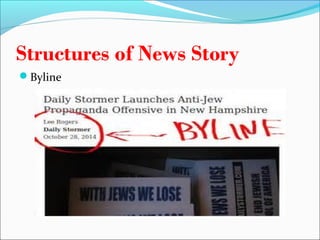
Structures of News Story
Byline
CHELDY S. ELUMBA-PABLEO,MPA;LlB
Structures of News Story
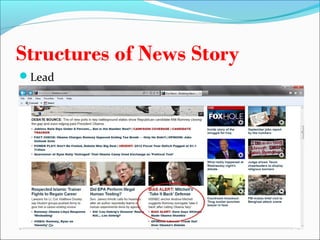
Lead
CHELDY S. ELUMBA-PABLEO,MPA;LlB
Structures of News Story
Body (Details)
CHELDY S. ELUMBA-PABLEO,MPA;LlB
COMMONLY USED STYLE
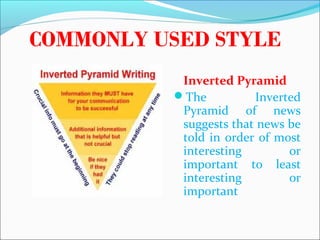
Inverted Pyramid
The Inverted
Pyramid of news
suggests that news be
told in order of most
interesting or
important to least
interesting or
important
Most interesting or
most important
Least
interesting
or least
important
CHELDY S. ELUMBA-PABLEO,MPA;LlB
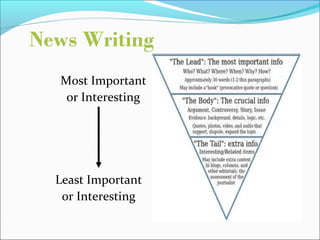
News Writing
Most Important
or Interesting
Least Important
or Interesting
CHELDY S. ELUMBA-PABLEO,MPA;LlB
LEAD
Most journalists
think the news lead
is the most
important part of the
news story. It is an
art work of concise
information that
captures the gist of a
news story in one or
two sentences.
CHELDY S. ELUMBA-PABLEO,MPA;LlB
Purposes of LEAD
To summarize the story.
To arouse the interest of the readers.
CHELDY S. ELUMBA-PABLEO,MPA;LlB
Lead Writing
1. Keep leads short. Those with 35 words or
less are preferred.
2. Leads limited to one or two sentences
are preferred.
3. Avoid starting leads with "when" or
"where" unless the time or place is unusual.
Most leads start with "who" or "what."
CHELDY S. ELUMBA-PABLEO,MPA;LlB
4. Avoid beginning leads with "there" or "this."
5. In leads about future events, the time, day
(date) and place usually go at the end of the
paragraph.
6. Use quote and question leads sparingly.
7. Avoid the trite lead, such as " caught like rats in
a trap " and " never in the history of.”
lead writing
CHELDY S. ELUMBA-
PABLEO,MPA;LlB
7. In leads about past events, the day (date) of
the event usually appears before or after the
verb. Sometimes the day (date) comes at the
end of the first sentence or the paragraph if it
is a one-sentence lead.
8. The first five to "what happened" makes a
better story than the fact it did.
CHELDY S. ELUMBA-PABLEO,MPA;LlB
TYPES OF LEAD
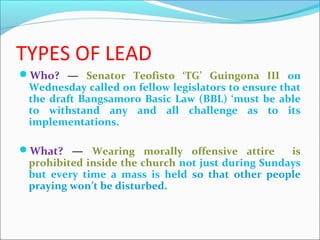
Who? — Senator Teofisto ‘TG’ Guingona III on
Wednesday called on fellow legislators to ensure that
the draft Bangsamoro Basic Law (BBL) ‘must be able
to withstand any and all challenge as to its
implementations.
What? — Wearing morally offensive attire is
prohibited inside the church not just during Sundays
but every time a mass is held so that other people
praying won’t be disturbed.
CHELDY S. ELUMBA-PABLEO,MPA;LlB
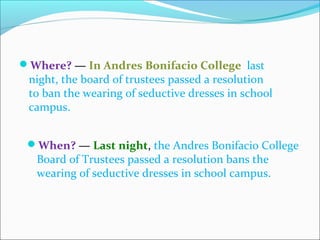
Where? — In Andres Bonifacio College last
night, the board of trustees passed a resolution
to ban the wearing of seductive dresses in school
campus.
When? — Last night, the Andres Bonifacio College
Board of Trustees passed a resolution bans the
wearing of seductive dresses in school campus.
CHELDY S. ELUMBA-PABLEO,MPA;LlB
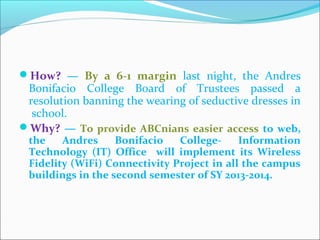
How? — By a 6-1 margin last night, the Andres
Bonifacio College Board of Trustees passed a
resolution banning the wearing of seductive dresses in
school.
Why? — To provide ABCnians easier access to web,
the Andres Bonifacio College- Information
Technology (IT) Office will implement its Wireless
Fidelity (WiFi) Connectivity Project in all the campus
buildings in the second semester of SY 2013-2014.
CHELDY S. ELUMBA-PABLEO,MPA;LlB
Body Construction and
Organization
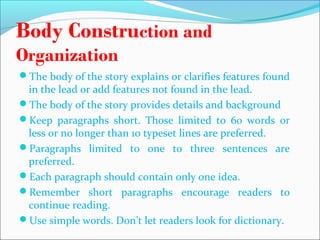
The body of the story explains or clarifies features found
in the lead or add features not found in the lead.
The body of the story provides details and background
Keep paragraphs short. Those limited to 60 words or
less or no longer than 10 typeset lines are preferred.
Paragraphs limited to one to three sentences are
preferred.
Each paragraph should contain only one idea.
Remember short paragraphs encourage readers to
continue reading.
Use simple words. Don’t let readers look for dictionary.
CHELDY S. ELUMBA-PABLEO,MPA;LlB
Body Construction and Organization
Make sure information introduced or outlined in
the lead is covered in the same order in the body of
the story.
Avoid introducing new information at the end of a
story. All aspects of a story should usually be
introduced or outlined in the first few paragraphs.
Transitions are necessary to show the reader that
the writer has a sense of direction. A word, phrase,
sentence or paragraph can move the reader from
one thought to another.
CHELDY S. ELUMBA-PABLEO,MPA;LlB
Body Construction and Organization
Add attributions of prominent persons
Add faculty and students’ reactions
Arrange your details in logical order
Before using the acronym of the word or phrase, elaborate
it first on the previous sentences
In attribution, use the position of the person (other titles
may be omitted)
Note:
When you want to incorporate information which is
not directly connected to the main story, but is related, use
conjunctive words or conjunctive phrase such as
meanwhile, in a related development, in this light, etc.
CHELDY S. ELUMBA-PABLEO,MPA;LlB
TRANSITION/QUOTE FORMULA
Each paragraph must relate the
other succeeding paragraphs. The
flow of the subject matter must
connect in a descending idea.
(From the most to least
Important.)
CHELDY S. ELUMBA-PABLEO,MPA;LlB
TRANSITIONS
VERY, VERY IMPORTANT. Hold the story together. Link the
paragraphs together.
Can be fact, indirect quote or a partial quote.
For example - FACT TRANSITION:
(Lead) President Barack Obama will speak on Friday to seniors
about getting involved in community service work.
(Direct Quote)“Seniors will learn a lot about duty and
commitment when they hear President Obama,” Principal Ike
Sumter said. “We are so excited that he agreed to come.”
(Fact Transition) Before becoming president, Obama worked as
a community organizer in Chicago.
CHELDY S. ELUMBA-PABLEO,MPA;LlB
TRANSITIONS
Can be fact, indirect quote or a partial quote.
For example - INDIRECT QUOTE TRANSITION:
(Lead) President Barack Obama will speak on Friday to seniors
about getting involved in community service work.
(Direct Quote)“Seniors will learn a lot about duty and
commitment when they hear President Obama,” Principal Ike
Sumter said. “We are so excited that he agreed to come.”
(IQ Transition) President Obama said he believes community
service is more important than college in building character.
CHELDY S. ELUMBA-PABLEO,MPA;LlB
Can be fact, indirect quote or a partial quote.
For example - PARTIAL QUOTE TRANSITION:
(Lead) President Barack Obama will speak on Friday to
seniors about getting involved in community service work.
(Direct Quote)“Seniors will learn a lot about duty and
commitment when they hear President Obama,” Principal
Ike Sumter said. “We are so excited that he agreed to come.”
(PQ Transition) President Obama said he believes
community service is “extremely valuable lesson” for every
teen to have.
CHELDY S. ELUMBA-PABLEO,MPA;LlB
Use transitional words to help with the flow (as
needed): After all, Also, Finally, In addition, However,
Otherwise, Then
For example:
In addition to speaking about community service, Obama
plans to talk to students about the importance of voting.
NOTE: BE SURE YOU USE THE APPROPRITE
TRANSITIONAL WORD.
• Use parts of the direct quotes to create the transition.
And then use the rest of the quote as direct quote.
CHELDY S. ELUMBA-PABLEO,MPA;LlB
AVOID
Editorializing - Keep your opinion out of the story.
Using first and second person - Keep yourself out of
the story. Common error: “our school”.
Messy handwriting, poor grammar and spelling
Too long paragraphs
Misspelling names in the story
Trying to use all of the information
CHELDY S. ELUMBA-PABLEO,MPA;LlB
Eliminate the word "that" whenever possible.
Eliminate the "be" verb. Write "she will
resign" instead of "she will be resigning.
"Write in future tense (will) instead of future
progressive tense (will be "ing").
Avoid the contractions of he'd and they'd.
"He'd" can mean both "he had" and "he
would," and "they'd" can mean both "they had"
and "they would."
CHELDY S. ELUMBA-PABLEO,MPA;LlB
Always double-check the spelling of names.
Make sure numbers match the items listed.
Make sure "only" is placed properly in a
sentence. The location of "only" can change
the meaning of a sentence.
Read the story out loud to catch awkward
sentence constructions.
Write. Rewrite. Revise. Rewrite. Revise.
Edit. Revise. Edit. Edit. The first version of a
story is NOT good enough to go into print.
Someone once said THERE IS NO GREAT
WRITING, ONLY GREAT REWRITING
CHELDY S. ELUMBA-PABLEO,MPA;LlB
GRAMMAR
When you use a pronoun to refer to a team or a
group, the proper pronoun to use is "its," NOT they.
Example: The team wants to improve its record.
Make sure verbs or other phrases are "parallel" or the
same in structure when they appear in stories or list.
 Examples: He likes gardening, fishing and
hunting. The fire killed at least 12 persons, injured 60
more and forced scores of residents to leap from
windows.
CHELDY S. ELUMBA-PABLEO,MPA;LlB
Use THIRD PERSON (she, he, it, its, her, hers, him,
his, they, them, their, theirs) in news stories. Only on
rare occasions do you use first person (I, mine, we,
our, ours) or second person (you, your, yours) in news
stories.
Use active voice vs. passive voice. The passive voice is
formed by using some form of the verb "be" with the
past participle of an action verb: is shot, was shot, has
been shot, had been shot, may be shot, will be shot.
CHELDY S. ELUMBA-PABLEO,MPA;LlB
OTHER CONSIDERATIONS
Avoid using the same word twice in a sentence.
Count the words in a story's sentences. Sentence length
should vary. Stories become dull when sentences are all
the same length.
Quotation marks go outside commas (,") and periods (.").
They go inside semicolons (";) and colons (":).
You can use TRANSITION WORDS to show coherence
from one paragraph to another. Examples: meanwhile, on
the other hand, moreover
CHELDY S. ELUMBA-PABLEO,MPA;LlB

Basic news writing

  • 1.
    Basic of NewsWriting CHELDY S. ELUMBA-PABLEO,MPA;LlB
  • 2.
    What is NewsWriting? News writing gives the reader information that will have an impact on them in some way. It usually flows from most important to least important. “What is news? It is information only.” –Walter Cronkite, former CBS News anchor CHELDY S. ELUMBA-PABLEO,MPA;LlB
  • 3.
  • 4.
    HOW TO WRITEHEADLINE A headline is an abstract sentence A headline will determine the angle of the story Usually it is only five to ten words It is a complete thought It has a subject and a verb, and often an object Be specific, direct and to the point. Write headlines, not titles. A headline must state a benefit to the target audience. CHELDY S. ELUMBA-PABLEO,MPA;LlB
  • 5.
    FUNCTIONS OF HEADLINE: Toattract readers To tell the story (in summary) CHELDY S. ELUMBA-PABLEO,MPA;LlB
  • 6.
    Limit your headlineto maximum of 10 words Use “,” instead of the word “and” Use the present tense of the verb Use the shortest words possible: cop-policeman vs-against nab-arrest stude-student up-increase join-participate down-decrease prexy-president CHELDY S. ELUMBA-PABLEO,MPA;LlB
  • 7.
    Use historical presenttense if the verb is in the active verb Wrong: Reyes topped editorial tilt Correct: Reyes tops editorial tilt Avoid helping verb if the verb is in the passive verb Wrong: Drug pushers are nabbed Correct: Drug pushers nabbed CHELDY S. ELUMBA-PABLEO,MPA;LlB
  • 8.
    Use infinitive verbfor future event: Wrong: NORSU will enjoy WiFi connectivity Correct: NORSU to enjoy WiFi connectivity Do not use a period at the end of the headline Omit the articles ‘a’, ‘an’ and ‘the’ Use single quotes (‘’) instead of double quotes (“”) Provide the source of the quote at the end of the headline Ex: Crackdown on errant bus firms–Enrile CHELDY S. ELUMBA-PABLEO,MPA;LlB
  • 9.
    Do not usea person’s surname unless he/she is prominent, use common noun instead Wrong: Recosana wins nat’l painting tilt Correct: NORSU stude wins nat’l painting tilt Use specific verb instead of generalities Wrong: Trader killed Better: Trader stabbed to death Just report facts; do not editorialize Wrong: Pnoy gives inspiring talk (The word “inspiring’ is an opinion) CHELDY S. ELUMBA-PABLEO,MPA;LlB
  • 10.
    Structures of NewsStory Byline CHELDY S. ELUMBA-PABLEO,MPA;LlB
  • 11.
    Structures of NewsStory Lead CHELDY S. ELUMBA-PABLEO,MPA;LlB
  • 12.
    Structures of NewsStory Body (Details) CHELDY S. ELUMBA-PABLEO,MPA;LlB
  • 13.
    COMMONLY USED STYLE InvertedPyramid The Inverted Pyramid of news suggests that news be told in order of most interesting or important to least interesting or important Most interesting or most important Least interesting or least important CHELDY S. ELUMBA-PABLEO,MPA;LlB
  • 14.
    News Writing Most Important orInteresting Least Important or Interesting CHELDY S. ELUMBA-PABLEO,MPA;LlB
  • 15.
    LEAD Most journalists think thenews lead is the most important part of the news story. It is an art work of concise information that captures the gist of a news story in one or two sentences. CHELDY S. ELUMBA-PABLEO,MPA;LlB
  • 16.
    Purposes of LEAD Tosummarize the story. To arouse the interest of the readers. CHELDY S. ELUMBA-PABLEO,MPA;LlB
  • 17.
    Lead Writing 1. Keepleads short. Those with 35 words or less are preferred. 2. Leads limited to one or two sentences are preferred. 3. Avoid starting leads with "when" or "where" unless the time or place is unusual. Most leads start with "who" or "what." CHELDY S. ELUMBA-PABLEO,MPA;LlB
  • 18.
    4. Avoid beginningleads with "there" or "this." 5. In leads about future events, the time, day (date) and place usually go at the end of the paragraph. 6. Use quote and question leads sparingly. 7. Avoid the trite lead, such as " caught like rats in a trap " and " never in the history of.” lead writing CHELDY S. ELUMBA- PABLEO,MPA;LlB
  • 19.
    7. In leadsabout past events, the day (date) of the event usually appears before or after the verb. Sometimes the day (date) comes at the end of the first sentence or the paragraph if it is a one-sentence lead. 8. The first five to "what happened" makes a better story than the fact it did. CHELDY S. ELUMBA-PABLEO,MPA;LlB
  • 20.
    TYPES OF LEAD Who?— Senator Teofisto ‘TG’ Guingona III on Wednesday called on fellow legislators to ensure that the draft Bangsamoro Basic Law (BBL) ‘must be able to withstand any and all challenge as to its implementations. What? — Wearing morally offensive attire is prohibited inside the church not just during Sundays but every time a mass is held so that other people praying won’t be disturbed. CHELDY S. ELUMBA-PABLEO,MPA;LlB
  • 21.
    Where? — InAndres Bonifacio College last night, the board of trustees passed a resolution to ban the wearing of seductive dresses in school campus. When? — Last night, the Andres Bonifacio College Board of Trustees passed a resolution bans the wearing of seductive dresses in school campus. CHELDY S. ELUMBA-PABLEO,MPA;LlB
  • 22.
    How? — Bya 6-1 margin last night, the Andres Bonifacio College Board of Trustees passed a resolution banning the wearing of seductive dresses in school. Why? — To provide ABCnians easier access to web, the Andres Bonifacio College- Information Technology (IT) Office will implement its Wireless Fidelity (WiFi) Connectivity Project in all the campus buildings in the second semester of SY 2013-2014. CHELDY S. ELUMBA-PABLEO,MPA;LlB
  • 23.
    Body Construction and Organization Thebody of the story explains or clarifies features found in the lead or add features not found in the lead. The body of the story provides details and background Keep paragraphs short. Those limited to 60 words or less or no longer than 10 typeset lines are preferred. Paragraphs limited to one to three sentences are preferred. Each paragraph should contain only one idea. Remember short paragraphs encourage readers to continue reading. Use simple words. Don’t let readers look for dictionary. CHELDY S. ELUMBA-PABLEO,MPA;LlB
  • 24.
    Body Construction andOrganization Make sure information introduced or outlined in the lead is covered in the same order in the body of the story. Avoid introducing new information at the end of a story. All aspects of a story should usually be introduced or outlined in the first few paragraphs. Transitions are necessary to show the reader that the writer has a sense of direction. A word, phrase, sentence or paragraph can move the reader from one thought to another. CHELDY S. ELUMBA-PABLEO,MPA;LlB
  • 25.
    Body Construction andOrganization Add attributions of prominent persons Add faculty and students’ reactions Arrange your details in logical order Before using the acronym of the word or phrase, elaborate it first on the previous sentences In attribution, use the position of the person (other titles may be omitted) Note: When you want to incorporate information which is not directly connected to the main story, but is related, use conjunctive words or conjunctive phrase such as meanwhile, in a related development, in this light, etc. CHELDY S. ELUMBA-PABLEO,MPA;LlB
  • 26.
    TRANSITION/QUOTE FORMULA Each paragraphmust relate the other succeeding paragraphs. The flow of the subject matter must connect in a descending idea. (From the most to least Important.) CHELDY S. ELUMBA-PABLEO,MPA;LlB
  • 27.
    TRANSITIONS VERY, VERY IMPORTANT.Hold the story together. Link the paragraphs together. Can be fact, indirect quote or a partial quote. For example - FACT TRANSITION: (Lead) President Barack Obama will speak on Friday to seniors about getting involved in community service work. (Direct Quote)“Seniors will learn a lot about duty and commitment when they hear President Obama,” Principal Ike Sumter said. “We are so excited that he agreed to come.” (Fact Transition) Before becoming president, Obama worked as a community organizer in Chicago. CHELDY S. ELUMBA-PABLEO,MPA;LlB
  • 28.
    TRANSITIONS Can be fact,indirect quote or a partial quote. For example - INDIRECT QUOTE TRANSITION: (Lead) President Barack Obama will speak on Friday to seniors about getting involved in community service work. (Direct Quote)“Seniors will learn a lot about duty and commitment when they hear President Obama,” Principal Ike Sumter said. “We are so excited that he agreed to come.” (IQ Transition) President Obama said he believes community service is more important than college in building character. CHELDY S. ELUMBA-PABLEO,MPA;LlB
  • 29.
    Can be fact,indirect quote or a partial quote. For example - PARTIAL QUOTE TRANSITION: (Lead) President Barack Obama will speak on Friday to seniors about getting involved in community service work. (Direct Quote)“Seniors will learn a lot about duty and commitment when they hear President Obama,” Principal Ike Sumter said. “We are so excited that he agreed to come.” (PQ Transition) President Obama said he believes community service is “extremely valuable lesson” for every teen to have. CHELDY S. ELUMBA-PABLEO,MPA;LlB
  • 30.
    Use transitional wordsto help with the flow (as needed): After all, Also, Finally, In addition, However, Otherwise, Then For example: In addition to speaking about community service, Obama plans to talk to students about the importance of voting. NOTE: BE SURE YOU USE THE APPROPRITE TRANSITIONAL WORD. • Use parts of the direct quotes to create the transition. And then use the rest of the quote as direct quote. CHELDY S. ELUMBA-PABLEO,MPA;LlB
  • 31.
    AVOID Editorializing - Keepyour opinion out of the story. Using first and second person - Keep yourself out of the story. Common error: “our school”. Messy handwriting, poor grammar and spelling Too long paragraphs Misspelling names in the story Trying to use all of the information CHELDY S. ELUMBA-PABLEO,MPA;LlB
  • 32.
    Eliminate the word"that" whenever possible. Eliminate the "be" verb. Write "she will resign" instead of "she will be resigning. "Write in future tense (will) instead of future progressive tense (will be "ing"). Avoid the contractions of he'd and they'd. "He'd" can mean both "he had" and "he would," and "they'd" can mean both "they had" and "they would." CHELDY S. ELUMBA-PABLEO,MPA;LlB
  • 33.
    Always double-check thespelling of names. Make sure numbers match the items listed. Make sure "only" is placed properly in a sentence. The location of "only" can change the meaning of a sentence. Read the story out loud to catch awkward sentence constructions. Write. Rewrite. Revise. Rewrite. Revise. Edit. Revise. Edit. Edit. The first version of a story is NOT good enough to go into print. Someone once said THERE IS NO GREAT WRITING, ONLY GREAT REWRITING CHELDY S. ELUMBA-PABLEO,MPA;LlB
  • 34.
    GRAMMAR When you usea pronoun to refer to a team or a group, the proper pronoun to use is "its," NOT they. Example: The team wants to improve its record. Make sure verbs or other phrases are "parallel" or the same in structure when they appear in stories or list.  Examples: He likes gardening, fishing and hunting. The fire killed at least 12 persons, injured 60 more and forced scores of residents to leap from windows. CHELDY S. ELUMBA-PABLEO,MPA;LlB
  • 35.
    Use THIRD PERSON(she, he, it, its, her, hers, him, his, they, them, their, theirs) in news stories. Only on rare occasions do you use first person (I, mine, we, our, ours) or second person (you, your, yours) in news stories. Use active voice vs. passive voice. The passive voice is formed by using some form of the verb "be" with the past participle of an action verb: is shot, was shot, has been shot, had been shot, may be shot, will be shot. CHELDY S. ELUMBA-PABLEO,MPA;LlB
  • 36.
    OTHER CONSIDERATIONS Avoid usingthe same word twice in a sentence. Count the words in a story's sentences. Sentence length should vary. Stories become dull when sentences are all the same length. Quotation marks go outside commas (,") and periods (."). They go inside semicolons (";) and colons (":). You can use TRANSITION WORDS to show coherence from one paragraph to another. Examples: meanwhile, on the other hand, moreover CHELDY S. ELUMBA-PABLEO,MPA;LlB