NEWS
WRITING
What is News?
 Information about current events printed in newspapers or broadcast by
media (Microsoft Encarta, 2009)
 Gives the reader information that will have an impact on them in some
way
 Usually flows from most important to least important
 Recent information
 Current events
 Somebody or something interesting
 Something previously unknown
Elements of a News
 Timeliness
 Proximity
 Impact
 Prominence
 Oddity
 Conflict
 Human Interest
Essential Qualities of a News
 Accuracy
 Brevity
 Clarity
 Objectivity
STRUCTURE OF
NEWS
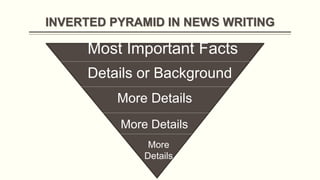
Most Important Facts
Details or Background
More Details
More Details
More
Details
INVERTED PYRAMID IN NEWS WRITING
Headline
 Text indicating the nature of the article or news story below it
 Brief summary of what the article is about
 Make your headline answer as many W’s as possible
 Must contain nothing that is not found in the story
 Use present tense for past stories and infinitive form for future stories
 Positive heads are preferable than negative ones
 Omit articles like a, an, and the and all forms of verb to be (is, are, be), unless needed
to make the meaning clear
 Use the strongest word in the first line as possible
 Active verb is better than the passive verb
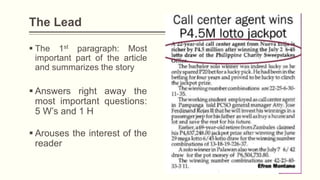
The Lead
 The 1st paragraph: Most
important part of the article
and summarizes the story
 Answers right away the
most important questions:
5 W’s and 1 H
 Arouses the interest of the
reader
The Body
 Details of the lead
 Arranged from most important to the least important
 One sentence, one paragraph
 Sentences are generally less than 25 words
 Includes quotations whenever possible (direct or indirect)
 The rest of the story is called the body. A story should proceed in a natural and
chronological order. Sticking to a logical order will make it easier to write the story, as
well as to allow you to keep track of your ideas and materials.
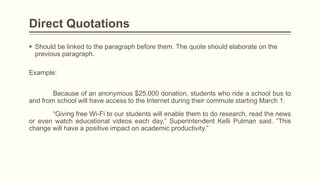
 Should be linked to the paragraph before them. The quote should elaborate on the
previous paragraph.
Direct Quotations
Example:
Because of an anonymous $25,000 donation, students who ride a school bus to
and from school will have access to the Internet during their commute starting March 1.
“Giving free Wi-Fi to our students will enable them to do research, read the news
or even watch educational videos each day,” Superintendent Kelli Putman said. “This
change will have a positive impact on academic productivity.”
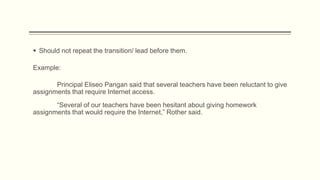
Example:
 Should not repeat the transition/ lead before them.
Principal Eliseo Pangan said that several teachers have been reluctant to give
assignments that require Internet access.
“Several of our teachers have been hesitant about giving homework
assignments that would require the Internet,” Rother said.
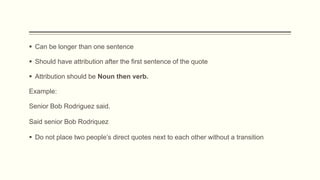
 Can be longer than one sentence
 Should have attribution after the first sentence of the quote
 Attribution should be Noun then verb.
Example:
Senior Bob Rodriguez said.
 Do not place two people’s direct quotes next to each other without a transition
Said senior Bob Rodriquez
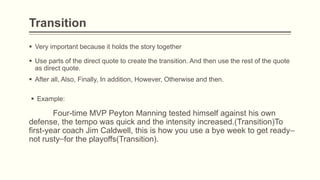
Transition
 Very important because it holds the story together
 Use parts of the direct quote to create the transition. And then use the rest of the quote
as direct quote.
 After all, Also, Finally, In addition, However, Otherwise and then.
 Example:
Four-time MVP Peyton Manning tested himself against his own
defense, the tempo was quick and the intensity increased.(Transition)To
first-year coach Jim Caldwell, this is how you use a bye week to get ready
not rusty for the playoffs(Transition).
GUIDELINES IN
WRITING:
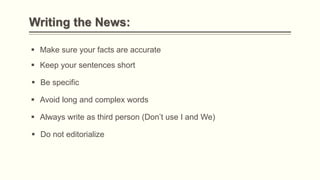
Writing the News:
 Make sure your facts are accurate
 Keep your sentences short
 Avoid long and complex words
 Be specific
 Always write as third person (Don’t use I and We)
 Do not editorialize
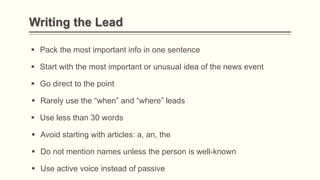
Writing the Lead
 Pack the most important info in one sentence
 Start with the most important or unusual idea of the news event
 Go direct to the point
 Rarely use the “when” and “where” leads
 Use less than 30 words
 Do not mention names unless the person is well-known
 Avoid starting with articles: a, an, the
 Use active voice instead of passive
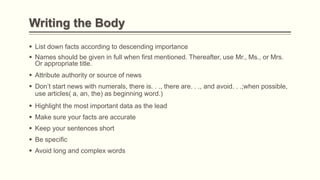
Writing the Body
 List down facts according to descending importance
 Names should be given in full when first mentioned. Thereafter, use Mr., Ms., or Mrs.
Or appropriate title.
 Attribute authority or source of news
 Don’t start news with numerals, there is. . ., there are. . ., and avoid. . .;when possible,
use articles( a, an, the) as beginning word.)
 Highlight the most important data as the lead
 Make sure your facts are accurate
 Keep your sentences short
 Be specific
 Avoid long and complex words
 Avoid passive verbs, jargons and cliches
 Do not editorialize
 Avoid redundancy and repetition
 Write in the third person
 Highlight the most important data as the lead
 Numbers 1-9 spelled out, 10 and above in figures
LET’S PRACTICE!
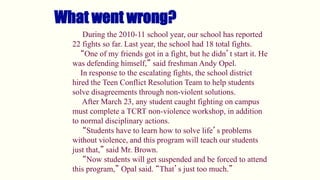
What went wrong?
During the 2010-11 school year, our school has reported
22 fights so far. Last year, the school had 18 total fights.
“One of my friends got in a fight, but he didn’t start it. He
was defending himself,” said freshman Andy Opel.
In response to the escalating fights, the school district
hired the Teen Conflict Resolution Team to help students
solve disagreements through non-violent solutions.
After March 23, any student caught fighting on campus
must complete a TCRT non-violence workshop, in addition
to normal disciplinary actions.
“Students have to learn how to solve life’s problems
without violence, and this program will teach our students
just that,” said Mr. Brown.
“Now students will get suspended and be forced to attend
this program,” Opal said. “That’s just too much.”

NEWS WRITING SLIDES.pptx

  • 1.
  • 2.
    What is News? Information about current events printed in newspapers or broadcast by media (Microsoft Encarta, 2009)  Gives the reader information that will have an impact on them in some way  Usually flows from most important to least important  Recent information  Current events  Somebody or something interesting  Something previously unknown
  • 3.
    Elements of aNews  Timeliness  Proximity  Impact  Prominence  Oddity  Conflict  Human Interest
  • 4.
    Essential Qualities ofa News  Accuracy  Brevity  Clarity  Objectivity
  • 5.
  • 6.
    Most Important Facts Detailsor Background More Details More Details More Details INVERTED PYRAMID IN NEWS WRITING
  • 7.
    Headline  Text indicatingthe nature of the article or news story below it  Brief summary of what the article is about  Make your headline answer as many W’s as possible  Must contain nothing that is not found in the story  Use present tense for past stories and infinitive form for future stories  Positive heads are preferable than negative ones  Omit articles like a, an, and the and all forms of verb to be (is, are, be), unless needed to make the meaning clear  Use the strongest word in the first line as possible  Active verb is better than the passive verb
  • 8.
    The Lead  The1st paragraph: Most important part of the article and summarizes the story  Answers right away the most important questions: 5 W’s and 1 H  Arouses the interest of the reader
  • 9.
    The Body  Detailsof the lead  Arranged from most important to the least important  One sentence, one paragraph  Sentences are generally less than 25 words  Includes quotations whenever possible (direct or indirect)  The rest of the story is called the body. A story should proceed in a natural and chronological order. Sticking to a logical order will make it easier to write the story, as well as to allow you to keep track of your ideas and materials.
  • 10.
     Should belinked to the paragraph before them. The quote should elaborate on the previous paragraph. Direct Quotations Example: Because of an anonymous $25,000 donation, students who ride a school bus to and from school will have access to the Internet during their commute starting March 1. “Giving free Wi-Fi to our students will enable them to do research, read the news or even watch educational videos each day,” Superintendent Kelli Putman said. “This change will have a positive impact on academic productivity.”
  • 11.
    Example:  Should notrepeat the transition/ lead before them. Principal Eliseo Pangan said that several teachers have been reluctant to give assignments that require Internet access. “Several of our teachers have been hesitant about giving homework assignments that would require the Internet,” Rother said.
  • 12.
     Can belonger than one sentence  Should have attribution after the first sentence of the quote  Attribution should be Noun then verb. Example: Senior Bob Rodriguez said.  Do not place two people’s direct quotes next to each other without a transition Said senior Bob Rodriquez
  • 13.
    Transition  Very importantbecause it holds the story together  Use parts of the direct quote to create the transition. And then use the rest of the quote as direct quote.  After all, Also, Finally, In addition, However, Otherwise and then.  Example: Four-time MVP Peyton Manning tested himself against his own defense, the tempo was quick and the intensity increased.(Transition)To first-year coach Jim Caldwell, this is how you use a bye week to get ready not rusty for the playoffs(Transition).
  • 14.
  • 15.
    Writing the News: Make sure your facts are accurate  Keep your sentences short  Avoid long and complex words  Be specific  Always write as third person (Don’t use I and We)  Do not editorialize
  • 16.
    Writing the Lead Pack the most important info in one sentence  Start with the most important or unusual idea of the news event  Go direct to the point  Rarely use the “when” and “where” leads  Use less than 30 words  Do not mention names unless the person is well-known  Avoid starting with articles: a, an, the  Use active voice instead of passive
  • 17.
    Writing the Body List down facts according to descending importance  Names should be given in full when first mentioned. Thereafter, use Mr., Ms., or Mrs. Or appropriate title.  Attribute authority or source of news  Don’t start news with numerals, there is. . ., there are. . ., and avoid. . .;when possible, use articles( a, an, the) as beginning word.)  Highlight the most important data as the lead  Make sure your facts are accurate  Keep your sentences short  Be specific  Avoid long and complex words
  • 18.
     Avoid passiveverbs, jargons and cliches  Do not editorialize  Avoid redundancy and repetition  Write in the third person  Highlight the most important data as the lead  Numbers 1-9 spelled out, 10 and above in figures
  • 19.
  • 20.
    What went wrong? Duringthe 2010-11 school year, our school has reported 22 fights so far. Last year, the school had 18 total fights. “One of my friends got in a fight, but he didn’t start it. He was defending himself,” said freshman Andy Opel. In response to the escalating fights, the school district hired the Teen Conflict Resolution Team to help students solve disagreements through non-violent solutions. After March 23, any student caught fighting on campus must complete a TCRT non-violence workshop, in addition to normal disciplinary actions. “Students have to learn how to solve life’s problems without violence, and this program will teach our students just that,” said Mr. Brown. “Now students will get suspended and be forced to attend this program,” Opal said. “That’s just too much.”