



BASIC LIBRARY
PROCEDURES: PROCESSING
LIBRARY MATERIALS
Prepared By: Jolo Van Clyde S. Abatayo, RL
“The librarian’s mission should be, not like up to now,
a mere handling of the book as an object, but rather a
know how (mis au point) of the book as a vital
function.”
----Mission del Bibliotecario Jose Ortega Y Gasset (1883-1955)
Purpose of processing materials
•Before items can be shelved and then circulated from
the library, they need to be physically prepared.
•Library materials go through processing so that they
can be located, used, and returned to the library from
which they originated.
Purpose of processing materials
Each item in the library must go through physical processing including the
applicant of:
• accession numbers (manual systems)
• circulation cards (manual systems)
• pockets (manual systems)
• plastic covers, laminates, or cases to protect materials
• barcodes (automated systems)
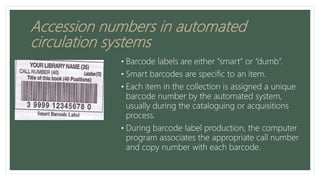
• detection strips or slips
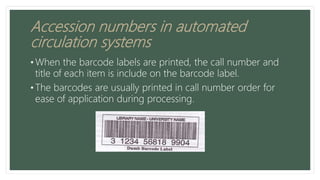
• property stamps
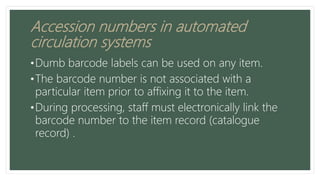
Purchased versus In-house processing
• Processing can be a tedious, time consuming, and labor
intensive procedure.
• In an effort to save time and money, many large libraries
have centralized technical services or entered into
cooperative agreements with other libraries.
• In large libraries or systems, the centralized processing unit
will handle acquisitions, cataloguing, and preparation of
materials for different libraries.
Purchased versus In-house processing
• All sizes and types of libraries have turned to outside
vendors and have contracted processing services.
• Most book jobbers (i.e. companies that sell large volumes of
books to libraries such as Baker and Taylor, Midwest, or
Coutts) offer processing services.
• As well, there are now a number of companies that offer
complete cataloguing and processing services (e.g. ISM).
Purchased versus In-house processing
• As part of the contract with a jobber or commercial cataloguing
service, the library would complete a profile sheet that identifies
exactly what they would like to have done to items before they
are delivered to the library.
• Each processing product would be priced out (see Appendix 1
for a sample list of charges for processing).
• The library may choose to have materials partially or fully
processed.
Purchased versus In-house processing
• If a vendor cannot meet particular processing specifications or, if a library
cannot afford to contract processing services they will opt to process
materials in-house.
• Even if funds are available, there are usually materials that end up being
processed in-house.
• For example, if materials are donated to the library, it may not be worth
the cost to send them for outside processing.
• As well, if a library is moving from a manual to an automated circulation
system and/or purchasing a theft detection system, extra funds may not
be available to add barcodes and/or detection strips.
Steps involved with processing
materials.
There is some variation in the steps involved with processing materials
depending on whether a library is using a manual or automated
circulation system. Basic physical preparation includes:
1. Inspection
2. Identification
3. Assignment of Accession Numbers
4. Preparation of Circulation Cards, Pockets, and Due Date Slips
5. Preparation of Call Numbers
6. Attachment of Protective Covering
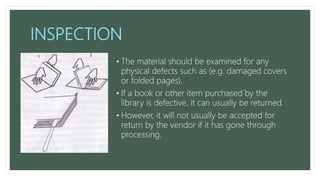
INSPECTION
• The material should be examined for any
physical defects such as (e.g. damaged covers
or folded pages).
• If a book or other item purchased by the
library is defective, it can usually be returned.
• However, it will not usually be accepted for
return by the vendor if it has gone through
processing.
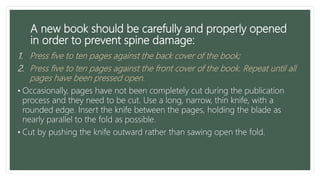
A new book should be carefully and properly opened
in order to prevent spine damage:
1. Press five to ten pages against the back cover of the book;
2. Press five to ten pages against the front cover of the book. Repeat until all
pages have been pressed open.
• Occasionally, pages have not been completely cut during the publication
process and they need to be cut. Use a long, narrow, thin knife, with a
rounded edge. Insert the knife between the pages, holding the blade as
nearly parallel to the fold as possible.
• Cut by pushing the knife outward rather than sawing open the fold.
IDENTIFICATION
• Most libraries label their materials with some form of
permanent identification that gives the name of the library
and its address.
• Identification is done to discourage theft and to ensure that
lost library materials are returned to the library from which
they originated.
• As well, identification is relatively inexpensive means of
publicizing the library.
Ownership stamps are usually applied in all of the following
places in books:
a) Along the top, front or bottom edge of the book:
Stamps in these locations are easily seen and cannot be erased or
torn out easily.
Very thin books cannot be stamped along the edge, In order to
stamp the book on the edge, it must beheld tightly closed. Because
the stamp must be narrow enough to fit between the covers, it usually
only states the name of the library.
Any type of rubber stamp can be used and these can be custom
ordered from any office supply store.
b) Title page, inside front cover, or inside back cover:
Again, these can be done with a rubber stamp.
Because this is a large area, the stamp used on these locations includes
name and address of the library.
Instead of a stamp, some libraries will l purchase special book plates that
are pasted on the inside front cover.
A book plate can be designed so that additional information might be
typed onto it (e.g. “This book was donated by the Smith family in memory
their son, John.”
Book plates can also be generated in-house on a laser printer.
c) Pockets:
In libraries with manual circulation systems, the
pocket is usually stamped with the name and
of the library.
Pockets can also be ordered with preprinted name
and address information.
ASSIGNMENT OF ACCESSION
NUMBERS
• Each item in the library should be uniquely distinguished
from every other item.
• This helps in the process of identifying whether a given copy
of an item has been returned and in inventorying the
collection.
• Although the first copy of an item has a unique author and
title, additional copies are not unique in this regard.
ASSIGNMENT OF ACCESSION
NUMBERS
• One way of handling this problem is to assign a copy
number to the record for the item (e.g. c.2).
• This eliminates the need for an accession number. Materials
can also be distinguished from one another by assigning a
unique number to each item.
• This process varies depending on whether the library uses a
manual or automated circulation system.
Accession numbers in manual
circulation systems
In libraries with manual systems, the accession number is
usually stamped (or written) on the:
Circulation card and/or pocket – if it is done on both,
ensure that the correct card is placed in the correct item
Shelf list card – this is done for inventorying purposes
Title page – helps to identify the book if the pocket and
circulation card go missing
ASSIGNMENT OF ACCESSION
NUMBERS
• Accession numbers need to be unique sequences of
numbers.
• To ensure that the numbers are not duplicated, most
libraries use an accession numbering machine.
• The machines are available through library supply vendors.
• The numbering machine is a stamp that can be set to
provide unique incremental sequences of numbers.
ASSIGNMENT OF ACCESSION
NUMBERS
• By pressing a lever, you can adjust the machine to indicate
the number of times that the same accession number will be
repeated.
• The machine is then stamped on each place where the
number will appear.
• For the next item, the machine will automatically advance to
the next sequential number.
ASSIGNMENT OF ACCESSION
NUMBERS
• Many libraries use the first 2 digits to indicate the year that an item was
added to the collection and the remainder of the digits as inventory control
counts for the year (e.g. 98-305, 98-306, 98-307).
• Other libraries simply take note of the accession number at the beginning of
the year and at the end of the year.
• This gives them the total number of processed items.
• Libraries that do not use accession numbers based on the date will also
often stamp the date on the new item.
• This helps indicate when the item was acquired and may be useful in
weeding and inventory processes.
Accession numbers in automated
circulation systems
• In libraries with automated circulation systems, barcodes provide a
unique accession number for an item.
• Remember that there are two types of barcode – Codabar and Code
39.
• In both barcodes there are unique information in the bar code for a
particular item.
• In the Codabar, the eight digits following the first five, represented the
item.
• In the Code 39 barcode, the last seven digits are unique to a particular
item.
Accession numbers in automated
circulation systems
• Barcode labels are either “smart” or “dumb”.
• Smart barcodes are specific to an item.
• Each item in the collection is assigned a unique
barcode number by the automated system,
usually during the cataloguing or acquisitions
process.
• During barcode label production, the computer
program associates the appropriate call number
and copy number with each barcode.
Accession numbers in automated
circulation systems
• When the barcode labels are printed, the call number and
title of each item is include on the barcode label.
• The barcodes are usually printed in call number order for
ease of application during processing.
Accession numbers in automated
circulation systems
•Dumb barcode labels can be used on any item.
•The barcode number is not associated with a
particular item prior to affixing it to the item.
•During processing, staff must electronically link the
barcode number to the item record (catalogue
record) .
Accession numbers in automated
circulation systems
• The barcode label is then affixed to the item.
• Usually a dumb barcode label will have an eye-readable
number printed below the barcode.
• The library may also choose to have the library name
printed above the barcode as a means of identification.
Smart or dumb barcode labels are put on materials in
the following locations:
1. Inside the front or back cover – this protects the barcode label
from being damaged but adds a step at the circulation desk
because the book has to be opened.
2. On the front or back cover – this makes it easier to circulate the
item because the book does not have to be opened but the label
may be subject to damage from patron use.
3. On both – this gives you more options but increases your
processing costs.
• Whatever location is chosen, it should be consistently used so
that circulation staff do not have to look for the barcode when
they are checking items out.
• Barcode labels are applied at different times during
including:
When they are received
During cataloguing
When the call number is being added
Accession numbers in automated circulation
systems
• Libraries can either purchase barcode labels or create labels in-house using a
laser printer.
• Purchased labels are usually photocomposed, a computer controlled graphic
process which forms original images within photosensitive paper.
• Photocomposed labels are very durable and will handle the abrasion of
repeated scannings very well.
• Laser printer produced labels are less durable because the barcode is printed
only on the surface.
• Repeated scannings, dirt, abrasion and grease will damage the label and so it
should be protected with a clear plastic label protector.
PREPARATION OF CIRCULATION
CARDS, BOOK POCKETS, AND DUE
DATE SLIPS
Circulation cards
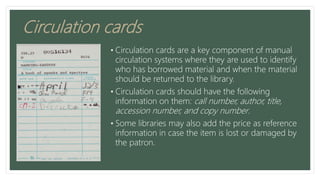
• Circulation cards are a key component of manual
circulation systems where they are used to identify
who has borrowed material and when the material
should be returned to the library.
• Circulation cards should have the following
information on them: call number, author, title,
accession number, and copy number.
• Some libraries may also add the price as reference
information in case the item is lost or damaged by
the patron.
Circulation cards
• The lower section of the circulation card is used when the
item is checked out in order to record borrower information
and due date.
• Circulation cards come in a wide variety of colours, paper
weights, and sizes (3” x 5” is very common).
Book
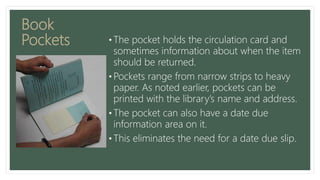
Pockets • The pocket holds the circulation card and
sometimes information about when the item
should be returned.
• Pockets range from narrow strips to heavy
paper. As noted earlier, pockets can be
printed with the library’s name and address.
• The pocket can also have a date due
information area on it.
• This eliminates the need for a date due slip.
Pockets can be attached by:
•Using glue or a glue gun
•Dampening a pre-gummed backing
•Peeling off the backing if the pocket is pre-glued
and pressure sensitive
The best place to place the pocket is on the
front flyleaf because:
• During circulation the book will not have to be turned over
• The book will lay flat and stay open for due date stamping
• A firm backing is available to support the pressure of a due
date stamp
Book Pockets
• They should always be placed in the same location so that circulation
staff do not have to waste time looking for them.
• Exceptions to the location can be made for items that may have
critical information located on the flyleaf.
• The pocket should be attached neatly and parallel to the paper edges.
It is a good idea to leave about 1” between the spine and the pocket
in the event that mending must be done to the book in the future.
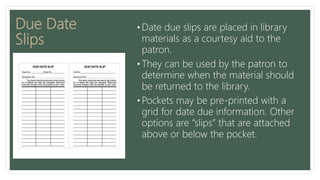
Due Date
Slips
• Date due slips are placed in library
materials as a courtesy aid to the
patron.
• They can be used by the patron to
determine when the material should
be returned to the library.
• Pockets may be pre-printed with a
grid for date due information. Other
options are “slips” that are attached
above or below the pocket.
Due Date Slips
• These can be purchased from library supply companies and
come ungummed, pregummed, or pressure-sensitive.
• Even libraries with automated circulation systems may opt
to insert a date due slip in order to ensure the patrons are
aware of the length of time they can keep the material.
Due Date Slips
• Many automated circulation systems would automatically print list of
items that the patron borrowed along with the due dates.
• This would be handed to the patron at the end of the check-out
procedure.
• However, if the patron loses this information and there is no date due
slip in the item, they will likely have to call the library to find out when
material is due.
• A bookmark prestamped with due d ate inserted into each book
eliminates the need for a pocket and still provides a date reference to
the patron.
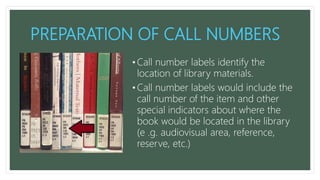
PREPARATION OF CALL NUMBERS
• Call number labels identify the
location of library materials.
• Call number labels would include the
call number of the item and other
special indicators about where the
book would be located in the library
(e .g. audiovisual area, reference,
reserve, etc.)
PREPARATION OF CALL NUMBERS
• In the past, an electric stylus was used to hand letter the call
numbers in a contrasting color directly onto the spine of a cloth-
bound book.
• This system required excellent lettering skills and could be
frustrating because the stylus needed time to heat up and could
cause finger burns.
• Shellac was used for coating the lettering so that it would be
durable.
• This was dabbed or sprayed on and required a work area with
good ventilation.
PREPARATION OF CALL NUMBERS
• A more practical solution is a label that can be adhered to
library materials.
• Information for an adhesive label can be typed on a
typewriter, printed as part of a cataloguing software
program, or purchased as part of a cataloguing service.
• Labels come in a wide variety of sizes and materials.
PREPARATION OF CALL NUMBERS
• Some have a special coating to prevent smudging.
• Some labels require the use of a special iron that
permanently adheres and bond them to materials.
• Labels can be purchased in sheets that fit printers (or
typewriters) or as part of a set that includes labels for the
circulation card, pocket, and call number label.
Three types of pressure sensitive labels are
widely used:
•Cloth
•Foil back
•Paper
Three types of pressure sensitive labels
are widely used:
a) Cloth labels
Cloth labels last longer than paper and foil back
labels because of their high tear resistance. They are
more resistant to water and conform to curved book
spines better than paper labels.
b) Foil back labels
• Foil back labels are more pliable for better adhesion to an irregular or curved
surface.
• They are highly recommended for use on fabric, cloth, and shiny surfaced
books.
• The foil back prevents the adhesive from penetrating through the label.
• Adhesives can discolor the label, attack the print, and cause it to fade.
• Foil labels are opaque and therefore you cannot see the underlying
information.
• They are excellent for placement over existing spine labels or barcode labels.
• However, they are more expensive than cloth or paper labels.
c) Paper labels
• Paper labels are less expensive than cloth or foil back labels
and are a good all-purpose label.
• They are smudge resistant and conform well to book covers
and other paper surfaces.
PREPARATION OF CALL NUMBERS
• Decisions about the type of label to use should be based on
budget, usage, and other processing steps that are employed.
• For example, if each book is covered by a plastic jacket cover, foil
back labels will be an unnecessary expense.
• Children’s books may justify the expense of foil back labels
because they are heavily circulated.
• Once call numbers have been printed or typed onto a label, they
should be placed on the item.
PREPARATION OF CALL NUMBERS
• Ideally, labels should all be placed at the same height.
• This aids the user in visually browsing the collection and
gives materials an orderly, attractive appearance.
• For narrow-spine books (or other irregularly shaped library
materials such as compact discs), the label can be placed on
the front.
• It is a good idea to protect the label with tape, or better still,
a clear label protector.
PREPARATION OF CALL NUMBERS
• Besides the basic call number label, some libraries also use
location and genre labels.
• Books are labeled with a mystery, romance, westerns,
science fiction, or other genre indicator.
• These can be useful in a library where the patrons prefer to
browse for materials and are looking for particular types of
fiction books.
PREPARATION OF CALL NUMBERS
• Some libraries do not use call numbers at all for paperback fiction, only a
genre label.
• This works well if all of the different genres are shelved together in separate
sections (e.g. mysteries).
• Other libraries use a call number label and identify the more popular genres
(eg. Mysteries, westerns, romance).
• This permits paperbacks to be combined with hardbacks or to be shelved
on special racks.
• Regardless of the system used, each label adds another step to processing
and additional costs for labour and materials.
ATTACHMENT OF PROTECTIVE
COVERING
• Protective coverings are used to
protect book jackets, prolong the life
of materials, increase the
attractiveness of materials, and
protect call number labels.
• Clear mylar covers can be purchased
as part of the processing contracted
from a jobber or commercial
cataloguing service.
Libraries can also apply covers in-house and
have a variety of choices including:
• single sheets precut to fit various sizes of books
• rolls of various sizes that are cut in-house
• adjustable book jacket covers that are perforated and can be
adjusted to fit a variety of sizes
• rolls of heat-fusible laminate
• clear vinyl laminates
• clear vinyl book tape
ATTACHMENT OF PROTECTIVE
COVERING
• The cost of these materials vary.
• The thicker the material, the more it costs.
• A minimum weight of 1.5 mm is recommended because it
offers durability and strength.
• Precut materials will be more expensive than perforated
materials.
• Covers will also cost more if they come with pressure-
sensitive adhesive tabs to fasten them to materials.
VARIATIONS IN PROCESSING
• The steps involved in processing varies in each library.
• The processing steps will certainly vary by type of library and within a
library different types of material may be processed in different ways.
• For example, a public library would probably reinforce fiction
paperbacks with vinyl book tape and protect book jackets with a vinyl
laminate.
• Academic libraries do not usually retain jackets because they do not
need eye-catching covers to attract readers. The purpose of the
collection is research not entertainment.
VARIATIONS IN PROCESSING
• Some libraries have found that automating their circulation system
results in revised and streamlined processing procedures.
• As well, time saving materials such as pressure sensitive labels and book
jackets can simplify processing.
• In order to make processing as efficient in terms of time and money,
libraries need to regularly evaluate their processing methods.
• When all processing steps are completed, materials are interfiled on a
book cart, separated by department or area, and set out for shelving.
References:
• Rach. (2009). Basic library procedures: Processing library materials. Retrieved last February 15,
2019 from http://livinginthelibraryworld.blogspot.com/2009/01/basic-library-procedures-
processing.html
• Fox, Beth Wheeler. Behind the scenes at the dynamic library : simplifying essential operations.
Chicago : American Library Association, 1990.
• Kascus, Marie A., Hale , Dawn. Outsourcing cataloguing, authority work, and physical
processing : a checklist of considerations. Chicago : American Library Association, 1995.
Appendix 1: Sample profile form and sample price list from United Library Services Inc.
available online at http://www.uls.com/ULS/DL.jsp?FileName=ULS_CP.pdf
Appendix 2: Protecting library materials during processing available online
athttp://www.carrmclean.ca/UploadedImages/Documents/REPAIR_LR.pdf
Basic Library Procedures: Processing Library Materials

Basic Library Procedures: Processing Library Materials

  • 1.
    BASIC LIBRARY PROCEDURES: PROCESSING LIBRARYMATERIALS Prepared By: Jolo Van Clyde S. Abatayo, RL
  • 2.
    “The librarian’s missionshould be, not like up to now, a mere handling of the book as an object, but rather a know how (mis au point) of the book as a vital function.” ----Mission del Bibliotecario Jose Ortega Y Gasset (1883-1955)
  • 3.
    Purpose of processingmaterials •Before items can be shelved and then circulated from the library, they need to be physically prepared. •Library materials go through processing so that they can be located, used, and returned to the library from which they originated.
  • 4.
    Purpose of processingmaterials Each item in the library must go through physical processing including the applicant of: • accession numbers (manual systems) • circulation cards (manual systems) • pockets (manual systems) • plastic covers, laminates, or cases to protect materials • barcodes (automated systems) • detection strips or slips • property stamps
  • 5.
    Purchased versus In-houseprocessing • Processing can be a tedious, time consuming, and labor intensive procedure. • In an effort to save time and money, many large libraries have centralized technical services or entered into cooperative agreements with other libraries. • In large libraries or systems, the centralized processing unit will handle acquisitions, cataloguing, and preparation of materials for different libraries.
  • 6.
    Purchased versus In-houseprocessing • All sizes and types of libraries have turned to outside vendors and have contracted processing services. • Most book jobbers (i.e. companies that sell large volumes of books to libraries such as Baker and Taylor, Midwest, or Coutts) offer processing services. • As well, there are now a number of companies that offer complete cataloguing and processing services (e.g. ISM).
  • 7.
    Purchased versus In-houseprocessing • As part of the contract with a jobber or commercial cataloguing service, the library would complete a profile sheet that identifies exactly what they would like to have done to items before they are delivered to the library. • Each processing product would be priced out (see Appendix 1 for a sample list of charges for processing). • The library may choose to have materials partially or fully processed.
  • 8.
    Purchased versus In-houseprocessing • If a vendor cannot meet particular processing specifications or, if a library cannot afford to contract processing services they will opt to process materials in-house. • Even if funds are available, there are usually materials that end up being processed in-house. • For example, if materials are donated to the library, it may not be worth the cost to send them for outside processing. • As well, if a library is moving from a manual to an automated circulation system and/or purchasing a theft detection system, extra funds may not be available to add barcodes and/or detection strips.
  • 9.
    Steps involved withprocessing materials. There is some variation in the steps involved with processing materials depending on whether a library is using a manual or automated circulation system. Basic physical preparation includes: 1. Inspection 2. Identification 3. Assignment of Accession Numbers 4. Preparation of Circulation Cards, Pockets, and Due Date Slips 5. Preparation of Call Numbers 6. Attachment of Protective Covering
  • 10.
    INSPECTION • The materialshould be examined for any physical defects such as (e.g. damaged covers or folded pages). • If a book or other item purchased by the library is defective, it can usually be returned. • However, it will not usually be accepted for return by the vendor if it has gone through processing.
  • 11.
    A new bookshould be carefully and properly opened in order to prevent spine damage: 1. Press five to ten pages against the back cover of the book; 2. Press five to ten pages against the front cover of the book. Repeat until all pages have been pressed open. • Occasionally, pages have not been completely cut during the publication process and they need to be cut. Use a long, narrow, thin knife, with a rounded edge. Insert the knife between the pages, holding the blade as nearly parallel to the fold as possible. • Cut by pushing the knife outward rather than sawing open the fold.
  • 12.
    IDENTIFICATION • Most librarieslabel their materials with some form of permanent identification that gives the name of the library and its address. • Identification is done to discourage theft and to ensure that lost library materials are returned to the library from which they originated. • As well, identification is relatively inexpensive means of publicizing the library.
  • 13.
    Ownership stamps areusually applied in all of the following places in books: a) Along the top, front or bottom edge of the book: Stamps in these locations are easily seen and cannot be erased or torn out easily. Very thin books cannot be stamped along the edge, In order to stamp the book on the edge, it must beheld tightly closed. Because the stamp must be narrow enough to fit between the covers, it usually only states the name of the library. Any type of rubber stamp can be used and these can be custom ordered from any office supply store.
  • 14.
    b) Title page,inside front cover, or inside back cover: Again, these can be done with a rubber stamp. Because this is a large area, the stamp used on these locations includes name and address of the library. Instead of a stamp, some libraries will l purchase special book plates that are pasted on the inside front cover. A book plate can be designed so that additional information might be typed onto it (e.g. “This book was donated by the Smith family in memory their son, John.” Book plates can also be generated in-house on a laser printer.
  • 15.
    c) Pockets: In librarieswith manual circulation systems, the pocket is usually stamped with the name and of the library. Pockets can also be ordered with preprinted name and address information.
  • 16.
    ASSIGNMENT OF ACCESSION NUMBERS •Each item in the library should be uniquely distinguished from every other item. • This helps in the process of identifying whether a given copy of an item has been returned and in inventorying the collection. • Although the first copy of an item has a unique author and title, additional copies are not unique in this regard.
  • 17.
    ASSIGNMENT OF ACCESSION NUMBERS •One way of handling this problem is to assign a copy number to the record for the item (e.g. c.2). • This eliminates the need for an accession number. Materials can also be distinguished from one another by assigning a unique number to each item. • This process varies depending on whether the library uses a manual or automated circulation system.
  • 18.
    Accession numbers inmanual circulation systems In libraries with manual systems, the accession number is usually stamped (or written) on the: Circulation card and/or pocket – if it is done on both, ensure that the correct card is placed in the correct item Shelf list card – this is done for inventorying purposes Title page – helps to identify the book if the pocket and circulation card go missing
  • 19.
    ASSIGNMENT OF ACCESSION NUMBERS •Accession numbers need to be unique sequences of numbers. • To ensure that the numbers are not duplicated, most libraries use an accession numbering machine. • The machines are available through library supply vendors. • The numbering machine is a stamp that can be set to provide unique incremental sequences of numbers.
  • 20.
    ASSIGNMENT OF ACCESSION NUMBERS •By pressing a lever, you can adjust the machine to indicate the number of times that the same accession number will be repeated. • The machine is then stamped on each place where the number will appear. • For the next item, the machine will automatically advance to the next sequential number.
  • 21.
    ASSIGNMENT OF ACCESSION NUMBERS •Many libraries use the first 2 digits to indicate the year that an item was added to the collection and the remainder of the digits as inventory control counts for the year (e.g. 98-305, 98-306, 98-307). • Other libraries simply take note of the accession number at the beginning of the year and at the end of the year. • This gives them the total number of processed items. • Libraries that do not use accession numbers based on the date will also often stamp the date on the new item. • This helps indicate when the item was acquired and may be useful in weeding and inventory processes.
  • 22.
    Accession numbers inautomated circulation systems • In libraries with automated circulation systems, barcodes provide a unique accession number for an item. • Remember that there are two types of barcode – Codabar and Code 39. • In both barcodes there are unique information in the bar code for a particular item. • In the Codabar, the eight digits following the first five, represented the item. • In the Code 39 barcode, the last seven digits are unique to a particular item.
  • 23.
    Accession numbers inautomated circulation systems • Barcode labels are either “smart” or “dumb”. • Smart barcodes are specific to an item. • Each item in the collection is assigned a unique barcode number by the automated system, usually during the cataloguing or acquisitions process. • During barcode label production, the computer program associates the appropriate call number and copy number with each barcode.
  • 24.
    Accession numbers inautomated circulation systems • When the barcode labels are printed, the call number and title of each item is include on the barcode label. • The barcodes are usually printed in call number order for ease of application during processing.
  • 25.
    Accession numbers inautomated circulation systems •Dumb barcode labels can be used on any item. •The barcode number is not associated with a particular item prior to affixing it to the item. •During processing, staff must electronically link the barcode number to the item record (catalogue record) .
  • 26.
    Accession numbers inautomated circulation systems • The barcode label is then affixed to the item. • Usually a dumb barcode label will have an eye-readable number printed below the barcode. • The library may also choose to have the library name printed above the barcode as a means of identification.
  • 27.
    Smart or dumbbarcode labels are put on materials in the following locations: 1. Inside the front or back cover – this protects the barcode label from being damaged but adds a step at the circulation desk because the book has to be opened. 2. On the front or back cover – this makes it easier to circulate the item because the book does not have to be opened but the label may be subject to damage from patron use. 3. On both – this gives you more options but increases your processing costs.
  • 28.
    • Whatever locationis chosen, it should be consistently used so that circulation staff do not have to look for the barcode when they are checking items out. • Barcode labels are applied at different times during including: When they are received During cataloguing When the call number is being added
  • 29.
    Accession numbers inautomated circulation systems • Libraries can either purchase barcode labels or create labels in-house using a laser printer. • Purchased labels are usually photocomposed, a computer controlled graphic process which forms original images within photosensitive paper. • Photocomposed labels are very durable and will handle the abrasion of repeated scannings very well. • Laser printer produced labels are less durable because the barcode is printed only on the surface. • Repeated scannings, dirt, abrasion and grease will damage the label and so it should be protected with a clear plastic label protector.
  • 30.
    PREPARATION OF CIRCULATION CARDS,BOOK POCKETS, AND DUE DATE SLIPS
  • 31.
    Circulation cards • Circulationcards are a key component of manual circulation systems where they are used to identify who has borrowed material and when the material should be returned to the library. • Circulation cards should have the following information on them: call number, author, title, accession number, and copy number. • Some libraries may also add the price as reference information in case the item is lost or damaged by the patron.
  • 32.
    Circulation cards • Thelower section of the circulation card is used when the item is checked out in order to record borrower information and due date. • Circulation cards come in a wide variety of colours, paper weights, and sizes (3” x 5” is very common).
  • 33.
    Book Pockets • Thepocket holds the circulation card and sometimes information about when the item should be returned. • Pockets range from narrow strips to heavy paper. As noted earlier, pockets can be printed with the library’s name and address. • The pocket can also have a date due information area on it. • This eliminates the need for a date due slip.
  • 34.
    Pockets can beattached by: •Using glue or a glue gun •Dampening a pre-gummed backing •Peeling off the backing if the pocket is pre-glued and pressure sensitive
  • 35.
    The best placeto place the pocket is on the front flyleaf because: • During circulation the book will not have to be turned over • The book will lay flat and stay open for due date stamping • A firm backing is available to support the pressure of a due date stamp
  • 36.
    Book Pockets • Theyshould always be placed in the same location so that circulation staff do not have to waste time looking for them. • Exceptions to the location can be made for items that may have critical information located on the flyleaf. • The pocket should be attached neatly and parallel to the paper edges. It is a good idea to leave about 1” between the spine and the pocket in the event that mending must be done to the book in the future.
  • 37.
    Due Date Slips • Datedue slips are placed in library materials as a courtesy aid to the patron. • They can be used by the patron to determine when the material should be returned to the library. • Pockets may be pre-printed with a grid for date due information. Other options are “slips” that are attached above or below the pocket.
  • 38.
    Due Date Slips •These can be purchased from library supply companies and come ungummed, pregummed, or pressure-sensitive. • Even libraries with automated circulation systems may opt to insert a date due slip in order to ensure the patrons are aware of the length of time they can keep the material.
  • 39.
    Due Date Slips •Many automated circulation systems would automatically print list of items that the patron borrowed along with the due dates. • This would be handed to the patron at the end of the check-out procedure. • However, if the patron loses this information and there is no date due slip in the item, they will likely have to call the library to find out when material is due. • A bookmark prestamped with due d ate inserted into each book eliminates the need for a pocket and still provides a date reference to the patron.
  • 40.
    PREPARATION OF CALLNUMBERS • Call number labels identify the location of library materials. • Call number labels would include the call number of the item and other special indicators about where the book would be located in the library (e .g. audiovisual area, reference, reserve, etc.)
  • 41.
    PREPARATION OF CALLNUMBERS • In the past, an electric stylus was used to hand letter the call numbers in a contrasting color directly onto the spine of a cloth- bound book. • This system required excellent lettering skills and could be frustrating because the stylus needed time to heat up and could cause finger burns. • Shellac was used for coating the lettering so that it would be durable. • This was dabbed or sprayed on and required a work area with good ventilation.
  • 42.
    PREPARATION OF CALLNUMBERS • A more practical solution is a label that can be adhered to library materials. • Information for an adhesive label can be typed on a typewriter, printed as part of a cataloguing software program, or purchased as part of a cataloguing service. • Labels come in a wide variety of sizes and materials.
  • 43.
    PREPARATION OF CALLNUMBERS • Some have a special coating to prevent smudging. • Some labels require the use of a special iron that permanently adheres and bond them to materials. • Labels can be purchased in sheets that fit printers (or typewriters) or as part of a set that includes labels for the circulation card, pocket, and call number label.
  • 44.
    Three types ofpressure sensitive labels are widely used: •Cloth •Foil back •Paper
  • 45.
    Three types ofpressure sensitive labels are widely used: a) Cloth labels Cloth labels last longer than paper and foil back labels because of their high tear resistance. They are more resistant to water and conform to curved book spines better than paper labels.
  • 46.
    b) Foil backlabels • Foil back labels are more pliable for better adhesion to an irregular or curved surface. • They are highly recommended for use on fabric, cloth, and shiny surfaced books. • The foil back prevents the adhesive from penetrating through the label. • Adhesives can discolor the label, attack the print, and cause it to fade. • Foil labels are opaque and therefore you cannot see the underlying information. • They are excellent for placement over existing spine labels or barcode labels. • However, they are more expensive than cloth or paper labels.
  • 47.
    c) Paper labels •Paper labels are less expensive than cloth or foil back labels and are a good all-purpose label. • They are smudge resistant and conform well to book covers and other paper surfaces.
  • 48.
    PREPARATION OF CALLNUMBERS • Decisions about the type of label to use should be based on budget, usage, and other processing steps that are employed. • For example, if each book is covered by a plastic jacket cover, foil back labels will be an unnecessary expense. • Children’s books may justify the expense of foil back labels because they are heavily circulated. • Once call numbers have been printed or typed onto a label, they should be placed on the item.
  • 49.
    PREPARATION OF CALLNUMBERS • Ideally, labels should all be placed at the same height. • This aids the user in visually browsing the collection and gives materials an orderly, attractive appearance. • For narrow-spine books (or other irregularly shaped library materials such as compact discs), the label can be placed on the front. • It is a good idea to protect the label with tape, or better still, a clear label protector.
  • 50.
    PREPARATION OF CALLNUMBERS • Besides the basic call number label, some libraries also use location and genre labels. • Books are labeled with a mystery, romance, westerns, science fiction, or other genre indicator. • These can be useful in a library where the patrons prefer to browse for materials and are looking for particular types of fiction books.
  • 51.
    PREPARATION OF CALLNUMBERS • Some libraries do not use call numbers at all for paperback fiction, only a genre label. • This works well if all of the different genres are shelved together in separate sections (e.g. mysteries). • Other libraries use a call number label and identify the more popular genres (eg. Mysteries, westerns, romance). • This permits paperbacks to be combined with hardbacks or to be shelved on special racks. • Regardless of the system used, each label adds another step to processing and additional costs for labour and materials.
  • 52.
    ATTACHMENT OF PROTECTIVE COVERING •Protective coverings are used to protect book jackets, prolong the life of materials, increase the attractiveness of materials, and protect call number labels. • Clear mylar covers can be purchased as part of the processing contracted from a jobber or commercial cataloguing service.
  • 53.
    Libraries can alsoapply covers in-house and have a variety of choices including: • single sheets precut to fit various sizes of books • rolls of various sizes that are cut in-house • adjustable book jacket covers that are perforated and can be adjusted to fit a variety of sizes • rolls of heat-fusible laminate • clear vinyl laminates • clear vinyl book tape
  • 54.
    ATTACHMENT OF PROTECTIVE COVERING •The cost of these materials vary. • The thicker the material, the more it costs. • A minimum weight of 1.5 mm is recommended because it offers durability and strength. • Precut materials will be more expensive than perforated materials. • Covers will also cost more if they come with pressure- sensitive adhesive tabs to fasten them to materials.
  • 55.
    VARIATIONS IN PROCESSING •The steps involved in processing varies in each library. • The processing steps will certainly vary by type of library and within a library different types of material may be processed in different ways. • For example, a public library would probably reinforce fiction paperbacks with vinyl book tape and protect book jackets with a vinyl laminate. • Academic libraries do not usually retain jackets because they do not need eye-catching covers to attract readers. The purpose of the collection is research not entertainment.
  • 56.
    VARIATIONS IN PROCESSING •Some libraries have found that automating their circulation system results in revised and streamlined processing procedures. • As well, time saving materials such as pressure sensitive labels and book jackets can simplify processing. • In order to make processing as efficient in terms of time and money, libraries need to regularly evaluate their processing methods. • When all processing steps are completed, materials are interfiled on a book cart, separated by department or area, and set out for shelving.
  • 57.
    References: • Rach. (2009).Basic library procedures: Processing library materials. Retrieved last February 15, 2019 from http://livinginthelibraryworld.blogspot.com/2009/01/basic-library-procedures- processing.html • Fox, Beth Wheeler. Behind the scenes at the dynamic library : simplifying essential operations. Chicago : American Library Association, 1990. • Kascus, Marie A., Hale , Dawn. Outsourcing cataloguing, authority work, and physical processing : a checklist of considerations. Chicago : American Library Association, 1995. Appendix 1: Sample profile form and sample price list from United Library Services Inc. available online at http://www.uls.com/ULS/DL.jsp?FileName=ULS_CP.pdf Appendix 2: Protecting library materials during processing available online athttp://www.carrmclean.ca/UploadedImages/Documents/REPAIR_LR.pdf