The Legal System
Section 1 - Basic Legal Concepts, Mr Shipp - Term 1, 2016
Mr Shipp’s hint and tips
Organise yourself by using the syllabus. As
you complete each dot point, mark it off so
you know where the course is currently placed
If you are away from class it is your
responsibility to keep up to date. Resources
will be available on the website and through
the Facebook group
Main Syllabus
Hint: Learn your syllabus points and you are
one step away from doing well in assessment
tasks
Meaning of Law
Laws evolve from traditions, cultures
and values
Law is a set of enforceable rules of
conduct which set out guidelines for the
way individuals and society behave
The law is always trying to keep up to
date with the changing society we live
in. Dynamic.
What is the Law?
Customs
Customs are collective habits or traditions
that have developed in a society overtime
Customary law are principles and
procedures that have developed due to
customs of people or a nation
Nation-State refers to a politically
independent country
different areas of
law
Australian Identity
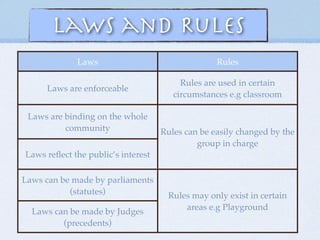
Laws and Rules
Laws Rules
Laws are enforceable
Rules are used in certain
circumstances e.g classroom
Laws are binding on the whole
community Rules can be easily changed by the
group in charge
Laws reflect the public’s interest
Laws can be made by parliaments
(statutes) Rules may only exist in certain
areas e.g Playground
Laws can be made by Judges
(precedents)
Classroom Rules
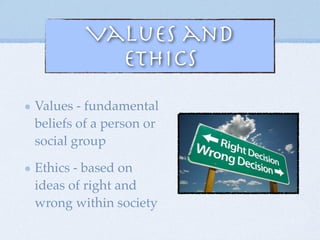
Values and
Ethics
Values - fundamental
beliefs of a person or
social group
Ethics - based on
ideas of right and
wrong within society
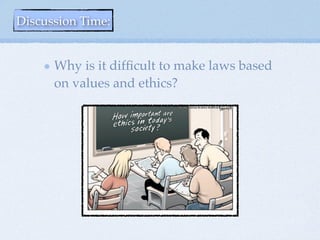
Why is it difficult to make laws based
on values and ethics?
Discussion Time:
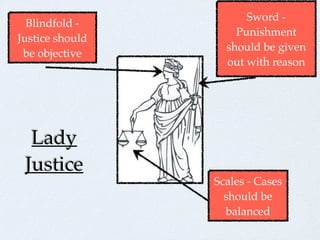
Lady
Justice
Sword -
Punishment
should be given
out with reason
Blindfold -
Justice should
be objective
Scales - Cases
should be
balanced
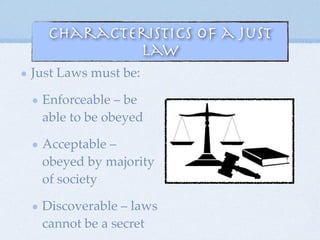
Characteristics of a Just
Law
Just Laws must be:
Enforceable – be
able to be obeyed
Acceptable –
obeyed by majority
of society
Discoverable – laws
cannot be a secret
The following are essential to ensure justice can be
achieved:
equality – that all people are treated in the same
way, without unfair advantage or disadvantage
fairness – that the legal system is free from bias,
dishonesty or injustice
access – the right or opportunity to make use of
something, particularly access to the legal system
The Nature of Justice
philosophy of ensuring an action
achieves the greatest good for the
greatest number of people
Utilitarianism
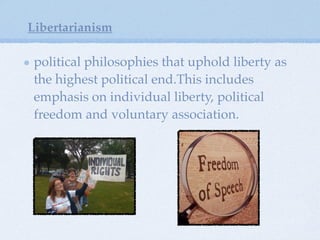
political philosophies that uphold liberty as
the highest political end.This includes
emphasis on individual liberty, political
freedom and voluntary association.
Libertarianism
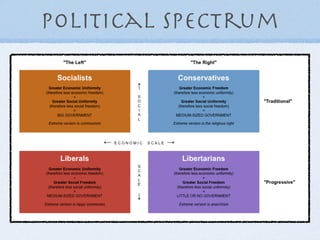
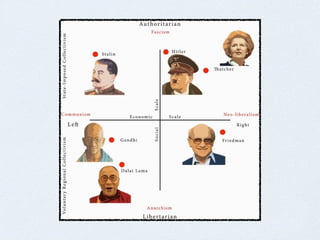
Political Spectrum
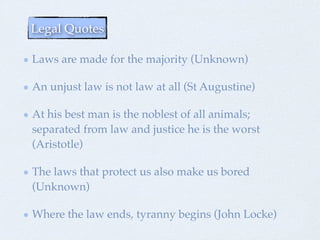
Laws are made for the majority (Unknown)
An unjust law is no law at all (St Augustine)
At his best man is the noblest of all animals;
separated from law and justice he is the worst
(Aristotle)
The laws that protect us also make us bored
(Unknown)
Where the law ends, tyranny begins (John Locke)
Legal Quotes
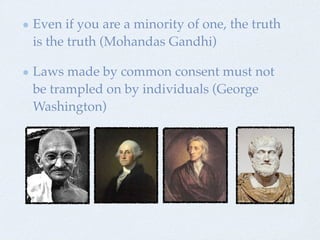
Even if you are a minority of one, the truth
is the truth (Mohandas Gandhi)
Laws made by common consent must not
be trampled on by individuals (George
Washington)
Natural Justice (Procedural
Fairness)
For justice to be achieved, there must be fairness
in the processes used to resolve disputes.
The two essential features of a fair and just
process are:
the right to be heard
the right to have a decision made by an
unbiased decision-maker
The Rule of Law
The rule of law requires that no one is above the
law.
This includes those who make the law and
enforce the law
Arbitrary power Is making decisions without any
reference to the law
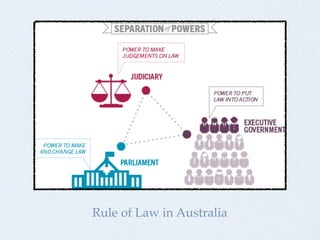
In Australia the use of separation of powers
under the constitution maintains the rule of law
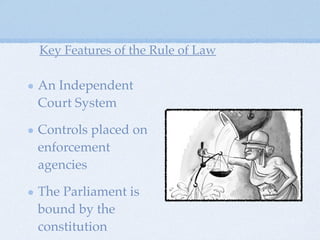
An Independent
Court System
Controls placed on
enforcement
agencies
The Parliament is
bound by the
constitution
Key Features of the Rule of Law
Rule of Law in Australia
Marcus Einfield
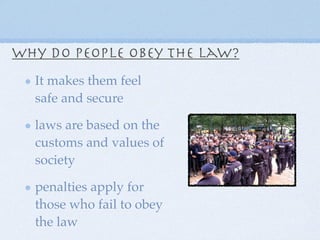
Why do people obey the law?
It makes them feel
safe and secure
laws are based on the
customs and values of
society
penalties apply for
those who fail to obey
the law
Anarchy and Tyranny
Anarchy is the absence of laws and
government
A state of anarchy can sometimes break
out after a major disaster or a war
in 2005 in New Orleans after
Hurricane Katrina, violence and
looting became widespread
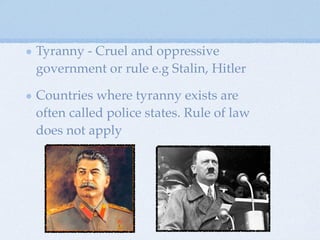
Tyranny - Cruel and oppressive
government or rule e.g Stalin, Hitler
Countries where tyranny exists are
often called police states. Rule of law
does not apply
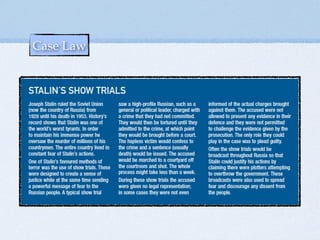
Case Law

Basic Legal Concepts

  • 1.
    The Legal System Section1 - Basic Legal Concepts, Mr Shipp - Term 1, 2016
  • 2.
    Mr Shipp’s hintand tips Organise yourself by using the syllabus. As you complete each dot point, mark it off so you know where the course is currently placed If you are away from class it is your responsibility to keep up to date. Resources will be available on the website and through the Facebook group
  • 3.
    Main Syllabus Hint: Learnyour syllabus points and you are one step away from doing well in assessment tasks
  • 4.
    Meaning of Law Lawsevolve from traditions, cultures and values Law is a set of enforceable rules of conduct which set out guidelines for the way individuals and society behave The law is always trying to keep up to date with the changing society we live in. Dynamic.
  • 5.
  • 6.
    Customs Customs are collectivehabits or traditions that have developed in a society overtime Customary law are principles and procedures that have developed due to customs of people or a nation Nation-State refers to a politically independent country
  • 7.
  • 8.
  • 9.
    Laws and Rules LawsRules Laws are enforceable Rules are used in certain circumstances e.g classroom Laws are binding on the whole community Rules can be easily changed by the group in charge Laws reflect the public’s interest Laws can be made by parliaments (statutes) Rules may only exist in certain areas e.g Playground Laws can be made by Judges (precedents)
  • 10.
  • 11.
    Values and Ethics Values -fundamental beliefs of a person or social group Ethics - based on ideas of right and wrong within society
  • 12.
    Why is itdifficult to make laws based on values and ethics? Discussion Time:
  • 13.
    Lady Justice Sword - Punishment should begiven out with reason Blindfold - Justice should be objective Scales - Cases should be balanced
  • 14.
    Characteristics of aJust Law Just Laws must be: Enforceable – be able to be obeyed Acceptable – obeyed by majority of society Discoverable – laws cannot be a secret
  • 15.
    The following areessential to ensure justice can be achieved: equality – that all people are treated in the same way, without unfair advantage or disadvantage fairness – that the legal system is free from bias, dishonesty or injustice access – the right or opportunity to make use of something, particularly access to the legal system The Nature of Justice
  • 16.
    philosophy of ensuringan action achieves the greatest good for the greatest number of people Utilitarianism
  • 17.
    political philosophies thatuphold liberty as the highest political end.This includes emphasis on individual liberty, political freedom and voluntary association. Libertarianism
  • 18.
  • 21.
    Laws are madefor the majority (Unknown) An unjust law is no law at all (St Augustine) At his best man is the noblest of all animals; separated from law and justice he is the worst (Aristotle) The laws that protect us also make us bored (Unknown) Where the law ends, tyranny begins (John Locke) Legal Quotes
  • 22.
    Even if youare a minority of one, the truth is the truth (Mohandas Gandhi) Laws made by common consent must not be trampled on by individuals (George Washington)
  • 23.
    Natural Justice (Procedural Fairness) Forjustice to be achieved, there must be fairness in the processes used to resolve disputes. The two essential features of a fair and just process are: the right to be heard the right to have a decision made by an unbiased decision-maker
  • 24.
    The Rule ofLaw The rule of law requires that no one is above the law. This includes those who make the law and enforce the law Arbitrary power Is making decisions without any reference to the law In Australia the use of separation of powers under the constitution maintains the rule of law
  • 25.
    An Independent Court System Controlsplaced on enforcement agencies The Parliament is bound by the constitution Key Features of the Rule of Law
  • 26.
    Rule of Lawin Australia
  • 27.
  • 28.
    Why do peopleobey the law? It makes them feel safe and secure laws are based on the customs and values of society penalties apply for those who fail to obey the law
  • 29.
    Anarchy and Tyranny Anarchyis the absence of laws and government A state of anarchy can sometimes break out after a major disaster or a war in 2005 in New Orleans after Hurricane Katrina, violence and looting became widespread
  • 30.
    Tyranny - Crueland oppressive government or rule e.g Stalin, Hitler Countries where tyranny exists are often called police states. Rule of law does not apply
  • 31.