 CONCEPT OF LAW
 ORIGIN AND EVOLUTION
 FEATURES
 SOURCES
 CLASSIFICATION
 CONCLUSION
The concept of law is viewed as a dynamic social science that evolves
alongside societal growth. As society faces new challenges, the
definition and scope of law must adapt to maintain relevance. Law, as
per jurisprudence, encompasses principles and regulations
established by authority, applicable through legislation or customary
practices enforced by the state. It serves as a set of rules governing
human actions, expressing general norms enforced by political
authority within a specific community, with non-compliance subject to
penalties.
The evolution of law is intricately tied to the growth of society, as new
developments give rise to fresh challenges. To align with societal
changes, the definition and scope of law must continually adapt. Law,
viewed through the lens of jurisprudence, comprises principles and
regulations established by authority, whether in the form of legislation
or customary practices recognized and enforced by the state. It
serves as a set of rules governing human actions, expressing general
norms enforced by sovereign political authority.
Law is a system of rules enforced through social instructions to
regulate behavior, created by collective legislatures, single
legislators, executives, or judges in common law jurisdictions. It
encompasses concepts such as justice, morality, reason, order, and
righteousness.
Law also pertains to statutes, acts, rules, regulations, orders, and
ordinances. Additionally, it involves maintaining uniformity of
behavior, consistency of happiness, or a course of events, providing
rules for actions in both natural phenomena and human relationships.
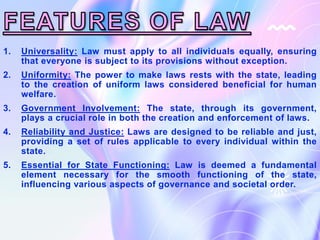
1. Universality: Law must apply to all individuals equally, ensuring
that everyone is subject to its provisions without exception.
2. Uniformity: The power to make laws rests with the state, leading
to the creation of uniform laws considered beneficial for human
welfare.
3. Government Involvement: The state, through its government,
plays a crucial role in both the creation and enforcement of laws.
4. Reliability and Justice: Laws are designed to be reliable and just,
providing a set of rules applicable to every individual within the
state.
5. Essential for State Functioning: Law is deemed a fundamental
element necessary for the smooth functioning of the state,
influencing various aspects of governance and societal order.
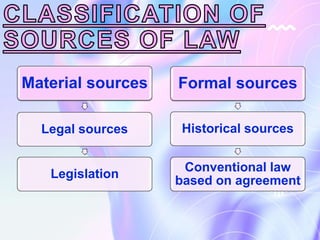
Material sources
Legal sources
Legislation
Formal sources
Historical sources
Conventional law
based on agreement
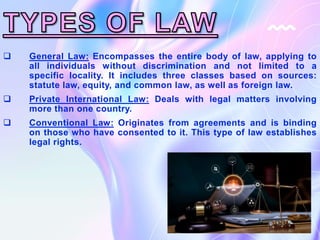
 General Law: Encompasses the entire body of law, applying to
all individuals without discrimination and not limited to a
specific locality. It includes three classes based on sources:
statute law, equity, and common law, as well as foreign law.
 Private International Law: Deals with legal matters involving
more than one country.
 Conventional Law: Originates from agreements and is binding
on those who have consented to it. This type of law establishes
legal rights.
 Special Law: Comprising specific legal rules applicable under
particular conditions. Sir John Salmon highlighted two types:
 Local and Municipal Law: Applicable in certain parts of states and
territories.
 Customary Law: Originating from pre-existing societal customs,
gaining legal status through general approval and enforcement by
the state.
 International Law: Governs relations between states and was
named by Bentham in the 18th century. It consists of rules
regulating interactions between nations.
 Private Law: Concerned with individual matters more than
public affairs, regulating the relationships among citizens.
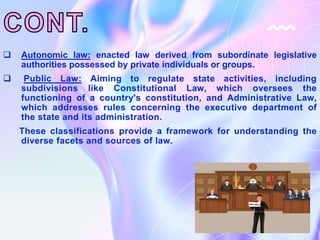
 Autonomic law: enacted law derived from subordinate legislative
authorities possessed by private individuals or groups.
 Public Law: Aiming to regulate state activities, including
subdivisions like Constitutional Law, which oversees the
functioning of a country's constitution, and Administrative Law,
which addresses rules concerning the executive department of
the state and its administration.
These classifications provide a framework for understanding the
diverse facets and sources of law.
In conclusion, law plays a crucial role in societies and globally by
establishing the framework of the state, defining institutional
structures, and outlining the limitations of power. It also governs the
relationships between states and individuals, contributing to peace
and unity. Without law, there is a risk of people exploiting one another,
highlighting the essential role of legal systems in maintaining order
and justice.

LAW: meaning, evolution,features,classification

  • 2.
     CONCEPT OFLAW  ORIGIN AND EVOLUTION  FEATURES  SOURCES  CLASSIFICATION  CONCLUSION
  • 3.
    The concept oflaw is viewed as a dynamic social science that evolves alongside societal growth. As society faces new challenges, the definition and scope of law must adapt to maintain relevance. Law, as per jurisprudence, encompasses principles and regulations established by authority, applicable through legislation or customary practices enforced by the state. It serves as a set of rules governing human actions, expressing general norms enforced by political authority within a specific community, with non-compliance subject to penalties.
  • 4.
    The evolution oflaw is intricately tied to the growth of society, as new developments give rise to fresh challenges. To align with societal changes, the definition and scope of law must continually adapt. Law, viewed through the lens of jurisprudence, comprises principles and regulations established by authority, whether in the form of legislation or customary practices recognized and enforced by the state. It serves as a set of rules governing human actions, expressing general norms enforced by sovereign political authority.
  • 5.
    Law is asystem of rules enforced through social instructions to regulate behavior, created by collective legislatures, single legislators, executives, or judges in common law jurisdictions. It encompasses concepts such as justice, morality, reason, order, and righteousness. Law also pertains to statutes, acts, rules, regulations, orders, and ordinances. Additionally, it involves maintaining uniformity of behavior, consistency of happiness, or a course of events, providing rules for actions in both natural phenomena and human relationships.
  • 6.
    1. Universality: Lawmust apply to all individuals equally, ensuring that everyone is subject to its provisions without exception. 2. Uniformity: The power to make laws rests with the state, leading to the creation of uniform laws considered beneficial for human welfare. 3. Government Involvement: The state, through its government, plays a crucial role in both the creation and enforcement of laws. 4. Reliability and Justice: Laws are designed to be reliable and just, providing a set of rules applicable to every individual within the state. 5. Essential for State Functioning: Law is deemed a fundamental element necessary for the smooth functioning of the state, influencing various aspects of governance and societal order.
  • 7.
    Material sources Legal sources Legislation Formalsources Historical sources Conventional law based on agreement
  • 8.
     General Law:Encompasses the entire body of law, applying to all individuals without discrimination and not limited to a specific locality. It includes three classes based on sources: statute law, equity, and common law, as well as foreign law.  Private International Law: Deals with legal matters involving more than one country.  Conventional Law: Originates from agreements and is binding on those who have consented to it. This type of law establishes legal rights.
  • 9.
     Special Law:Comprising specific legal rules applicable under particular conditions. Sir John Salmon highlighted two types:  Local and Municipal Law: Applicable in certain parts of states and territories.  Customary Law: Originating from pre-existing societal customs, gaining legal status through general approval and enforcement by the state.  International Law: Governs relations between states and was named by Bentham in the 18th century. It consists of rules regulating interactions between nations.  Private Law: Concerned with individual matters more than public affairs, regulating the relationships among citizens.
  • 10.
     Autonomic law:enacted law derived from subordinate legislative authorities possessed by private individuals or groups.  Public Law: Aiming to regulate state activities, including subdivisions like Constitutional Law, which oversees the functioning of a country's constitution, and Administrative Law, which addresses rules concerning the executive department of the state and its administration. These classifications provide a framework for understanding the diverse facets and sources of law.

  • 11.
    In conclusion, lawplays a crucial role in societies and globally by establishing the framework of the state, defining institutional structures, and outlining the limitations of power. It also governs the relationships between states and individuals, contributing to peace and unity. Without law, there is a risk of people exploiting one another, highlighting the essential role of legal systems in maintaining order and justice.