BASIC KNOWLEDGE ABOUT
VENTILATOR MACHINE
DR MAYURESH PAREEK
Assistant Professor
Department of Anaesthesiology
PDUMC, Rajkot
OBJECTIVES
• Parts of ventilator
• Non invasive mode of ventilation
• Invasive mode of ventilation
• Supportive care
• Weaning
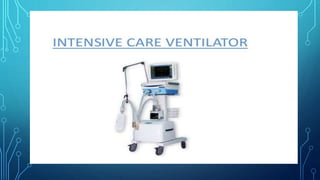
•Mechanical ventilator is an apparatus which can
replace normal mechanism of breathing either
by providing intermittent or continuous flow of
oxygen or air under pressure ,which is
connected to the patient by a tube inserted
through mouth ,the nose or an opening in the
trachea
GOALS OF MECHANICAL VENTILATION
• Avoiding extension of lung injury,
• ↓O2 toxicity
• Recruiting alveoli by ↑ mean Paw by ↑
PEEP and/or prolonging inspiration,
• ↓ Peak Paw
• Preventing atelectasis
• Using sedation and paralysis judiciously
• Better Patient-Ventilator synchrony
• If the patient deteriorates on niv then invasive ventilation with
definitive airway has to be started
INITIAL SETUP
• Position
• Head of the bed at a 45°
angle
• Mask
• Choose correct size mask
• Connect mask to ventilator
• Pulse Oximeter
• Avoid nasogastric tube
VENTILATOR SETUP AND ADJUSTMENT
• 1. Calculate predicted body weight (PBW)
Males = 50 + 2.3 [height (inches) - 60]
Females = 45.5 + 2.3 [height (inches) -60]
• 2. Select appropriate ventilator mode
• 3. Set ventilator settings to achieve initial VT = 8 ml/kg PBW
• 4. Reduce VT by 1 ml/kg at intervals ≤ 2 hours until VT =
6ml/kg PBW.
• 5. Set initial rate to approximate baseline minute ventilation
(not > 35 bpm).
• 6. Adjust VT and RR to achieve pH and plateau pressure goals
MODE
•Mode is a method or way a breath is delivered
•TYPES OF NON INVASIVE MODE
1.BIPAP MODE
2.C PAP MODE
TYPES OF INVASIVE MODE
1.Controlled
2.Supporitive
3.Combination
CONTROLLED MODES
•Every breath delivered to patient is a
mechanical breath
•Breath may be triggered by a timing mechanism
or patient effort
1.Volume control
2.Pressure control
3.PRVC
SUPPORTED MODE
•Every breath is spontaneous
•Patient triggered and patient cycled
1.Volume support
2.Pressure support /CPAP
COMBINATION MODES
•Combination of both controlled and supported
1.SIMV(VC)+PS
2.SIMV (PC)+PS
3.SIMV (PRVC)+PS
ADVANTAGES OF NIV
• Avoids ETT-associated complication
• Flexibility in initiating and removing MV
• Decrease the need for invasive monitoring
• Decreases sedation requirements
• Ventilates effectively at lower pressures
COMPLICATIONS AND SIDE EFFECTS OF NIV
• Conjunctival irritation / conjunctivitis
• Mouth or nasal dryness
• Sinus pain or ear pain
• Nasal congestion
• Gastric insufflation
• ‘Claustrophobia’
• Nasal bridge irritation or ulceration
• Aspiration pneumonia
CONTRAINDICATIONS
• 1. Respiratory arrest
• 2. Medically unstable
• 3. Unconscious, unable to protect airways
• 4. Excessive secretions
• 5. Significant vomiting
• 6. Agitated or uncooperative
• 7. Facial trauma, burns, surgery or anatomic
• abnormalities interfering with mask application
n
CHOICE OF MODE
THANK YOU

Basic knowledge about ventilator machine PART 1.pptx

  • 1.
    BASIC KNOWLEDGE ABOUT VENTILATORMACHINE DR MAYURESH PAREEK Assistant Professor Department of Anaesthesiology PDUMC, Rajkot
  • 2.
    OBJECTIVES • Parts ofventilator • Non invasive mode of ventilation • Invasive mode of ventilation • Supportive care • Weaning
  • 6.
    •Mechanical ventilator isan apparatus which can replace normal mechanism of breathing either by providing intermittent or continuous flow of oxygen or air under pressure ,which is connected to the patient by a tube inserted through mouth ,the nose or an opening in the trachea
  • 8.
    GOALS OF MECHANICALVENTILATION • Avoiding extension of lung injury, • ↓O2 toxicity • Recruiting alveoli by ↑ mean Paw by ↑ PEEP and/or prolonging inspiration, • ↓ Peak Paw • Preventing atelectasis • Using sedation and paralysis judiciously • Better Patient-Ventilator synchrony • If the patient deteriorates on niv then invasive ventilation with definitive airway has to be started
  • 9.
    INITIAL SETUP • Position •Head of the bed at a 45° angle • Mask • Choose correct size mask • Connect mask to ventilator • Pulse Oximeter • Avoid nasogastric tube
  • 10.
    VENTILATOR SETUP ANDADJUSTMENT • 1. Calculate predicted body weight (PBW) Males = 50 + 2.3 [height (inches) - 60] Females = 45.5 + 2.3 [height (inches) -60] • 2. Select appropriate ventilator mode • 3. Set ventilator settings to achieve initial VT = 8 ml/kg PBW • 4. Reduce VT by 1 ml/kg at intervals ≤ 2 hours until VT = 6ml/kg PBW. • 5. Set initial rate to approximate baseline minute ventilation (not > 35 bpm). • 6. Adjust VT and RR to achieve pH and plateau pressure goals
  • 11.
    MODE •Mode is amethod or way a breath is delivered •TYPES OF NON INVASIVE MODE 1.BIPAP MODE 2.C PAP MODE TYPES OF INVASIVE MODE 1.Controlled 2.Supporitive 3.Combination
  • 14.
    CONTROLLED MODES •Every breathdelivered to patient is a mechanical breath •Breath may be triggered by a timing mechanism or patient effort 1.Volume control 2.Pressure control 3.PRVC
  • 15.
    SUPPORTED MODE •Every breathis spontaneous •Patient triggered and patient cycled 1.Volume support 2.Pressure support /CPAP
  • 16.
    COMBINATION MODES •Combination ofboth controlled and supported 1.SIMV(VC)+PS 2.SIMV (PC)+PS 3.SIMV (PRVC)+PS
  • 17.
    ADVANTAGES OF NIV •Avoids ETT-associated complication • Flexibility in initiating and removing MV • Decrease the need for invasive monitoring • Decreases sedation requirements • Ventilates effectively at lower pressures
  • 18.
    COMPLICATIONS AND SIDEEFFECTS OF NIV • Conjunctival irritation / conjunctivitis • Mouth or nasal dryness • Sinus pain or ear pain • Nasal congestion • Gastric insufflation • ‘Claustrophobia’ • Nasal bridge irritation or ulceration • Aspiration pneumonia
  • 19.
    CONTRAINDICATIONS • 1. Respiratoryarrest • 2. Medically unstable • 3. Unconscious, unable to protect airways • 4. Excessive secretions • 5. Significant vomiting • 6. Agitated or uncooperative • 7. Facial trauma, burns, surgery or anatomic • abnormalities interfering with mask application n
  • 20.
  • 21.