Le Plus-que-Parfait
   Qu’est-ce que c’est?
     La Formation…
   Verbes en –er, -ir, -re

           Mrs Shannon       1
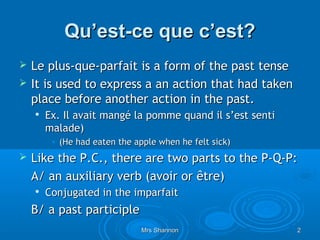
Qu’est-ce que c’est?
   Le plus-que-parfait is a form of the past tense
   It is used to express a an action that had taken
    place before another action in the past.
       Ex. Il avait mangé la pomme quand il s’est senti
        malade)
         • (He had eaten the apple when he felt sick)
   Like the P.C., there are two parts to the P-Q-P:
    A/ an auxiliary verb (avoir or être)
       Conjugated in the imparfait
    B/ a past participle
                               Mrs Shannon                 2
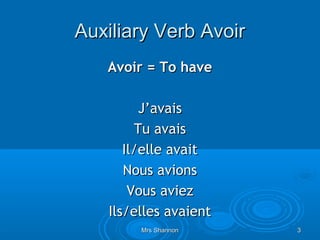
Auxiliary Verb Avoir
   Avoir = To have

         J’avais
        Tu avais
      Il/elle avait
      Nous avions
       Vous aviez
   Ils/elles avaient
        Mrs Shannon    3
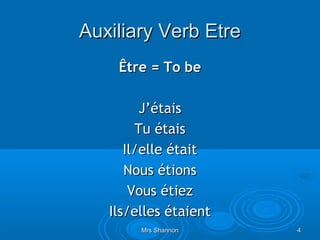
Auxiliary Verb Etre
    Être = To be

         J’étais
        Tu étais
      Il/elle était
      Nous étions
       Vous étiez
   Ils/elles étaient
        Mrs Shannon    4
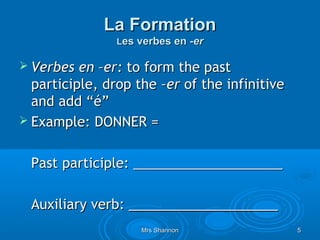
La Formation
                Les verbes en -er

 Verbes  en –er: to form the past
  participle, drop the –er of the infinitive
  and add “é”
 Example: DONNER =


 Past participle: ____________________

 Auxiliary verb: ____________________
                    Mrs Shannon                5
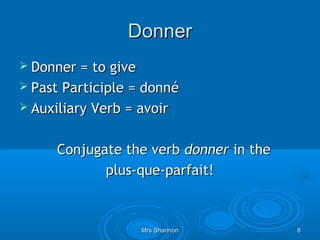
Donner
 Donner  = to give
 Past Participle = donné
 Auxiliary Verb = avoir


     Conjugate the verb donner in the
            plus-que-parfait!


                   Mrs Shannon          6
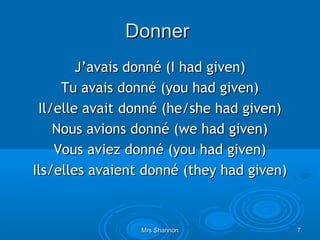
Donner
        J’avais donné (I had given)
     Tu avais donné (you had given)
 Il/elle avait donné (he/she had given)
    Nous avions donné (we had given)
    Vous aviez donné (you had given)
Ils/elles avaient donné (they had given)


                 Mrs Shannon               7
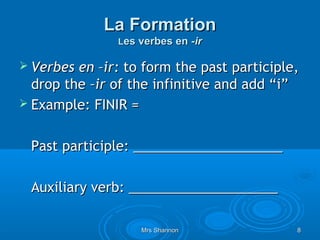
La Formation
               Les verbes en -ir

 Verbes en –ir: to form the past participle,
  drop the –ir of the infinitive and add “i”
 Example: FINIR =


 Past participle: ____________________

 Auxiliary verb: ____________________

                   Mrs Shannon              8
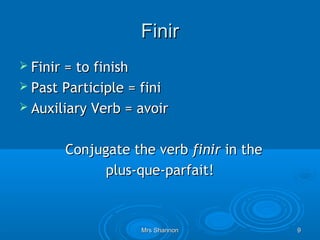
Finir
 Finir= to finish
 Past Participle = fini
 Auxiliary Verb = avoir


          Conjugate the verb finir in the
                plus-que-parfait!


                     Mrs Shannon            9
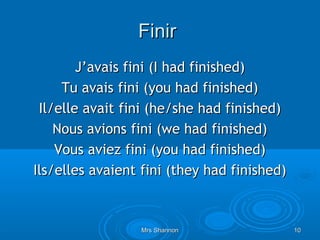
Finir
        J’avais fini (I had finished)
     Tu avais fini (you had finished)
 Il/elle avait fini (he/she had finished)
    Nous avions fini (we had finished)
    Vous aviez fini (you had finished)
Ils/elles avaient fini (they had finished)


                 Mrs Shannon                 10
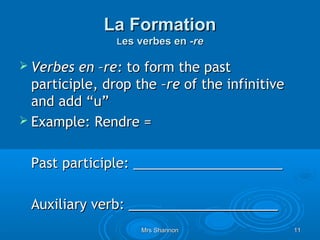
La Formation
                Les verbes en -re

 Verbes  en –re: to form the past
  participle, drop the –re of the infinitive
  and add “u”
 Example: Rendre =


 Past participle: ____________________

 Auxiliary verb: ____________________
                    Mrs Shannon                11
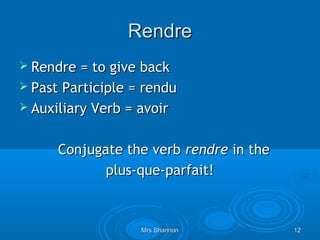
Rendre
 Rendre  = to give back
 Past Participle = rendu
 Auxiliary Verb = avoir


      Conjugate the verb rendre in the
             plus-que-parfait!


                   Mrs Shannon           12
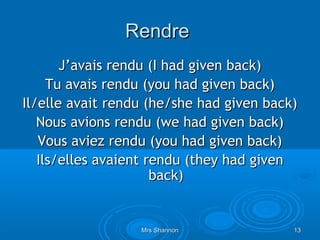
Rendre
       J’avais rendu (I had given back)
     Tu avais rendu (you had given back)
Il/elle avait rendu (he/she had given back)
   Nous avions rendu (we had given back)
   Vous aviez rendu (you had given back)
   Ils/elles avaient rendu (they had given
                      back)


                  Mrs Shannon             13
Devoirs
 Conjugez    les verbes suivants au plus-que-
 parfait:
     Fermer =    ____________
     Parler =    ____________
  
      Devenir =   ____________
     Dormir =    ____________
     Battre =    ____________
  
      Vendre =    ____________

                      Mrs Shannon            14
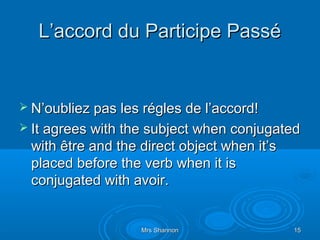
L’accord du Participe Passé


 N’oubliez pas les régles de l’accord!
 It agrees with the subject when conjugated
 with être and the direct object when it’s
 placed before the verb when it is
 conjugated with avoir.


                   Mrs Shannon               15
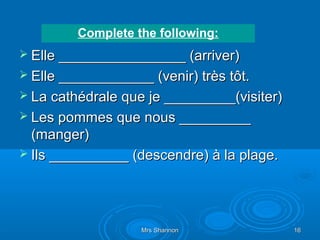
Complete the following:
 Elle ________________ (arriver)
 Elle ____________ (venir) très tôt.
 La cathédrale que je _________(visiter)
 Les pommes que nous _________
  (manger)
 Ils __________ (descendre) à la plage.


                   Mrs Shannon              16

Plus que-parfait

  • 1.
    Le Plus-que-Parfait Qu’est-ce que c’est? La Formation… Verbes en –er, -ir, -re Mrs Shannon 1
  • 2.
    Qu’est-ce que c’est?  Le plus-que-parfait is a form of the past tense  It is used to express a an action that had taken place before another action in the past.  Ex. Il avait mangé la pomme quand il s’est senti malade) • (He had eaten the apple when he felt sick)  Like the P.C., there are two parts to the P-Q-P: A/ an auxiliary verb (avoir or être)  Conjugated in the imparfait B/ a past participle Mrs Shannon 2
  • 3.
    Auxiliary Verb Avoir Avoir = To have J’avais Tu avais Il/elle avait Nous avions Vous aviez Ils/elles avaient Mrs Shannon 3
  • 4.
    Auxiliary Verb Etre Être = To be J’étais Tu étais Il/elle était Nous étions Vous étiez Ils/elles étaient Mrs Shannon 4
  • 5.
    La Formation Les verbes en -er  Verbes en –er: to form the past participle, drop the –er of the infinitive and add “é”  Example: DONNER = Past participle: ____________________ Auxiliary verb: ____________________ Mrs Shannon 5
  • 6.
    Donner  Donner = to give  Past Participle = donné  Auxiliary Verb = avoir Conjugate the verb donner in the plus-que-parfait! Mrs Shannon 6
  • 7.
    Donner J’avais donné (I had given) Tu avais donné (you had given) Il/elle avait donné (he/she had given) Nous avions donné (we had given) Vous aviez donné (you had given) Ils/elles avaient donné (they had given) Mrs Shannon 7
  • 8.
    La Formation Les verbes en -ir  Verbes en –ir: to form the past participle, drop the –ir of the infinitive and add “i”  Example: FINIR = Past participle: ____________________ Auxiliary verb: ____________________ Mrs Shannon 8
  • 9.
    Finir  Finir= tofinish  Past Participle = fini  Auxiliary Verb = avoir Conjugate the verb finir in the plus-que-parfait! Mrs Shannon 9
  • 10.
    Finir J’avais fini (I had finished) Tu avais fini (you had finished) Il/elle avait fini (he/she had finished) Nous avions fini (we had finished) Vous aviez fini (you had finished) Ils/elles avaient fini (they had finished) Mrs Shannon 10
  • 11.
    La Formation Les verbes en -re  Verbes en –re: to form the past participle, drop the –re of the infinitive and add “u”  Example: Rendre = Past participle: ____________________ Auxiliary verb: ____________________ Mrs Shannon 11
  • 12.
    Rendre  Rendre = to give back  Past Participle = rendu  Auxiliary Verb = avoir Conjugate the verb rendre in the plus-que-parfait! Mrs Shannon 12
  • 13.
    Rendre J’avais rendu (I had given back) Tu avais rendu (you had given back) Il/elle avait rendu (he/she had given back) Nous avions rendu (we had given back) Vous aviez rendu (you had given back) Ils/elles avaient rendu (they had given back) Mrs Shannon 13
  • 14.
    Devoirs  Conjugez les verbes suivants au plus-que- parfait:  Fermer = ____________  Parler = ____________  Devenir = ____________  Dormir = ____________  Battre = ____________  Vendre = ____________ Mrs Shannon 14
  • 15.
    L’accord du ParticipePassé  N’oubliez pas les régles de l’accord!  It agrees with the subject when conjugated with être and the direct object when it’s placed before the verb when it is conjugated with avoir. Mrs Shannon 15
  • 16.
    Complete the following: Elle ________________ (arriver)  Elle ____________ (venir) très tôt.  La cathédrale que je _________(visiter)  Les pommes que nous _________ (manger)  Ils __________ (descendre) à la plage. Mrs Shannon 16