Ontology in Buffalo
June 6, 2013
Barry Smith
Watson’s law of
bioinformatics ontologies
“As the time spent discussing a
particular bioinformatics topic
grows longer, the probability that
someone will suggest the group
develops an ontology for that topic
approaches 1”
http://biomickwatson.wordpress.com
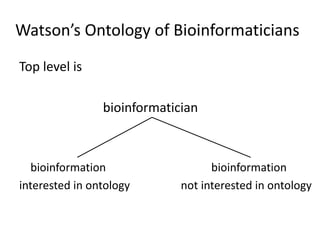
Watson’s Ontology of Bioinformaticians
Top level is
bioinformatician
bioinformation bioinformation
interested in ontology not interested in ontology
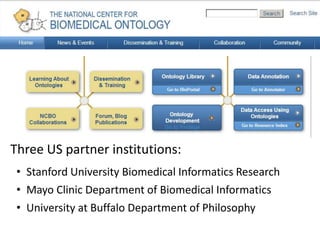
• Stanford University Biomedical Informatics Research
• Mayo Clinic Department of Biomedical Informatics
• University at Buffalo Department of Philosophy
Three US partner institutions:
RELATION
TO TIME
GRANULARITY
CONTINUANT OCCURRENT
INDEPENDENT DEPENDENT
ORGAN AND
ORGANISM
Organism
(NCBI
Taxonomy)
Anatomical
Entity
(FMA,
CARO)
Organ
Function
(FMP, CPRO) Phenotypic
Quality
(PaTO)
Biological
Process
(GO)
CELL AND
CELLULAR
COMPONENT
Cell
(CL)
Cellular
Component
(FMA, GO)
Cellular
Function
(GO)
MOLECULE
Molecule
(ChEBI, SO,
RnaO, PrO)
Molecular Function
(GO)
Molecular Process
(GO)
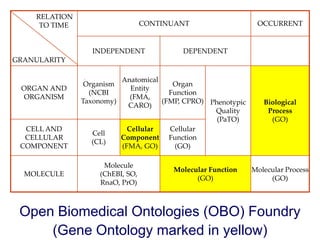
Open Biomedical Ontologies (OBO) Foundry
(Gene Ontology marked in yellow)
© Ocean Informatics 2005 4.10
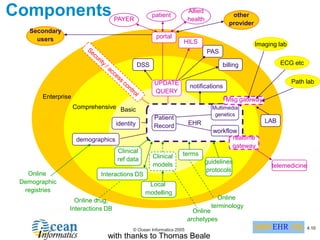
Enterprise
Comprehensive Basic
Components
EHR
Multimedia
genetics
workflow
identity
Clinical
ref data Clinical
models
terms
realtime
gateway
telemedicine
HILS
other
provider
UPDATE
QUERY
demographics
guidelines
protocols
Interactions DS
Local
modelling
notifications
DSS
PAS
billing
portal
Allied
health
patient
PAYER
Msg gateway
Imaging lab
ECG etc
Path lab
LAB
Secondary
users
Online drug,
Interactions DB Online
archetypes
Online
terminology
Online
Demographic
registries
Patient
Record
with thanks to Thomas Beale
11
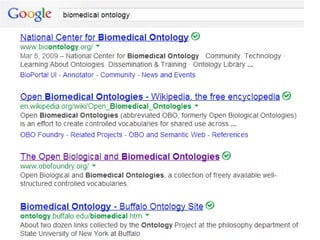
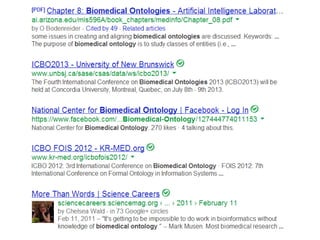
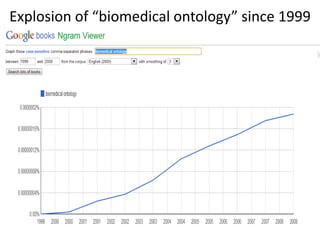
Explosion of “biomedical ontology” since 1999
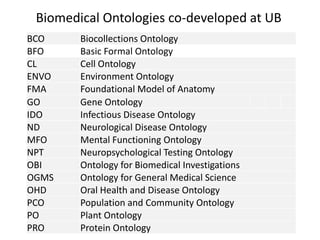
Biomedical Ontologies co-developed at UB
BCO Biocollections Ontology
BFO Basic Formal Ontology
CL Cell Ontology
ENVO Environment Ontology
FMA Foundational Model of Anatomy
GO Gene Ontology
IDO Infectious Disease Ontology
ND Neurological Disease Ontology
MFO Mental Functioning Ontology
NPT Neuropsychological Testing Ontology
OBI Ontology for Biomedical Investigations
OGMS Ontology for General Medical Science
OHD Oral Health and Disease Ontology
PCO Population and Community Ontology
PO Plant Ontology
PRO Protein Ontology
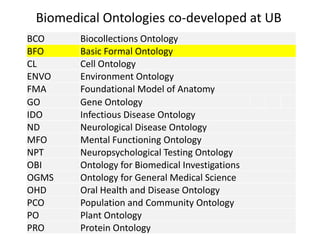
Biomedical Ontologies co-developed at UB
BCO Biocollections Ontology
BFO Basic Formal Ontology
CL Cell Ontology
ENVO Environment Ontology
FMA Foundational Model of Anatomy
GO Gene Ontology
IDO Infectious Disease Ontology
ND Neurological Disease Ontology
MFO Mental Functioning Ontology
NPT Neuropsychological Testing Ontology
OBI Ontology for Biomedical Investigations
OGMS Ontology for General Medical Science
OHD Oral Health and Disease Ontology
PCO Population and Community Ontology
PO Plant Ontology
PRO Protein Ontology
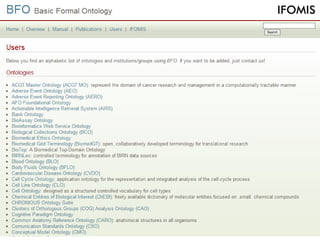
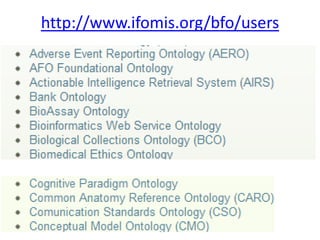
http://www.ifomis.org/bfo/users
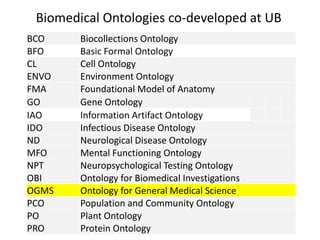
Biomedical Ontologies co-developed at UB
BCO Biocollections Ontology
BFO Basic Formal Ontology
CL Cell Ontology
ENVO Environment Ontology
FMA Foundational Model of Anatomy
GO Gene Ontology
IAO Information Artifact Ontology
IDO Infectious Disease Ontology
ND Neurological Disease Ontology
MFO Mental Functioning Ontology
NPT Neuropsychological Testing Ontology
OBI Ontology for Biomedical Investigations
OGMS Ontology for General Medical Science
PCO Population and Community Ontology
PO Plant Ontology
PRO Protein Ontology
Biomedical Ontology in Buffalo
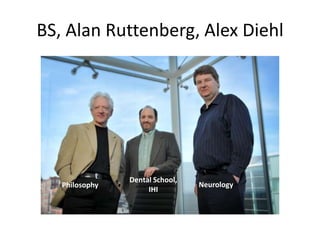
BS, Alan Ruttenberg, Alex Diehl
Philosophy
Dental School,
IHI
Neurology
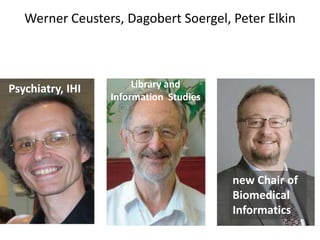
Werner Ceusters, Dagobert Soergel, Peter Elkin
Psychiatry, IHI
Dental School,
Library and
Information Studies
new Chair of
Biomedical
Informatics
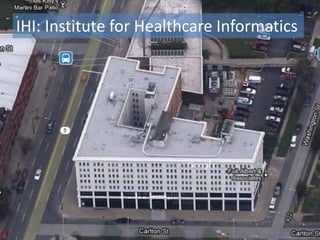
IHI: Institute for Healthcare Informatics
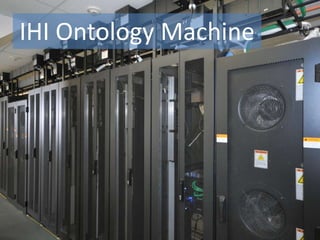
IHI Ontology Machine
Strategy
• using BFO, OGMS and their extension ontologies
to provide a consistent framework for the
representation of the types of particulars
• developing systematic ways for the consistent
tracking of particulars (patients, disorders,
encounters …)
• putting these together to serve consistent
representation of the assertional knowledge in
the IHI repository
Strategy
• using BFO, OGMS and their extension ontologies
to provide a consistent framework for the
representation of the types of particulars
• developing systematic ways for the consistent
tracking of particulars (patients, disorders,
encounters …)
• putting these together to serve consistent
representation of the assertional knowledge in
the IHI repository
Acknowledgement
• IDO: Immune System Biological Networks: A Case
Study in Improved Data Integration & Analysis (NIH /
NIAID)
• ImmPort: Bioinformatics Integration Support
Contract (NIH/NIAID)
• Plant Ontology (NSF)
• OPMQoL: Ontology for Pain and Related Disability,
Mental Health and Quality of Life (NIH/National
Institute of Dental and Craniofacial Research)
• PRO: A Protein Ontology in Open Biomedical
Ontologies (NIH/NIGMS)
• NCBO: National Center for Biomedical Ontology
(NIH/NHGRI)
Further reading
National Center for Ontological Research
http://ncor.buffalo.edu
Contact
phismith@buffalo.edu

Ontology in-buffalo-2013

  • 1.
    Ontology in Buffalo June6, 2013 Barry Smith
  • 2.
    Watson’s law of bioinformaticsontologies “As the time spent discussing a particular bioinformatics topic grows longer, the probability that someone will suggest the group develops an ontology for that topic approaches 1” http://biomickwatson.wordpress.com
  • 3.
    Watson’s Ontology ofBioinformaticians Top level is bioinformatician bioinformation bioinformation interested in ontology not interested in ontology
  • 5.
    • Stanford UniversityBiomedical Informatics Research • Mayo Clinic Department of Biomedical Informatics • University at Buffalo Department of Philosophy Three US partner institutions:
  • 7.
    RELATION TO TIME GRANULARITY CONTINUANT OCCURRENT INDEPENDENTDEPENDENT ORGAN AND ORGANISM Organism (NCBI Taxonomy) Anatomical Entity (FMA, CARO) Organ Function (FMP, CPRO) Phenotypic Quality (PaTO) Biological Process (GO) CELL AND CELLULAR COMPONENT Cell (CL) Cellular Component (FMA, GO) Cellular Function (GO) MOLECULE Molecule (ChEBI, SO, RnaO, PrO) Molecular Function (GO) Molecular Process (GO) Open Biomedical Ontologies (OBO) Foundry (Gene Ontology marked in yellow)
  • 10.
    © Ocean Informatics2005 4.10 Enterprise Comprehensive Basic Components EHR Multimedia genetics workflow identity Clinical ref data Clinical models terms realtime gateway telemedicine HILS other provider UPDATE QUERY demographics guidelines protocols Interactions DS Local modelling notifications DSS PAS billing portal Allied health patient PAYER Msg gateway Imaging lab ECG etc Path lab LAB Secondary users Online drug, Interactions DB Online archetypes Online terminology Online Demographic registries Patient Record with thanks to Thomas Beale
  • 11.
  • 12.
    Explosion of “biomedicalontology” since 1999
  • 13.
    Biomedical Ontologies co-developedat UB BCO Biocollections Ontology BFO Basic Formal Ontology CL Cell Ontology ENVO Environment Ontology FMA Foundational Model of Anatomy GO Gene Ontology IDO Infectious Disease Ontology ND Neurological Disease Ontology MFO Mental Functioning Ontology NPT Neuropsychological Testing Ontology OBI Ontology for Biomedical Investigations OGMS Ontology for General Medical Science OHD Oral Health and Disease Ontology PCO Population and Community Ontology PO Plant Ontology PRO Protein Ontology
  • 14.
    Biomedical Ontologies co-developedat UB BCO Biocollections Ontology BFO Basic Formal Ontology CL Cell Ontology ENVO Environment Ontology FMA Foundational Model of Anatomy GO Gene Ontology IDO Infectious Disease Ontology ND Neurological Disease Ontology MFO Mental Functioning Ontology NPT Neuropsychological Testing Ontology OBI Ontology for Biomedical Investigations OGMS Ontology for General Medical Science OHD Oral Health and Disease Ontology PCO Population and Community Ontology PO Plant Ontology PRO Protein Ontology
  • 16.
  • 17.
    Biomedical Ontologies co-developedat UB BCO Biocollections Ontology BFO Basic Formal Ontology CL Cell Ontology ENVO Environment Ontology FMA Foundational Model of Anatomy GO Gene Ontology IAO Information Artifact Ontology IDO Infectious Disease Ontology ND Neurological Disease Ontology MFO Mental Functioning Ontology NPT Neuropsychological Testing Ontology OBI Ontology for Biomedical Investigations OGMS Ontology for General Medical Science PCO Population and Community Ontology PO Plant Ontology PRO Protein Ontology
  • 18.
  • 19.
    BS, Alan Ruttenberg,Alex Diehl Philosophy Dental School, IHI Neurology
  • 20.
    Werner Ceusters, DagobertSoergel, Peter Elkin Psychiatry, IHI Dental School, Library and Information Studies new Chair of Biomedical Informatics
  • 21.
    IHI: Institute forHealthcare Informatics
  • 22.
  • 23.
    Strategy • using BFO,OGMS and their extension ontologies to provide a consistent framework for the representation of the types of particulars • developing systematic ways for the consistent tracking of particulars (patients, disorders, encounters …) • putting these together to serve consistent representation of the assertional knowledge in the IHI repository
  • 24.
    Strategy • using BFO,OGMS and their extension ontologies to provide a consistent framework for the representation of the types of particulars • developing systematic ways for the consistent tracking of particulars (patients, disorders, encounters …) • putting these together to serve consistent representation of the assertional knowledge in the IHI repository
  • 25.
    Acknowledgement • IDO: ImmuneSystem Biological Networks: A Case Study in Improved Data Integration & Analysis (NIH / NIAID) • ImmPort: Bioinformatics Integration Support Contract (NIH/NIAID) • Plant Ontology (NSF) • OPMQoL: Ontology for Pain and Related Disability, Mental Health and Quality of Life (NIH/National Institute of Dental and Craniofacial Research) • PRO: A Protein Ontology in Open Biomedical Ontologies (NIH/NIGMS) • NCBO: National Center for Biomedical Ontology (NIH/NHGRI)
  • 26.
    Further reading National Centerfor Ontological Research http://ncor.buffalo.edu Contact phismith@buffalo.edu

Editor's Notes

  • #22 923 Main Street location at the heart of the Medical Campus; 2 blocks from both CTRC and CCR
  • #23 Including individually locked and monitored racks, cold aisle design, dual power