BASIC
DRAFTING
GOALS OF TECHNICAL DRAWING
⚫Detail drawing must be accurate.
⚫Detail drawing must be executed
with proper technique or good
workmanship.
⚫Detail drawing should be neat.
⚫Detail drawing must be made
with speed.
TWO CLASSES OF DRAWING
⚫ARTISTIC- The artist expresses
aesthetic ideas or emotions.
⚫TECHNICAL- Exact means of
expression and accuracy is one
of the main objective.
DEFINITION AND RELATIONSHIP OF;
⚫PAINTING
⚫DRAWING
⚫DRAFTING
⚫SKETCHING
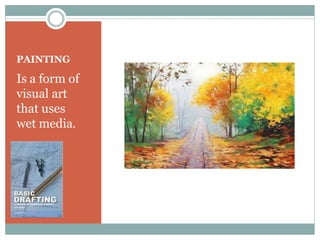
PAINTING
Is a form of
visual art
that uses
wet media.
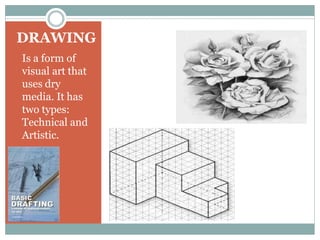
DRAWING
Is a form of
visual art that
uses dry
media. It has
two types:
Technical and
Artistic.
• Is the act and discipline of composing plans
that visually communicate how something
functions or has to be constructed. Drafting is
the visual language of industry and
engineering.
• Drafting is the term used to refer to the
systematic representation and dimensional
specification of mechanical and architectural
structures.
DRAFTING OR TECHNICAL
DRAWING
• A drafter, draftsperson, or draftsman is
a person who makes a technical drawing. A
professional drafter who makes technical
drawings is sometimes called a drafting
technician.
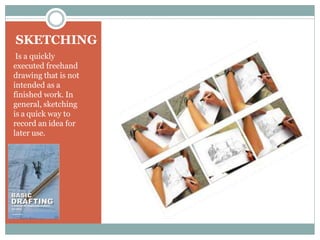
SKETCHING
Is a quickly
executed freehand
drawing that is not
intended as a
finished work. In
general, sketching
is a quick way to
record an idea for
later use.
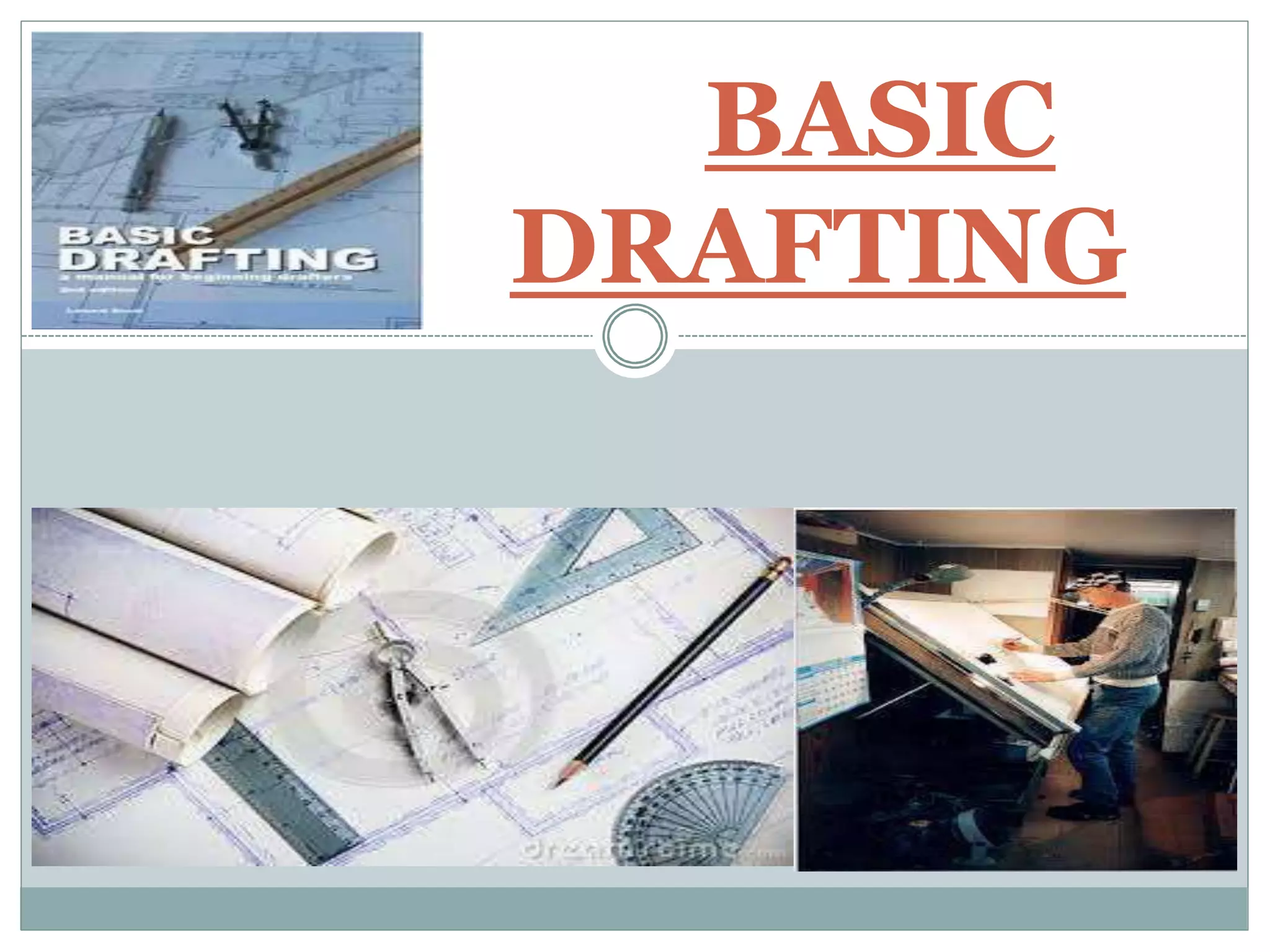
MATERIALS NEEDED FOR DRAWING
⚫DRAWING BOARD/TABLE
⚫DRAWING PAPER/PLATES
⚫TECHNICAL PEN
⚫MECHANICAL PENCIL
⚫ERASER
⚫COMPASS
⚫T-SQUARE
⚫TRIANGLES (45x45 AND 30x60)
⚫RULER
⚫PROTRACTOR
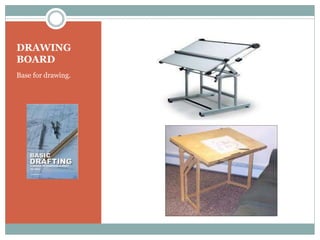
DRAWING
BOARD
Base for drawing.
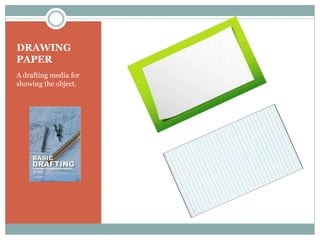
DRAWING
PAPER
A drafting media for
showing the object.
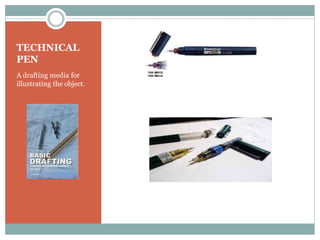
TECHNICAL
PEN
A drafting media for
illustrating the object.
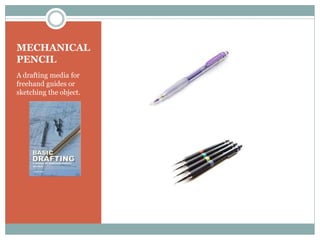
MECHANICAL
PENCIL
A drafting media for
freehand guides or
sketching the object.
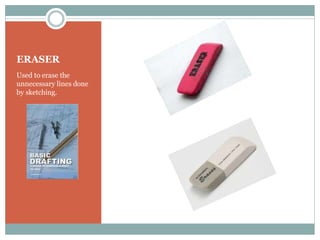
ERASER
Used to erase the
unnecessary lines done
by sketching.
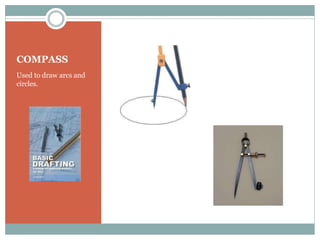
COMPASS
Used to draw arcs and
circles.
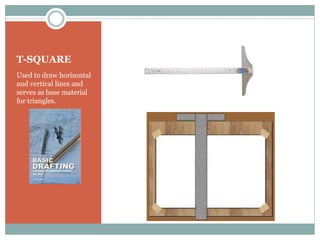
T-SQUARE
Used to draw horizontal
and vertical lines and
serves as base material
for triangles.
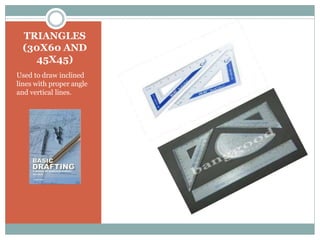
TRIANGLES
(30X60 AND
45X45)
Used to draw inclined
lines with proper angle
and vertical lines.
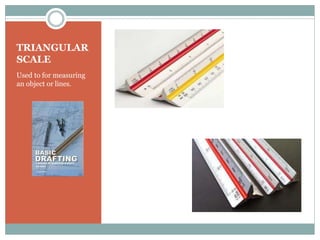
TRIANGULAR
SCALE
Used to for measuring
an object or lines.
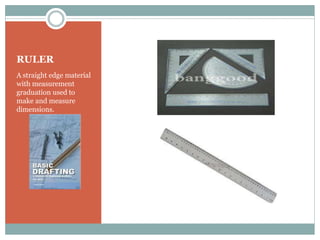
RULER
A straight edge material
with measurement
graduation used to
make and measure
dimensions.
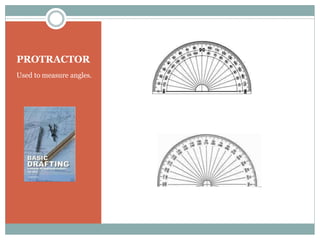
PROTRACTOR
Used to measure angles.
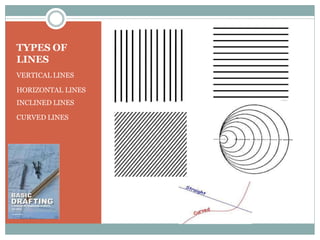
TYPES OF
LINES
VERTICAL LINES
HORIZONTAL LINES
INCLINED LINES
CURVED LINES
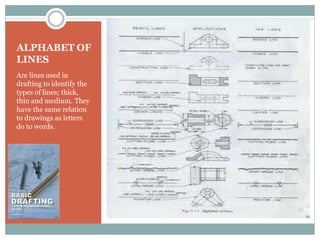
ALPHABET OF
LINES
Are lines used in
drafting to identify the
types of lines; thick,
thin and medium. They
have the same relation
to drawings as letters
do to words.
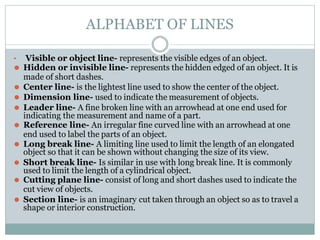
ALPHABET OF LINES
• Visible or object line- represents the visible edges of an object.
⚫ Hidden or invisible line- represents the hidden edged of an object. It is
made of short dashes.
⚫ Center line- is the lightest line used to show the center of the object.
⚫ Dimension line- used to indicate the measurement of objects.
⚫ Leader line- A fine broken line with an arrowhead at one end used for
indicating the measurement and name of a part.
⚫ Reference line- An irregular fine curved line with an arrowhead at one
end used to label the parts of an object.
⚫ Long break line- A limiting line used to limit the length of an elongated
object so that it can be shown without changing the size of its view.
⚫ Short break line- Is similar in use with long break line. It is commonly
used to limit the length of a cylindrical object.
⚫ Cutting plane line- consist of long and short dashes used to indicate the
cut view of objects.
⚫ Section line- is an imaginary cut taken through an object so as to travel a
shape or interior construction.
ALPHABET OF LINES
LETTERING
⚫Is a fundamental part of technical drawing.
⚫It is used for dimensions, notes and specifications to
communicate with the fabricator.
BASIC CLASSIFICATION OF LETTERS
⚫ROMAN- all letters having strokes “accented” or
made up of thick and thin elements.
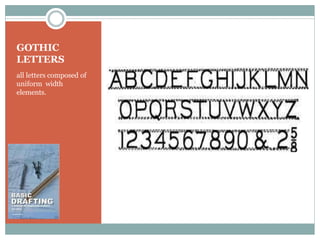
⚫GOTHIC- all letters composed of uniform width
elements.
⚫TEXT- Text lettering is one of the oldest letters styles
in use. Text letters consist of solid main stems.
 ITALIC- All slanting or inclined letters are classified as italic
style.
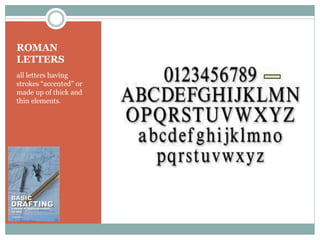
ROMAN
LETTERS
all letters having
strokes “accented” or
made up of thick and
thin elements.
GOTHIC
LETTERS
all letters composed of
uniform width
elements.
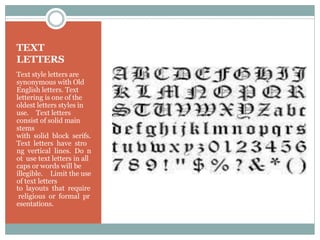
TEXT
LETTERS
Text style letters are
synonymous with Old
English letters. Text
lettering is one of the
oldest letters styles in
use. Text letters
consist of solid main
stems
with solid block serifs.
Text letters have stro
ng vertical lines. Do n
ot use text letters in all
caps or words will be
illegible. Limit the use
of text letters
to layouts that require
religious or formal pr
esentations.
ITALIC
LETTERS
All slanting or inclined
letters are classified as
italic style.
LETTERING
UNIFORMITY AND DESIGN IN LETTERING
⚫In any style of lettering, uniformity is essential.
Uniformity in height, proportion, inclination,
strength of lines, spacing of letters and spacing of
words ensures a pleasing appearance. Uniformity in
height and inclination is promoted by the use of light
guidelines
PROPORTIONS OF LETTERS
⚫NORMAL LETTERS
⚫EXTENDED LETTERS
⚫CONDENSED LETTERS
⚫LIGHTFACE
⚫BOLDFACE LETTERS
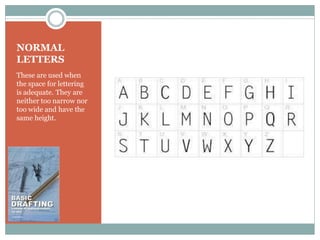
NORMAL
LETTERS
These are used when
the space for lettering
is adequate. They are
neither too narrow nor
too wide and have the
same height.
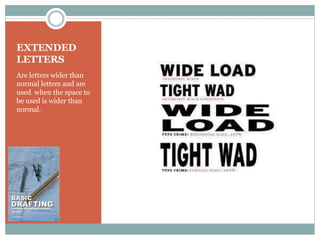
EXTENDED
LETTERS
Are letters wider than
normal letters and are
used when the space to
be used is wider than
normal.
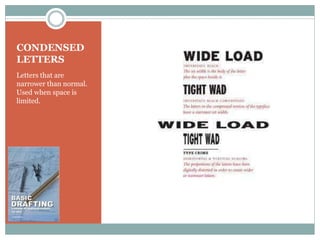
CONDENSED
LETTERS
Letters that are
narrower than normal.
Used when space is
limited.
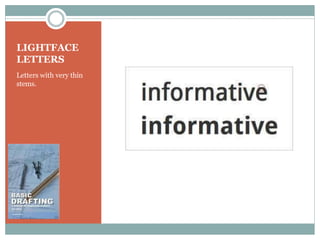
LIGHTFACE
LETTERS
Letters with very thin
stems.
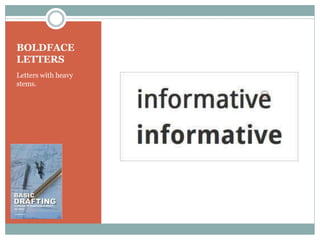
BOLDFACE
LETTERS
Letters with heavy
stems.
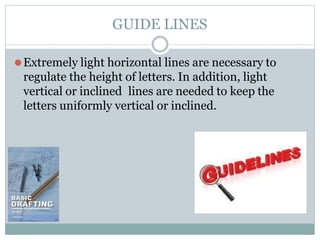
GUIDE LINES
⚫Extremely light horizontal lines are necessary to
regulate the height of letters. In addition, light
vertical or inclined lines are needed to keep the
letters uniformly vertical or inclined.
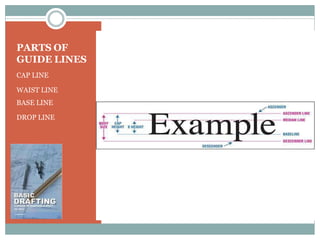
PARTS OF
GUIDE LINES
CAP LINE
WAIST LINE
BASE LINE
DROP LINE
TYPES OF DRAWING
⚫ ORTHOGRAPHIC DRAWING
⚫ ISOMETRIC DRAWING
⚫ PICTORIAL DRAWING
 AXONOMETRIC
⯍ ISOMETRIC
⯍ DIMETRIC
⯍ TRIMETRIC
 OBLIQUE
⯍ CAVALIER
⯍ CABINET
 PERSPECTIVE
⯍ PARALLEL
⯍ ANGULAR
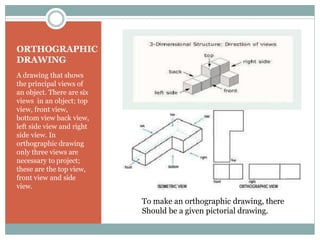
ORTHOGRAPHIC
DRAWING
A drawing that shows
the principal views of
an object. There are six
views in an object; top
view, front view,
bottom view back view,
left side view and right
side view. In
orthographic drawing
only three views are
necessary to project;
these are the top view,
front view and side
view.
To make an orthographic drawing, there
Should be a given pictorial drawing.
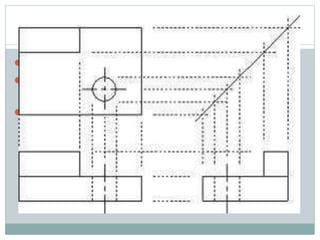
PRINCIPLES OF ORTHOGRAPHIC PROJECTION
⚫The top view is directly drawn above the front view.
⚫The side view is drawn horizontally in line with the
front view.
⚫A line parallel to a plane of projection will show its
true length on that plane.
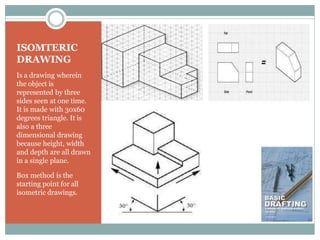
ISOMTERIC
DRAWING
Is a drawing wherein
the object is
represented by three
sides seen at one time.
It is made with 30x60
degrees triangle. It is
also a three
dimensional drawing
because height, width
and depth are all drawn
in a single plane.
Box method is the
starting point for all
isometric drawings.
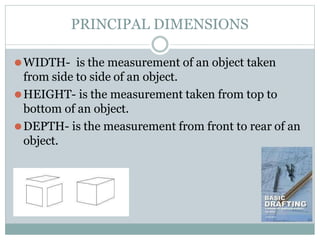
PRINCIPAL DIMENSIONS
⚫WIDTH- is the measurement of an object taken
from side to side of an object.
⚫HEIGHT- is the measurement taken from top to
bottom of an object.
⚫DEPTH- is the measurement from front to rear of an
object.
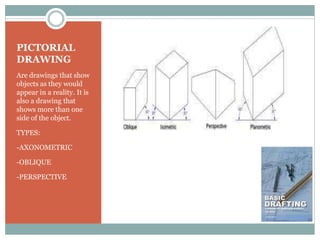
PICTORIAL
DRAWING
Are drawings that show
objects as they would
appear in a reality. It is
also a drawing that
shows more than one
side of the object.
TYPES:
-AXONOMETRIC
-OBLIQUE
-PERSPECTIVE
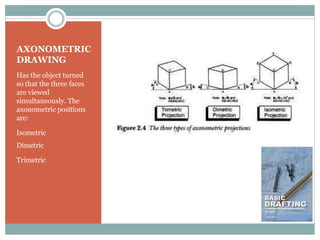
AXONOMETRIC
DRAWING
Has the object turned
so that the three faces
are viewed
simultaneously. The
axonometric positions
are:
Isometric
Dimetric
Trimetric
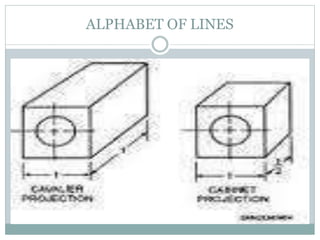
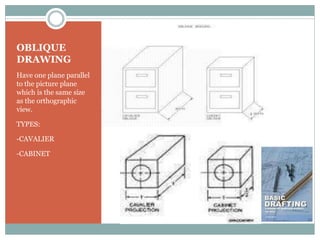
OBLIQUE
DRAWING
Have one plane parallel
to the picture plane
which is the same size
as the orthographic
view.
TYPES:
-CAVALIER
-CABINET
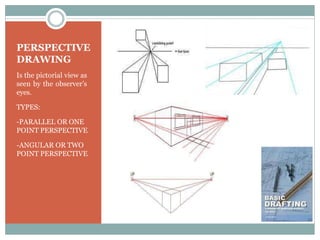
PERSPECTIVE
DRAWING
Is the pictorial view as
seen by the observer’s
eyes.
TYPES:
-PARALLEL OR ONE
POINT PERSPECTIVE
-ANGULAR OR TWO
POINT PERSPECTIVE
ADDITIONAL INFORMATION
⚫OBJECT is a figure being projected and
PROJECTION is a way of expressing and showing
the object.
DIMENSIONING A DRAWING
⚫ DIMENSION- Tells the accurate shape and size of an object.
 DIMENSION LINE- A line that contrasts well with the outline
of the object.
 EXTENSION LINE- A fine line used to show clearly the
dimension limits.
 CENTER LINE- are light broken line which are sometimes
used as an extension line.
 LEADER LINE- are straight line leading from a dimension
value.
 ARROWHEADS- indicate the direction in which the value
applies.
 NUMERICAL VALUE- gives the actual distance of the objects.
 NOTES- provide a means of explanatory information along
with a size.

Basic Drafting.pptx

  • 1.
  • 2.
    GOALS OF TECHNICALDRAWING ⚫Detail drawing must be accurate. ⚫Detail drawing must be executed with proper technique or good workmanship. ⚫Detail drawing should be neat. ⚫Detail drawing must be made with speed.
  • 3.
    TWO CLASSES OFDRAWING ⚫ARTISTIC- The artist expresses aesthetic ideas or emotions. ⚫TECHNICAL- Exact means of expression and accuracy is one of the main objective.
  • 4.
    DEFINITION AND RELATIONSHIPOF; ⚫PAINTING ⚫DRAWING ⚫DRAFTING ⚫SKETCHING
  • 5.
    PAINTING Is a formof visual art that uses wet media.
  • 6.
    DRAWING Is a formof visual art that uses dry media. It has two types: Technical and Artistic.
  • 7.
    • Is theact and discipline of composing plans that visually communicate how something functions or has to be constructed. Drafting is the visual language of industry and engineering. • Drafting is the term used to refer to the systematic representation and dimensional specification of mechanical and architectural structures. DRAFTING OR TECHNICAL DRAWING
  • 8.
    • A drafter,draftsperson, or draftsman is a person who makes a technical drawing. A professional drafter who makes technical drawings is sometimes called a drafting technician.
  • 9.
    SKETCHING Is a quickly executedfreehand drawing that is not intended as a finished work. In general, sketching is a quick way to record an idea for later use.
  • 10.
    MATERIALS NEEDED FORDRAWING ⚫DRAWING BOARD/TABLE ⚫DRAWING PAPER/PLATES ⚫TECHNICAL PEN ⚫MECHANICAL PENCIL ⚫ERASER ⚫COMPASS ⚫T-SQUARE ⚫TRIANGLES (45x45 AND 30x60) ⚫RULER ⚫PROTRACTOR
  • 11.
  • 12.
    DRAWING PAPER A drafting mediafor showing the object.
  • 13.
    TECHNICAL PEN A drafting mediafor illustrating the object.
  • 14.
    MECHANICAL PENCIL A drafting mediafor freehand guides or sketching the object.
  • 15.
    ERASER Used to erasethe unnecessary lines done by sketching.
  • 16.
    COMPASS Used to drawarcs and circles.
  • 17.
    T-SQUARE Used to drawhorizontal and vertical lines and serves as base material for triangles.
  • 18.
    TRIANGLES (30X60 AND 45X45) Used todraw inclined lines with proper angle and vertical lines.
  • 19.
    TRIANGULAR SCALE Used to formeasuring an object or lines.
  • 20.
    RULER A straight edgematerial with measurement graduation used to make and measure dimensions.
  • 21.
  • 22.
    TYPES OF LINES VERTICAL LINES HORIZONTALLINES INCLINED LINES CURVED LINES
  • 23.
    ALPHABET OF LINES Are linesused in drafting to identify the types of lines; thick, thin and medium. They have the same relation to drawings as letters do to words.
  • 24.
    ALPHABET OF LINES •Visible or object line- represents the visible edges of an object. ⚫ Hidden or invisible line- represents the hidden edged of an object. It is made of short dashes. ⚫ Center line- is the lightest line used to show the center of the object. ⚫ Dimension line- used to indicate the measurement of objects. ⚫ Leader line- A fine broken line with an arrowhead at one end used for indicating the measurement and name of a part. ⚫ Reference line- An irregular fine curved line with an arrowhead at one end used to label the parts of an object. ⚫ Long break line- A limiting line used to limit the length of an elongated object so that it can be shown without changing the size of its view. ⚫ Short break line- Is similar in use with long break line. It is commonly used to limit the length of a cylindrical object. ⚫ Cutting plane line- consist of long and short dashes used to indicate the cut view of objects. ⚫ Section line- is an imaginary cut taken through an object so as to travel a shape or interior construction.
  • 25.
  • 26.
    LETTERING ⚫Is a fundamentalpart of technical drawing. ⚫It is used for dimensions, notes and specifications to communicate with the fabricator.
  • 27.
    BASIC CLASSIFICATION OFLETTERS ⚫ROMAN- all letters having strokes “accented” or made up of thick and thin elements. ⚫GOTHIC- all letters composed of uniform width elements. ⚫TEXT- Text lettering is one of the oldest letters styles in use. Text letters consist of solid main stems.  ITALIC- All slanting or inclined letters are classified as italic style.
  • 28.
    ROMAN LETTERS all letters having strokes“accented” or made up of thick and thin elements.
  • 29.
    GOTHIC LETTERS all letters composedof uniform width elements.
  • 30.
    TEXT LETTERS Text style lettersare synonymous with Old English letters. Text lettering is one of the oldest letters styles in use. Text letters consist of solid main stems with solid block serifs. Text letters have stro ng vertical lines. Do n ot use text letters in all caps or words will be illegible. Limit the use of text letters to layouts that require religious or formal pr esentations.
  • 31.
    ITALIC LETTERS All slanting orinclined letters are classified as italic style. LETTERING
  • 32.
    UNIFORMITY AND DESIGNIN LETTERING ⚫In any style of lettering, uniformity is essential. Uniformity in height, proportion, inclination, strength of lines, spacing of letters and spacing of words ensures a pleasing appearance. Uniformity in height and inclination is promoted by the use of light guidelines
  • 33.
    PROPORTIONS OF LETTERS ⚫NORMALLETTERS ⚫EXTENDED LETTERS ⚫CONDENSED LETTERS ⚫LIGHTFACE ⚫BOLDFACE LETTERS
  • 34.
    NORMAL LETTERS These are usedwhen the space for lettering is adequate. They are neither too narrow nor too wide and have the same height.
  • 35.
    EXTENDED LETTERS Are letters widerthan normal letters and are used when the space to be used is wider than normal.
  • 36.
    CONDENSED LETTERS Letters that are narrowerthan normal. Used when space is limited.
  • 37.
  • 38.
  • 39.
    GUIDE LINES ⚫Extremely lighthorizontal lines are necessary to regulate the height of letters. In addition, light vertical or inclined lines are needed to keep the letters uniformly vertical or inclined.
  • 40.
    PARTS OF GUIDE LINES CAPLINE WAIST LINE BASE LINE DROP LINE
  • 41.
    TYPES OF DRAWING ⚫ORTHOGRAPHIC DRAWING ⚫ ISOMETRIC DRAWING ⚫ PICTORIAL DRAWING  AXONOMETRIC ⯍ ISOMETRIC ⯍ DIMETRIC ⯍ TRIMETRIC  OBLIQUE ⯍ CAVALIER ⯍ CABINET  PERSPECTIVE ⯍ PARALLEL ⯍ ANGULAR
  • 42.
    ORTHOGRAPHIC DRAWING A drawing thatshows the principal views of an object. There are six views in an object; top view, front view, bottom view back view, left side view and right side view. In orthographic drawing only three views are necessary to project; these are the top view, front view and side view. To make an orthographic drawing, there Should be a given pictorial drawing.
  • 43.
    PRINCIPLES OF ORTHOGRAPHICPROJECTION ⚫The top view is directly drawn above the front view. ⚫The side view is drawn horizontally in line with the front view. ⚫A line parallel to a plane of projection will show its true length on that plane.
  • 44.
    ISOMTERIC DRAWING Is a drawingwherein the object is represented by three sides seen at one time. It is made with 30x60 degrees triangle. It is also a three dimensional drawing because height, width and depth are all drawn in a single plane. Box method is the starting point for all isometric drawings.
  • 45.
    PRINCIPAL DIMENSIONS ⚫WIDTH- isthe measurement of an object taken from side to side of an object. ⚫HEIGHT- is the measurement taken from top to bottom of an object. ⚫DEPTH- is the measurement from front to rear of an object.
  • 46.
    PICTORIAL DRAWING Are drawings thatshow objects as they would appear in a reality. It is also a drawing that shows more than one side of the object. TYPES: -AXONOMETRIC -OBLIQUE -PERSPECTIVE
  • 47.
    AXONOMETRIC DRAWING Has the objectturned so that the three faces are viewed simultaneously. The axonometric positions are: Isometric Dimetric Trimetric
  • 48.
    OBLIQUE DRAWING Have one planeparallel to the picture plane which is the same size as the orthographic view. TYPES: -CAVALIER -CABINET
  • 49.
    PERSPECTIVE DRAWING Is the pictorialview as seen by the observer’s eyes. TYPES: -PARALLEL OR ONE POINT PERSPECTIVE -ANGULAR OR TWO POINT PERSPECTIVE
  • 50.
    ADDITIONAL INFORMATION ⚫OBJECT isa figure being projected and PROJECTION is a way of expressing and showing the object.
  • 51.
    DIMENSIONING A DRAWING ⚫DIMENSION- Tells the accurate shape and size of an object.  DIMENSION LINE- A line that contrasts well with the outline of the object.  EXTENSION LINE- A fine line used to show clearly the dimension limits.  CENTER LINE- are light broken line which are sometimes used as an extension line.  LEADER LINE- are straight line leading from a dimension value.  ARROWHEADS- indicate the direction in which the value applies.  NUMERICAL VALUE- gives the actual distance of the objects.  NOTES- provide a means of explanatory information along with a size.