Lesson 2
MAINTAIN HAND TOOLS,
DRAWING INSTRUMENTS,
EQUIPMENT AND PARAPHERNALIA
Drafting tools are indispensable
implements needed by the
drafter to perform his/her tasks.
A good set of drafting
instruments can be quite an
investment. Therefore, these
equipment must be well taken
care of. Keeping your drafting
tools clean, well maintained,
and properly stored will result in
better performance and longer
service life.
The performance of simple
cleaning, maintenance,
and storage procedures
help a lot in keeping the
efficiency of every drafting
instrument. The early
detection and reparation
of any signs of deterioration
will enable the drafter to
save time and resources in
the future.
Lesson 2
MAINTAIN HAND TOOLS,
DRAWING INSTRUMENTS,
EQUIPMENT AND PARAPHERNALIA:
LO1. Maintain Hand Tools,
Drawing Instruments, Equipment
and Paraphernalia
Learning Competencies:
LO 1. Maintain hand tools, drawing instruments,
equipment, and paraphernalia
1.1 Perform safety procedures in maintaining hand
tools, drawing instruments, equipment, and
paraphernalia
1.2 Follow procedures in cleaning, tightening and
simple repair of hand tools, drawing instruments,
equipment, and paraphernalia
1.3 Identify common malfunction (unplanned or
unusual events) when using tools, drawing instruments,
equipment, and paraphernalia
o maintain the quality of work
produced by a drafter, the tools he/she
uses must always be at their optimum
condition. A good drafter knows how to
extend the service life of his/her
equipment. Proper care, maintenance
and storage are the key elements in
sustaining the efficiency and precision
of these implements.
The following are common good practices in handling
and caring for your drafting tools and equipment.
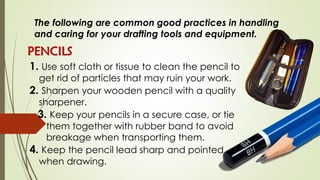
PENCILS
1. Use soft cloth or tissue to clean the pencil to
get rid of particles that may ruin your work.
2. Sharpen your wooden pencil with a quality
sharpener.
3. Keep your pencils in a secure case, or tie
them together with rubber band to avoid
breakage when transporting them.
4. Keep the pencil lead sharp and pointed
when drawing.
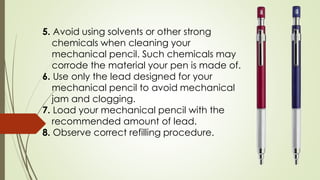
5. Avoid using solvents or other strong
chemicals when cleaning your
mechanical pencil. Such chemicals may
corrode the material your pen is made of.
6. Use only the lead designed for your
mechanical pencil to avoid mechanical
jam and clogging.
7. Load your mechanical pencil with the
recommended amount of lead.
8. Observe correct refilling procedure.
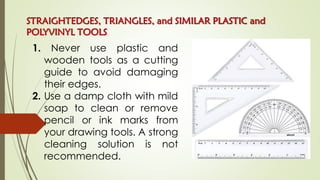
STRAIGHTEDGES, TRIANGLES, and SIMILAR PLASTIC and
POLYVINYL TOOLS
1. Never use plastic and
wooden tools as a cutting
guide to avoid damaging
their edges.
2. Use a damp cloth with mild
soap to clean or remove
pencil or ink marks from
your drawing tools. A strong
cleaning solution is not
recommended.
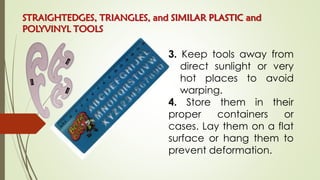
3. Keep tools away from
direct sunlight or very
hot places to avoid
warping.
4. Store them in their
proper containers or
cases. Lay them on a flat
surface or hang them to
prevent deformation.
STRAIGHTEDGES, TRIANGLES, and SIMILAR PLASTIC and
POLYVINYL TOOLS
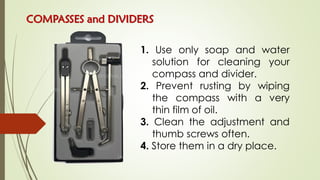
COMPASSES and DIVIDERS
1. Use only soap and water
solution for cleaning your
compass and divider.
2. Prevent rusting by wiping
the compass with a very
thin film of oil.
3. Clean the adjustment and
thumb screws often.
4. Store them in a dry place.
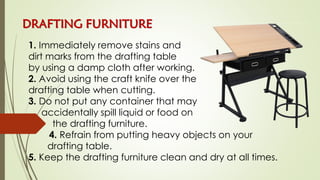
DRAFTING FURNITURE
1. Immediately remove stains and
dirt marks from the drafting table
by using a damp cloth after working.
2. Avoid using the craft knife over the
drafting table when cutting.
3. Do not put any container that may
accidentally spill liquid or food on
the drafting furniture.
4. Refrain from putting heavy objects on your
drafting table.
5. Keep the drafting furniture clean and dry at all times.
Procedures In Cleaning, Tightening And Simple Repair Of Hand
Tools, Drawing Instruments, Equipment, And Paraphernalia.
Drafting tools are often delicate and have
many intricate and small pieces that need to
be well maintained to continue working
properly. Organizing and storing these items
has a great deal to do with keeping them in
pristine shape and working correctly. With a
little patience and developing a routine, your
tools will be well taken care of and working
for a long time.
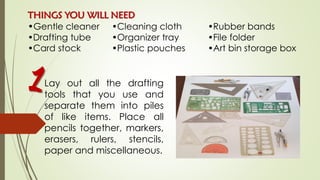
THINGS YOU WILL NEED
•Gentle cleaner •Cleaning cloth •Rubber bands
•Drafting tube •Organizer tray •File folder
•Card stock •Plastic pouches •Art bin storage box
Lay out all the drafting
tools that you use and
separate them into piles
of like items. Place all
pencils together, markers,
erasers, rulers, stencils,
paper and miscellaneous.
1
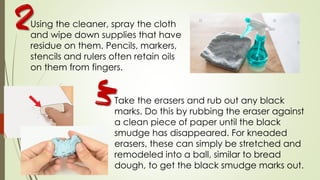
Using the cleaner, spray the cloth
and wipe down supplies that have
residue on them. Pencils, markers,
stencils and rulers often retain oils
on them from fingers.
Take the erasers and rub out any black
marks. Do this by rubbing the eraser against
a clean piece of paper until the black
smudge has disappeared. For kneaded
erasers, these can simply be stretched and
remodeled into a ball, similar to bread
dough, to get the black smudge marks out.
2
3
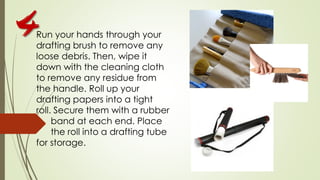
Run your hands through your
drafting brush to remove any
loose debris. Then, wipe it
down with the cleaning cloth
to remove any residue from
the handle. Roll up your
drafting papers into a tight
roll. Secure them with a rubber
band at each end. Place
the roll into a drafting tube
for storage.
4
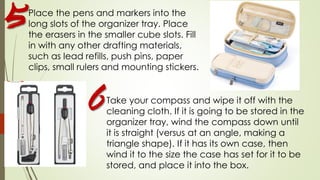
Place the pens and markers into the
long slots of the organizer tray. Place
the erasers in the smaller cube slots. Fill
in with any other drafting materials,
such as lead refills, push pins, paper
clips, small rulers and mounting stickers.
Take your compass and wipe it off with the
cleaning cloth. If it is going to be stored in the
organizer tray, wind the compass down until
it is straight (versus at an angle, making a
triangle shape). If it has its own case, then
wind it to the size the case has set for it to be
stored, and place it into the box.
5
6
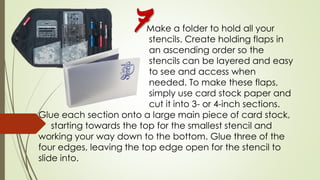
Make a folder to hold all your
stencils. Create holding flaps in
an ascending order so the
stencils can be layered and easy
to see and access when
needed. To make these flaps,
simply use card stock paper and
cut it into 3- or 4-inch sections.
Glue each section onto a large main piece of card stock,
starting towards the top for the smallest stencil and
working your way down to the bottom. Glue three of the
four edges, leaving the top edge open for the stencil to
slide into.
7
Place this newly made stencil holder into a large
plastic or mesh pouch. Put a dry-cleaning cloth in the
pouch, placed over the stencils, to help keep them
clean.
Place the drafting brush and rulers into the pouch.
Then place the organizer tray into the pouch. If the
compass had its own storage box, then place this in
the pouch. All the major tools should now be in this
portable carrying pouch with your paper in the
separate portable carrying drafting tube.
8
9
Proper Care and Maintenance
It is essential to take proper care of the drafting tools,
materials, and equipment. Below are some tips to properly use
and take care of them.
1. Avoid dropping your tools and equipment.
2. Never use measuring tools in cutting paper.
3. Wipe off the surface and edges of triangles and T-squares.
4. Sharpen and store your pencils properly after use.
5. Find or create and organizer where you can hang your
measuring tools.
6. Have a separate container for making tools.
7. Keep your drawing sheets in a plastic tube to protect them
from a dust and dirt.
8. Never lend or borrow drafting tools and materials if may.
Hand tools and equipment are subjected to different levels of
abuse while in use. These abuses may result in the tools being
dirty, loosely connected or even damaged. Before using any
tool or equipment, it is a must that they be inspected properly
to ensure that they are operational and safe.
One basic thing to remember to keep hand tools, equipment
and paraphernalia clean is to make sure that the workplace is
properly organized.
The work area must always be kept neat and tidy.
All tools and equipment must be placed in a clean and
dry place.
Clean tools and equipment work more efficiently. This lessens
the effort needed to operate them and reduces the possibility
of mishaps.
Usual defects of drafting tools and equipment
In maintaining the functionality and good
working condition of drafting instrument, damage
control, and prevention is one effective measure to
implement. This is done by carefully examining the tool to
identify the potential defects and imperfections that
could eventually cause further damage. It is also wise to
conduct a thorough inspection to detect defects
beforehand when acquiring new drafting equipment.
The following are the usual defects to look for when
evaluating the condition of the drafting tools and equipment.
CHIPPED or NICKED EDGES are usually caused by hitting
the tool’s edges on a hard surface when it is dropped or
used beyond its recommended application. Nicked
edges make ruts that result in poorly drawn lines.
CRACKS occur when tools are bent, dropped or
subjected to strong impact. When purchasing new
tools, carefully check their plastic or polyvinyl parts for
any flaws as these may eventually lead to greater
damage.
WARPED SURFACES are caused by exposing plastic tools
to extreme temperature and inappropriate storage
position. Wooden tools may also warp when spilled with
liquid or exposed to moisture.
FADED or SCRATCHED HATCH MARKS are caused by
misuse and improper storage of tools. When measuring
instruments are scratched or rusted, the graduation lines
fade and vanish.
MISSING PARTS could greatly affect the performance
and precision of the tool. When acquiring new tools,
double-check and ensure that all important parts such
as screws, adjustment knobs and the like are present.
DULL POINTS cause a tool to lose its holding capability
and drawing accuracy. Pencils, compasses, and dividers
have leads and needles that need constant sharpening.
BLOCKING or CLOGGING occurs mostly with tools that
have ink chambers and lead dispensers. This problem
is brought about by lack of cleaning and
maintenance of the tool.
RUSTING is caused by the oxidation of metallic
materials brought by poor storage and safekeeping
of the tools.
Common malfunction when using hand tools, drawing
instruments, equipment, and paraphernalia
The proper use of tools, equipment and paraphernalia
will greatly increase efficiency and occupational safety
in a workplace. Having the proper knowledge and skills
in using such tools is needed in order to operate and
use them effectively. But more often than not, problems
and malfunctions may arise while using these tools. These
malfunctions can be minimized by exercising careful
usage of the tools.
Malfunctions and other unplanned and unusual event may not
be totally eliminated, but it can surely be minimized.
LO1MaintainHandTools.pdf.pdf

LO1MaintainHandTools.pdf.pdf

  • 1.
    Lesson 2 MAINTAIN HANDTOOLS, DRAWING INSTRUMENTS, EQUIPMENT AND PARAPHERNALIA
  • 2.
    Drafting tools areindispensable implements needed by the drafter to perform his/her tasks. A good set of drafting instruments can be quite an investment. Therefore, these equipment must be well taken care of. Keeping your drafting tools clean, well maintained, and properly stored will result in better performance and longer service life.
  • 3.
    The performance ofsimple cleaning, maintenance, and storage procedures help a lot in keeping the efficiency of every drafting instrument. The early detection and reparation of any signs of deterioration will enable the drafter to save time and resources in the future.
  • 4.
    Lesson 2 MAINTAIN HANDTOOLS, DRAWING INSTRUMENTS, EQUIPMENT AND PARAPHERNALIA: LO1. Maintain Hand Tools, Drawing Instruments, Equipment and Paraphernalia
  • 5.
    Learning Competencies: LO 1.Maintain hand tools, drawing instruments, equipment, and paraphernalia 1.1 Perform safety procedures in maintaining hand tools, drawing instruments, equipment, and paraphernalia 1.2 Follow procedures in cleaning, tightening and simple repair of hand tools, drawing instruments, equipment, and paraphernalia 1.3 Identify common malfunction (unplanned or unusual events) when using tools, drawing instruments, equipment, and paraphernalia
  • 6.
    o maintain thequality of work produced by a drafter, the tools he/she uses must always be at their optimum condition. A good drafter knows how to extend the service life of his/her equipment. Proper care, maintenance and storage are the key elements in sustaining the efficiency and precision of these implements.
  • 7.
    The following arecommon good practices in handling and caring for your drafting tools and equipment. PENCILS 1. Use soft cloth or tissue to clean the pencil to get rid of particles that may ruin your work. 2. Sharpen your wooden pencil with a quality sharpener. 3. Keep your pencils in a secure case, or tie them together with rubber band to avoid breakage when transporting them. 4. Keep the pencil lead sharp and pointed when drawing.
  • 8.
    5. Avoid usingsolvents or other strong chemicals when cleaning your mechanical pencil. Such chemicals may corrode the material your pen is made of. 6. Use only the lead designed for your mechanical pencil to avoid mechanical jam and clogging. 7. Load your mechanical pencil with the recommended amount of lead. 8. Observe correct refilling procedure.
  • 9.
    STRAIGHTEDGES, TRIANGLES, andSIMILAR PLASTIC and POLYVINYL TOOLS 1. Never use plastic and wooden tools as a cutting guide to avoid damaging their edges. 2. Use a damp cloth with mild soap to clean or remove pencil or ink marks from your drawing tools. A strong cleaning solution is not recommended.
  • 10.
    3. Keep toolsaway from direct sunlight or very hot places to avoid warping. 4. Store them in their proper containers or cases. Lay them on a flat surface or hang them to prevent deformation. STRAIGHTEDGES, TRIANGLES, and SIMILAR PLASTIC and POLYVINYL TOOLS
  • 11.
    COMPASSES and DIVIDERS 1.Use only soap and water solution for cleaning your compass and divider. 2. Prevent rusting by wiping the compass with a very thin film of oil. 3. Clean the adjustment and thumb screws often. 4. Store them in a dry place.
  • 12.
    DRAFTING FURNITURE 1. Immediatelyremove stains and dirt marks from the drafting table by using a damp cloth after working. 2. Avoid using the craft knife over the drafting table when cutting. 3. Do not put any container that may accidentally spill liquid or food on the drafting furniture. 4. Refrain from putting heavy objects on your drafting table. 5. Keep the drafting furniture clean and dry at all times.
  • 13.
    Procedures In Cleaning,Tightening And Simple Repair Of Hand Tools, Drawing Instruments, Equipment, And Paraphernalia. Drafting tools are often delicate and have many intricate and small pieces that need to be well maintained to continue working properly. Organizing and storing these items has a great deal to do with keeping them in pristine shape and working correctly. With a little patience and developing a routine, your tools will be well taken care of and working for a long time.
  • 14.
    THINGS YOU WILLNEED •Gentle cleaner •Cleaning cloth •Rubber bands •Drafting tube •Organizer tray •File folder •Card stock •Plastic pouches •Art bin storage box Lay out all the drafting tools that you use and separate them into piles of like items. Place all pencils together, markers, erasers, rulers, stencils, paper and miscellaneous. 1
  • 15.
    Using the cleaner,spray the cloth and wipe down supplies that have residue on them. Pencils, markers, stencils and rulers often retain oils on them from fingers. Take the erasers and rub out any black marks. Do this by rubbing the eraser against a clean piece of paper until the black smudge has disappeared. For kneaded erasers, these can simply be stretched and remodeled into a ball, similar to bread dough, to get the black smudge marks out. 2 3
  • 16.
    Run your handsthrough your drafting brush to remove any loose debris. Then, wipe it down with the cleaning cloth to remove any residue from the handle. Roll up your drafting papers into a tight roll. Secure them with a rubber band at each end. Place the roll into a drafting tube for storage. 4
  • 17.
    Place the pensand markers into the long slots of the organizer tray. Place the erasers in the smaller cube slots. Fill in with any other drafting materials, such as lead refills, push pins, paper clips, small rulers and mounting stickers. Take your compass and wipe it off with the cleaning cloth. If it is going to be stored in the organizer tray, wind the compass down until it is straight (versus at an angle, making a triangle shape). If it has its own case, then wind it to the size the case has set for it to be stored, and place it into the box. 5 6
  • 18.
    Make a folderto hold all your stencils. Create holding flaps in an ascending order so the stencils can be layered and easy to see and access when needed. To make these flaps, simply use card stock paper and cut it into 3- or 4-inch sections. Glue each section onto a large main piece of card stock, starting towards the top for the smallest stencil and working your way down to the bottom. Glue three of the four edges, leaving the top edge open for the stencil to slide into. 7
  • 19.
    Place this newlymade stencil holder into a large plastic or mesh pouch. Put a dry-cleaning cloth in the pouch, placed over the stencils, to help keep them clean. Place the drafting brush and rulers into the pouch. Then place the organizer tray into the pouch. If the compass had its own storage box, then place this in the pouch. All the major tools should now be in this portable carrying pouch with your paper in the separate portable carrying drafting tube. 8 9
  • 20.
    Proper Care andMaintenance It is essential to take proper care of the drafting tools, materials, and equipment. Below are some tips to properly use and take care of them. 1. Avoid dropping your tools and equipment. 2. Never use measuring tools in cutting paper. 3. Wipe off the surface and edges of triangles and T-squares. 4. Sharpen and store your pencils properly after use. 5. Find or create and organizer where you can hang your measuring tools. 6. Have a separate container for making tools. 7. Keep your drawing sheets in a plastic tube to protect them from a dust and dirt. 8. Never lend or borrow drafting tools and materials if may.
  • 21.
    Hand tools andequipment are subjected to different levels of abuse while in use. These abuses may result in the tools being dirty, loosely connected or even damaged. Before using any tool or equipment, it is a must that they be inspected properly to ensure that they are operational and safe. One basic thing to remember to keep hand tools, equipment and paraphernalia clean is to make sure that the workplace is properly organized. The work area must always be kept neat and tidy. All tools and equipment must be placed in a clean and dry place. Clean tools and equipment work more efficiently. This lessens the effort needed to operate them and reduces the possibility of mishaps.
  • 22.
    Usual defects ofdrafting tools and equipment In maintaining the functionality and good working condition of drafting instrument, damage control, and prevention is one effective measure to implement. This is done by carefully examining the tool to identify the potential defects and imperfections that could eventually cause further damage. It is also wise to conduct a thorough inspection to detect defects beforehand when acquiring new drafting equipment.
  • 23.
    The following arethe usual defects to look for when evaluating the condition of the drafting tools and equipment. CHIPPED or NICKED EDGES are usually caused by hitting the tool’s edges on a hard surface when it is dropped or used beyond its recommended application. Nicked edges make ruts that result in poorly drawn lines. CRACKS occur when tools are bent, dropped or subjected to strong impact. When purchasing new tools, carefully check their plastic or polyvinyl parts for any flaws as these may eventually lead to greater damage.
  • 24.
    WARPED SURFACES arecaused by exposing plastic tools to extreme temperature and inappropriate storage position. Wooden tools may also warp when spilled with liquid or exposed to moisture. FADED or SCRATCHED HATCH MARKS are caused by misuse and improper storage of tools. When measuring instruments are scratched or rusted, the graduation lines fade and vanish. MISSING PARTS could greatly affect the performance and precision of the tool. When acquiring new tools, double-check and ensure that all important parts such as screws, adjustment knobs and the like are present.
  • 25.
    DULL POINTS causea tool to lose its holding capability and drawing accuracy. Pencils, compasses, and dividers have leads and needles that need constant sharpening. BLOCKING or CLOGGING occurs mostly with tools that have ink chambers and lead dispensers. This problem is brought about by lack of cleaning and maintenance of the tool. RUSTING is caused by the oxidation of metallic materials brought by poor storage and safekeeping of the tools.
  • 26.
    Common malfunction whenusing hand tools, drawing instruments, equipment, and paraphernalia The proper use of tools, equipment and paraphernalia will greatly increase efficiency and occupational safety in a workplace. Having the proper knowledge and skills in using such tools is needed in order to operate and use them effectively. But more often than not, problems and malfunctions may arise while using these tools. These malfunctions can be minimized by exercising careful usage of the tools. Malfunctions and other unplanned and unusual event may not be totally eliminated, but it can surely be minimized.